

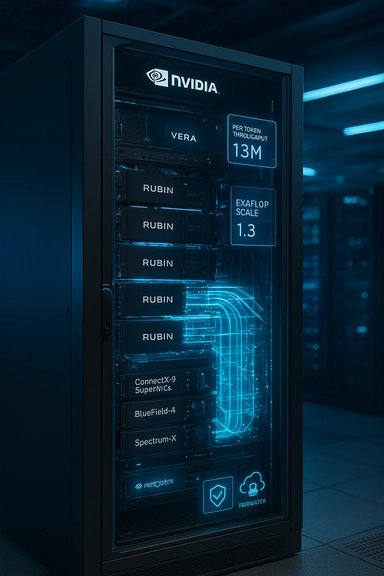
NVIDIA’s Rubin platform — unveiled at CES 2026 — is being pitched as a generational leap in rack‑scale AI computing: a six‑chip, tightly co‑designed system that promises dramatically lower inference token costs, exaflops‑scale rack throughput, and a reimagined storage layer for long‑context, agentic workloads — and Microsoft has already positioned its Fairwater datacenter program to accept Rubin racks at hyperscale.
Background
NVIDIA presented Rubin as Vera Rubin, an integrated system that binds together a custom server CPU (Vera), the Rubin GPU family, a sixth‑generation NVLink fabric, ConnectX‑9 SuperNICs, BlueField‑4 DPUs and Spectrum‑X switching into rack‑scale products such as the NVL72. The company’s launch narrative centers on one thesis: inference and multi‑turn agentic reasoning are now the dominant cost drivers for AI, and only a rack‑first architecture can deliver the memory, bandwidth and security primitives needed to scale these workloads affordably.NVIDIA framed Rubin with a set of headline claims — up to 10× lower inference cost per token for targeted workloads, ~50 petaflops NVFP4 of per‑GPU inference compute in some Rubin configurations, and hundreds of terabytes per second of NVLink interconnect inside a rack. Microsoft, among other cloud partners, was named as a launch adopter; Azure’s Fairwater “superfactory” program and other hyperscale projects are the intended first homes for Rubin NVL‑class racks.
What Rubin actually is: architecture and components
The six‑chip codesign
Rubin is not a single chip but a system‑level architecture. NVIDIA’s launch materials and early technical reporting describe six co‑engineered components:- NVIDIA Vera CPU — a custom Arm‑based server CPU optimized for rack‑scale coherency and low‑latency orchestration.
- NVIDIA Rubin GPU — a family of inference‑first accelerators with a third‑generation Transformer Engine and NVFP4 optimizations.
- NVLink 6 switch and fabric — a high‑bandwidth interconnect that pools memory and enables single‑address‑space strategies across a rack.
- ConnectX‑9 SuperNIC — high‑speed RDMA networking for low‑latency KV cache access and GPU offload paths.
- BlueField‑4 DPU — the DPU that runs DOCA microservices, offloads storage and security, and powers the proposed Inference Context Memory Storage Platform.
- Spectrum‑X Ethernet Photonics — an optical switching layer designed for high reliability and power efficiency at scale.
Key hardware claims (vendor language)
NVIDIA’s public specifications (as repeated in launch coverage) emphasize the following:- Per‑GPU peak NVFP4 performance: ~50 petaflops (vendor peak figure for some Rubin variants).
- NVL72 rack interconnect: quoted aggregate NVLink bandwidth figures on the order of ~260 TB/s.
- Rack‑level exascale performance: multi‑exaFLOP NVFP4 figures for larger NVL configurations.
- AI‑native shared storage: BlueField‑4‑backed Inference Context Memory Storage Platform intended to deliver multiple‑times improvements in tokens/sec and power efficiency compared to NVMe/CPU stacks.
Microsoft and Rubin: readiness, Fairwater, and cloud strategy
Fairwater and rack‑first datacenters
Microsoft’s Fairwater program — its publicly announced purpose‑built AI datacenter effort centered in Mount Pleasant, Wisconsin, and other sites — was designed to host very large NVLink‑class deployments and accelerate production model operations. Fairwater’s electrical, cooling and mechanical design make it a natural fit for dropping in high‑density Rubin NVL72 racks, and Microsoft’s Azure engineering messaging emphasizes that the company has been planning multi‑year infrastructure upgrades to avoid expensive retrofits when new rack‑scale hardware arrives.Microsoft’s public posture is that its existing investments — from procurement pipelines to orchestration stacks (CycleCloud, AKS optimizations, Blob enhancements) — reduce the integration time required for Rubin systems and thus amplify the platform’s near‑term commercial impact on Azure customers. The partnership messaging also fits a longer trend: hyperscalers that co‑engineer closely with silicon vendors capture early access to capacity and tailored feature sets.
What Microsoft stands to gain
- Faster time‑to‑value for advanced inference and agentic features across Microsoft 365 Copilot, Azure AI Foundry and other services.
- A direct path to lower per‑token costs for compute‑heavy services, improving product margins or enabling more generous pricing to customers.
- Competitive positioning: being an early Rubin adopter helps Azure offer multi‑model, high‑context services that are difficult to match without the same rack‑scale investments.
Why Rubin matters: inference economics and long‑context reasoning
The per‑token problem
As AI moved from research to continuous service, recurrent inference cost (the dollars spent per token served to end users) has become the dominant operating expense for many businesses. Rubin targets this by combining:- higher arithmetic throughput per rack,
- low‑precision NVFP4 arithmetic tailored to inference,
- offloading of large KV caches from HBM into a shared DPU‑backed context store,
- and MoE model efficiencies that reduce active parameter counts per token.
Storage as memory: the Inference Context Memory Storage Platform
One of Rubin’s most novel proposals is treating shared, DPU‑managed storage as a first‑class platform for inference context rather than treating GPU HBM as the only fast cache. BlueField‑4 DPUs running DOCA microservices would manage KV caches, replication, and low‑latency access so many GPUs in a rack can share large context stores without each carrying expensive HBM capacity. This architecture intends to:- reduce HBM provisioning per GPU,
- increase tokens/sec for long contexts,
- improve power efficiency for memory‑bound workloads.
Ecosystem and software: who’s on board
Rubin’s launch included a broad partner list: major clouds (AWS, Google Cloud, Microsoft Azure, OCI), cloud natives (CoreWeave, Lambda), system builders (Dell, HPE, Lenovo, Supermicro), and model labs (Anthropic, Mistral, OpenAI‑adjacent organizations). NVIDIA also emphasized expanded collaborations with Red Hat to optimize enterprise Linux and OpenShift for Rubin deployments. CoreWeave is explicitly named as an early Rubin host and operator that will fold Rubin into managed services for customers.From a software standpoint, success depends on:
- Runtime adaptations: TensorRT, PyTorch/XLA kernels and scheduler changes to exploit NVFP4 and remote KV caching efficiently.
- Orchestration innovations: scheduler fairness, eviction and prefetch policies to support multi‑tenant shared context stores.
- Security and trust: confidential computing primitives across NVLink and CPU/GPU domains to secure proprietory models and data.
Independent verification, benchmarks and cautions
Vendor claims vs. production reality
NVIDIA’s performance claims are headline‑driving: 10× token cost reductions, 50 PF per GPU, 260 TB/s per rack. Independent trade coverage repeated these numbers during CES, but the industry standard for verification remains reproducible, community‑audited benchmarks (MLPerf or equivalent) and real customer case studies. At launch, vendor results are directional and demonstrative; sustained, multi‑tenant production performance will be the true test.Key caveats to keep in mind:
- The 10× claim is plausibly true for specific MoE topologies and tightly co‑designed software/hardware stacks; dense, non‑sparse or retrieval‑augmented workloads may not see the same gains.
- Peak FLOPS figures represent an architectural ceiling; sustained throughput depends on memory, IO, scheduling, and kernel efficiency.
- The shared context store idea reduces HBM pressure but increases reliance on the rack fabric and DPUs; new bottlenecks may emerge there.
Supply chain and economic risk
Rubin’s architecture depends on advanced memory (HBM4) and large LPDDR pools. The memory supply chain has historically been a volatility point; if HBM or advanced packaging capacity cannot scale with demand, Rubin deployments could be delayed or cost‑inflated, shrinking the commercial upside or concentrating capacity among the largest hyperscalers who can secure supply.Practical consequences for enterprise IT teams and Windows users
For enterprise IT and CTOs
- Procurement: Take vendor performance numbers as directional; require third‑party benchmark commitments and production pilots before committing to large orders.
- Architecture planning: Rubin shifts the unit of design from nodes to racks. Enterprises will need to evaluate whether to consume Rubin through cloud partners or pursue on‑prem NVL racks (with attendant power, space, and cooling implications).
- Security & compliance: Rubin’s confidential computing primitives are promising, but enterprises must verify the attestation and telemetry story for regulated workloads.
For Windows users and developers
The Rubin story is largely a datacenter and hyperscaler play, but its downstream effects matter to Windows users and developers. Lower inference costs can:- enable richer Copilot features across Microsoft 365,
- drive more responsive cloud‑based AI in productivity and creative apps,
- enable new developer experiences (Azure AI Foundry, Copilot Studio) that expose longer‑context models to third‑party apps.
Competitive landscape and longer‑term implications
Rubin is a counter‑move to other vendors pursuing rack‑scale or memory‑heavy designs. AMD’s Helios and other emerging architectures are aimed at similar markets. The battleground will be:- usable inference cost (not just peak FLOPS),
- memory capacity and bandwidth per rack,
- software and runtime maturity (ease of porting and optimizing models),
- and availability/pricing via clouds and managed hosts.
Deployment timeline, pricing and what to expect next
NVIDIA indicated Rubin‑based products will begin rolling out through partners in the second half of 2026, with Microsoft and CoreWeave among the earliest hosts. That timetable gives cloud providers a window to complete software integration, pilot customer workloads, and run independent benchmarks before broad availability. Enterprises should budget accordingly and treat Rubin‑class capacity as a multi‑quarter procurement and integration project rather than an immediate drop‑in replacement.Pricing will be a crucial signal. If cloud providers translate hardware efficiency into lower per‑token prices for customers, Rubin could accelerate adoption of advanced agentic features. If providers keep margin while offering only limited price improvements, Rubin’s economic impact will be muted for many customers. Procurement teams should insist on clear price‑performance metrics and pilot terms.
Strengths, risks and the bottom line
Notable strengths
- Holistic, rack‑level design that addresses the memory and fabric bottlenecks of long‑context inference.
- Strong hyperscaler alignment — Microsoft and other partners accelerate real‑world testing and potential early scale.
- Novel storage‑as‑memory approach that could reduce expensive HBM requirements and improve tokens/sec for targeted workloads.
Material risks
- Benchmark and reproducibility risk: Vendor demos are promising but independent verification is required across realistic, multi‑tenant workloads.
- Supply chain exposure: HBM4 and advanced packaging availability could limit early deployments or raise costs.
- Operational complexity: Shared context stores and DPU orchestration introduce new failure modes that must be engineered out before enterprise trust is achieved.
Conclusion
NVIDIA’s Rubin is a bold reinvention of the unit of AI scale: by treating the rack as the fundamental accelerator and melding CPU, GPU, DPU, fabric and storage into a single platform, Rubin targets the most stubborn economic problem in deployed AI today — per‑token inference cost for long‑context, agentic workloads. Microsoft’s Fairwater program and other hyperscale investments give Rubin clear early adopters and a plausible path to real production scale.At the same time, Rubin’s most consequential promises remain vendor claims until independent benchmarks and customer case studies demonstrate sustained, multi‑tenant gains. IT leaders should treat Rubin as a potentially transformative option that requires careful validation: demand reproducible performance, pilot on representative workloads, and plan for the operational and supply‑chain implications of adopting rack‑scale AI hardware. If the vendor claims are borne out in practice, Rubin could reshape how enterprise services, cloud providers and developers build the next wave of agentic AI — but prudence, measurement and staged adoption will determine who truly benefits and how quickly those benefits reach Windows users and enterprise customers.
Source: Neowin https://www.neowin.net/news/ces-2026-nvidia-introduces-rubin-ai-platform-microsoft-ready-to-deploy/
