

NVIDIA’s new open Physical AI Data Factory Blueprint promises to redraw how robots, vision AI agents and autonomous vehicles are trained by turning compute into a steady, agent-driven pipeline for massive synthetic and real-world data production — a shift NVIDIA and its partners say will speed development of long-tail, safety-critical capabilities while lowering the cost and friction of building embodied intelligence. //www.nvidia.com/en-us//ai/cosmos/)
Physical AI — systems that see, reason and act in the real world — faces a single hard constraint: you need enormous, varied, and physically accurate datasets that include edge cases the real world rarely exposes. NVIDIA’s answer is a single, open reference architecture that automates data curation, synthetic-data multiplication, reinforcement learning workflows, and evaluation so teams can spin up continuous training pipelines at scale. That architecture is called the Physical AI Data Factory Blueprint and it was presented as part of Nnouncements.
At a technical level the blueprint stitches together three core ideas NVIDIA has been developing publicly over the last 12–18 months:
That said, the blueprint amplifies both capabilities and responsibilities. Synthetic data is powerful, but it is not a replacement for rigorous real‑world validation. The sim‑to‑real gap, governance and energy footprint are not solved by a reference architecture alone; they require disciplined engineering, third‑party verification, and strong governance frameworks. Teams that adopt the blueprint should do so iteratively: validate incrementally, measure sim‑to‑real transfer carefully, and maintain strict provenance on every generated datum.
NVIDIA’s public artifacts — Cosmos repositories, OSMO, and Omniverse blueprints — give developers an easy entry point to explore these ideas; cloud integrations from Azure and Nebius mean you can trial large-scale pipelines without months of hardware lead time. For organizations building embodied AI, that combination is both an opportunity and a mandate: move faster, but verify harder.
Conclusion: the Physical AI Data Factory Blueprint is an important, practical milestone for robotics and autonomous systems — one that accelerates capability but also amplifies the need for rigorous validation, governance and operational discipline.
Source: Bitget NVIDIA Announces Open Physical AI Data Factory Blueprint to Accelerate Robotics, Vision AI Agents and Autonomous Vehicle Development | Bitget News
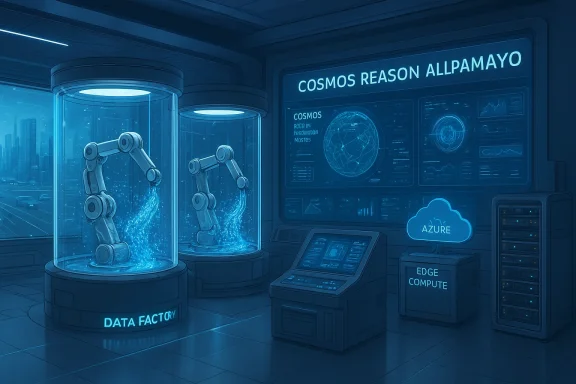 Background / Overview
Physical AI — systems that see, reason and act in the real world — faces a single hard constraint: you need enormous, varied, and physically accurate datasets that include edge cases the real world rarely exposes. NVIDIA’s answer is a single, open reference architecture that automates data curation, synthetic-data multiplication, reinforcement learning workflows, and evaluation so teams can spin up continuous training pipelines at scale. That architecture is called the Physical AI Data Factory Blueprint and it was presented as part of Nnouncements.At a technical level the blueprint stitches together three core ideas NVIDIA has been developing publicly over the last 12–18 months:
- World Foundation Models (Cosmos) for physics-aware synthetic scene and video generation, scenario variation, and digital-twin rendering.
- OSMO, an open orchestration platform that coordinates heterogeneous compute, simulation clusters, training GPUs and edge devices into repeatable CI/CD workflows for physical AI.
- Evaluation and reasoning models (Cosmos Reason / Alpamayo) to filter, score and verify generated data and closed-loop policies before they touch expensive hardware or the road.
What the Blueprint Actually Does
The blueprint outlines modular workflows and the software stack needed to move from raw inputs to model-ready datasets at world scale. Practically speaking it offers the following pipelines:Curate & Search
- Ingest raw sensor logs, video, telemetry and labeled datasets.
- Index, filter and annotate large volumes of heterogeneous inputs so they’re discoverable by agents and downstream workflows.
This stage is the foundation for reliable augmentation; without a consistent, searchable corpus you cannot automate scenario amplification.
Augment & Multiply (Cosmos Transfer)
- Use Cosmos Transfer and other world foundation models to expand small real datasets into many simulated variations: different lighting, weather, occlusions, actor behavior and rare edge events.
- Generate both sensor-level outputs (camera, LiDAR, radar) and corresponding labels (depth maps, segmentation, pose, physical state).
Cosmos-Transfer repositories and docs show explicit support for multi-modal video conditioning and structured control inputs that make controlled augmentation feasible.
Evaluate & Validate (Cosmos Reason, Alpamayo)
- Run generated scenarios through reasoning models that automatically flag physically implausible frames, unrealistic sensor artifacts, or label inconsistencies.
- Score scenario utility for training and for closed-loop policy evaluation (reinforcement learning).
NVIDIA has published technical material describing Cosmos Reason and Alpamayo’s closed-loop evaluation approach for autonomous driving and embodied agents.
Orchestration (OSMO + Agentic Coding Assistants)
- OSMO centralizes experiment management, dataset versioning, compute scheduling and edge-in-the-loop testbeds.
- It can be driven by coding agents (for example, Claude Code, OpenAI Codex) to perform AI-native operations: allocate resources, triage bottlenecks, and run iterative training cycles.
Who’s Using It (and Where It Will Run)
NVIDIA positions the blueprint as an open architecture for the ecosystem rather than a single-vendor product. Public partners and early users mentioned during NVIDIA’s announcements include cloud providers and physical-AI developers:- **Cloud icrosoft Azure (integration into an open physical-AI toolchain and enterprise services like Azure IoT / Fabric / Foundry was showcased), and Nebius (integration into Nebius AI Cloud running NVIDIA-powered Blackwell/RTX PRO hardware).
- Physical AI developers / integrators: a mix of robotics and perception vendors were named in conference coverage — FieldAI, Hexagon Robotics, Linker Vision, Milestone Systems, Skild AI, Uber, Teradyne and others — though the depth of integration varies and some firms are listed as early testers rather than production users.
Why This Matters: Strengths and Immediate Gains
- Addresses the long-tail problem — The blueprint explicitly focuses on rarity and edge events (pedestrian occlusions, sensor failures, complex multi-agent traffic interactions). Generative world models can create many plausible variations from a single logged event, making it cheaper to train for safety-critical failures.
- End-to-end automation reduces friction — Orchestration with OSMO plus agentic coding assistants reduces manual pipeline management, enabling smaller teams to run thousands of RL and data-generation experiments that previously required large SRE squads.
- Open references accelerate reproducibility — By publishing models, tooling and a reference architecture, NVIDIA aims to give researchers and integrators a common set of primitives to benchmark and share progress — an important step for a field where tool fragmentation slows adoption.
- Cloud partner integrations enable scale — When major cloud providers and specialized AI clouds make validated stacks available, teams can avoid the months-long hardware procurement and systems-integration cycle for data-heavy experiments. Azure and Nebius have already announced platform-level offerings that align with the blueprint.
Critical Analysis: Where the Blueprint Helps — and Where It Doesn’t Solve Everything
The blueprint is a practical and timely step, but it’s not a silver bullet. Here are the most important strengths and the principal risks or gaps enterprises must consider.Strengths (what it really improves)
- Scale without physical risk: Synthetic data reduces the need for dangerous on-road testing of corner cases. That’s a clear win for safety and cost.
- Faster iteration for RL-driven policies: Closed-loop simulated evaluation shortens RL cycles; developers can prototype policies in parallel clouds and reproduce results.
- Platformized reproducibility: Publishing reference orchestration and model components makes cross-team comparison more straightforward.
Risks and Limitations
- Sim-to-real fidelity gap remains: Even the best world foundation models must avoid producing “useful but wrong” signals. A dataset that looks realistic but breaks subtle sensor physics can encourage brittle policies. The blueprint’s validation layer mitigates this, but empirical sim‑to‑real transfer still needs conservative field validation.
- Compute and energy costs: Generating billions of synthetic frames and training large VLA (vision–language–action) models requires enormous compute — and power. Organizations must weigh the cost of synthetic-first training against the marginal benefit for each model. Public cloud availability helps, but operational expenses will be non-trivial.
- Governance & provenance: Openly synthesized data complicates provenance, compliance and auditing. Enterprises training safety-critical systems will need robust lineage, versioning and audit trails (areas OSMO and Azure Fabric aim to support, but policy work remains).
- Bias and edge-case misrepresentation: Synthetic amplifications can unintentionally over-represent rare but unrealistic behaviors if the generative models aren’t tightly constrained by physical priors and domain-specific guardrails. Cosmos Reason and similar filters help, but human oversight is still essential.
- Vendor lock and ecosystem concentration: The blueprint is open, but early implementations are optimized for NVIDIA toolchains and GPUs. Teams that want portable, multi-vendor architectures should plan for abstraction layers and multi-cloud testing rather than assuming a single path to production. Nebius and Azure integrations are helpful but underline the initial NVIDIA-cecom]
Technical Verification — What I checked and where
To ground the claims in public, verifiable artifacts I cross-checked NVIDIA’s announced building blocks and the cloud integrations:- The Cosmos family and Cosmos-Transfer repositories are public and show multi-modal, physics-aware generation primitives. The Cosmos Transfer repo and its release notes are available on NVIDIA’s GitHub.
- OSMO is published as an orchestration project designed for physical AI workloads, with explicit support for heterogeneous compute, experiment tracking and cluster-local caching. The GitHub project contains docs for pipeline orchestration and cluster integrations.
- NVIDIA’s corporate blogs and press material describe Omniverse/Omniverse DSX blueprints and Cosmos world models as the intended foundation for “AI factories” and large-scale simulation-based training. Those materials were referenced in the GTC/press releases.
- Microsoft’s Azure product literature (Fabric, Azure AI Foundry and Copilot integration points) shows active investment in agentic and data-factory workflows that map to the kind of toolchain NVIDIA describes; Azure’s partnership mentions match the integration described in conference coverage.
- Nebius has public announcements about offering NVIDIA Blackwell/RTX PRO hardware and rolling platform updates that align with the blueprint’s recommendations for compute substrates. Nebius’s newsroom lists Blackwell availability and large-scale cloud capabilities.
Practical Guidance: How teams should evaluate and adopt the blueprint
If you run a robotics, AV, or vision-agent program, treat the blueprint as a strategic accelerator — but adopt it in stages and with guardrails.- Start with a proof-of-value dataset: pick a narrow safety-relevant scenario (e.g., pedestrian occlusion at dusk) and build a controlled augmentation pipeline with Cosmos Transfer to measure sim-to-real benefit.
- Introduce OSMO for orchestration: use OSMO to version datasets, record experiments, and stop ad-hoc scripts from proliferating. This provides reproducible rollbacks and reliable benchmarks.
- Validate with Cosmos Reason / Alpamayo: before any policy sees hardware, run automated sanity checks for physical plausibility and label consistency. Use reasoning models to flag anomalies.
- Instrument cost-control: synthetic pipelines scale quickly. Implement budget caps, staged dataset expansion, and compute autoscaling to avoid runaway bills.
- Harden governance: require dataset lineage, approval workflows for generated data, and an external audit for safety-critical models; embed human-in-the-loop review for top-risk scenarios.
6.ity: if avoiding vendor lock is important, containerize pipeline components, maintain abstraction layers for inference runtimes, and continuously test on non-NVIDIA hardware early in the stack.
Business and Policy Implications
- Enterprises building physical AI now face a new operational model: treating compute as a repeatable data source. That changes procurement, budgeting and organizational alignment: expect closer partnerships between ML teams, OT (operations technology), and data-center engineering.
- Regulatory bodies will demand better provenance and auditable evaluations. The blueprint’s open nature makes it easier to standardize reporting and evaluation, but companies must still invest in independent verification and certification processes.
- Energy and sustainability concerns are real. Gories and prolonged synthetic data generation may drive intense power demand; data-center design and procurement should account for both compute and thermal/energy systems. Recent Omniverse DSX work and vendor reference designs call out cooling and power as first-order design constraints.
Final assessment — Practical optimism with necessary caution
The NVIDIA Physical AI Data Factory Blueprint is a substantial, pragmatic step toward industrializing the data workflows that will underpin the next wave of robotics and autonomous systems. By combining open world foundation models, an orchestration layer purpose-built for heterogeneous physical‑AI workloads, and cloud-ready integrations, NVIDIA and its partners lower the barrier to producing the quantity and diversity of data needed for safety-critical long‑tail problems.That said, the blueprint amplifies both capabilities and responsibilities. Synthetic data is powerful, but it is not a replacement for rigorous real‑world validation. The sim‑to‑real gap, governance and energy footprint are not solved by a reference architecture alone; they require disciplined engineering, third‑party verification, and strong governance frameworks. Teams that adopt the blueprint should do so iteratively: validate incrementally, measure sim‑to‑real transfer carefully, and maintain strict provenance on every generated datum.
NVIDIA’s public artifacts — Cosmos repositories, OSMO, and Omniverse blueprints — give developers an easy entry point to explore these ideas; cloud integrations from Azure and Nebius mean you can trial large-scale pipelines without months of hardware lead time. For organizations building embodied AI, that combination is both an opportunity and a mandate: move faster, but verify harder.
What to watch next (short checklist)
- Confirm the full blueprint GitHub release (NVIDIA indicated broader availability on GitHub; check the official repos for the release date and artifacts).
- Trial OSMO in a contained sandbox to assess orchestration fit and cost controls.
- Run side-by-side sim-to-real benchmarks with and without Cosmos-augmented datasets to quantify benefit for your use case.
- Track partner rollouts (Azure, Nebius and others) for prebuilt stacks that reduce integration work.
Conclusion: the Physical AI Data Factory Blueprint is an important, practical milestone for robotics and autonomous systems — one that accelerates capability but also amplifies the need for rigorous validation, governance and operational discipline.
Source: Bitget NVIDIA Announces Open Physical AI Data Factory Blueprint to Accelerate Robotics, Vision AI Agents and Autonomous Vehicle Development | Bitget News
