

NWN’s expanded Intelligent Cloud plays like a blueprint for the AI era: layered managed services, a patented observability engine, and tighter procurement and partner integrations aimed at turning messy cloud estates into predictable, secure platforms for AI workloads. The announcement frames this as more than product packaging — it’s a response to a common IT problem in 2026: exploding AI demand, fractured toolchains, uncertain costs, and brittle operations. NWN says the enhanced offering combines AI‑enabled managed services, its Experience Management Platform (EMP), AWS and Azure modernization paths, and select AWS Marketplace listings to deliver a single operating model for migration, operations, and AI enablement — a claim that demands both careful reading and healthy skepticism.
AI workloads are reshaping enterprise infrastructure. They drive higher GPU and storage demands, impose new data governance rules, and increase traffic patterns that traditional cloud monitoring wasn’t built to manage. Organizations juggling multiple clouds, on‑prem clusters, and SaaS silos often see costs spike and visibility evaporate as they adopt generative AI and data‑intensive services. Vendors and systems integrators have rushed to respond with purpose‑built stacks, FinOps tooling, and “AI‑ready” managed services. NWN’s Intelligent Cloud is positioned squarely in that response: a packaged set of services and platform capabilities intended to reduce fragmentation and provide operational continuity from migration through AI enablement.
NWN’s positioning matters because the company has been actively consolidating cloud and CX capabilities since mid‑2024 and accelerated growth with acquisitions — notably InterVision in 2025 — that expanded its AWS contact center and cloud expertise. Those moves have given NWN deeper AWS practice capabilities and a broader services portfolio to bring to the Intelligent Cloud stack. This acquisition and related expansion are part of the context for the announcement, not an incidental detail.
Why this matters in practical terms:
That said, the real value will come down to measurable operational outcomes in your environment: how EMP integrates with your existing telemetry, whether automations reduce real workload without introducing risk, and whether the combined cost model delivers predictable economics as AI consumption grows. Treat the announcement as a strong starting point, but require pilot validation, transparent FinOps modeling, and contractual guardrails before committing mission‑critical AI workloads to any single vendor‑centric operating plane.
In short: NWN’s Intelligent Cloud looks like the kind of integrated, partner‑led solution many enterprises need — but the proof will be in the pilots, the numbers, and the operational contracts you negotiate before full rollout.
Source: Business Wire https://www.businesswire.com/news/h...gent-Cloud-Services-for-the-Modern-Workplace/
 Background and market context
AI workloads are reshaping enterprise infrastructure. They drive higher GPU and storage demands, impose new data governance rules, and increase traffic patterns that traditional cloud monitoring wasn’t built to manage. Organizations juggling multiple clouds, on‑prem clusters, and SaaS silos often see costs spike and visibility evaporate as they adopt generative AI and data‑intensive services. Vendors and systems integrators have rushed to respond with purpose‑built stacks, FinOps tooling, and “AI‑ready” managed services. NWN’s Intelligent Cloud is positioned squarely in that response: a packaged set of services and platform capabilities intended to reduce fragmentation and provide operational continuity from migration through AI enablement.NWN’s positioning matters because the company has been actively consolidating cloud and CX capabilities since mid‑2024 and accelerated growth with acquisitions — notably InterVision in 2025 — that expanded its AWS contact center and cloud expertise. Those moves have given NWN deeper AWS practice capabilities and a broader services portfolio to bring to the Intelligent Cloud stack. This acquisition and related expansion are part of the context for the announcement, not an incidental detail.
What NWN announced — the package, in plain terms
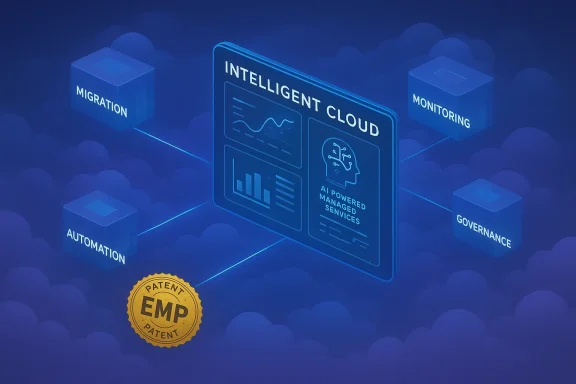
NWN’s update folds four primary elements together into what it calls Intelligent Cloud:- AI‑powered managed services for cloud operations and contact center workloads, including 24×7 monitoring, incident response, and continuous optimization.
- Unified visibility and automation through the Experience Management Platform (EMP) — a platform NWN describes as patented and central to automated troubleshooting and cross‑environment observability.
- Expanded AWS and Azure modernization services, including Azure Cloud Migration Services, Amazon Connect enhancements for contact center modernization, and NWN Cloud Support delivered via the AWS Partner‑Led Support program.
- Simplified procurement routes via AWS Marketplace listings for select services and private offers to accelerate time‑to‑value and compliance procurement. NWN already appears in AWS Marketplace as a seller for specific managed service offerings.
Why the EMP claim matters — and what the patent actually means
NWN describes EMP as a “patented” Experience Management Platform that provides a single pane for telemetry, analytics, automation, and governance. A USPTO‑issued patent for a unifying telemetry and remediation approach strengthens NWN’s intellectual property claims and signals investment in a single control plane intended to reduce mean time to resolution and create repeatable operational playbooks. The company’s press outreach explicitly frames EMP as the linchpin that connects device‑to‑cloud observability and automation.Why this matters in practical terms:
- Centralized telemetry reduces tool fragmentation and the attendant context‑switching that lengthens incident resolution.
- Model‑based analytics and automated remediation can cut routine ticket volumes and improve MTTR if implemented with robust, contextual data models.
- Patenting the approach helps NWN differentiate in a crowded MSP market and protects their approach to correlating disparate signals across cloud and on‑premises systems.
The AWS angle: Partner‑Led Support, Amazon Connect, and Marketplace
Three AWS‑related moves are central to NWN’s messaging: support alignment, contact center depth, and Marketplace availability.- AWS Partner‑Led Support (PLS) gives partners the ability to support customers directly while retaining secure access to AWS diagnostics and faster escalation paths. PLS also changes the economics of support — partner fees are typically a percentage of AWS spend, with minimums and tiered rates defined by AWS. NWN’s stated use of PLS suggests customers can get a partner‑managed support model backed by AWS tools and specialist collaboration. This can materially shorten escalation cycles for high‑severity incidents compared with a strictly partner‑only setup.
- NWN’s expanded Amazon Connect services — bolstered by the InterVision acquisition and existing AWS contact center experience — position NWN to deploy AI‑enhanced contact centers that integrate LLMs, conversational AI, and CX analytics. AWS Connect plus NWN’s contact‑center playbooks may be attractive for public‑sector and regulated customers that need predictable compliance and procurement. CRN’s coverage of NWN’s InterVision acquisition underscores the depth of those contact‑center capabilities.
- Marketplace presence simplifies procurement: NWN already lists multiple professional services and packaged solutions on AWS Marketplace (ConnectIV CX, Network Health Assessments, cloud migration services, and others). These listings typically use private offers, which means procurement and contract terms still require vendor engagement, but Marketplace listing reduces friction for discovery and initial procurement conversations. Enterprises should still verify which capabilities are available as an immediately purchasable SaaS versus a professional services engagement.
Strengths: where NWN’s offering can actually narrow risk
- Unified operating model: NWN combines modernization (migration + refactor), managed operations, and observability/automation under EMP. That reduces the handoff friction common in “lift‑and‑shift then manage” engagements and can accelerate time‑to‑value when executed with experienced SREs and architects. NWN’s Intelligent Cloud page and recent cloud‑and‑connectivity press releases show an integrated product narrative across cloud, network, and CX.
- AWS and Azure depth: NWN’s practices reflect certifications and competencies across both hyperscalers. That breadth matters for hybrid workloads and mission‑critical applications that can’t be simply rehosted. NWN’s recent acquisitions and partnerships and presence in AWS Marketplace demonstrate active investment in these ecosystems.
- Patented observability with automation: EMP’s patent and productization indicate a long‑term play for horizontal observability — if EMP scales and maintains low‑noise automation, customers can see reduced ticket volumes and predictable operating costs. NWN frames EMP as a platform that ties workplace, connectivity, contact center, and cloud telemetry into a single model.
- Public‑sector and regulated market fit: NWN’s existing wins (state and local contracts, public safety projects) suggest the company knows procurement and compliance workflows, which lowers integration risk for similarly regulated customers. Past press releases and case studies reinforce this track record.
Risks, open questions, and red flags
- Toolchain lock‑in vs. flexibility: NWN’s approach encourages reliance on EMP for observability and automation. That reduces fragmentation, but it raises portability questions. If EMP becomes the central operating controller, how easily can customers migrate to another operations layer or interoperate with existing investments in Datadog, Splunk, Dynatrace, or native hyperscaler observability? Customers should request clear migration and API contracts before committing.
- Automation accuracy and guardrails: Automated remediation is powerful — and risky if policies aren’t contextually aware. Enterprises running mission‑critical workloads must verify automation runbooks, escalation windows, and rollback paths in controlled pilots. Empirical evidence of automation success rates and incident postmortems should be part of procurement diligence.
- Cost model clarity: Partner‑Led Support pricing and Marketplace private offers simplify procurement but introduce cost variability if cloud consumption and support fee bases aren’t crystal clear. AWS Partner‑Led Support pricing is tiered and includes minimums; customers need fully transparent FinOps forecasts that include NWN managed services fees in addition to base cloud consumption. Ask for modeled scenarios that show end‑to‑end costs for projected AI workloads.
- Vendor consolidation risk: Consolidating modernization, contact center, networking, and observability with one provider improves coordination — but larger providers also create a single point of failure. Ensure contracts articulate service credits, incident escape hatches, and third‑party verification options. Procurement should preserve the right to engage independent audits and third‑party incident response.
- Unverified launch specifics: The Business Wire copy accompanying the announcement states rollout beginning February 24, 2026 and a webinar on March 12, 2026; NWN’s own marketing pages confirm Intelligent Cloud and EMP but do not publicly mirror each line of launch detail in identical language. Until NWN’s newsroom or vendor portal publishes a detailed launch matrix, customers should consider rollout windows tentative and confirm availability for specific services directly with NWN. This is a practical procurement step, not a question about technical merit.
How to evaluate NWN Intelligent Cloud — a buyer checklist
When your team evaluates NWN’s Intelligent Cloud for migration and AI readiness, use this practical checklist to separate marketing from measurable outcomes:- Proof points and metrics
- Request specific MTTR, automation success rate, and cost‑savings figures from comparable customers.
- Ask for playbook examples showing pre‑ and post‑deployment KPIs.
- Integration and API coverage
- Verify EMP’s native integrations with your existing telemetry stacks (Akamai, Datadog, Splunk, Azure Monitor, CloudWatch).
- Confirm export and backup options for monitoring data and runbooks.
- Automation safety
- Define which automations will be run in observe versus act modes during pilot phases.
- Insist on documented rollback and human‑in‑the‑loop thresholds for critical systems.
- Cost transparency
- Request modeled FinOps scenarios that combine AWS/Azure consumption with NWN managed services fees and PLS percentages.
- Confirm Marketplace private offer terms and support contract billings.
- Compliance and data governance
- Map EMP data flows and retention to your compliance requirements (HIPAA, FedRAMP, CJIS, GDPR).
- Request third‑party security attestations and SOC reports.
- Exit and portability
- Negotiate exportable playbooks and tooling artifacts to limit “operational lock‑in.”
Real customer signals — what early adopters report
The Business Wire announcement includes customer quotes describing smoother transitions and faster time‑to‑value; NWN’s public case studies and prior announcements (public safety deployments, state contracts, and contact center modernization) demonstrate real engagements at scale. NWN’s acquisition activity and marketplace listings further indicate the offering is being productized for repeatable consumption. That combination — references to operational wins, product listings on Marketplace, and an IP posture that includes EMP’s patent — is encouraging for organizations that need proven, turnkey support for cloud‑to‑AI transitions. Still, potential buyers should demand mapped outcomes tied to their own SLAs and workloads.Analyst perspective — where this fits in the cloud MSP landscape
NWN is moving into the “full‑stack managed services” segment that blends device management, CX, connectivity, and cloud operations under a single delivery model. The market trend is clear: enterprises favor fewer, more capable partners that offer both deep hyperscaler integrations and an orchestration layer that reduces operational complexity. NWN is not alone — many MSPs are expanding into observability, automation, and AI enablement — but the combination of a patented EMP, AWS Marketplace productization, and AWS Partner‑Led Support alignment gives NWN a practical playbook for customers that prefer a co‑managed model anchored in partner expertise plus native hyperscaler escalation channels. That hybrid approach reduces the friction of complex support cases and can accelerate AI deployment cycles. Analysts will judge NWN on two axes: operational outcomes (MTTR, cost stability) and ecosystem fidelity (how well EMP plays with other vendor stacks).Practical recommendations for IT leaders
- Run a shadow‑pilot: start with a non‑mission‑critical AI or contact center workload to validate EMP integrations, automation fidelity, and cost forecasts.
- Insist on outcome‑based SLAs: require measurable KPIs for downtime, MTTR, automation success, and FinOps targets.
- Validate Marketplace offers: confirm that the Marketplace listing you intend to purchase matches the operational model you need (SaaS vs. professional services vs. private offer).
- Negotiate clear support escalation: if NWN uses AWS Partner‑Led Support, document the escalation steps that include AWS specialist engagement and expected response times for Sev‑1 events.
- Preserve auditability: require the right to independent security audits and a contractual commitment for telemetry and runbook exports on contract termination.
Bottom line
NWN’s Intelligent Cloud announcement is strategically coherent: it stitches modernization, managed operations, and patented observability together under a single customer narrative. The company’s investments — acquisitions, EMP patenting, AWS Marketplace presence, and explicit alignment with AWS Partner‑Led Support — make a credible case that NWN is building a practical migration‑to‑AI runway for customers who prefer a consolidated partner.That said, the real value will come down to measurable operational outcomes in your environment: how EMP integrates with your existing telemetry, whether automations reduce real workload without introducing risk, and whether the combined cost model delivers predictable economics as AI consumption grows. Treat the announcement as a strong starting point, but require pilot validation, transparent FinOps modeling, and contractual guardrails before committing mission‑critical AI workloads to any single vendor‑centric operating plane.
In short: NWN’s Intelligent Cloud looks like the kind of integrated, partner‑led solution many enterprises need — but the proof will be in the pilots, the numbers, and the operational contracts you negotiate before full rollout.
Source: Business Wire https://www.businesswire.com/news/h...gent-Cloud-Services-for-the-Modern-Workplace/
