

Microsoft’s NZ North cloud region is no longer a promise on paper — a year after launch it is the backbone for several high‑profile AI and cloud projects in Aotearoa, supporting telco modernization, national telehealth, local government migrations and creative‑sector skilling while pushing sustainability and data‑residency commitments to the fore. The single‑paragraph takeaway: Microsoft’s hyperscale investment has moved from infrastructure build to practical adoption, with clear wins and persistent questions about cost, governance and long‑term market competition.
Source: IT Brief New Zealand https://itbrief.co.nz/story/microsoft-cloud-region-powers-new-zealand-s-ai-growth/
 Background
What the NZ North region is and why it matters
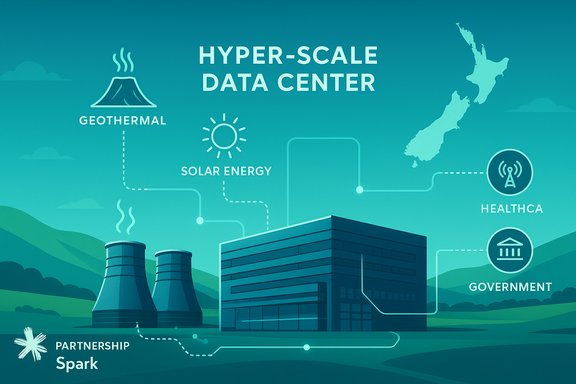
Microsoft opened the NZ North Azure region in December 2024 as the company’s first local hyperscale cloud region in New Zealand. The region provides on‑shore compute, storage and platform services that reduce latency, enable local data residency, and permit organizations to run sensitive workloads inside national borders. Microsoft describes the region as built with water‑free cooling technology and backed by a decade‑long renewable attribute agreement with Contact Energy — a commercial structure intended to demonstrate 100% carbon‑free electricity for the site. These technical and commercial choices — onshore compute, renewable attribute purchase agreements (APAs) and water‑free cooling — are the foundation for Microsoft’s pitch that NZ North is a secure, sustainable and sovereign platform for New Zealand’s next wave of AI and cloud services. The local availability of advanced Azure services is also intended to remove regulatory and latency barriers that previously kept many government and regulated workloads offshore.One year on: who’s using NZ North and how
Telco: Spark’s strategic pivot to AI and cloud
Spark and Microsoft announced what both parties called New Zealand’s largest Microsoft public cloud partnership earlier in 2025. The agreement covers a proportion of Spark’s workloads moving to Azure and a large‑scale deployment of Microsoft 365 Copilot — bringing Copilot to roughly 2,500 Spark staff (an uplift of about 1,800 seats), alongside an advanced data‑residency commitment for Spark’s Microsoft 365 tenant. Microsoft frames the deal as a stepping stone for Spark to modernize its hybrid cloud economics and develop new AI‑led revenue lines. Why this matters: the Spark deal is the archetype for how large New Zealand firms might use NZ North — keep sensitive operational data onshore, modernize the hybrid estate, and deploy AI productivity tools at scale. That combination addresses compliance, performance and the practical need to upskill internal teams to operate an AI‑augmented workplace. Early signals from Spark and Microsoft highlight productivity and service‑quality wins, but the true ROI will be visible only after broader, sustained usage and independent evaluation.Public sector and councils: gradual migration, tangible outcomes
Local government has been an early adopter of staged cloud modernization. Christchurch City Council, for example, completed a major migration into public cloud in the first year and now uses the new systems to analyze local needs and modernize citizen services. Government agencies and councils cite improved agility, more reliable disaster‑recovery options, and the ability to use real‑time analytics as primary benefits. These projects are still in the scalability phase — teams typically strengthen data foundations and pilot before committing to full‑scale production.Health: Whakarongorau Aotearoa’s telehealth modernisation
Whakarongorau Aotearoa, New Zealand’s national telehealth provider, migrated core systems to Azure in the NZ North region as part of a major infrastructure transformation. The migration was delivered with partner Valentia Technologies and — according to the organisations — created immediate operational and cost benefits such as roughly NZD $10,000 per month in technology and administration savings and faster, data‑driven staffing adjustments in real time. The team reports substantial productivity gains from Copilot and plans to pilot agentic AI tools to triage and keep callers engaged until clinicians are available. Caveat: the productivity numbers cited (for example, “three quarters of our Copilot users report a strong productivity lift”) are internal, self‑reported metrics from the organisation; they are meaningful operational indicators but not independently audited measurements. They signal positive early effects but should be treated as directional rather than definitive until external evaluation confirms them.Industry and start‑ups: local partners and collaboration
Tenants and partners using NZ North are not limited to crown agencies and telcos. The region lists organisations ranging from agri‑tech to financial services and creative hubs. Microsoft and local partners (including CCL and PwC among others) are building migration pathways, shared services and partner skilling programs to reduce friction for businesses moving to hyperscale cloud. These partnerships aim to accelerate adoption by offering migration frameworks, security blueprints and data‑residency guarantees.Skills and jobs: the human side of the cloud transition
Microsoft’s skilling commitment and local programs
Microsoft has set a public target to upskill 100,000 New Zealanders in digital and AI skills by 2027. The company is delivering this through partnerships with Te Pūkenga (the New Zealand Institute of Skills and Technology), Auckland Council and regional initiatives such as the Te Puna Creative Hub in West Auckland, which offers technology‑focused micro‑credentials aimed at underrepresented groups. Microsoft positions skilling as essential: without a trained workforce, the productivity and job‑creation potential from AI and cloud will be limited.- Key elements of the skilling push:
- Micro‑credentials for students and adult learners.
- Joint training programs with telcos and local partners.
- Public‑facing bootcamps and digital inclusion initiatives.
Strengths and gaps
Upskilling at scale is vital and the commitment is welcome, but execution risk is real: scaling quality training outside urban centres, ensuring curriculum relevance for employer needs, and measuring outcomes (job placements, career progression) are non‑trivial tasks. Public–private coordination will be the decisive factor in turning training commitments into durable workforce gains.Sustainability and energy: how green is NZ North?
Renewable agreement with Contact Energy
Microsoft’s NZ North region is powered by a 10‑year renewable attribute purchase agreement with Contact Energy tied to the Te Huka Unit 3 geothermal power station. Contact’s reporting and Microsoft’s announcements confirm the APA was an enabling commercial factor for both Microsoft’s investment and Contact’s decision to expand geothermal capacity. The APA supplies renewable attributes rather than directly isolating electrons on the grid; this is the accepted market mechanism for hyperscalers to claim renewable energy use.Water‑free / closed‑loop cooling and carbon claims
Microsoft states the NZ North datacentre uses water‑free (air) cooling and operates on 100% renewable attributes, which reduces local freshwater use and helps the carbon narrative. These are tangible design decisions that reduce specific environmental risks associated with data centre builds (particularly freshwater usage in dry climates). Mandala Partners research commissioned by Microsoft suggests that faster public cloud adoption — into renewable, efficient hyperscale facilities like NZ North — could reduce the public sector’s carbon footprint materially (Microsoft and media coverage cite estimates such as an 11% reduction or an equivalence of removing ~14,000 cars from New Zealand roads). Those estimates are based on modelling and scenario analysis; they should be treated as projections rather than measured outcomes. The research is valuable but commissioned by Microsoft, so independent verification and longer‑term audited data will be necessary to confirm the scale of actual emissions reductions.Technical and security considerations
Data residency and compliance
A central selling point for NZ North is onshore data residency, which simplifies compliance for regulated sectors. Spark’s deal includes an NZ‑first advanced data residency commitment for Microsoft 365 tenants, addressing legitimate concerns from regulated industries and public bodies about cross‑border data handling. Having compute and storage physically located in New Zealand reduces legal complexity and can shorten procurement cycles for government and health organisations.Availability zones and service parity
Azure’s global deployment model typically uses multiple Availability Zones per region for resilience. Public infrastructure notes and third‑party infrastructure trackers indicate New Zealand North is configured to offer multi‑zone resilience (three zones are commonly referenced in region planning documentation). Practical implications: high availability architectures and regional disaster‑recovery designs become straightforward for local customers. Still, new regions often reach service parity gradually — some Azure services, VM SKUs or GPU configurations may arrive later than the core compute/storage services. Organisations with advanced GPU‑heavy AI training needs should validate availability and timelines before migrating critical workloads.Security posture
Microsoft emphasizes its global security telemetry and corporate controls as part of the offering; local customers benefit from the combination of onshore hosting and Microsoft’s global security services. That said, security responsibility is shared — customers must architect securely, manage identities and protect data appropriately. Public sector migrations should treat cloud as a shift in operational model rather than a lift‑and‑shift that absolves them from cybersecurity governance.Economic impact: headline figures and a reality check
Big numbers and who produced them
Microsoft cites research (including Accenture and Mandala Partners work commissioned by Microsoft) that estimates generational economic benefits from generative AI and cloud adoption: figures such as NZD $76 billion in potential contribution to GDP by 2038 for generative AI trajectories have been repeated in coverage, alongside government savings projections tied to faster cloud migration (e.g., NZD $3.6 billion by 2035 in one Mandala scenario). These models combine productivity uplift scenarios, public‑sector efficiency gains and broader spillover effects.Assessing credibility
Such economic modelling is standard in major technology rollouts and useful for high‑level planning, but models rely on assumptions about adoption rates, regulation, workforce reskilling, and competitive responses. Important caveats:- Some studies are commissioned by parties with commercial interests (e.g., Microsoft), which does not invalidate them but requires cautious interpretation.
- The timeline to realize GDP and fiscal savings depends on effective public procurement reform, rapid skilling and sustained private investment.
- Independent, neutral audits over coming years will be necessary to test whether early projections match real‑world outcomes.
Risks and open questions
Competition, market concentration and long‑term resilience
Microsoft’s large, early investment brings benefits — but also raises questions about market concentration. A small number of hyperscalers controlling critical national infrastructure increases dependence on a limited supplier set. Policymakers and sector buyers should weigh the benefits of scale against strategic risks, considering multi‑cloud strategies where appropriate and investing in local partner ecosystems that can provide competition and resilience.Procurement, governance and vendor lock‑in
Large hyperscaler deals risk creating long‑term vendor dependencies if contract design, data‑exit terms, and interoperability are not carefully managed. Public sector procurement must include strong exit and portability clauses, clear auditing requirements and staged pilot‑to‑production approaches to reduce lock‑in risk.Skills mismatch and inclusion
Training 100,000 people is necessary but not sufficient. Closing the gap between training content and employer demand, ensuring equitable geographic access to programs, and tracking real placement and career outcomes will determine whether skilling commitments translate into resilient local employment growth.Energy and supply chain pressures
While Microsoft’s APA with Contact Energy strengthens the renewable claim, broader grid constraints and global supply dynamics (accelerators, networking hardware) could limit the region’s ability to rapidly scale specific AI workloads. Energy pricing and national grid readiness remain business‑critical variables for future growth scenarios.Practical guidance for IT leaders in New Zealand
- Validate service parity: confirm that the Azure services and VM SKUs you need are available in NZ North before committing production workloads.
- Pilot then scale: use a staged approach — start with non‑critical workloads, prove security and performance, then migrate core systems.
- Design multi‑zone resilience: leverage Availability Zones for critical services and plan cross‑region DR where required.
- Contract carefully: insist on clear data‑exit clauses, audit rights and local support SLAs.
- Invest in people: prioritize role‑based training and tie skilling outcomes to hiring pipelines and career pathways.
What to watch next
- Follow the Spark modernization roadmap and measurable KPIs for service quality, cost and customer experience post‑Copilot deployment.
- Monitor independent verification studies on carbon and water footprint reductions tied to datacentre migration and APA impacts. Early projections exist; audited emissions data will be decisive.
- Track service parity and GPU availability in NZ North for AI training workloads — organisations with heavy GPU demand should validate timelines directly with Azure.
- Watch public procurement reforms and how government agencies adopt cloud‑first strategies; the Mandala modeling shows material fiscal upside if migration accelerates, but the governance work is essential.
Conclusion
The NZ North Azure region has moved quickly from build to use: telcos, public sector agencies, health providers and local partners are already using the region to modernize services, test AI workflows and pursue sustainability goals. The region delivers clear technical benefits — local data residency, reduced latency, and sustainability features — and Microsoft’s commercial agreements (Contact Energy APA) and skilling commitments set ambitious targets for social and economic impact. That said, the most important work is still ahead. Models and internal pilot metrics point to large productivity and emissions benefits, but independent validation, careful procurement, resilient governance and measured scaling will determine whether NZ North becomes the foundation of a broadly shared AI economy or simply another isolated hyperscale footprint. The next 12–24 months should reveal whether early efficiency gains translate into structural, long‑term value for New Zealand’s businesses, public services and workforce.Source: IT Brief New Zealand https://itbrief.co.nz/story/microsoft-cloud-region-powers-new-zealand-s-ai-growth/
