

AI is here now — and for public servants in New Zealand that is not a slogan but the starting point for a major program of system change, risk management and capability building that will permanently reshape many behind-the-scenes jobs in government.
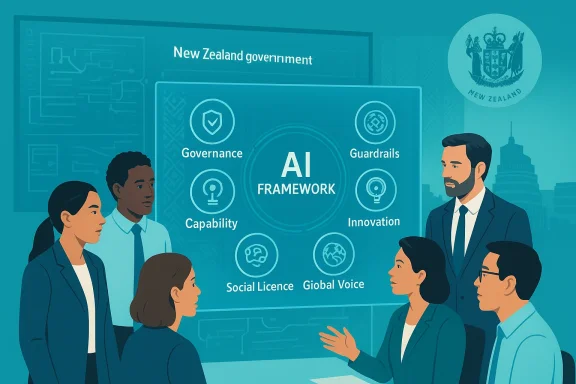
The Government Chief Digital Officer (GCDO), Paul James, has put the New Zealand Public Service on an explicit trajectory to adopt artificial intelligence at scale. The Department of Internal Affairs (which houses the GCDO role) published a formal Public Service Artificial Intelligence Framework that articulates a system-level approach to “adopt AI responsibly to modernise public services and deliver better outcomes for all New Zealanders.” This framework is the linchpin of a broader GCDO-led AI work programme meant to move agencies beyond isolated pilots and into sustained, governed use of AI tools.
That strategic push sits alongside a national-level AI strategy from the Ministry of Business, Innovation & Employment (MBIE) — New Zealand’s “Investing with confidence” AI Strategy — which signals coordinated public and private sector support for faster adoption, skills development and a principles-based approach aligned with international standards such as the OECD AI Principles. Together these initiatives make clear: the government is signalling uptake, not restraint.
On the ground, operational tools such as algorithm impact assessments (AIAs) and model assurance processes are already recommended and available in New Zealand’s public sector guidance materials — these form the practical bridge between principles and everyday procurement, development and deployment decisions. The AIA guidance includes checklists on accountability, transparency, monitoring, appeals and community engagement, and it explicitly calls out the need for Māori engagement where cultural data or tikanga may be involved.
If those conditions are met, the gains can be substantive — better, faster services and a modernised public sector workforce focused on judgement rather than paperwork. If they are not, the inevitable incidents — privacy leaks, biased outcomes, or concentrated security failures — will damage trust and set back adoption for years. The next 18 months will be the proving ground: realistic pilots, published assurance work and transparent remediation when things go wrong will determine whether “AI is here now” becomes an enduring public good or an avoidable reputational liability.
Source: ThePost.co.nz The Post
 Background / Overview
The Government Chief Digital Officer (GCDO), Paul James, has put the New Zealand Public Service on an explicit trajectory to adopt artificial intelligence at scale. The Department of Internal Affairs (which houses the GCDO role) published a formal Public Service Artificial Intelligence Framework that articulates a system-level approach to “adopt AI responsibly to modernise public services and deliver better outcomes for all New Zealanders.” This framework is the linchpin of a broader GCDO-led AI work programme meant to move agencies beyond isolated pilots and into sustained, governed use of AI tools.That strategic push sits alongside a national-level AI strategy from the Ministry of Business, Innovation & Employment (MBIE) — New Zealand’s “Investing with confidence” AI Strategy — which signals coordinated public and private sector support for faster adoption, skills development and a principles-based approach aligned with international standards such as the OECD AI Principles. Together these initiatives make clear: the government is signalling uptake, not restraint.
What the Public Service AI Framework actually does
Six pillars: governance, guardrails, capability, innovation, social licence and global voice
The Framework is deliberately practical. It aims to provide tools, tactical guidance and a pathway for agencies to:- establish governance and accountability over AI projects;
- require algorithm and privacy impact assessments for material uses;
- build workforce capability through role-based training and masterclasses;
- pilot and scale use cases in secure sandboxes; and
- engage the public — including tangata whenua — to preserve social licence.
System leadership and advisory capacity
To operationalise the Framework the GCDO has established concrete delivery vehicles: cross-agency surveys of AI activity, an AI expert advisory panel to provide independent technical advice, and events intended to equip leaders with the confidence to adopt AI responsibly. Recent announcements show the GCDO running an “AI Accelerate” forum and publishing survey results that indicate agency use cases are moving from pilot to production.Where AI is already being used in the Public Service — scale and types of projects
Public-facing numbers and independent reporting show rapid growth in public sector experimentation. A GCDO survey published in 2025 recorded hundreds of AI use cases across dozens of agencies; follow-up reporting and agency commentary put the number of experiments in the low hundreds, spread across functions such as:- customer-service chatbots and virtual assistants;
- document automation and draft generation for policy and communications;
- operational analytics and scheduling; and
- ingestion and remediation of legacy technical debt (AI used to map and prioritise legacy modernization work).
Why the GCDO is pushing now: efficiency, service quality and modernisation
The arguments driving system leadership are straightforward and familiar to technologists and managers:- AI can automate repetitive tasks and reduce time spent on drafting, data wrangling and simple information retrieval, freeing staff for more complex judgement work.
- Generative and analytic AI can surface insights faster than manual methods, improving policy iteration and case handling.
- AI tools can help identify and prioritise legacy system upgrades by scanning code and configuration, accelerating a long-running modernization challenge.
How New Zealand’s approach maps to international norms
New Zealand’s Framework and MBIE strategy explicitly align with the OECD’s AI Principles, and the government’s guidance emphasises human-centred, trustworthy AI: explainability where required, accountability for outcomes, and a lifecycle approach to risk management. That alignment is important because the OECD principles — first adopted in 2019 and updated more recently — are now the dominant multilateral reference for “responsible” AI governance across developed economies.On the ground, operational tools such as algorithm impact assessments (AIAs) and model assurance processes are already recommended and available in New Zealand’s public sector guidance materials — these form the practical bridge between principles and everyday procurement, development and deployment decisions. The AIA guidance includes checklists on accountability, transparency, monitoring, appeals and community engagement, and it explicitly calls out the need for Māori engagement where cultural data or tikanga may be involved.
Practical mechanisms the public service is adopting
- Approved tools lists and “enterprise instances”: agencies are being urged to restrict high-risk work to vetted, contracted enterprise providers or in on‑premise/sovereign cloud instances to reduce leakage of sensitive data.
- Sandboxes for pilots: controlled environments with logging, evaluation criteria (accuracy, fairness, privacy) and defined exit/scale gates.
- Role-based training and mandatory impact assessments: requiring AI literacy for staff with material interaction with models and mandatory AIAs for medium and high-risk projects.
- Independent advisory and peer-review: technical panels and cross-agency peer review for higher-risk deployments.
The benefits, in concrete terms
Public agencies expect measurable gains if governance is done well:- Faster processing and reduced backlog: document automation and summarisation tools can reclaim hours per case for clerical and policy staff.
- Better customer experience: chatbots and triage assistants can deliver 24/7 responses and reduce repetitive contact, while escalation rules preserve human oversight.
- Data‑driven policy and service design: analytics-driven scenario modelling and forecasting enable better targeting and resource allocation.
- Lowered operational costs over time: by automating high-volume tasks and improving accuracy, agencies can reallocate budget to high-value activities.
The risks — technical, social and legal — that demand attention
No public sector AI strategy can be credible without a clear-eyed inventory of the risks. New Zealand’s public leadership has already highlighted several, and independent reporting and specialist guidance flesh them out.Security and single-point-of-failure risks
Centralising public access into one “front door” or single government assistant can simplify citizen journeys but also concentrates risk. The GCDO and Department of Internal Affairs have cautioned against a single‑app model that creates a tempting high-value target for attackers and a single operational failure mode. Agencies must therefore design for redundancy, segmentation and rigorous threat modelling when they consider cross-government portals.Privacy, data governance and leakage
Generative models and remote AI services can inadvertently expose sensitive content through logging, model training or prompt‑sharing. Effective mitigations require contractual protections from vendors, tenant‑bound (enterprise) processing options, strict access controls, prompt-retention policies and staff training on what not to paste into a public AI prompt. These are non-negotiable for health, social welfare and other sensitive domains.Accuracy, bias and “hallucinations”
Generative systems are useful but not infallible. Public service work frequently demands high assurance: legal, clinical and welfare decisions cannot tolerate confident but wrong outputs. Agencies must therefore require verification, human-in-the-loop sign-off, and rigorous monitoring of operational metrics (accuracy, false positives/negatives, disparate impact) for any model that materially affects citizens. The OECD and other guidance instruments make this explicit.Cultural risk and Māori data sovereignty
New Zealand’s context requires particular attention to tikanga, mana whenua rights and Māori data sovereignty. Guidance and strategy documents now emphasise early and meaningful engagement with Māori communities, tikanga-based auditing for high-risk projects and protections for culturally ailure to embed these processes risks not just legal challenge but the erosion of social licence for AI-enabled services.Workforce disruption and industrial relations
While government messaging stresses augmentation and retraining, unions and staff will rightly press for protections: clarity on whether AI will be used to assess performance, explicit limitsnised roles without negotiation, and guarantees of training and job-safety measures where AI changes day‑to‑day tasks. Those issues are governance matters as much as technical ones — they must be negotiated.Lessons from other public services (comparative examples)
New Zealand is not alone in wrestling with these choices. International experience provides useful precedents and cautionary tales:- Flanders (Belgium) negotiated large-scale Copilot-style deployments with Microsoft, offering an example of rapid adoption within a familiar productivity ecosystem; critics raised concerns about vendor lock‑in, training needs and long-tail privacy management. Practical lesson: existing vendor footprints accelerate uptake but increase the need for procurement discipline and contractual safeguards.
- The Government of the Northwest Territories (GNWT, Canada) produced detailed “frontline guidance” suggesting minimum standards for AI use — including strict bans on putting sensitive personal, health or Indigenous cultural data into public, unvetted AI services, and the need to document AI use for auditability. This pragmatic guidance is a useful template for operational rules that agencies can adapt.
- Large enterprise Copilot deployments illustrate both productivity gains and governance gaps: when enterprise Copilot is configured properly and bound to tenant data, it can be protective; but misconfiguration or overbroad sharing means the assistant can surface widely shared internal documents, exposing them in unexpected contexts. The technical lesson is straightforward: permissions and retention policies must be enforced as rigorously as the model itself.
How agencies should sequence AI work: a practical playbook
Agencies that want to move from curiosity to capability can follow a pragmatic sequence:- Inventory: catalogue data assets, systems, and current AI experiments.
- Risk triage: classify use cases into low/medium/high risk (privacy, safety, legal impact).
- Sandbox pilots: test with limited datasets, measurable evaluation criteria and sunset clauses.
- AIA and assurance: run algorithm impact assessments for medium/high-risk projects and set monitoring plans.
- Procurement & contracts: insist on contractual guarantees about data use, retention and training usage.
- Role-based training: deploy mandatory training for staff who interact materially with AI.
- Scale with governance: only scale when auditability, monitoring and redress mechanisms are in place.
The accountability checklist every public manager should adopt
- Who is accountable for AI-driven decisions at each lifecycle stage?
- Has an AIA been completed and signed off by an appropriate governance forum?
- Are vendor contracts explicit about on‑boarded data, prompt logging and training data reuse?
- Have Māori governance and community stakeholders been consulted where data has cultural sensitivity?
- Are audit logs, prompts, outputs and decision trails retained in line with records law?
- Is there a documented plan for human oversight, performance monitoring and rollback?
Workforce strategy: reskilling, roles and new professional practices
Adoption at scale will change many job descriptions in government: less time spent on repetitive drafting and more on validation, sense‑making, supervision and community engagement. Agencies should therefore:- invest in targeted “use‑case” training rather than generic AI hype sessions;
- create new “assurance” and “AI-op” roles responsible for model monitoring, logs and fairness testing;
- embed AI literacy in leadership development so managers can commission safe AI projects; and
- negotiate workforce changes with unions early, framing AI as an augmentation tool but with transparent safeguards.
Public trust and social licence: the political dimension
For public sector AI, technical controls are necessary but not sufficient. The adoption path must include transparent public communication, clear redress mechanisms and meaningful engagement with communities — particularly Māori, who have distinct rights and interests around data. Failure to secure social licence will not only stall projects but risk reputational damage and legal challenges. New Zealand’s national AI strategy and the GCDO Framework explicitly make public trust an objective, but turning aspiration into practice will require visible commitments, audits and public reporting.What success looks like — measurable indicators
A successful public sector AI programme should be judged by both outcomes and safeguards. Key indicators include:- number of use cases moved from pilot to production with published assurance reports;
- measurable productivity gains (time saved per case, backlog reduction);
- documented incidents and remediation actions with transparent reporting;
- demonstrated inclusion of Māori governance for projects involving cultural or community data;
- workforce retraining metrics and evolution of role descriptions; and
- public sentiment measures tracking trust in AI-enabled public services.
Critical strengths of the current New Zealand approach
- System leadership: having the GCDO coordinate cross-agency guidance reduces fragmentation and helps share learnings rapidly.
- Alignment with OECD norms: the MBIE strategy and the Framework both explicitly map to established international principles, which aids interoperability and investor confidence.
- Focus on capability: prioritising role-based training and advisory panels increases the chance agencies will use AI competently rather than just buy tools.
- Practical governance tools: algorithm impact assessments, sandboxes, and approved tool lists are already in circulation as pragmatic checks on adoption.
Key weaknesses and risks to watch
- Implementation gap: frameworks and principles do not automatically produce consistent practice. If agency uptake of AIA, procurement discipline, and training is uneven, systemic risks will compound.
- Vendor dependence and procurement complexity: rapid adoption within dominant productivity ecosystems (e.g., Microsoft Copilot) can introduce lock-in risks and contractual blindspots if procurement teams are not expert in AI-specific clauses.
- Social licence fragility: without explicit, early Māori engagement and clear public-facing accountability, trust can erode quickly and halt projects.
- Operational security: centralised or single-app ambitions create high-value attack surfaces — a single failure can have outsized consequences.
Recommendations for immediate next steps (for agency leaders)
- Treat the AIA as mandatory for any project that affects people materially: no AIA, no roll-out.
- Require vendor contract clause templates that explicitly ban data use for external model training unless consented and ensure clear logging/retention rules.
- Implement a “safe‑prompting” training module and a prompt‑logging policy for all staff using generative tools.
- Convene Māori governance review for any project touching on cultural or community data and embed tikanga expectations into project charters.
- Publish a 12‑month transparency dashboard that lists active AI projects, their AIA status, and key monitoring metrics.
Conclusion — permanent shift, conditional on governance
New Zealand’s public sector has moved from “if” to “how” on AI. The GCDO’s Framework, MBIE’s national strategy and emerging practice across agencies together make clear that AI is being built into the machinery of government — not as an experiment but as an operational capability. That shift is permanent only if the public service meets three conditions: robust, enforced governance; sustained, role-specific capability building; and genuine, early engagement with communities (especially Māori) to maintain social licence.If those conditions are met, the gains can be substantive — better, faster services and a modernised public sector workforce focused on judgement rather than paperwork. If they are not, the inevitable incidents — privacy leaks, biased outcomes, or concentrated security failures — will damage trust and set back adoption for years. The next 18 months will be the proving ground: realistic pilots, published assurance work and transparent remediation when things go wrong will determine whether “AI is here now” becomes an enduring public good or an avoidable reputational liability.
Source: ThePost.co.nz The Post
