

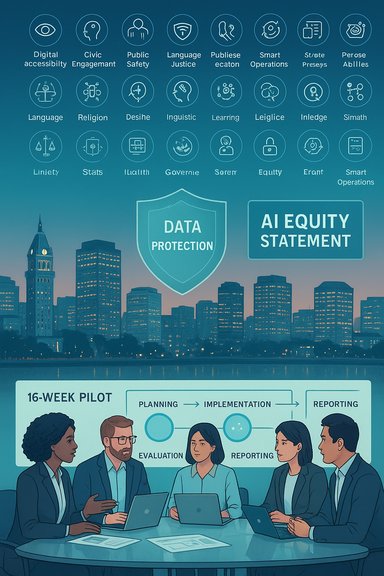
Oakland’s new AI pilot solicitation signals a decisive shift from internal policy-setting to real-world experimentation, offering no-cost, 16-week pilots to vendors and researchers on a slate of 30 city‑identified use cases aimed at improving access, efficiency, and transparency across municipal services. The announcement — framed by the cross-departmental AI Working Group (AIWG) and anchored to an explicit AI Equity Statement and automated data‑classification protections — promises rapid, measured experimentation while attempting to harden privacy and governance guardrails that many cities have struggled to operationalize.
Oakland’s AI Working Group formed in 2024 and has spent the first phase of its program building policy foundations: an AI Equity Statement, staff pilots (including Microsoft 365 Copilot), and a pilot data governance model that prevents sensitive datasets from being exposed to external AI systems. The city is now soliciting external partners via a Request for Information (RFI) to test practical solutions against a prioritized list of civic challenges — from digital accessibility and language justice to public‑safety review tools and digital twins for planning. The RFI offers selected partners a no-cost 16‑week pilot, direct staff engagement, and the potential for later procurement if pilots demonstrate value.
This approach places Oakland among a growing list of municipalities choosing a staged, pilot-first path: develop policies first, test candidate technologies in tightly scoped trials, and only then evaluate broader procurement or scale decisions. That pattern reflects municipal best practice: short, measurable pilots under a Center of Excellence with human‑in‑the‑loop controls, identity hardening, and firm contractual clauses on data use and portability. These governance recommendations are widely echoed by municipal AI guidance used in comparable programs.
For vendors and researchers: this is a serious opportunity to test civic solutions in a real municipal environment — but plan for rigorous governance and clear exit paths. For the public: the promise is meaningful, but continued transparency, frequent reporting and community engagement will be the decisive factors in whether these pilots translate into sustained improvements for Oakland residents.
Acknowledgement: details in this feature are based on the City’s announcement of the AI Pilot Program and the AI Working Group’s stated priorities, as well as municipal AI governance guidance and pilot playbooks commonly used by local governments. Practical governance and threat‑mitigation recommendations align with established municipal frameworks used in similar city and county AI pilots.
Source: City of Oakland (.gov) Oakland's AI Working Group Unveils AI Projects & No-Cost Pilot Program
 Background / Overview
Oakland’s AI Working Group formed in 2024 and has spent the first phase of its program building policy foundations: an AI Equity Statement, staff pilots (including Microsoft 365 Copilot), and a pilot data governance model that prevents sensitive datasets from being exposed to external AI systems. The city is now soliciting external partners via a Request for Information (RFI) to test practical solutions against a prioritized list of civic challenges — from digital accessibility and language justice to public‑safety review tools and digital twins for planning. The RFI offers selected partners a no-cost 16‑week pilot, direct staff engagement, and the potential for later procurement if pilots demonstrate value.This approach places Oakland among a growing list of municipalities choosing a staged, pilot-first path: develop policies first, test candidate technologies in tightly scoped trials, and only then evaluate broader procurement or scale decisions. That pattern reflects municipal best practice: short, measurable pilots under a Center of Excellence with human‑in‑the‑loop controls, identity hardening, and firm contractual clauses on data use and portability. These governance recommendations are widely echoed by municipal AI guidance used in comparable programs.
What Oakland is asking for — the RFI and the pilot offer
The core offer
- Selected responders will be invited to run a 16‑week, no‑cost pilot with City staff, implementing their solution against one or more of Oakland’s 30 use cases.
- Applicants must submit a respondent profile, chosen use case(s), a detailed solution plan, measurable success metrics, and supporting materials.
- The city will notify potential partners for follow‑up discussions by January 1, 2026; the stated RFI submission deadline is November 30, 2025, by 2:00 p.m. Pacific Time (the announcement lists a city submission contact email for responses).
- The announcement discloses that the press release itself was partially generated by Microsoft 365 Copilot and edited by city staff — an explicit transparency detail consistent with the city’s equity and disclosure posture.
The 30 use cases — what’s on the table
Oakland’s catalog of 30 potential pilots is broad and municipal in focus. Highlighted categories include:- Digital Accessibility: automated scanning and remediation of documents for ADA compliance to improve equitable access.
- Civic Engagement: real‑time captions, ASL avatars, and multilingual summaries for public meetings.
- Virtual Assistants: public‑facing chatbots to help residents navigate permits, services, and applications.
- Public Safety: AI‑assisted review of body‑worn camera footage to accelerate investigations and improve transparency.
- Language Justice: mobile interpreter assistants and real‑time translation plugins for city meetings.
- Smart Operations: predictive analytics for scheduling, automated payroll/grant reminders, and contract‑compliance tracking.
- Community Impact: drone systems for wildfire awareness, AI monitoring for illegal dumping, and city “digital twins” for planning simulation.
- Transparency & Ethics: tools to detect financial anomalies in campaign filings and build secure evidence timelines for ethics investigations.
Why Oakland’s sequence matters: policy before procurement
Oakland’s AIWG deliberately matured policies and controls before opening a market call. That sequencing addresses two core municipal risks:- Data exposure and records liability. Generative AI and copilots ingest prompt context; if staff paste or upload sensitive records, they can create a persistent exposure and complicate public‑records discovery. Municipal pilots should treat prompts, outputs, and logs as recordable artifacts and update retention and FOIA procedures accordingly.
- Identity and integration risk. Integrations between AI assistants and enterprise content (SharePoint, Exchange, Graph connectors) amplify the consequences of credential compromise. Cities that pair pilots with identity hardening (for example, Entra/Azure AD P2 features like Privileged Identity Management and conditional access) materially reduce that risk in practice.
The governance baseline the city must operationalize
Announcing an RFI is the right move — but success hinges on operational discipline. Cities that have run similar pilots highlight a consistent checklist that Oakland will need to enforce across each pilot:- Clear Acceptable Use Policy (AUP) and signed AI‑use agreements for pilot participants to define forbidden prompts and data classes.
- Data classification + DLP enforcement that blocks PII/PHI/privileged or investigative data from being submitted to unapproved endpoints.
- Human‑in‑the‑loop mandates for any AI output used in decisions or public communications.
- Comprehensive logging and audit trails for prompts, model outputs, timestamps, and the content sources referenced (retain as legally discoverable when required).
- Role‑based access and least‑privilege for AI capabilities.
- Independent privacy/security assessments and regular red‑team testing for high‑impact pilots.
- Contract language requiring data portability (export formats), on‑demand forensics, non‑use for model training (unless expressly permitted), and breach notification clauses.
Technical implications — what vendors and Oakland’s ITD should prepare for
Identity and connector controls
AI integrations often require connectors to content stores. The immediate technical actions for Oakland’s Information Technology Department (ITD) include:- Enforce phishing‑resistant multi‑factor authentication and Conditional Access for pilot accounts.
- Use just‑in‑time (JIT) elevation for administrative tasks and apply Privileged Identity Management to reduce standing privileges.
- Lock tenant settings conservatively: disable web grounding, block free‑form file uploads to Copilot or equivalent tools unless explicitly enabled for a pilot and logged.
Data governance and DLP
- Deploy semantic DLP or DSPM tooling that understands context (not just keywords) to prevent subtle leaks of PII/PHI or protected program data.
- Label and enforce sensitivity tags (e.g., Public, Internal, Protected, Confidential) so that AI calls automatically respect policy gating.
Logging and records management
- Make prompts, outputs and model metadata discoverable under FOIA/public‑records rules, while balancing redaction needs for legitimate privacy protections.
- Ensure logs are tamper‑evident and stored under a records retention schedule with legal sign‑off. Municipalities that have done this well treat model artifacts as part of the city’s official record.
Cost, scaling, and procurement posture
- Expect pilot licensing costs to scale quickly if a pilot is extended city‑wide: enterprise copilots are commonly priced in municipal programs at levels that translate to non‑trivial annual recurring expense per seat.
- Model a five‑year Total Cost of Ownership that includes subscription fees, professional services for integration, audit and compliance costs, staff training, and an ongoing governance program. Municipal reviews repeatedly show that the subscription is only part of the budget story.
Equity, transparency and civil‑rights considerations
Oakland’s decision to publish an AI Equity Statement is a meaningful signal. Equity statements matter only if they are operationalized through measurable impact assessments, public reporting, and community governance mechanisms.- Bias and disparate impact testing: every pilot that touches residents — permitting decisions, benefits routing, civil‑safety triage — should include pre‑deployment bias audits and ongoing outcome monitoring disaggregated by race, geography, age and income.
- Community oversight: adopt public dashboards of anonymized pilot KPIs and create community advisory boards for high‑impact pilots (public safety, enforcement, benefits).
- Transparency on AI use in communications: any public output influenced by AI should be labeled and corrections protocols established.
Risks to watch and how Oakland can mitigate them
- Data leakage via prompts and connectors. Mitigation: automated classification, DLP blocking, and strict tenant settings with audit logging.
- Vendor lock‑in and procurement opacity. Mitigation: insist on portability and egress clauses, metric‑based go/no‑go gates, and stage procurement into limited phases.
- Over‑reliance and deskilling. Mitigation: human‑in‑the‑loop rules, mandatory role‑based training, and periodic accuracy audits.
- Public records discoverability and legal risk. Mitigation: explicitly classify AI artifacts as records where required, and update retention policies with legal counsel.
- Operational and recurring cost creep. Mitigation: publish pilot ROI, fix pilot cohorts, and require a formal board‑level decision point before scaling licenses.
What vendors responding to Oakland’s RFI should include
Responders should assume the city will judge proposals on a combination of technical feasibility, equity and privacy posture, measurable civic outcomes, and operational readiness. At minimum, proposals should include:- A succinct respondent profile and prior municipal experience.
- Selection of one or more of the city’s published use cases and a clear mapping from the solution to the targeted KPI(s).
- A detailed 16‑week plan including data flows, required integrations, identity model, and a timeline for discrete deliverables.
- Success metrics expressed in measurable terms (e.g., reduce permit intake processing time by X minutes or increase first‑contact resolution for 311 by Y%).
- A privacy & security appendix: a data‑flow diagram, classification policy alignment, DLP and logging controls, and a legal statement on training‑use of submitted data.
- A pilot exit plan and dataset egress/return process — the city is unlikely to tolerate opaque post‑pilot data handling.
- Discovery & least‑privilege onboarding (weeks 1–2).
- Integration and controlled test runs (weeks 3–6).
- Human‑in‑the‑loop operational testing with monitoring (weeks 7–12).
- Quantitative evaluation, debrief, and procurement readiness report (weeks 13–16).
Independent reporting and verification
Third‑party coverage of Oakland’s effort appeared in a local industry blog that corroborated the broad contours of the city’s approach — a cross‑departmental AI working group, university partnerships for research, and a prioritized use‑case list leading to staged pilots — reinforcing that the city is taking a carefully sequenced approach to civic AI experimentation. That reporting underscores the central themes of Oakland’s announcement: equity, governance and real‑world pilots. It is advisable for prospective respondents and observers to confirm details directly on the city’s procurement and IT department pages and to treat the RFI as the authoritative source for deadlines, contact points, and submission formats. When public information appears scarce, vendors should assume the city expects diligence and direct verification with the listed submission contact.Independent assessment — strengths and notable weaknesses
Strengths
- Policy-first posture. Oakland spent time developing an AI Equity Statement and automated classification policy before inviting pilots — a prudent sequence that many municipalities skipped. This reduces initial legal and privacy exposure.
- Broad, pragmatic use‑case list. The 30 use cases are a balanced mix of accessibility, operational efficiency, and civic‑value pilots that are achievable in 16‑week cycles if scoped correctly.
- No‑cost pilot offer lowers barriers. By shouldering the cost of participation during the pilot window, Oakland widens the vendor pool to include smaller teams and university researchers with novel solutions.
- Transparent signal about AI usage. Disclosing that the press release was partially generated by a Copilot product is a small but meaningful step toward transparency.
Weaknesses / risks
- Operational enforcement is the hard part. Policies exist; enforcement at scale and consistent auditability are what break or make municipal AI programs. Implementation rigor (for example, consistently applying DLP and identity controls) remains a practical hurdle.
- Cost and procurement transition risk. Pilots look inexpensive but can lead to recurring license spend, integration services and monitoring overhead if scaled without strict ROI gates.
- Public coverage and trust. Early disclosure is good; broader community outreach and accessible reporting on pilot KPIs will be necessary to maintain trust, particularly for public‑safety and enforcement‑adjacent pilots.
Practical recommendations for Oakland and prospective partners
- Oakland should publish a concise pilot playbook that every responder must follow — including a template for the privacy/security appendix, mandatory training requirements for city staff using pilots, and an established legal sign‑off workflow for records and FOIA handling.
- Make the COE’s go/no‑go criteria explicit: define the minimum acceptable KPI improvements, acceptable error/hallucination thresholds, and the legal/compliance checks that must pass before a pilot proceeds or scales.
- Require vendors to demonstrate an exit strategy and data export plan that returns or destroys city data in a verifiable format at pilot close.
- Engage community stakeholders up front for pilots that touch resident outcomes (public safety, benefits, permitting), and commit to publishing anonymized pilot metrics on a regular cadence.
Conclusion
Oakland’s RFI and 16‑week no‑cost pilot offer represent a deliberate, responsible step into municipal AI experimentation. The city’s emphasis on an AI Equity Statement and automated data protection reveals an understanding that policy and technical controls must mature before scale. That said, the real success of the program will be judged by how Oakland operationalizes enforcement — identity hardening, semantic DLP, logging-as‑records, measurable KPIs, and community oversight — and how tightly it binds procurement decisions to pilot outcomes.For vendors and researchers: this is a serious opportunity to test civic solutions in a real municipal environment — but plan for rigorous governance and clear exit paths. For the public: the promise is meaningful, but continued transparency, frequent reporting and community engagement will be the decisive factors in whether these pilots translate into sustained improvements for Oakland residents.
Acknowledgement: details in this feature are based on the City’s announcement of the AI Pilot Program and the AI Working Group’s stated priorities, as well as municipal AI governance guidance and pilot playbooks commonly used by local governments. Practical governance and threat‑mitigation recommendations align with established municipal frameworks used in similar city and county AI pilots.
Source: City of Oakland (.gov) Oakland's AI Working Group Unveils AI Projects & No-Cost Pilot Program
