

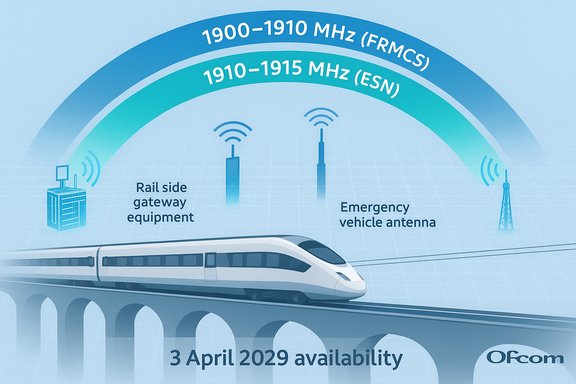
Ofcom has launched a formal consultation to repurpose an unused slice of the 1900 MHz band—specifically the 1900–1920 MHz block—and is proposing to allocate 1900–1910 MHz to the rail industry for Future Rail Mobile Communication System (FRMCS) rollout and 1910–1915 MHz to support Emergency Services Network (ESN) gateway coverage, with licences expected to become available from 3 April 2029 if the plan proceeds.
The 1900–1920 MHz range was originally assigned to mobile services two decades ago but has largely remained unused in practice. Ofcom’s March 10, 2025 consultation sets out a targeted re-use of that otherwise idle spectrum to meet two pressing public-infrastructure needs: modernising rail communications via FRMCS and improving emergency services connectivity in hard-to-reach locations through ESN gateways. The consultation period closed on 19 May 2025 and the regulator’s page summarises proposals, draft licence templates and the supporting consultation documents. This is not a generic spectrum auction for commercial mobile operators. Instead Ofcom proposes purpose-built, restricted licences:
Source: ISPreview UK Ofcom Make Part of 1900MHz Band Available for 5G Mobile on UK's Rail Network
 Background / Overview
The 1900–1920 MHz range was originally assigned to mobile services two decades ago but has largely remained unused in practice. Ofcom’s March 10, 2025 consultation sets out a targeted re-use of that otherwise idle spectrum to meet two pressing public-infrastructure needs: modernising rail communications via FRMCS and improving emergency services connectivity in hard-to-reach locations through ESN gateways. The consultation period closed on 19 May 2025 and the regulator’s page summarises proposals, draft licence templates and the supporting consultation documents. This is not a generic spectrum auction for commercial mobile operators. Instead Ofcom proposes purpose-built, restricted licences:- 1900–1910 MHz: restricted operational rail communications (FRMCS).
- 1910–1915 MHz: restricted ESN gateways for emergency services’ extended coverage (intended for gateway equipment on vehicles), with a limited-duration licence aligned with the ESN supplier contract.
Why the 1900 MHz band matters for rail and emergency services
FRMCS: the future of rail radio
FRMCS (Future Rail Mobile Communication System) is the 5G-based successor to GSM‑R and is being standardised through ETSI and 3GPP-led workstreams. FRMCS is designed to carry both safety-critical signalling and a broader set of operational services (voice, telemetry, video, passenger information) and is expected to be a cornerstone of rail digitalisation. ETSI and rail-industry programmes have explicitly identified 1900–1910 MHz as a harmonised unpaired TDD block that many European administrations consider for FRMCS migration, because it offers a path to additional capacity during the switch from legacy GSM‑R. Key technical reasons FRMCS proponents favour 1900 MHz include:- Harmonisation in Europe reduces cross-border interference risk and increases the chance of an ecosystem of compatible equipment.
- The band provides a TDD block suitable for high-reliability, relatively low-latency FRMCS use cases.
- Additional spectrum is needed during migration because operators will likely need both GSM‑R and FRMCS in parallel for a transition period.
ESN gateways: extending emergency coverage
Ofcom proposes to authorise a narrower 1910–1915 MHz slice to enable ESN gateway use cases—mobile repeater/gateway units mounted on emergency vehicles to allow emergency responders to bridge coverage gaps (e.g., underground car parks, rural depressions). The approach limits use to the contracted ESN gateway provider and ties licence duration to contract terms, recognising the service-specific and time-limited nature of the expected deployments.The proposal in detail: licences, fees, timeline
Licence design and restrictions
Ofcom’s consultation includes draft licence templates and lays out intended technical/operational restrictions:- FRMCS licences (1900–1910 MHz) would be restricted to operational rail communications and include technical coordination and route-length-based scaling for fees.
- ESN gateway licences (1910–1915 MHz) would be restricted to the government-contracted ESN gateway supplier and have a fixed duration aligned with the ESN procurement timeframe.
Fees and cost signals
Ofcom proposes fees based on the opportunity cost of the spectrum. The headline figures in the consultation are:- FRMCS (1900–1910 MHz) — proposed annual fee for a Great Britain licence: £1,458,000 (which is £145,800 per MHz × 10 MHz). For Northern Ireland cover the per‑MHz level is substantially lower by design, producing a smaller fee for route-specific licences.
- ESN gateways (1910–1915 MHz) — proposed annual fee for a Great Britain licence: £364,500 (half the per‑MHz rate to reflect lower power permissions).
Timeline and consultation process
- Consultation launched: 10 March 2025.
- Consultation closed: responses accepted up to 19 May 2025.
- Ofcom’s page shows the consultation status as “Pending Statement” (last updated 9 June 2025) and lists stakeholder responses published after the close (including Network Rail, Home Office, operators and equipment vendors). That indicates active industry engagement ahead of a final decision.
What this means for stakeholders
For the rail industry
Positive implications:- Access to a harmonised 10 MHz block gives FRMCS deployments a predictable spectral home and may simplify procurement of rail-grade FRMCS radio equipment.
- Dedicated FRMCS spectrum can reduce reliance on commercial MNO networks for safety‑critical services and help ensure the necessary quality-of-service for signalling and control systems.
- FRMCS migration is not a drop-in replacement: onboard equipment will likely need to support both GSM‑R and FRMCS during transition, which raises interoperability, testing and procurement costs. ETSI and the rail community have highlighted the need for interworking specifications and dual-mode hardware during migration.
- The proposed 10 MHz TDD block is valuable but limited in bandwidth; in dense corridors or for high-capacity non-safety passenger services, operators may still need additional spectrum or complementary solutions.
For emergency services
Positive implications:- ESN gateways in 1910–1915 MHz could materially improve connectivity for frontline responders in coverage blackspots, improving situational awareness and safety.
- A limited, contract-aligned licence reduces competition friction and simplifies technical alignment with the ESN architecture.
- The ESN gateway licence proposal restricts use to a single contracted supplier, which concentrates operational risk and could complicate vendor changes mid-contract.
- The 5 MHz allocation and relatively low permitted power mean gateways will be a tactical fix for coverage holes rather than a wholesale replacement for robust fixed coverage.
For mobile network operators and passengers
- MNOs in the UK historically licensed parts of this band but have not used the specific unpaired 20 MHz slice targeted by Ofcom’s consultation. The regulator’s approach avoids a wide-spectrum auction and instead prioritises public-infrastructure use, which reduces the amount of general-purpose spectrum available to MNOs. That’s a policy choice: maximise public-safety and transport benefits, rather than seek highest commercial return from auction.
- Passengers could benefit indirectly: FRMCS can support better signalling reliability (reducing delays) and may enable new onboard operational services that improve punctuality and safety. But passenger mobile broadband services on trains will likely remain a separate commercial and technical challenge for MNOs and transport operators.
For equipment vendors and the chipset ecosystem
One important real-world constraint is ecosystem availability. Multiple industry pieces note that rail-dedicated bands are niche and that large chipset suppliers have limited incentive to prioritise railway-specific FRMCS frequencies unless volume demand becomes clear. That can slow the readiness of interoperable, low-cost FRMCS modems and base station equipment. ETSI and EU projects have been working on FRMCS specifications and prototypes, but equipment availability and full commercial maturity will be a multi-year effort.Technical and regulatory risks
Interference and guard-band concerns
Ofcom explicitly declines to authorise 1915–1920 MHz due to the need to protect the mobile band above 1920 MHz from interference. Narrow guard-band constraints and the low-power restrictions near the band edge are both technical realities that limit how the top of the block can be used, and they shape the regulator’s decision to leave 1915–1920 MHz unused. That conservative choice reduces interference risk but wastes a slice of otherwise idle spectrum.Migration complexity and dual-network demand
FRMCS migration will require dual‑stack operation for a period: retaining GSM‑R legacy infrastructure while rolling out FRMCS. The ECC and rail-industry reports note that 1900 MHz is a prerequisite for many countries to manage migration without unacceptable operational risk, but it does not eliminate the transitional complexity. Operators must fund and manage parallel networks—this increases capex and operational complexity during the migration window.Licence design risks: single-supplier constraints for ESN
Locking 1910–1915 MHz use to the government‑contracted gateway supplier helps coordinate technical design with the ESN procurement timetable, but it raises procurement and resilience questions:- What happens if the contract changes or is re‑tendered?
- Does the narrow licence design allow easy vendor replacement?
- How will Ofcom ensure gateway functionality and interference coordination if multiple suppliers are later involved? These are material governance issues that stakeholders raised during the consultation.
Equipment and interoperability uncertainty
Even with harmonised spectrum, rail-industry transition to FRMCS depends on:- timely completion of ETSI FRMCS specifications,
- vendor implementation timelines,
- availability of certified FRMCS radios and onboard equipment,
- cross-border harmonisation among neighbouring administrations.
Strengths of Ofcom’s approach
- Targeted public benefit: Prioritises mission-critical infrastructure (rail and emergency services) instead of a purely commercial auction, aligning spectrum use with national resilience and safety priorities.
- Harmonised European alignment: Assigning 1900–1910 MHz for FRMCS aligns with European harmonisation efforts, improving prospects for interoperable equipment and cross-border rail operations.
- Predictable allocation timeline: The April 2029 availability date and published draft licence templates give rail operators and suppliers a predictable planning horizon.
- Proportionate fee design: Fees are transparent and route-length scaling for rail licences implies that smaller heritage or short lines wouldn’t face the same burden as national operators, which helps fairness in allocation.
Potential weaknesses and policy risks
- Limited bandwidth for long-term demand: A single 10 MHz FRMCS block is useful but may be insufficient in the long term for high-density or video-heavy operational use cases, requiring further spectrum or complementary capabilities (e.g., private 5G in higher bands).
- Ecosystem and chipset risk: Railway-specific bands have historically faced slow handset/modem supply because of limited commercial scale; rail vendors and authorities must plan for higher per-unit hardware costs and longer lead times.
- Concentrated ESN gateway procurement risk: Restricting 1910–1915 MHz to a single supplier reduces competition and may create vendor-lock or operational fragility unless licence design supports seamless reassignment on contract changes.
- Unusable top slice (1915–1920 MHz): Leaving 1915–1920 MHz unused is technically prudent to protect neighbouring bands, but it reduces spectral efficiency; this trade-off reflects conservative interference management rather than an optimal utilisation outcome.
Practical advice for railway and public-safety planners
- Plan for multi-year equipment procurement and interoperability testing; expect certified FRMCS modems and base stations to follow standards and pilot programs, not to appear overnight.
- Budget for parallel-network operation during transition to FRMCS; dual-mode onboard units and interworking gateways will be necessary.
- Engage proactively with Ofcom’s coordination mechanisms and neighbouring administrations to minimise cross-border interference and protect operational continuity.
- For ESN implementers, negotiate licence flexibility clauses and clear reallocation procedures in procurement documents to reduce single‑supplier operational risk.
Wider implications and what to watch next
- Watch Ofcom’s final statement following the consultation: it will determine precise licence conditions, final fees, and detailed technical constraints that materially affect rollout economics and design.
- Monitor ETSI, UIC and 3GPP FRMCS outputs: any shift in specification timelines or radio characteristics could change equipment availability and cost.
- Observe procurement language from Network Rail, TfL, and national rail authorities: their responses to Ofcom’s consultation and procurement timelines will indicate how quickly FRMCS pilots will be turned into network rollouts. Ofcom’s consultation page already lists several stakeholder responses, signalling engaged parties.
- Keep an eye on cross-border coordination in EU neighbour states to ensure harmonised usage and avoid fragmentation of the FRMCS ecosystem.
Conclusion
Ofcom’s proposal to reclaim part of the idle 1900 MHz band for FRMCS and ESN gateways is a pragmatic, policy-driven use of scarce spectrum aimed at boosting national infrastructure resilience. The regulator balances technical caution (protecting adjacent bands) with targeted allocation and a clear availability date (3 April 2029), while setting fees that reflect the public-purpose nature of the assignments. The plan addresses real needs—rail modernisation and emergency responders’ coverage—while confronting real constraints: limited bandwidth, an immature FRMCS equipment ecosystem, migration complexity, and governance questions around ESN gateway procurement. How those trade-offs are resolved in Ofcom’s final statement and in subsequent industry procurement will determine whether this reuse delivers fast, affordable, and interoperable benefits for rail passengers and frontline services, or whether it becomes a cautious but necessary first step toward a longer and costlier migration. Stakeholders should treat the consultation as the start of a multi-year programme that requires co‑ordinated regulatory, technical and procurement work if the promise of FRMCS and improved ESN coverage is to be realised.Source: ISPreview UK Ofcom Make Part of 1900MHz Band Available for 5G Mobile on UK's Rail Network
