

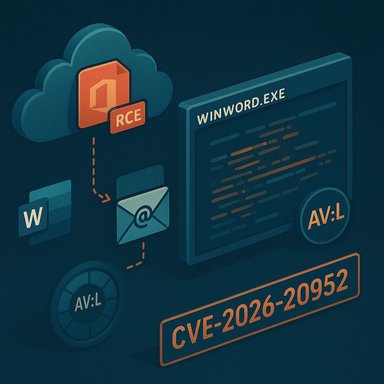
Microsoft’s use of the phrase “Remote Code Execution” in the CVE title for CVE-2026-20952 signals what an adversary can achieve — not the precise technical moment the vulnerable code executes — and that distinction is why the CVSS Attack Vector is correctly listed as AV:L (Local) even though the CVE headline reads RCE.
Microsoft’s advisory language for Office vulnerabilities often describes the impact in plain English: an external actor can cause attacker-controlled code to run on a target endpoint. That description is short and urgent by design, because Remote Code Execution (RCE) is high-impact and grabs attention. CVSS, by contrast, is a standardized scoring system that documents the exploitation mechanics — one of which is the Attack Vector (AV) metric that records where the vulnerable code must execute at the moment of exploitation. When that moment occurs inside a local process (for example, Microsoft Word or Excel parsing a file on disk), CVSS uses AV:L even if the malicious file was received from across the network.
This apparent mismatch — RCE in the CVE title, AV:L in CVSS — crops up frequently for document‑parsing vulnerabilities in Office and similar desktop applications. The headline communicates attacker origin and worst-case impact; the CVSS AV captures the trigger mechanics. Reading both together gives a full, actionable picture for triage.
Source: MSRC Security Update Guide - Microsoft Security Response Center
 Background
Microsoft’s advisory language for Office vulnerabilities often describes the impact in plain English: an external actor can cause attacker-controlled code to run on a target endpoint. That description is short and urgent by design, because Remote Code Execution (RCE) is high-impact and grabs attention. CVSS, by contrast, is a standardized scoring system that documents the exploitation mechanics — one of which is the Attack Vector (AV) metric that records where the vulnerable code must execute at the moment of exploitation. When that moment occurs inside a local process (for example, Microsoft Word or Excel parsing a file on disk), CVSS uses AV:L even if the malicious file was received from across the network.This apparent mismatch — RCE in the CVE title, AV:L in CVSS — crops up frequently for document‑parsing vulnerabilities in Office and similar desktop applications. The headline communicates attacker origin and worst-case impact; the CVSS AV captures the trigger mechanics. Reading both together gives a full, actionable picture for triage.
Why the title says “Remote Code Execution” while CVSS lists AV:L
Two different questions, two different answers
- CVE/advisory title: What can an attacker achieve and from where can the attack be initiated? If a remote actor can deliver a crafted input (via email, cloud share, or download) that ultimately causes code to execute on a victim host, vendors will label the issue Remote Code Execution to communicate the operational risk quickly.
- CVSS Attack Vector (AV): Where must the vulnerable code run at the moment of exploitation? If the vulnerability is in a local parser (an Office process parsing a file on the endpoint), CVSS records AV:L because the exploit trigger is local, even though the delivery channel may have been remote. This prevents double‑counting network delivery in the exploitability calculation.
The canonical “remote delivery, local execution” chain
- Attacker crafts a malicious Office document that targets a native parser bug (memory corruption, type confusion, use‑after‑free, etc..
- Attacker delivers the file remotely: spear‑phishing email attachment, cloud share link, public download, or file transfer.
- Victim opens or previews the file in a local Office application. The local process parses the crafted content and hits the vulnerable code path.
- Arbitrary code executes inside the local Office process under the logged‑on user context.
Technical clarification: what AV:L, UI:R, PR:N mean in this context
The CVSS vector commonly seen for Office document RCEs includes several key metrics that tell defenders how exploitation works in practice:- AV:L (Attack Vector: Local) — the vulnerable code executes within a local process on the target host (for example WINWORD.EXE, EXCEL.EXE). The scoring rule for CVSS is explicit: when an exploitable component is invoked by a local parser, AV:L is the correct designation, even if the data originally arrived over a network channel.
- UI:R (User Interaction: Required) — exploitation requires a user action, usually opening or previewing the crafted document. This is the common case for Office file parsing bugs and is why social engineering remains a primary delivery mechanism.
- PR:N (Privileges Required: None) — the attacker does not need prior privileges on the victim machine; the exploit runs with the privileges of the user who opened the file. That makes targeted phishing effective because standard users typically have sufficient privileges to be useful to attackers.
The important exception: when AV becomes Network (AV:N)
There is a critical caveat to the AV:L pattern: if a network‑exposed server or gateway parses uploaded Office files on behalf of remote clients (mail gateways that render attachments, CMS preview engines, Office Online Server, cloud preview/detectors), then the vulnerable parser may execute in a network‑bound process. In that scenario, the correct CVSS Attack Vector is AV:N (Network) because an unauthenticated remote actor can trigger the vulnerable code without a local user opening a file. Advisories will explicitly call this out when applicable because it materially increases exposure and changes prioritization. Inventorying where parsing happens in an environment — not just on endpoints but on mail servers, collaboration platforms, and file-conversion services — is therefore essential.Why vendors choose the RCE label (operational trade-offs)
Vendors use “Remote Code Execution” in CVE titles and advisory headlines for several practical reasons:- Brevity and triage: RCE is a high‑signal phrase that quickly communicates critical impact to busy IT teams and managers. It pushes rapid prioritization.
- Attacker-origin emphasis: “Remote” signals that the attacker can be off-host (across the Internet or via cloud services), which is important for operational threat modeling.
- Avoids technical overload: Advisory headlines must be readable to diverse audiences; the body of the advisory and the CVSS vector provide the technical details for security teams. That’s why the advisory body frequently clarifies the local execution requirement or whether preview handlers or server-side parsers are affected.
Practical risk analysis: why AV:L Office bugs are still high‑priority
Labeling a vulnerability AV:L can mislead non‑technical audiences into thinking the issue is low-risk. In reality, document‑parsing vulnerabilities in Office are among the most actively exploited vectors because of several converging factors:- Ubiquity of Office clients: Millions of endpoints run Office applications, making potential victim sets large.
- Low delivery friction: Attackers can distribute weaponized documents at scale via email campaigns, cloud shares, or downloads. Social engineering makes user interaction surprisingly easy.
- Data‑only exploitation: Many modern Office flaws are data‑only — they don’t rely on macros or scripts. They exploit native parsers, so macro-blocking measures alone won’t stop them.
- Preview handlers and server‑side renderers: Preview panes (Outlook preview), mail gateways generating thumbnails, and web services that render documents can reduce or eliminate explicit user actions, increasing risk. If those services are network‑exposed, AV:N may apply.
- Rapid weaponization potential: Memory corruption primitives (use‑after‑free, heap overflows) can often be chained into reliable exploits by skilled authors, and public details can accelerate weaponization. Historical patterns show Office RCEs are among the fastest to be weaponized after disclosure.
Defenders’ playbook: prioritized actions for CVE‑class Office RCEs
Immediate steps (triage and mitigation):- Patch first: identify affected Office builds and deploy Microsoft’s security updates to endpoints and server components as quickly as possible. Patching is the authoritative remediation.
- Harden mail and file ingestion: enable attachment detonation/sandboxing at the mail gateway; quarantine or block suspicious attachments; enforce file‑type policies for external mail.
- Enable Protected View and Application Guard for Office: ensure files from untrusted sources open in restricted sandboxes, reducing the attack surface of parsers.
- Apply Attack Surface Reduction (ASR) rules and EDR policies that block Office processes from spawning unusual child processes (powershell.exe, cmd.exe, mshta.exe, wscript.exe).
- Use AppLocker or Windows Defender Application Control (WDAC) to restrict which binaries can run in the environment.
- Enforce least privilege: make sure users run as standard, non‑admin accounts to reduce the post‑exploit blast radius.
- Monitor for Office processes that spawn suspicious child processes or make anomalous outbound network connections immediately after opening a document. Hunt for sequences where WINWORD.EXE or EXCEL.EXE create cmd.exe/powershell.exe.
- Alert on unexpected network connections from Office binaries and on Office processes that attempt credential‑dumping or process injection patterns.
- Identify any mail gateways, CMS servers, file conversion services, or Office Online Server instances that parse user‑submitted Office files. Prioritize patching these systems because they can convert an AV:L scenario into AV:N if they perform parsing in network‑exposed processes.
How to read CVE titles and CVSS scores together (operational guidance)
- Treat the CVE title as a triage flag: RCE headlines mean the ultimate impact is high and external actors can deliver payloads. They should force immediate prioritization.
- Use CVSS fields to understand exploit mechanics and to fine‑tune mitigations: AV, UI, PR, S, and C/I/A tell you whether to focus on user education, network defenses, or server hardening.
- Don’t let AV:L lull you into complacency. Many Office RCEs require only a trivial user action and can be triggered at scale; they remain high‑value targets for attackers. Prioritize patching and layered defenses accordingly.
Handling unverifiable technical claims and public PoCs
Advisories and public write‑ups vary in technical depth. When exploit details are not provided by the vendor or validated by multiple independent researchers, treat granular exploitation claims cautiously. Flag any single-source exploitation claims as unverified until corroborated by the vendor or by at least one independent, reputable research group. The absence of a public proof‑of‑concept does not indicate low risk — it often merely reflects vendor disclosure or researcher embargo timelines.Conclusion
The headline “Remote Code Execution” in the CVE title for CVE-2026-20952 communicates practical impact: an external attacker can deliver a crafted document that leads to arbitrary code running on a victim machine. The CVSS Attack Vector AV:L is not a contradiction; it records the moment of exploitation — when the vulnerable code path executes inside a local process after a file is opened or previewed. Both statements are correct and complementary: the CVE headline signals urgency and attacker reach, while CVSS provides the mechanistic detail teams need to triage and mitigate effectively. Read both together, prioritize patching and controls (Protected View, mail sandboxing, ASR, app control), and inventory server‑side parsers — because when a parser runs in a network‑exposed service, AV:L can legitimately become AV:N, and exposure rises sharply.Source: MSRC Security Update Guide - Microsoft Security Response Center
