
Ofwat has published its first artificial intelligence adoption plan for the water sector in England and Wales, setting out in June 2026 how the regulator will guide companies on responsible AI use before new water regulators take over in England and Wales. The move is not a glossy futurist manifesto so much as a handover note written under institutional pressure. AI is already in the pipes, the call centres, the billing systems and the pollution-risk models; Ofwat is trying to make sure the governance arrives before the next scandal does. That makes the plan less about whether water companies should use AI, and more about whether a distrusted sector can be trusted with another powerful layer of automation.
There is an irony at the centre of Ofwat’s new AI plan: the regulator is designing rules for a sector while its own future is being redesigned around it. Following the Independent Water Commission’s 2025 reform agenda, Ofwat is expected to give way to a new integrated regulator in England and a separate regulatory arrangement for Wales. In ordinary circumstances, that might make a first AI adoption plan feel provisional. In this case, provisional may be the point.
The water sector does not have the luxury of waiting for a perfect institutional map before deciding how to use AI. Leakage detection, sewer monitoring, customer contact, network optimisation and regulatory reporting are already being touched by machine learning and generative AI. Ofwat’s plan therefore reads like a stabilising document: a way to set expectations while the architecture of regulation is still being rebuilt.
That matters because the English and Welsh water industry is not entering the AI era from a position of public confidence. It is entering it after years of anger over sewage discharges, underinvestment, dividends, debt, executive pay and rising bills. Any technology that promises prediction, automation and efficiency will be judged against that backdrop, not against a vendor slide deck.
The regulator’s central claim is modest but important. AI can help the sector perform better, but only if companies understand their data, explain their systems, manage risk and remain accountable for decisions. In a sector where “computer says no” would be politically toxic and environmentally dangerous, that accountability clause is not decorative.
This is exactly where AI tends to become consequential: not in a dramatic replacement of human expertise, but in the quiet reordering of everyday workflows. A model that flags a likely leak faster than a conventional rule-based system can change where crews are sent. A model that predicts a sewer blockage can change maintenance schedules. A generative AI assistant that drafts customer responses can change the tone and accuracy of customer service at scale.
The operational logic is strong. Water networks are sprawling, old, sensor-rich in some places and data-poor in others. They produce streams of telemetry, rainfall data, asset records, complaints, maintenance logs and environmental readings. AI is naturally attractive in that environment because the sector’s hardest problems are pattern problems: where pressure is changing, where assets are failing, where rainfall will overwhelm infrastructure, where a pollution incident is becoming likely.
But the fact that AI is already embedded also raises the stakes. A regulator can shape a pilot more easily than it can reshape an installed operating model. Once companies have built internal teams, signed platform contracts, trained staff on Microsoft Copilot-style tools and created dashboards around model outputs, governance becomes retrofit work. Ofwat is arriving early by the standards of public-sector AI regulation, but not early by the standards of the water companies already deploying the technology.
That is why the plan’s emphasis on discovery is sensible. Before Ofwat can prescribe detailed rules, it needs to understand where AI is being used, what data feeds it, whether humans review outputs, and how companies distinguish machine learning analytics from newer generative systems. In a sector with both mature engineering models and fast-moving workplace AI tools, a single label — “AI” — can hide radically different risks.
The shift from reactive response to preventative action is also one of the few ways the sector can plausibly do more with constrained operational capacity. Crews, treatment capacity and capital programmes are finite. If AI helps companies decide where intervention is most urgent, it can turn scattered data into operational triage.
This is where the technology’s appeal is real rather than fashionable. Water systems are physical networks governed by weather, geography, ageing assets and human use. They are not abstract software environments where failures can be rolled back with a patch. A better forecast can prevent a costly incident; a bad forecast can create misplaced confidence.
That duality should keep expectations disciplined. A model that predicts storm overflow risk is not the same thing as infrastructure that prevents storm overflows. AI may help operators see failure earlier, but it does not replace pipes, tanks, treatment works or catchment planning. If the technology becomes a substitute for investment rather than a multiplier of it, the sector will have learned the wrong lesson.
The stronger argument for AI in water is not that it makes infrastructure problems disappear. It is that it can make infrastructure choices more precise. In a sector facing large investment commitments through the 2025–30 price review period, that precision could matter: which assets are deteriorating fastest, which interventions deliver the greatest environmental benefit, which customer groups are most exposed to service failures, and which data gaps are obscuring risk.
Water company data is difficult because the physical system is difficult. Asset registers may be incomplete. Legacy systems may not speak to one another. Telemetry may be unevenly deployed. Historic incident records may reflect reporting habits as much as underlying reality. Customer data may be fragmented across billing platforms, complaint systems and field-service tools.
AI readiness, then, is not only a technical condition. It is a governance condition. A company needs to know what data it holds, where it came from, who is responsible for it, how accurate it is, how often it is updated, and whether it can be used lawfully and ethically for a particular purpose. Without that discipline, “AI transformation” becomes a faster way to make old mistakes.
Ofwat’s planned guidance on data readiness standards could therefore become more important than any statement of AI principles. Principles are easy to endorse. Data standards are where aspiration meets cost. They require companies to invest in plumbing of a different kind: metadata, lineage, controls, quality checks, access management and auditability.
This is also where sysadmins and IT leaders should pay attention. The water sector’s AI problem is recognisably an enterprise IT problem. The visible layer may be Copilot, dashboards and predictive models, but the hard work is identity, permissions, retention, data classification, integration and monitoring. If those foundations are weak, AI does not become a clever assistant; it becomes a privileged intern with access to everything and context for very little.
For WindowsForum readers, the Copilot angle is more than a footnote. Microsoft’s AI stack is becoming the default entry point for many public bodies and regulated companies because it sits inside the productivity environment they already use. The first serious AI governance questions often do not arrive with a bespoke machine learning model; they arrive when staff can ask an assistant to summarise documents, search internal material or draft responses based on organisational data.
That changes the risk model. A leakage prediction tool may be narrow, technical and heavily supervised. A generative AI assistant inside an office suite is broad, conversational and available to thousands of employees. It can improve productivity, but it can also expose overshared documents, create plausible but wrong summaries, blur the line between internal and external knowledge, and make weak information governance impossible to ignore.
Ofwat’s plan acknowledges that its internal AI journey is early and that more sensitive use cases need stronger governance. That is the right posture. Regulators should experiment, but they should not pretend experimentation is harmless simply because the software is wrapped in familiar enterprise branding.
The regulator’s Ocean data platform is more strategically interesting than the Copilot rollout. A platform designed to support AI-ready data structures suggests Ofwat understands that its future role will depend on the ability to process more complex, less standardised company information. If regulators are to supervise AI-enabled companies, they may need AI-enabled supervision — not automated judgement, but better tools for detecting patterns, inconsistencies and emerging risks.
That line is crucial. Ofwat says AI will support regulatory work but will not replace regulatory judgement. In practice, that promise will be tested not by press releases but by workflows. If AI-generated analysis becomes the first draft of regulatory understanding, humans must have the time, skill and authority to challenge it. Otherwise, “human in the loop” becomes another phrase meaning “human near the loop.”
The complication is that Ofwat itself notes many companies may not yet be ready to use them. That is a telling admission. A sandbox is useful only if participants can define a use case, provide suitable data, understand the risks, and measure outcomes. If companies are still struggling with data quality, internal governance and basic taxonomies, a sandbox risks becoming a showcase for the best-prepared firms rather than a sector-wide accelerator.
There is also a political risk. The word “sandbox” can sound indulgent in a sector accused of failing at basics. Customers facing higher bills and environmental campaigners tracking pollution incidents may not be impressed by controlled AI experiments if core performance remains poor. Ofwat and the future regulators will need to make clear that experimentation is not a substitute for compliance.
Still, the sandbox concept should not be dismissed. Water companies need places to test AI systems before deploying them into operational settings. Regulators need to learn how these systems behave before writing rules that are either too vague to matter or too rigid to survive contact with the technology. A well-designed sandbox can create evidence, not just enthusiasm.
The better version would be tied to concrete public-interest outcomes: reducing leakage, preventing pollution, improving vulnerable-customer support, strengthening asset planning, or improving the quality of regulatory submissions. The weaker version would be a branded innovation zone where companies demonstrate tools that never scale. Ofwat’s challenge is to insist on the former.
These projects are important because they show AI being aimed at sector-specific problems rather than generic back-office productivity. Near-real-time network optimisation is not just a nicer dashboard; it hints at a different operating model for water systems. Satellite-assisted river monitoring similarly expands the idea of what counts as regulatory and environmental visibility.
But innovation funds are also where hard questions about scale tend to hide. A funded demonstrator can prove feasibility. It does not automatically prove that every company can integrate the approach into legacy systems, maintain it, govern it, finance it, and explain it to regulators and the public. The path from “promising project” to “standard operating practice” is where many public-interest technologies go to stall.
That is why Ofwat’s emphasis on taxonomy and reporting frameworks matters. The sector needs a common language for AI use cases, maturity, risk and performance. Without that, each company can describe its work in flattering but incomparable terms. One firm’s predictive maintenance model may be another firm’s spreadsheet with a statistical wrapper.
The future regulators should go further. If AI systems are used to support decisions that affect environmental performance, customer treatment or investment planning, companies should expect to explain their models in terms regulators can test. That does not necessarily mean publishing source code or exposing commercially sensitive information. It does mean documenting purpose, data sources, validation, limitations, human oversight and failure modes.
AI governance becomes meaningful when it creates friction at the right points. It should not stop an engineer from using better tools to identify a failing asset. It should stop a company from quietly delegating consequential decisions to a model it cannot adequately explain.
AI could help manage that complexity. Regulators will need to monitor delivery, compare company performance, analyse financial resilience, scrutinise environmental outcomes and understand whether promised investments are materialising. Companies will need to sequence work, manage asset risk, forecast demand, report progress and respond to customers. The case for better analytics is obvious.
But transitions are also moments when accountability can blur. If an AI-supported decision is made under Ofwat’s guidance, implemented by a company, reported into one framework and later supervised by a successor regulator, who owns the consequences? The answer should be simple — the company remains responsible for its operations, and the regulator remains responsible for its regulatory decisions — but institutional change can make simple answers harder to enforce.
That is why Ofwat’s plan should be judged partly as a continuity document. It is laying down concepts, expectations and initial governance language that successor bodies can inherit. A weak plan would try to solve everything before the new regulators exist. A useful plan creates enough structure that the next bodies do not start from scratch.
The cross-regulator dimension is especially important. Ofwat says it will work with the Environment Agency, the Drinking Water Inspectorate, Natural Resources Wales and Natural England to avoid duplication and reduce burdens. That sounds bureaucratic, but in water it is fundamental. Economic regulation, drinking-water quality, environmental protection and natural-resource management overlap in the real world even when they sit in separate institutions.
AI will intensify that overlap. A model predicting storm overflow risk may matter to environmental regulators, economic regulators, local communities and customer-service teams. A system prioritising capital maintenance may affect bills, resilience and ecological outcomes. If each regulator asks for different evidence in different formats, companies will waste effort and the public will get less clarity.
The minimum standard should be explainability appropriate to the decision. A customer does not need to understand the architecture of a neural network to challenge a billing outcome. A regulator does need to know whether a model used in regulatory reporting is consistent, validated and free from obvious incentives to understate problems. An environmental body needs confidence that pollution-risk models are not tuned to optimise appearances rather than outcomes.
There is a danger that AI becomes a new language for old asymmetries. Companies already know more than regulators and customers about the condition of their networks. If AI systems deepen that information advantage without stronger reporting duties, the sector could become harder to scrutinise precisely as it becomes more data-driven.
The better outcome is the opposite: AI makes the sector more legible. Better monitoring could reveal issues earlier. Better data standards could make company submissions more comparable. Better internal tools could help regulators detect anomalies and challenge weak explanations. Better customer systems could make support faster and more consistent.
That outcome requires governance designed for adversarial reality, not just cooperative aspiration. Regulators must assume that companies under financial and performance pressure will use technology in ways that serve their incentives. Most uses may be responsible; some will be self-serving; a few may be reckless. A credible framework plans for all three.
Generative AI makes those basics more urgent. A company that has tolerated messy SharePoint permissions, duplicated documents and unclear data ownership may find that Copilot-style tooling turns information sprawl into an operational risk. The same assistant that helps staff find a maintenance policy may also surface stale guidance, sensitive files or conflicting records.
Operational AI adds a different set of demands. Models used for leakage, sewer blockage prediction or asset maintenance need monitoring over time because networks, weather patterns and operating conditions change. A model that worked well last year can drift. A sensor fault can poison inputs. A process change can invalidate assumptions.
The governance burden therefore cannot sit solely with data scientists. It has to involve operational engineers, cyber teams, legal teams, customer specialists, procurement officers and senior management. AI risk in water is multidisciplinary because water itself is multidisciplinary: physical infrastructure, public health, environmental protection, finance and customer service all meet in the same system.
That is why Ofwat’s proposed sector taxonomy could be more useful than it sounds. If companies classify AI systems consistently by purpose, risk, data type and decision impact, boards and regulators can have better conversations. If they do not, “we use AI” will remain an empty phrase that obscures more than it reveals.
That does not mean regulators should slow-walk AI adoption. It means they should tie it to outcomes that customers and communities can recognise. If AI helps water companies detect leaks earlier, pollution incidents should fall. If it improves billing systems, complaints should fall. If it improves asset management, emergency failures should fall. If none of that happens, the sector will have bought itself another transformation narrative rather than transformation.
Ofwat’s plan gestures in the right direction by focusing on monitoring and reporting frameworks. The key will be to make those frameworks concrete. Companies should not merely report that they have deployed AI; they should report where it is used, what decisions it supports, how performance is measured, what controls exist, and what changed as a result.
There is also a workforce dimension that deserves more attention than most AI plans give it. Field engineers, call-centre staff, analysts and compliance teams will be the people living with these systems. If AI tools are imposed from above without their expertise, they will miss context and invite workarounds. If the tools are designed with frontline knowledge, they may capture the tacit understanding that formal datasets often lack.
The promise of AI in water is therefore not automation in the abstract. It is better coordination between data and judgement. The sector needs both, and it has been punished publicly when either has been absent.
The plan’s weakness is also inherent in its moment. Ofwat can propose, consult and convene, but it is operating in the shadow of abolition. Companies may be tempted to wait for the next regulator before investing heavily in compliance with guidance that might evolve. Conversely, they may rush ahead, betting that technological momentum will shape the rules that follow.
That makes the autumn 2026 consultation important. It should not become a polite exchange between regulators and company AI leads. Consumer groups, environmental organisations, technical experts, local authorities and frontline workers all have legitimate interests in how AI is used in water. A framework designed only by institutions already comfortable with data systems will miss the people most affected by failure.
The eventual joint cross-regulator plan expected around 2027–28 will need to be sharper. By then, AI use will be broader, tools will be more capable, and the new regulatory bodies should be clearer. The question will no longer be whether water companies are experimenting with AI. It will be whether regulators can supervise AI-mediated operations with enough technical competence and public credibility.
Ofwat’s final contribution may be to ensure that AI governance is not treated as an optional workstream for the new regime. In a sector where public patience is thin, that would be a meaningful legacy.
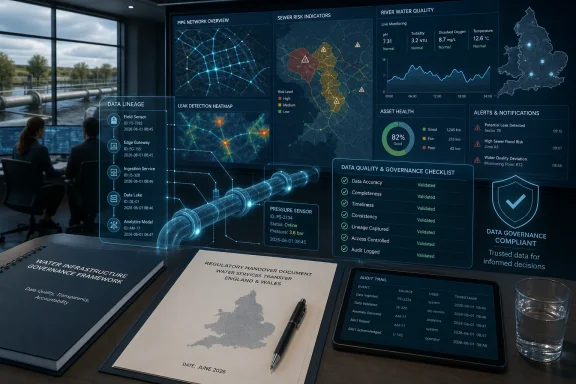 Ofwat Puts AI Governance on the Table Before the Regulator Itself Leaves It
There is an irony at the centre of Ofwat’s new AI plan: the regulator is designing rules for a sector while its own future is being redesigned around it. Following the Independent Water Commission’s 2025 reform agenda, Ofwat is expected to give way to a new integrated regulator in England and a separate regulatory arrangement for Wales. In ordinary circumstances, that might make a first AI adoption plan feel provisional. In this case, provisional may be the point.The water sector does not have the luxury of waiting for a perfect institutional map before deciding how to use AI. Leakage detection, sewer monitoring, customer contact, network optimisation and regulatory reporting are already being touched by machine learning and generative AI. Ofwat’s plan therefore reads like a stabilising document: a way to set expectations while the architecture of regulation is still being rebuilt.
That matters because the English and Welsh water industry is not entering the AI era from a position of public confidence. It is entering it after years of anger over sewage discharges, underinvestment, dividends, debt, executive pay and rising bills. Any technology that promises prediction, automation and efficiency will be judged against that backdrop, not against a vendor slide deck.
The regulator’s central claim is modest but important. AI can help the sector perform better, but only if companies understand their data, explain their systems, manage risk and remain accountable for decisions. In a sector where “computer says no” would be politically toxic and environmentally dangerous, that accountability clause is not decorative.
The Water Sector Has Already Moved Beyond the Pilot Phase
The most useful part of the plan is its refusal to pretend AI is a future event. Ofwat’s early engagement with chief data officers and AI leads found that companies are already using AI across the unglamorous machinery of water operations. That includes leakage detection, network management, predictive maintenance, billing support, customer service and regulatory reporting.This is exactly where AI tends to become consequential: not in a dramatic replacement of human expertise, but in the quiet reordering of everyday workflows. A model that flags a likely leak faster than a conventional rule-based system can change where crews are sent. A model that predicts a sewer blockage can change maintenance schedules. A generative AI assistant that drafts customer responses can change the tone and accuracy of customer service at scale.
The operational logic is strong. Water networks are sprawling, old, sensor-rich in some places and data-poor in others. They produce streams of telemetry, rainfall data, asset records, complaints, maintenance logs and environmental readings. AI is naturally attractive in that environment because the sector’s hardest problems are pattern problems: where pressure is changing, where assets are failing, where rainfall will overwhelm infrastructure, where a pollution incident is becoming likely.
But the fact that AI is already embedded also raises the stakes. A regulator can shape a pilot more easily than it can reshape an installed operating model. Once companies have built internal teams, signed platform contracts, trained staff on Microsoft Copilot-style tools and created dashboards around model outputs, governance becomes retrofit work. Ofwat is arriving early by the standards of public-sector AI regulation, but not early by the standards of the water companies already deploying the technology.
That is why the plan’s emphasis on discovery is sensible. Before Ofwat can prescribe detailed rules, it needs to understand where AI is being used, what data feeds it, whether humans review outputs, and how companies distinguish machine learning analytics from newer generative systems. In a sector with both mature engineering models and fast-moving workplace AI tools, a single label — “AI” — can hide radically different risks.
Predictive Sewers Are the Easy Part to Sell
If Ofwat wanted a politically attractive use case for AI, wastewater prediction is the obvious candidate. Machine learning models that analyse sewer levels, rainfall forecasts, blockage history and network telemetry can help operators identify risks before they become overflows, flooding events or pollution incidents. That is the sort of AI story even sceptics can understand: fewer emergencies, better targeting, cleaner rivers.The shift from reactive response to preventative action is also one of the few ways the sector can plausibly do more with constrained operational capacity. Crews, treatment capacity and capital programmes are finite. If AI helps companies decide where intervention is most urgent, it can turn scattered data into operational triage.
This is where the technology’s appeal is real rather than fashionable. Water systems are physical networks governed by weather, geography, ageing assets and human use. They are not abstract software environments where failures can be rolled back with a patch. A better forecast can prevent a costly incident; a bad forecast can create misplaced confidence.
That duality should keep expectations disciplined. A model that predicts storm overflow risk is not the same thing as infrastructure that prevents storm overflows. AI may help operators see failure earlier, but it does not replace pipes, tanks, treatment works or catchment planning. If the technology becomes a substitute for investment rather than a multiplier of it, the sector will have learned the wrong lesson.
The stronger argument for AI in water is not that it makes infrastructure problems disappear. It is that it can make infrastructure choices more precise. In a sector facing large investment commitments through the 2025–30 price review period, that precision could matter: which assets are deteriorating fastest, which interventions deliver the greatest environmental benefit, which customer groups are most exposed to service failures, and which data gaps are obscuring risk.
Bad Data Is the Leak AI Cannot Fix by Itself
The plan’s most revealing finding is also its least surprising: companies identified poor data quality as the leading obstacle to safe and effective AI adoption. That sentence should be printed above every utility AI strategy. Models do not rescue bad data from organisational neglect; they often amplify it, launder it and present it with a confidence score.Water company data is difficult because the physical system is difficult. Asset registers may be incomplete. Legacy systems may not speak to one another. Telemetry may be unevenly deployed. Historic incident records may reflect reporting habits as much as underlying reality. Customer data may be fragmented across billing platforms, complaint systems and field-service tools.
AI readiness, then, is not only a technical condition. It is a governance condition. A company needs to know what data it holds, where it came from, who is responsible for it, how accurate it is, how often it is updated, and whether it can be used lawfully and ethically for a particular purpose. Without that discipline, “AI transformation” becomes a faster way to make old mistakes.
Ofwat’s planned guidance on data readiness standards could therefore become more important than any statement of AI principles. Principles are easy to endorse. Data standards are where aspiration meets cost. They require companies to invest in plumbing of a different kind: metadata, lineage, controls, quality checks, access management and auditability.
This is also where sysadmins and IT leaders should pay attention. The water sector’s AI problem is recognisably an enterprise IT problem. The visible layer may be Copilot, dashboards and predictive models, but the hard work is identity, permissions, retention, data classification, integration and monitoring. If those foundations are weak, AI does not become a clever assistant; it becomes a privileged intern with access to everything and context for very little.
Copilot Is the Gateway Drug to Regulatory AI
Ofwat’s internal adoption path mirrors the one many organisations are taking: start with Microsoft Copilot, learn from low-risk productivity use cases, then move toward more complex analytical work. The regulator began rolling out Copilot in 2025 and is now looking at data processing, financial modelling and internal knowledge management. That is a cautious sequence, but it is not a trivial one.For WindowsForum readers, the Copilot angle is more than a footnote. Microsoft’s AI stack is becoming the default entry point for many public bodies and regulated companies because it sits inside the productivity environment they already use. The first serious AI governance questions often do not arrive with a bespoke machine learning model; they arrive when staff can ask an assistant to summarise documents, search internal material or draft responses based on organisational data.
That changes the risk model. A leakage prediction tool may be narrow, technical and heavily supervised. A generative AI assistant inside an office suite is broad, conversational and available to thousands of employees. It can improve productivity, but it can also expose overshared documents, create plausible but wrong summaries, blur the line between internal and external knowledge, and make weak information governance impossible to ignore.
Ofwat’s plan acknowledges that its internal AI journey is early and that more sensitive use cases need stronger governance. That is the right posture. Regulators should experiment, but they should not pretend experimentation is harmless simply because the software is wrapped in familiar enterprise branding.
The regulator’s Ocean data platform is more strategically interesting than the Copilot rollout. A platform designed to support AI-ready data structures suggests Ofwat understands that its future role will depend on the ability to process more complex, less standardised company information. If regulators are to supervise AI-enabled companies, they may need AI-enabled supervision — not automated judgement, but better tools for detecting patterns, inconsistencies and emerging risks.
That line is crucial. Ofwat says AI will support regulatory work but will not replace regulatory judgement. In practice, that promise will be tested not by press releases but by workflows. If AI-generated analysis becomes the first draft of regulatory understanding, humans must have the time, skill and authority to challenge it. Otherwise, “human in the loop” becomes another phrase meaning “human near the loop.”
The Sandbox Idea Is Sensible, but the Sector May Not Be Ready
Ofwat is considering AI sandboxes: controlled environments in which companies can test applications with regulatory oversight. In theory, that is exactly what a high-risk infrastructure sector needs. Sandboxes can let regulators observe emerging uses, identify common problems, and distinguish genuinely beneficial innovation from speculative technology theatre.The complication is that Ofwat itself notes many companies may not yet be ready to use them. That is a telling admission. A sandbox is useful only if participants can define a use case, provide suitable data, understand the risks, and measure outcomes. If companies are still struggling with data quality, internal governance and basic taxonomies, a sandbox risks becoming a showcase for the best-prepared firms rather than a sector-wide accelerator.
There is also a political risk. The word “sandbox” can sound indulgent in a sector accused of failing at basics. Customers facing higher bills and environmental campaigners tracking pollution incidents may not be impressed by controlled AI experiments if core performance remains poor. Ofwat and the future regulators will need to make clear that experimentation is not a substitute for compliance.
Still, the sandbox concept should not be dismissed. Water companies need places to test AI systems before deploying them into operational settings. Regulators need to learn how these systems behave before writing rules that are either too vague to matter or too rigid to survive contact with the technology. A well-designed sandbox can create evidence, not just enthusiasm.
The better version would be tied to concrete public-interest outcomes: reducing leakage, preventing pollution, improving vulnerable-customer support, strengthening asset planning, or improving the quality of regulatory submissions. The weaker version would be a branded innovation zone where companies demonstrate tools that never scale. Ofwat’s challenge is to insist on the former.
Innovation Funding Shows the Upside — and the Distance to Scale
Ofwat’s plan points to projects funded through the Water Innovation Fund as evidence of AI’s potential. Safe Smart Systems, led by Anglian Water, uses machine learning to optimise network operations in near real time. River Deep Mountain AI, led by Northumbrian Water, has demonstrated how AI and satellite data can improve river water quality monitoring.These projects are important because they show AI being aimed at sector-specific problems rather than generic back-office productivity. Near-real-time network optimisation is not just a nicer dashboard; it hints at a different operating model for water systems. Satellite-assisted river monitoring similarly expands the idea of what counts as regulatory and environmental visibility.
But innovation funds are also where hard questions about scale tend to hide. A funded demonstrator can prove feasibility. It does not automatically prove that every company can integrate the approach into legacy systems, maintain it, govern it, finance it, and explain it to regulators and the public. The path from “promising project” to “standard operating practice” is where many public-interest technologies go to stall.
That is why Ofwat’s emphasis on taxonomy and reporting frameworks matters. The sector needs a common language for AI use cases, maturity, risk and performance. Without that, each company can describe its work in flattering but incomparable terms. One firm’s predictive maintenance model may be another firm’s spreadsheet with a statistical wrapper.
The future regulators should go further. If AI systems are used to support decisions that affect environmental performance, customer treatment or investment planning, companies should expect to explain their models in terms regulators can test. That does not necessarily mean publishing source code or exposing commercially sensitive information. It does mean documenting purpose, data sources, validation, limitations, human oversight and failure modes.
AI governance becomes meaningful when it creates friction at the right points. It should not stop an engineer from using better tools to identify a failing asset. It should stop a company from quietly delegating consequential decisions to a model it cannot adequately explain.
Regulatory Transition Makes AI Both More Useful and More Dangerous
The timing of this plan is not incidental. The water sector is moving through one of the biggest regulatory resets since privatisation, with Ofwat’s functions expected to be absorbed into new arrangements. At the same time, companies are entering a major investment period under PR24, with large commitments to infrastructure, environmental improvement and service performance.AI could help manage that complexity. Regulators will need to monitor delivery, compare company performance, analyse financial resilience, scrutinise environmental outcomes and understand whether promised investments are materialising. Companies will need to sequence work, manage asset risk, forecast demand, report progress and respond to customers. The case for better analytics is obvious.
But transitions are also moments when accountability can blur. If an AI-supported decision is made under Ofwat’s guidance, implemented by a company, reported into one framework and later supervised by a successor regulator, who owns the consequences? The answer should be simple — the company remains responsible for its operations, and the regulator remains responsible for its regulatory decisions — but institutional change can make simple answers harder to enforce.
That is why Ofwat’s plan should be judged partly as a continuity document. It is laying down concepts, expectations and initial governance language that successor bodies can inherit. A weak plan would try to solve everything before the new regulators exist. A useful plan creates enough structure that the next bodies do not start from scratch.
The cross-regulator dimension is especially important. Ofwat says it will work with the Environment Agency, the Drinking Water Inspectorate, Natural Resources Wales and Natural England to avoid duplication and reduce burdens. That sounds bureaucratic, but in water it is fundamental. Economic regulation, drinking-water quality, environmental protection and natural-resource management overlap in the real world even when they sit in separate institutions.
AI will intensify that overlap. A model predicting storm overflow risk may matter to environmental regulators, economic regulators, local communities and customer-service teams. A system prioritising capital maintenance may affect bills, resilience and ecological outcomes. If each regulator asks for different evidence in different formats, companies will waste effort and the public will get less clarity.
The Public Will Not Accept Black-Box Water Management
For all the technical detail, Ofwat’s AI plan is ultimately about legitimacy. Water companies are private operators of essential public infrastructure. They provide a service households cannot opt out of, and they do so in a sector where failures are visible in rivers, beaches, streets and bills. AI systems used in that context cannot be treated as ordinary internal tools.The minimum standard should be explainability appropriate to the decision. A customer does not need to understand the architecture of a neural network to challenge a billing outcome. A regulator does need to know whether a model used in regulatory reporting is consistent, validated and free from obvious incentives to understate problems. An environmental body needs confidence that pollution-risk models are not tuned to optimise appearances rather than outcomes.
There is a danger that AI becomes a new language for old asymmetries. Companies already know more than regulators and customers about the condition of their networks. If AI systems deepen that information advantage without stronger reporting duties, the sector could become harder to scrutinise precisely as it becomes more data-driven.
The better outcome is the opposite: AI makes the sector more legible. Better monitoring could reveal issues earlier. Better data standards could make company submissions more comparable. Better internal tools could help regulators detect anomalies and challenge weak explanations. Better customer systems could make support faster and more consistent.
That outcome requires governance designed for adversarial reality, not just cooperative aspiration. Regulators must assume that companies under financial and performance pressure will use technology in ways that serve their incentives. Most uses may be responsible; some will be self-serving; a few may be reckless. A credible framework plans for all three.
For IT Teams, This Is a Data Governance Story Wearing an AI Badge
The most practical lesson for IT professionals is that Ofwat’s plan is not really about exotic AI. It is about the unglamorous controls that determine whether AI is safe enough to use in critical operations. Identity, access, audit trails, data quality, retention, procurement, model monitoring and incident response will matter more than whichever model is fashionable this quarter.Generative AI makes those basics more urgent. A company that has tolerated messy SharePoint permissions, duplicated documents and unclear data ownership may find that Copilot-style tooling turns information sprawl into an operational risk. The same assistant that helps staff find a maintenance policy may also surface stale guidance, sensitive files or conflicting records.
Operational AI adds a different set of demands. Models used for leakage, sewer blockage prediction or asset maintenance need monitoring over time because networks, weather patterns and operating conditions change. A model that worked well last year can drift. A sensor fault can poison inputs. A process change can invalidate assumptions.
The governance burden therefore cannot sit solely with data scientists. It has to involve operational engineers, cyber teams, legal teams, customer specialists, procurement officers and senior management. AI risk in water is multidisciplinary because water itself is multidisciplinary: physical infrastructure, public health, environmental protection, finance and customer service all meet in the same system.
That is why Ofwat’s proposed sector taxonomy could be more useful than it sounds. If companies classify AI systems consistently by purpose, risk, data type and decision impact, boards and regulators can have better conversations. If they do not, “we use AI” will remain an empty phrase that obscures more than it reveals.
The Real Test Is Whether AI Serves Customers or Excuses Companies
The central risk in the AI adoption plan is not that Ofwat is too enthusiastic. It is that the sector will learn to speak the language of AI responsibility while using the technology to protect existing habits. Predictive models can help reduce leakage, but they can also become explanations for why crews were sent elsewhere. Customer-service AI can reduce waiting times, but it can also automate deflection. Regulatory-reporting AI can improve consistency, but it can also make submissions more polished without making them more truthful.That does not mean regulators should slow-walk AI adoption. It means they should tie it to outcomes that customers and communities can recognise. If AI helps water companies detect leaks earlier, pollution incidents should fall. If it improves billing systems, complaints should fall. If it improves asset management, emergency failures should fall. If none of that happens, the sector will have bought itself another transformation narrative rather than transformation.
Ofwat’s plan gestures in the right direction by focusing on monitoring and reporting frameworks. The key will be to make those frameworks concrete. Companies should not merely report that they have deployed AI; they should report where it is used, what decisions it supports, how performance is measured, what controls exist, and what changed as a result.
There is also a workforce dimension that deserves more attention than most AI plans give it. Field engineers, call-centre staff, analysts and compliance teams will be the people living with these systems. If AI tools are imposed from above without their expertise, they will miss context and invite workarounds. If the tools are designed with frontline knowledge, they may capture the tacit understanding that formal datasets often lack.
The promise of AI in water is therefore not automation in the abstract. It is better coordination between data and judgement. The sector needs both, and it has been punished publicly when either has been absent.
The Handover Notes That May Outlast Ofwat
Ofwat’s AI plan is strongest when read as groundwork for successors rather than as a finished regime. It identifies where AI is already being used, names data readiness as a core constraint, proposes guidance and taxonomy, explores sandboxes, and commits the regulator to building its own capability. None of that solves the sector’s deeper problems. But it gives future regulators a starting map.The plan’s weakness is also inherent in its moment. Ofwat can propose, consult and convene, but it is operating in the shadow of abolition. Companies may be tempted to wait for the next regulator before investing heavily in compliance with guidance that might evolve. Conversely, they may rush ahead, betting that technological momentum will shape the rules that follow.
That makes the autumn 2026 consultation important. It should not become a polite exchange between regulators and company AI leads. Consumer groups, environmental organisations, technical experts, local authorities and frontline workers all have legitimate interests in how AI is used in water. A framework designed only by institutions already comfortable with data systems will miss the people most affected by failure.
The eventual joint cross-regulator plan expected around 2027–28 will need to be sharper. By then, AI use will be broader, tools will be more capable, and the new regulatory bodies should be clearer. The question will no longer be whether water companies are experimenting with AI. It will be whether regulators can supervise AI-mediated operations with enough technical competence and public credibility.
Ofwat’s final contribution may be to ensure that AI governance is not treated as an optional workstream for the new regime. In a sector where public patience is thin, that would be a meaningful legacy.
The Pipes, the Models and the Billpayer
Ofwat’s plan should be read less as a celebration of AI than as an early warning that AI is becoming part of essential infrastructure governance. The technology may help the water sector become more predictive, efficient and transparent, but only if regulators force companies to connect AI claims to measurable public outcomes.- Ofwat has published its first AI adoption plan while preparing for replacement by new regulatory arrangements in England and Wales.
- Water companies are already using AI in leakage detection, network management, maintenance, billing, customer support, wastewater prediction and regulatory reporting.
- Poor data quality is the sector’s most important AI constraint because weak records can turn advanced models into confident error machines.
- Microsoft Copilot-style adoption will make information governance, permissions and auditability urgent issues for both regulators and companies.
- AI sandboxes could help test useful systems, but only if they are tied to real outcomes such as fewer leaks, fewer pollution incidents and better customer service.
- The successor regulators will inherit not just Ofwat’s policy work, but a sector where AI is already becoming part of operational decision-making.
References
- Primary source: Smart Water Magazine
Published: 2026-06-18T11:50:23.690762
Ofwat sets out a plan to bring AI into the heart of the water sector
The water regulator for England and Wales has published its first artificial intelligence adoption plan, outlining how it intends to guide water compani...smartwatermagazine.com - Related coverage: ofwat.gov.uk
Our plans - Ofwat
We set out our plans to meet our strategy in our five-year strategic business plan and our annual forward programme.www.ofwat.gov.uk
- Related coverage: worldwatertechinnovation.com
Accelerating the adoption of proven innovation across the water sector - World Water-Tech Innovation Summit 2026
www.worldwatertechinnovation.com
- Related coverage: water-ai-summit.com
WATER AI 2026 | AI Moves From Lab to Water Networks
WATER AI 2026 reports on Argonne’s Water + AI programme as research and pilots aim to modernise US water infrastructure.www.water-ai-summit.com - Related coverage: watermagazine.co.uk
Ofwat launches consultation on PR24 delivery monitoring framework - Water Magazine
Ofwat launches consultation on new monitoring and assessment framework designed to track water companies’ delivery of PR24. www.watermagazine.co.uk
- Related coverage: gov.uk
- Related coverage: hsfkramer.com
Independent Water Commission final report
www.hsfkramer.com
- Related coverage: instituteforgovernment.org.uk
Ofwat | Institute for Government
Ofwat is the economic regulator for the water and sewage sectors in England and Wales. But how does it work?www.instituteforgovernment.org.uk - Related coverage: eversheds-sutherland.com
A blueprint for the future of the water sector in England and Wales | Eversheds Sutherland
A blueprint for the future of the water sector in England and Wales – the Independent Water Commission publishes its final report   www.eversheds-sutherland.com
- Related coverage: idealhome.co.uk
Government announces water regulator Ofwat to be abolished | Ideal Home
The government is scrapping water regulator Ofwat. Here's everything you need to know.www.idealhome.co.uk