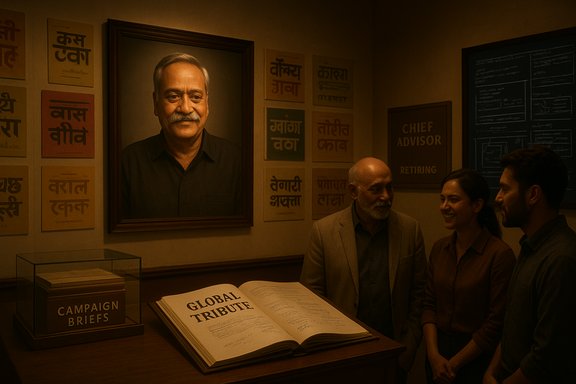
Ogilvy India’s decision to retire the title of Chief Advisor as a lasting tribute to Piyush Pandey is a deliberate, symbolic act that both cements an individual legacy and raises fresh questions about how creative cultures preserve, codify, and transmit influence in a modern global agency network.
Piyush Pandey, the towering creative force behind some of India’s most enduring advertising work, died on October 24, 2025. His death prompted an outpouring of tributes across industry and government, and renewed scrutiny of his outsized influence on the language of Indian advertising. Pandey’s role at Ogilvy evolved over four decades: he joined in the early 1980s and rose through creative ranks to become Ogilvy India’s executive chairman and later chief creative officer worldwide. In late 2023 the agency announced a leadership transition that moved Pandey into an advisory capacity; he was serving as Chief Advisor at the time of his passing. Within days of the funeral tribute, Ogilvy India — or at least senior figures associated with the agency at a memorial gathering — signalled a further step: they would retire the title Chief Advisor in his honour and publish a global tribute book chronicling his campaigns and influence. The report of the title retirement and the tribute book was carried in industry media. That specific decision — the formal retirement of the title — appears in reporting tied to the memorial event and agency statements made there. Readers should note that the retirement-of-title report is principally documented in industry coverage of the tribute.
But symbolism without systems risks becoming mythology rather than memory. The real test will be whether Ogilvy converts tribute into action: archives, fellowships, masterclasses, and transparent knowledge transfer that make Pandey’s craft teachable and replicable. That pragmatic work will determine whether this tribute becomes a living legacy — one that shapes the next generation of Indian advertising rather than merely memorializing the last.
In the meantime, this unusual merger of memorial and corporate governance invites broader industry reflection on how creative institutions honour icons, manage ethical tensions that arise when creative work crosses into politics, and sustain distinctive cultural voices inside global agency architectures. The retirement of a title marks the end of one era — it should also be the beginning of a structured program to make sure that a great creative worldview does not vanish with its most famous steward.
Source: Storyboard18 Ogilvy retires Chief Advisor role as lasting tribute to Piyush Pandey
 Background / Overview
Piyush Pandey, the towering creative force behind some of India’s most enduring advertising work, died on October 24, 2025. His death prompted an outpouring of tributes across industry and government, and renewed scrutiny of his outsized influence on the language of Indian advertising. Pandey’s role at Ogilvy evolved over four decades: he joined in the early 1980s and rose through creative ranks to become Ogilvy India’s executive chairman and later chief creative officer worldwide. In late 2023 the agency announced a leadership transition that moved Pandey into an advisory capacity; he was serving as Chief Advisor at the time of his passing. Within days of the funeral tribute, Ogilvy India — or at least senior figures associated with the agency at a memorial gathering — signalled a further step: they would retire the title Chief Advisor in his honour and publish a global tribute book chronicling his campaigns and influence. The report of the title retirement and the tribute book was carried in industry media. That specific decision — the formal retirement of the title — appears in reporting tied to the memorial event and agency statements made there. Readers should note that the retirement-of-title report is principally documented in industry coverage of the tribute. Piyush Pandey: the career and the creative imprint
From services to storytelling
Piyush Pandey’s career is shorthand for a broader transformation in Indian advertising: the shift from anglicized, urban-centric messaging to a vernacular, culturally grounded storytelling that connected with the country’s towns and villages. He started at Ogilvy in 1982 and built campaigns that became part of the national lexicon. His roster of iconic work includes campaigns for Fevicol, Cadbury Dairy Milk, Asian Paints, the polio-awareness effort featuring Amitabh Bachchan, and brand-building work for telecom and financial services that leaned on simple, emotional storytelling. These campaigns were notable for their rooted language, everyday insights, and often a gentle humour that made brands feel native rather than imported.Awards, recognition and global stature
Pandey’s influence was validated not only by domestic awards and client loyalty but also by international recognition. Under his leadership Ogilvy India became a creative powerhouse in the Ogilvy network, and he and his brother were honoured with major creative awards — recognition that underscored his standing within the industry.The decision: retiring a title as corporate memorial
What was announced
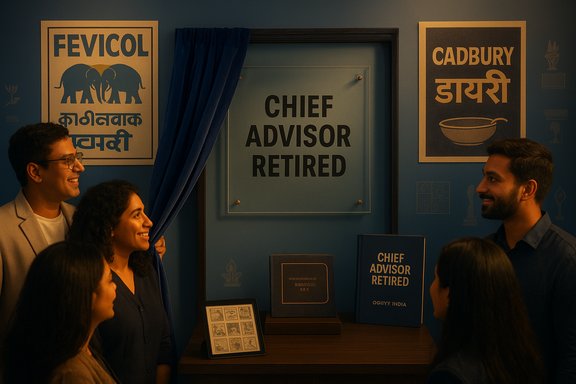
At a tribute gathering attended by industry leaders and public figures, Ogilvy India executives reportedly said the firm would retire the Chief Advisor title in honour of Pandey and produce a global commemorative book that chronicles his most iconic campaigns. Senior agency executives framed the move as a recognition that the Chief Advisor role had become inseparable from Pandey’s personal legacy. Monty Bharali, Ogilvy’s Chief Talent Officer, was quoted as saying, “No one can replace Piyush at Ogilvy. He will always be our guiding light.” Hephzibah Pathak, Executive Chairperson of Ogilvy India, reportedly said Pandey “will always remain our Chief Advisor and will always bless us from above,” and announced the global tribute. The memorial reportedly drew a wide cross-section of the Indian advertising, business and cultural community.How unusual is it to retire a corporate title?
Retiring a job title in tribute is rare in modern corporate practice. Companies occasionally retire product names or brand elements, or create endowed positions and scholarships that memorialize leaders — but the formal retirement of a generic corporate title (e.g., Chief Advisor) is exceptional. Typically, organizations codify legacy through:- archival programs (internal museums, digital archives),
- endowed chairs or fellowships,
- named awards or scholarships,
- tribute publications and public events.
Why the move matters: strengths and symbolic power
1. Preserving identity and signalling values
Retiring the title loudly signals Ogilvy India’s desire to preserve a specific identity and a creative lineage anchored by Pandey’s work. In an era when global agencies struggle with homogenization, this is an assertion of a distinct Indian creative DNA — an act of cultural stewardship. The planned global tribute book further extends that signal, promising to circulate Pandey’s campaigns and methods across Ogilvy’s international network.2. Institutional morale and mythology
Corporate rituals that commemorate founders or cultural icons reinforce internal morale and provide junior staff with a clear line of cultural inheritance. By commemorating Pandey in such a visible way, Ogilvy reinforces a mythology around creative risk-taking, vernacular authenticity, and mentorship — traits that prospective hires and clients may find attractive.3. Client reassurance and brand continuity
Clients often buy more than tactical outputs; they buy a philosophy and a creative culture. For long-standing clients who equate Ogilvy India’s value with the sensibility Pandey exemplified, the retirement-and-tribute move sends a message that the firm will anchor its future on those same creative principles. The tribute book and public memorial are tangible reassurances that the agency values and preserves that tradition.The risks and the practical questions
1. Symbolism without succession planning
Symbols are powerful but fragile if unaccompanied by practical institutional measures. Retiring a title does not automatically transfer skills, networks, or judgment. Without clear structures — mentoring programs, documented creative frameworks, apprenticeships — the risk is that the agency memorializes a style while failing to institutionalize the processes that produced it. Senior executives will need to translate Pandey’s tacit methods into repeatable practice.2. Setting a precedent
Retiring a title can create future expectations: which roles merit retirement? Will other senior creatives or leaders expect similar ceremonial treatment? That can complicate talent management and succession norms if not handled transparently. Agencies must be careful to distinguish between unique, one-off ceremonial acts and routine organizational governance.3. The politics of legacy
Pandey’s career included work and influence beyond commercial briefs: he has been associated with political messaging that left an imprint on modern Indian political communications. The well-known anecdote — that he initially resisted and later accepted involvement in the 2014 slogan “Abki Baar Modi Sarkar” after being persuaded it was a national need — illustrates how individual careers can span both commercial and political domains. Memorializing such a figure carries political valence; agencies must navigate the optics of that valence in client-facing work and in talent recruitment.4. Single-source reporting and verification
While multiple outlets confirmed Pandey’s death and his historical role within Ogilvy, the specific claim that Ogilvy has formally and permanently retired the Chief Advisor title has — at the time of reporting — been documented in coverage of the memorial and by a leading industry outlet. That retirement-of-title claim appears tied to the memorial statements rather than a standalone corporate press release. Until an official, independently archived corporate announcement or a WPP/Ogilvy press statement appears in multiple sources, the retirement-of-title detail should be treated as significant but not yet thoroughly corroborated beyond the industry reporting. This caveat matters for archival accuracy and for future historians of advertising.How Ogilvy could operationalize Pandey’s legacy (practical steps)
If the intention is to preserve and propagate the creative ethos Pandey embodied, the symbolic retirement must be matched with durable, operational choices. Recommended approaches include:- Create a permanent digital archive: catalog scripts, storyboards, and campaign case studies to make tacit creative choices explicit and searchable.
- Institute a Piyush Pandey Fellowship or mentorship program: place early-career creatives under senior mentors with specific learning objectives tied to Pandey-era craft — writing, cultural insight, and direction for mass-media storytelling.
- Publish the promised global tribute book as an annotated casebook: include process notes, client-brief examples, and candid post-mortems on what worked and why.
- Launch a biennial creative lecture / festival in his name that focuses on vernacular storytelling, media craft, and ethics in brand communication.
- Formalize knowledge transfer through internal masterclasses and documented creative frameworks so the “what” and the “how” of his work survive beyond anecdote.
The ethical and industry dimensions
Political work and agency ethics
Pandey’s reported involvement in crafting a political slogan that shaped a national election raises questions that the ad industry has long wrestled with: to what extent should agencies or their leaders engage directly in partisan political communication? Ogilvy’s historical stance reportedly favored avoiding direct political assignments, and Pandey’s 2014 involvement is often recalled as a moment of ethical reckoning, not only creative triumph. Public memorials and title retirements can revive debate about the relationship between commercial craft, civic life, and political advocacy — a debate that deserves explicit policy clarity from agencies that operate across markets and political systems.The cult of personality vs. institutional craft
Advertising has long celebrated creative auteurs; yet, an overemphasis on singular figures can obscure the collaborative systems that generate enduring work. Organizations must resist turning cults of personality into gatekeeping structures where access to legacy is informal and opaque. Instead, the industry is better served by mechanisms that democratize learning: apprenticeships, open archives, and curriculum integration. The retirement of a title can be a starting point — not the end point — for this work.What the industry reaction reveals
The memorial attracted a cross-section of leaders: agency heads, client executives, filmmakers, and political figures. That breadth of attendance reflects the boundary-crossing character of Pandey’s influence — he was a cultural broker whose work sat at the intersection of commerce, storytelling, and national imagination. The event’s guest list also shows how advertising leadership occupies a visible civic role in India’s public life. Statements from government figures and corporate clients underscore two facts: first, Pandey’s work had genuine business value and cultural impact; second, the boundaries between corporate culture and public culture in India are porous. That porousness is a strength for storytelling, but it also demands clearer institutional guardrails around ethics and client selection going forward.A reporter’s note on verification
Key load-bearing facts in this piece are supported by multiple independent reports:- Pandey’s passing on October 24, 2025, and the circumstances around his illness and death are confirmed across mainstream outlets.
- The timeline of his move from executive chairman into an advisory role in 2023 (effectively moving into Chief Advisor duties by early 2024) appears in industry reporting and in contemporaneous agency coverage of the leadership transition.
- The memorial, the announced tribute book, and the reported retirement of the Chief Advisor title are documented in authoritative industry reporting from Storyboard18 and covered in memorial coverage; however, the formal corporate record (a standalone Ogilvy or WPP public announcement explicitly and separately declaring permanent retirement of the title) is not widely available as a distinct press release at the time these reports were published. Readers should treat the title-retirement item as a significant and newsworthy act recorded in industry coverage and memorial statements, while noting the difference between on-the-record corporate policy changes and memorial rhetoric.
Longer-term implications for Ogilvy and the advertising ecosystem
Institutional memory in the age of global networks
Global agency networks like Ogilvy must balance local cultural leadership with network-wide consistency. Honouring Pandey with a retired title and a widely shared tribute book attempts to preserve a local, culturally specific approach inside a global firm. The test will be whether that cultural specificity is converted into governance: training curricula, creative playbooks, and client engagement protocols that ensure sustainable continuity.Talent pipelines and creative leadership
If Ogilvy uses the moment to build formal mentoring and archival programs, it could turn a symbolic act into a competitive advantage in the talent market. Young creatives often seek lineage and craft: formalized programs that let them trace how a campaign developed — from brief to insight to execution — will be more effective for retention and recruitment than purely ceremonial honours.The message to clients and competitors
Ogilvy’s tribute positions the agency as an institutional guardian of a particular creative voice. That message can reassure legacy clients and differentiate the agency from competitors who emphasize digital metrics or technology-first approaches. But competitors will also use the moment to critique any perceived overreliance on nostalgia unless Ogilvy couples homage with demonstrable innovation.Conclusion
Retiring the title of Chief Advisor to honour Piyush Pandey is a powerful, emotive act that codifies a human legacy inside an organization — and it is the kind of symbolic leadership move that agencies and brands use to anchor cultural identity. The step tells a clear story: Ogilvy India wants Pandey’s name and what he stood for to be part of its institutional DNA.But symbolism without systems risks becoming mythology rather than memory. The real test will be whether Ogilvy converts tribute into action: archives, fellowships, masterclasses, and transparent knowledge transfer that make Pandey’s craft teachable and replicable. That pragmatic work will determine whether this tribute becomes a living legacy — one that shapes the next generation of Indian advertising rather than merely memorializing the last.
In the meantime, this unusual merger of memorial and corporate governance invites broader industry reflection on how creative institutions honour icons, manage ethical tensions that arise when creative work crosses into politics, and sustain distinctive cultural voices inside global agency architectures. The retirement of a title marks the end of one era — it should also be the beginning of a structured program to make sure that a great creative worldview does not vanish with its most famous steward.
Source: Storyboard18 Ogilvy retires Chief Advisor role as lasting tribute to Piyush Pandey