

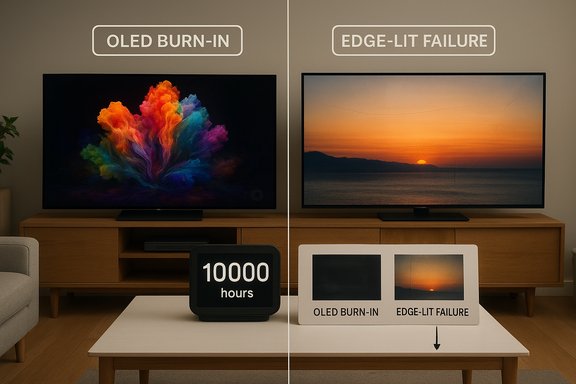
RTINGS’ three‑year accelerated longevity experiment has delivered a clear, actionable headline for TV buyers: OLED panels (both WOLED and QD‑OLED) age far more gracefully than most LCD designs under prolonged, continuous use, while edge‑lit LED LCDs remain the weakest link in modern TV longevity. Over roughly 10,000 hours of simulated usage across more than 100 displays, testers recorded 20 total failures and 24 partial failures — outcomes that illuminate where manufacturers still need to improve and what buyers should look for when investing in a TV.
RTINGS launched an accelerated longevity and burn‑in test in late 2022 to stress a large, diverse pool of TVs and monitor panels with the goal of mimicking many years of typical household use in a compressed timeframe. Their method involved continuous operation under heavy, static content conditions to expose both OLED burn‑in risk and the mechanical/electrical weak points of LCD backlighting systems. After nearly three years and more than 10,000 hours for most units, they published updated results showing trends by panel technology, backlight architecture, brand, and price bracket. Tom’s Hardware summarized RTINGS’ update, noting the headline figures — 102 TVs tested, 20 outright failures, and 24 partial failures — and reinforced the conclusion that most TVs survive the first 10,000 hours without catastrophic problems, but that certain designs and build choices accelerate failure. The coverage also stressed that every OLED in the test exhibited burn‑in under the deliberately extreme conditions, yet under normal consumer usage that risk remains low.
Additional context on OLED innovation and TV platform evolution from related industry coverage reinforces why manufacturers are iterating quickly: vendors are introducing advanced OLED generations, Micro RGB backlight concepts, and AI‑driven processing that affect brightness management and usability — all developments that will influence longevity outcomes in the near future. Buyers should treat durability claims as evolving and check up‑to‑date lab reports and warranty terms before purchasing.
Source: Tom's Hardware https://www.tomshardware.com/monito...10-000-hours-20-tvs-failed-out-of-102-tested/
 Background / Overview
RTINGS launched an accelerated longevity and burn‑in test in late 2022 to stress a large, diverse pool of TVs and monitor panels with the goal of mimicking many years of typical household use in a compressed timeframe. Their method involved continuous operation under heavy, static content conditions to expose both OLED burn‑in risk and the mechanical/electrical weak points of LCD backlighting systems. After nearly three years and more than 10,000 hours for most units, they published updated results showing trends by panel technology, backlight architecture, brand, and price bracket. Tom’s Hardware summarized RTINGS’ update, noting the headline figures — 102 TVs tested, 20 outright failures, and 24 partial failures — and reinforced the conclusion that most TVs survive the first 10,000 hours without catastrophic problems, but that certain designs and build choices accelerate failure. The coverage also stressed that every OLED in the test exhibited burn‑in under the deliberately extreme conditions, yet under normal consumer usage that risk remains low. How the test was run (and what that means)
Test method at a glance
- Continuous operation at accelerated duty cycles (many units ran well over 10,000 hours).
- Static, repeated content patterns designed to replicate persistent UI elements (news tickers, static logos) so image retention and backlight stress could surface quickly.
- Detailed photographic and teardown documentation of failing units to pinpoint failure modes.
Why accelerated testing is useful — and what to watch out for
Accelerated tests are powerful for discovering systemic design weaknesses that wouldn’t show up for years in normal home use. They help identify:- Weak mechanical parts (light guide plates, adhesives).
- Electrical failure points (series‑wired LED strings).
- Long‑term material degradation (organic pixel wear in OLEDs).
What failed and why: the engineering behind the headlines
OLED — resilient but not invulnerable
- All OLED panels in the experiment showed burn‑in artifacts under the test’s extreme conditions, because organic emitters degrade with prolonged static stress. However, OLEDs were still the least likely to suffer total hardware failure compared to backlit LCDs. RTINGS notes this distinction clearly: OLEDs have no backlight or light guide to crack or lose LEDs, which eliminates a class of mechanical failures that plague many LCDs. Under normal viewing patterns (varied content, moderated brightness, and power‑saving features), RTINGS and Tom’s Hardware argue consumer burn‑in risk is low.
- Real‑world corroboration from additional monitoring tests shows early brightness drops can be measurable but often perceptually minor (single‑digit percent changes over long intervals). Still, buyers who run static HUD‑style content (PC desktop, signage, or channels with permanent tickers) should plan mitigations.
LCD failures cluster around edge‑lit designs
- Edge‑lit LED LCDs failed most often. The light guide plate (LGP) and diffuser stack used in edge‑lit panels were frequent structural failure points. Cracking, warped reflectors, and burnt‑out LEDs created severe uniformity and backlight-dropping failures. Since many edge LED strings are wired in series, a single LED failure can darken an entire row or group, resulting in a red‑LED “won’t power on” state or catastrophic dark bands. RTINGS found more than 60% of TVs without local dimming experienced partial or total failure in the test.
- Full‑array local dimming (FALD) and Mini‑LED approaches performed much better than edge‑lit implementations, though not immune: around one in four FALD units still developed some failure mode during the run. The mechanical complexity and numerous point light sources in FALD help resilience but increase the number of potential single‑point failures.
IPS vs VA: the local‑dimming wrinkle
- RTINGS’ data shows IPS‑panel TVs suffered more failures than VA types in this pool. The nuance is that many IPS models are edge‑lit and therefore carried the backlight failure risk; VA models more frequently include local dimming, which reduces edge‑lit exposure and thus improves longevity statistics. The panel chemistry (IPS vs. VA) is only part of the story; the backlight and chassis design drive much of the observed variance.
Brand performance — what the numbers say (and don’t)
- RTINGS’ update named LG and TCL among brands with the lowest failure counts in this specific test cohort: LG recorded only one outright OLED failure among 24 total TVs in the test, and TCL lost a single unit near the test’s end out of 10 models. Tom’s Hardware emphasized these results while reminding readers the test includes only one sample per model, so brand percentages are noisy at best. A single failure for a model family doesn’t equal a factory‑wide defect rate; it’s a small‑n snapshot that’s useful for pattern spotting, not brand condemnation.
- Lower‑cost labels can both outperform and underperform expectations. Some budget models survived the accelerated torture without major issues, while expensive flagship units sometimes developed problems sooner. Repairability differences mattered: cheaper sets showed assembly shortcuts (strong adhesive, glued panels, non‑modular backlight assemblies) that made repairs impractical. RTINGS attempted repairs on failed units but succeeded only twice out of 20 full failures, underscoring the practical value of warranty coverage for consumers.
Critical analysis — strengths, weaknesses, and the limits of the dataset
Strengths of the RTINGS program
- Scale and duration: few independent labs put 100+ TVs through a continuous longevity rig for years; this is uniquely revealing for long‑term failure modes.
- Transparency: detailed photos, failure narratives, and teardown notes allow readers and engineers to see exactly what went wrong.
- Useful engineering intelligence: the data exposes recurring mechanical/electrical trouble spots (LGP cracks, series‑wired LEDs, diffuser warping) that OEMs can address in future designs.
Key limitations and risks
- Sample size per model: the test typically uses one unit per SKU. That makes statistical noise significant when assigning brand reliability percentages; an unlucky single unit does not establish a pattern for a manufacturer. Both RTINGS and Tom’s Hardware warn against overinterpreting brand percentages for that reason.
- Accelerated conditions vs real life: the test intentionally uses extreme static patterns and brightness settings to provoke burn‑in and backlight stress. Real living‑room usage — varied content, lower typical brightness, and power‑saving modes — usually yields much longer lifespans and lower burn‑in risk for OLEDs. RTINGS explicitly notes that consumer burn‑in risk is much lower under normal viewing.
- Repairability and service access: while RTINGS documented internal failures, the lab’s ability (and willingness) to repair is limited. Commercial repair ecosystems and warranty policies vary, so the “repair or replace” calculus differs for consumers depending on brand support and retail return windows. Only two of 20 failed units were returned to service by RTINGS.
- Evolving panel tech: the TV market moves quickly — Micro RGB backlighting, new QD‑OLED iterations, and manufacturing process improvements will change the landscape. Tests are a snapshot; follow‑up testing and manufacturer updates can shift the prognosis for some models. Industry demonstrations and CES presentations in 2025–2026 show vendors moving to address precisely these durability and brightness tradeoffs.
Practical guidance for buyers (plain language, actionable)
- If you prioritize long‑term reliability and picture quality for varied content (movies, series, and gaming), OLED (WOLED or QD‑OLED) is a strong choice, provided you choose a reputable brand and moderate peak brightness settings. Use built‑in pixel maintenance features, avoid permanently static content for long stretches, and enable screen‑saver/auto‑sleep options if you sometimes use the TV as a second monitor.
- If you frequently watch in very bright rooms, run HDR at high sustained brightness, or need very large screens, FALD / Mini‑LED LCDs remain the practical alternative. They offer higher sustained brightness with better resistance to burn‑in — but avoid edge‑lit LED models if you want durability over time. Look for Mini‑LED implementations with many dimming zones and robust mechanical assembly.
- Avoid edge‑lit LED TVs for heavy continuous use. Edge‑lit panels were disproportionately represented among the failures; internal mechanical complexity in the LGP and series‑wired LED strings creates fragile failure modes that are hard or expensive to repair.
- Prioritize warranty and service: because many failures are difficult to repair and because RTINGS’ repair success was extremely low, a strong warranty and good customer service are essential. If you plan to use a TV for signage or as a PC monitor (long static usage), confirm burn‑in coverage and vendor repair policies before buying.
- Check internal construction if repairability matters: mid/high‑end TVs typically allow back access to internals and modular replacement of power and backlight boards. Budget sets often use adhesives and tape that make disassembly destructive. If you care about out‑of‑warranty repairs, favor brands and models known for modular serviceability.
Engineering deeper dive: why edge‑lit fails and OLEDs show burn‑in
- Edge‑lit LED LCDs rely on a light guide plate to distribute LEDs’ light evenly across the panel. Over time heat, adhesive creep, and mechanical stress can warp or crack the LGP or diffuser stack, producing large uniformity defects or dark bands. Because many LED strings are wired in series, a single LED failure can cascade into a full row failure. RTINGS documented multiple cases of cracked light guide plates and series string failures in the edge‑lit cohort.
- Mini‑LED and FALD replace the single edge source with many, closer‑to‑pixel point light sources; that distributes thermal and electrical stress and reduces reliance on the fragile LGP structure. However, Mini‑LED still introduces many more components (and potential failure points), so engineering quality and thermal management matter.
- OLED burn‑in stems from organic emitter degradation: pixels driven hard for sustained periods age chemically and change luminance/colour emission profile. The lab test’s use of static ticker bars and fixed anchors on the image accelerated that wear. Under realistic mixed content, pixel reuse and lower average luminance substantially slow the process. Regular pixel refresh cycles and moderation of peak brightness extend useful life.
Cross‑checks and corroboration
- The Tom’s Hardware summary of RTINGS’ work mirrors RTINGS’ own published results and failure breakdowns, confirming the headline figures (20 full failures, 24 partial failures, most TVs surviving the first ~10,000 hours) and the panel‑type trends (edge‑lit LCDs fail far more often; OLED shows burn‑in under torture but resists total failure). These independent writeups reinforce the validity of the observed trends while emphasizing caveats about sample sizes and lab conditions.
- Additional reporting on long‑duration OLED monitor tests shows similar behavior: measurable but often small brightness drops over long durations and burn‑in when devices are used as static desktop screens or run fixed UI elements continuously. This aligns with RTINGS’ conclusion that normal home use is unlikely to reproduce the worst lab outcomes, but certain use cases (signage, pro‑workstations with static HUDs) remain risky for OLED without mitigation.
What manufacturers can and should do next
- Improve mechanical robustness of edge‑lit architectures or phase them out in favor of FALD/Mini‑LED where budget and size permit.
- Re‑engineer LED string topologies to avoid long series chains that fail catastrophically when one LED dies.
- Make burn‑in mitigation user‑facing: factory presets that limit static UI luminance, stronger pixel‑refresh scheduling, and clearer warranty language on burn‑in coverage for use cases that match consumer behavior.
- Improve documentation and modular design to help third‑party and in‑warranty servicing, reducing landfill waste by making repairs cheaper and more feasible. RTINGS’ teardown evidence makes these gaps painfully clear.
Final verdict and recommendations
RTINGS’ multi‑year, 100‑plus device longevity experiment is one of the most consequential large‑scale durability studies in the consumer TV space. The takeaways are simple, practical, and relevant:- OLED is not the longevity liability it’s sometimes portrayed as — for most living‑room use it offers better overall resilience than many low‑cost LCD implementations, though it will show burn‑in under extreme, static stress.
- Avoid edge‑lit LCDs for heavy, long‑duration use. These were the most failure‑prone in the test due to mechanical/electrical backlight fragility.
- FALD/Mini‑LED is a reasonable compromise for buyers needing high sustained brightness and extra HDR headroom, but check vendor implementation quality.
- Warranty, repairability, and service ecosystem matter more than ever; given RTINGS’ limited ability to repair failed units, consumers should favor vendors with strong service reputations and clear policies covering panel/backlight issues.
Additional context on OLED innovation and TV platform evolution from related industry coverage reinforces why manufacturers are iterating quickly: vendors are introducing advanced OLED generations, Micro RGB backlight concepts, and AI‑driven processing that affect brightness management and usability — all developments that will influence longevity outcomes in the near future. Buyers should treat durability claims as evolving and check up‑to‑date lab reports and warranty terms before purchasing.
Source: Tom's Hardware https://www.tomshardware.com/monito...10-000-hours-20-tvs-failed-out-of-102-tested/
