

Two sister companies — a vertically integrated manufacturer and a multi‑location distributor — took an uncommon path to modernization: instead of running two separate ERP projects, they executed a single, programmatic transformation with one playbook, delivered by Volt Technologies, that moved both organizations from legacy systems to Microsoft Dynamics 365 Business Central. The coordinated approach prioritized standardized processes, financial automation, shared analytics, and reusable assets to create a scalable ERP foundation capable of supporting additional entities and faster rollouts. (msdynamicsworld.com)
Two related organizations—one producing goods and the other distributing them through multiple locations—faced a familiar modern ERP problem: divergent legacy systems, fragmented master data, and manual finance workflows that slowed reporting and obscured operational visibility. Facing growth ambitions, they needed an approach that would both unify operations and preserve each entity’s required local configuration and autonomy.
Rather than conduct parallel but siloed migrations, the companies engaged Volt Technologies to deliver a coordinated, program‑level implementation of Dynamics 365 Business Central that treated the pair as a single transformation program with multi‑entity scope. Volt framed the engagement around reuse, governed rollout phases, and a single “playbook” of standardized processes and automation patterns to be deployed across both entities.
Business Central also benefits from an ecosystem of ISV extensions—Multi‑Entity Management (MEM) and multi‑company sync apps among them—that extend and automate intercompany postings, master data sharing (customers, vendors, items), and consolidation workflows. Partners commonly use these extensions to speed multi‑entity deployments and reduce custom code.
Standardization reduced the number of unique integrations and customizations and made testing and training repeatable. The reuse of configuration and training assets substantially shortened subsequent entity rollout windows, which is a critical economy of scale in multi‑entity programs.
The case materials report improvements in reporting cadence and a streamlined AR process. While the published summary highlights faster reporting and streamlined AR as outcomes, concrete KPIs (for example, DSO reduction or staff time saved) were not published in the public summary and should be verified with the organizations for precise measurement. Where quantitative measurement is absent, expect improvements consistent with comparable Business Central deployments but treat exact gains as implementation‑specific. (msdynamicsworld.com)
Shared analytics enabled leaders to move from spreadsheet‑based reconciliations to self‑service dashboards that combined data across companies—driving faster decision cycles and better inventory optimization. This pattern aligns with best practices for Business Central rollouts that emphasize consolidation companies and the platform’s Inbox/Outbox flows for intercompany document exchange.
Industry practice shows partners frequently combine Business Central’s native intercompany functionality with third‑party MEM solutions to manage master data sharing, intercompany settlement automation, and consolidated reporting—allowing the program to scale to many entities without a linear increase in implementation effort.
Technical claims about Business Central’s multi‑company, intercompany, and consolidation features are supported by Microsoft documentation and validated marketplace extensions such as Multi‑Entity Management and other multi‑company apps. Those resources describe the platform capabilities and common ISV approaches used to manage master data and intercompany transactions at scale. Still, the exact architecture (single tenant vs multiple tenants, native intercompany vs MEM) materially affects the implementation complexity and must be decided case‑by‑case.
While the public summaries from MSDynamicsWorld and Volt Technologies confirm the program approach and outcomes, organizations evaluating similar programs should seek detailed KPIs and architectural specifics to estimate ROI accurately. In multi‑entity contexts, the right combination of Business Central’s native features and proven ISV extensions—paired with disciplined data governance and change management—creates a practical, repeatable path from legacy fragmentation to a single, enterprise‑grade operational playbook. (msdynamicsworld.com)
Source: MSDynamicsWorld.com Sister Companies, One Playbook: A Program Approach to Multi Entity Transformation
 Background
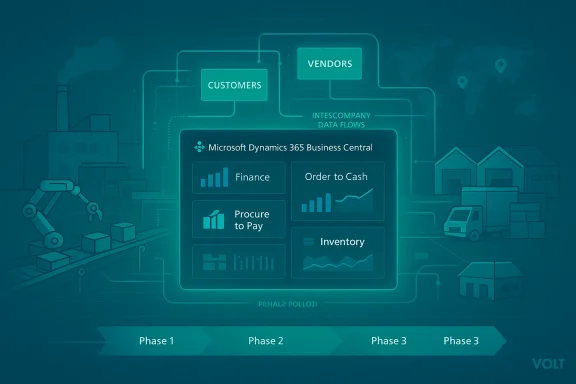
Two related organizations—one producing goods and the other distributing them through multiple locations—faced a familiar modern ERP problem: divergent legacy systems, fragmented master data, and manual finance workflows that slowed reporting and obscured operational visibility. Facing growth ambitions, they needed an approach that would both unify operations and preserve each entity’s required local configuration and autonomy.Rather than conduct parallel but siloed migrations, the companies engaged Volt Technologies to deliver a coordinated, program‑level implementation of Dynamics 365 Business Central that treated the pair as a single transformation program with multi‑entity scope. Volt framed the engagement around reuse, governed rollout phases, and a single “playbook” of standardized processes and automation patterns to be deployed across both entities.
Overview: Why a program approach matters
Most ERP projects for related companies default to one of two extremes: a single shared instance shoehorned to fit every local nuance, or multiple independent projects that replicate the same discovery and build work twice. The program approach used here balances those extremes by combining:- A governed, phased rollout that enforces standards while allowing local configuration.
- Reusable assets, templates, and process playbooks that minimize duplicate effort across entities.
- Centralized analytics and shared master data models to enable consolidated reporting and operational visibility. (msdynamicsworld.com)
The solution: Dynamics 365 Business Central as the program’s backbone
Why Business Central?
Microsoft Dynamics 365 Business Central is positioned as an ERP platform for small and mid‑market businesses with built‑in capabilities for finance, supply chain, warehousing, and manufacturing. Its core strengths for multi‑entity programs include native multi‑company support, intercompany transaction flows, and the ability to consolidate across companies using consolidation companies or intercompany integrations. These features make Business Central a natural fit for organizations seeking unified reporting without losing company‑level legal separation.Business Central also benefits from an ecosystem of ISV extensions—Multi‑Entity Management (MEM) and multi‑company sync apps among them—that extend and automate intercompany postings, master data sharing (customers, vendors, items), and consolidation workflows. Partners commonly use these extensions to speed multi‑entity deployments and reduce custom code.
How Volt packaged the program
Volt delivered a governed, phased Business Central rollout with:- A single playbook of standardized business processes mapped to Business Central workflows.
- Shared services patterns to centralize finance automation while allowing entity‑level controls.
- Reusable configuration templates and integration patterns to accelerate future entity onboarding.
- Shared analytics and reporting artifacts to enable consolidated and entity‑level visibility.
Implementation highlights
Standardizing processes across distinct operations
The program started with a canonical process mapping exercise: identify the core finance, order‑to‑cash, procure‑to‑pay, and inventory workflows that could be standardized across both companies. Volt’s team then defined exceptions—local tax rules, warehouse processes, or unique distributor channel flows—that required local configuration.Standardization reduced the number of unique integrations and customizations and made testing and training repeatable. The reuse of configuration and training assets substantially shortened subsequent entity rollout windows, which is a critical economy of scale in multi‑entity programs.
Financial automation and accounts receivable
Accounts receivable and financial close processes were a key focus. The program automated common finance tasks—invoice posting, bank reconciliation templates, and intercompany settlements—while introducing shared rules for credit holds and collections.The case materials report improvements in reporting cadence and a streamlined AR process. While the published summary highlights faster reporting and streamlined AR as outcomes, concrete KPIs (for example, DSO reduction or staff time saved) were not published in the public summary and should be verified with the organizations for precise measurement. Where quantitative measurement is absent, expect improvements consistent with comparable Business Central deployments but treat exact gains as implementation‑specific. (msdynamicsworld.com)
Shared analytics and a single source of truth
A central analytics layer provided both consolidated views and entity‑level dashboards. Volt leveraged Business Central’s native data model and standard reporting, augmented by shared Power BI artifacts and governed data extracts, to provide operational visibility across manufacturing, inventory, and finance.Shared analytics enabled leaders to move from spreadsheet‑based reconciliations to self‑service dashboards that combined data across companies—driving faster decision cycles and better inventory optimization. This pattern aligns with best practices for Business Central rollouts that emphasize consolidation companies and the platform’s Inbox/Outbox flows for intercompany document exchange.
Multi‑entity technical architecture
The architecture choice—single tenant with multiple companies vs. multiple instances with consolidation—depends on governance, performance, and compliance requirements. The Volt program used reusable assets and shared services to ensure consistency across instances/companies and leveraged Business Central’s intercompany features to automate cross‑entity transactions where needed.Industry practice shows partners frequently combine Business Central’s native intercompany functionality with third‑party MEM solutions to manage master data sharing, intercompany settlement automation, and consolidated reporting—allowing the program to scale to many entities without a linear increase in implementation effort.
Outcomes reported
The public case summary and Volt’s case page highlight several headline outcomes:- Stronger operational visibility from consolidated dashboards and standardized reporting. (msdynamicsworld.com)
- Faster reporting cycles thanks to automation and a single data model. (msdynamicsworld.com)
- Streamlined accounts receivable processes via automated workflows and shared rules.
- A scalable ERP foundation designed to support future growth and on‑boarding of additional entities using the same playbook.
Critical analysis: strengths
1. Economies of scale and repeatability
A program playbook plus reusable assets turns the costly discovery and design phases into repeatable modules. For sister entities with overlapping processes, this yields clear cost and time savings on subsequent rollouts, because testing, training, and documentation can be reused rather than recreated. This approach directly addresses one of the biggest overruns in ERP projects: duplicated implementation work.2. Better master data governance
Centralizing master data management—customers, vendors, items—reduces reconciliation effort and prevents duplicate records. Using Business Central’s native consolidation tools and proven MEM extensions minimizes bespoke middleware and reduces long‑term support costs. Industry documentation confirms the availability of these consolidation and intercompany tools within Business Central and through marketplace ISVs.3. Faster financial close and improved AR discipline
Automating invoice posting, intercompany settlements, and bank reconciliation reduces manual touchpoints and human error. For manufacturing/distribution pairs that bill across entities, this automation is frequently the single biggest driver of improved cash conversion cycles, provided the automation is accompanied by disciplined collections processes and clear credit policy governance. Volt’s case emphasizes improved AR workflows and faster reporting as program outcomes.4. Scalable, future‑proof platform
By standardizing on Business Central and investing in reusable deployment patterns, the companies created a foundation that supports more entities without a linear increase in implementation effort. That positions the group to consolidate newly acquired businesses faster or to spin up new legal entities with consistent processes and analytics.Critical analysis: risks, trade‑offs, and what to watch for
No approach is risk‑free. Programmatic, multi‑entity ERP projects introduce architectural, governance, and people risks that demand specific mitigation.1. Over‑standardization vs. local needs
Standardization is powerful, but overzealous enforcement of one “playbook” can create friction with local operations where regulatory, tax, or market differences exist. The proper balance is a standardized core with documented and controlled exceptions. Volt’s approach recognized exception handling, but organizations must budget for the inevitable local configurations that surface during rollout.2. Data migration complexity
Consolidating master data from different legacy systems is rarely straightforward. Duplicates, inconsistent item numbering, and mismatched customer records require time‑consuming remediation. Using MEM extensions and a rigorous data governance program helps, but stakeholders should expect a nontrivial cleanup phase. Microsoft’s documentation on intercompany setup and consolidation underscores the technical options but also the need for careful master data planning.3. Intercompany accounting and eliminations
Intercompany postings, currency translation, and eliminations are technical areas that tend to create surprises in consolidation. Business Central supports intercompany transactions and consolidated reporting, but each group must validate its legal and tax reporting requirements—particularly where local GAAP or reporting schedules differ. Third‑party tools can automate complex intercompany logic, but selecting or building the right solution requires clear functional requirements and technical validation.4. Change management and user adoption
Rolling out a single playbook across diverse user communities requires disciplined change management. Training, role‑based documentation, and phased cutovers reduce risk. The program approach helps because it standardizes training packages, but executive sponsorship and locally empowered change champions are still mandatory for adoption.5. Vendor ecosystem and long‑term support
Relying on ISV extensions (e.g., MEM solutions) accelerates deployments but increases vendor dependency. Assess vendor roadmaps, update cadence, and support SLAs early. Ensure that upgrades and platform changes are part of a managed lifecycle to avoid technical debt accumulation. Marketplace products extend capability but carry independent maintenance requirements.Practical checklist for organizations considering a similar program approach
- Define the canonical processes to standardize and catalogue all exceptions up front.
- Choose the multi‑entity architecture (single instance with companies or multiple instances with consolidation) based on governance and compliance needs.
- Invest in master data remediation before go‑live—focus on customers, vendors, items, and chart of accounts mapping.
- Evaluate ISV extensions (MEM, multi‑company sync) and confirm they meet your intercompany, consolidation, and reporting needs.
- Build a repeatable playbook with templates for configuration, test scripts, training materials, and cutover runbooks.
- Establish a center of excellence (CoE) responsible for governance, analytics artifacts, and onboarding new entities.
- Measure and publish KPIs (DSO, days to close, report lead time, number of manual reconciliations eliminated) so you can quantify benefits and iterate.
What this case teaches the broader ERP market
The sister companies’ program shows a pragmatic middle path between monolithic consolidation and fragmented multi‑project approaches. It demonstrates that organizations with related business models can achieve:- Cost efficiencies through reuse,
- Improved cash and finance discipline via automation, and
- Faster decision‑making through shared analytics.
Verification and caveats
The public summary available on MSDynamicsWorld outlines the program outcomes—standardized processes, financial automation, shared analytics, and improved visibility—but the full case study content requires membership access and that level of detail is not publicly accessible in the free summary. Volt’s own site provides a complementary case overview that confirms the program approach and the solution architecture, including the use of Business Central and phased rollouts. For readers seeking precise KPIs or detailed implementation timelines, request the full case study from the implementer or the client. (msdynamicsworld.com)Technical claims about Business Central’s multi‑company, intercompany, and consolidation features are supported by Microsoft documentation and validated marketplace extensions such as Multi‑Entity Management and other multi‑company apps. Those resources describe the platform capabilities and common ISV approaches used to manage master data and intercompany transactions at scale. Still, the exact architecture (single tenant vs multiple tenants, native intercompany vs MEM) materially affects the implementation complexity and must be decided case‑by‑case.
Recommendations for IT leaders planning multi‑entity ERP programs
- Start with a clear inventory of shared vs. local processes. This will drive your playbook and technical architecture.
- Prioritize master data governance as a program‑level workstream with assigned ownership.
- Evaluate third‑party MEM or multi‑company automation tools early; their adoption can significantly shorten rollout time and reduce custom development.
- Build a center of excellence to maintain the playbook, analytics artifacts, and onboarding processes for new entities.
- Insist on measurable KPIs and a benefits realization plan tied to the rollout cadence so that improvements in DSO, reporting time, and operational visibility are tracked and validated.
Conclusion
The “one playbook” program carried out by the vertically integrated manufacturer and its distribution sister demonstrates a modern blueprint for multi‑entity ERP transformation: standardize where it matters, automate finance, centralize analytics, and deliver rollouts with reusable assets and governed processes. When executed with the right balance of central governance and local flexibility, this approach reduces duplication, accelerates time to value, and builds a scalable ERP foundation for future growth.While the public summaries from MSDynamicsWorld and Volt Technologies confirm the program approach and outcomes, organizations evaluating similar programs should seek detailed KPIs and architectural specifics to estimate ROI accurately. In multi‑entity contexts, the right combination of Business Central’s native features and proven ISV extensions—paired with disciplined data governance and change management—creates a practical, repeatable path from legacy fragmentation to a single, enterprise‑grade operational playbook. (msdynamicsworld.com)
Source: MSDynamicsWorld.com Sister Companies, One Playbook: A Program Approach to Multi Entity Transformation