
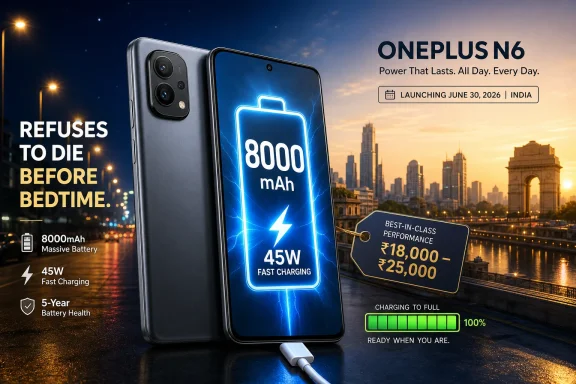
OnePlus has again teased the OnePlus N6 ahead of its June 30, 2026 India launch, confirming 45W fast charging for the first handset in its new N Series, a budget-focused lineup expected to sit below Nord in the company’s local portfolio. The detail matters less because 45W is spectacular and more because it completes the outline of OnePlus’s new pitch: huge battery, controlled price, and enough brand polish to make the crowded Indian midrange nervous. The N6 is not being framed as a flagship killer. It is being framed as the phone that refuses to die before bedtime.
For years, OnePlus lived off a relatively simple mythology: flagship-adjacent hardware, enthusiast credibility, and prices that made Samsung and Apple look complacent. That story was always easier to tell when the company sold fewer phones to a narrower audience. In 2026, the smartphone market does not reward purity. It rewards segmentation.
The N Series looks like OnePlus accepting that fact in public. If the flagship line carries the halo and Nord does the aspirational midrange work, the N6 appears designed to fight in the practical, high-volume band where battery life, serviceability, retail availability, and financing matter as much as benchmark charts. That is not glamorous territory, but it is where a lot of phones are actually bought.
The reported ₹18,000 to ₹25,000 target range puts the N6 into a brutally competitive Indian segment. This is the zone where Xiaomi, Realme, iQOO, Vivo, Samsung, Motorola, and increasingly aggressive sub-brands fight over small spec advantages and large marketing claims. OnePlus is not entering empty space. It is trying to create a new shelf in a store that is already packed.
That makes the confirmed 45W charging detail more revealing than it first appears. OnePlus could have tried to lead with charging wattage, as it has often done in the past. Instead, the N6 story appears to begin with an enormous 8000mAh battery and then use 45W charging as reassurance that living with such a cell will not be a punishment.
This is not a device chasing the thinnest frame or the highest charging headline. It is a device chasing anxiety reduction. The promise is that users who stream, navigate, hotspot, record video, doomscroll, game casually, and forget to charge overnight should still have room to breathe.
That pitch is especially powerful in India, where heavy mobile-first usage collides with long commutes, patchy charging access, and a market that has learned to scrutinize every rupee of hardware value. Battery life is not a niche enthusiast obsession there. It is a mainstream buying criterion, and OnePlus appears to be treating it as the center of the product rather than a consolation prize.
The challenge is that battery claims are easy to market and hard to evaluate before launch. Capacity alone does not guarantee endurance. Display efficiency, modem behavior, thermal management, chipset tuning, background process control, and software update quality all decide whether a large cell feels liberating or merely heavy.
But it may be the more rational match for this particular phone. Charging an 8000mAh battery at 45W will not produce the same headline-grabbing empty-to-full times as smaller batteries paired with 80W, 100W, or 120W systems. It should, however, offer a useful middle ground: enough speed to recover meaningful charge during a short break, without defining the phone around thermal theatrics.
That matters because large-battery budget phones often ask users to accept a trade. They last long, but when they finally do run low, they can take an age to fill. OnePlus seems to understand that the N6 cannot simply be a power bank with a screen. It has to feel modern in daily use.
The other unresolved question is charger ecosystem compatibility. OnePlus and its Oppo-derived charging technologies have historically been fastest with compatible bricks and cables, while USB Power Delivery behavior can vary by model and market. If the N6’s 45W figure depends on bundled or proprietary accessories, that will matter to buyers. If it plays nicely with common USB-C PD chargers, the phone becomes much easier to recommend.
The N6 is reportedly being positioned toward younger buyers, with OnePlus leaning on language around staying online and staying useful. Strip away the campaign gloss and the strategy is straightforward: sell durability of experience. The phone is meant to feel like a dependable daily device rather than an enthusiast toy.
That is a meaningful shift for OnePlus. The company’s early identity was built around users who read spec sheets, unlocked bootloaders, and argued about performance-per-dollar. The N6 is aimed at people who may care less about silicon lineage and more about whether the phone survives a weekend trip without charger panic.
There is a risk in that move. OnePlus has to broaden without becoming generic. In the Indian budget and lower-midrange market, “big battery, decent camera, high refresh display” is not a differentiator by itself. The brand has to prove that OxygenOS, build quality, after-sales support, update cadence, and tuning still add something beyond the parts list.
That would also explain the emerging shape of the product. A modest but efficient chipset paired with a massive battery can produce excellent endurance, especially if OnePlus avoids burdening the device with an unnecessarily power-hungry display or aggressive background behavior. The N6 may not need to win sustained gaming tests to succeed. It needs to avoid stutter, heat, and battery drain in the workflows its target buyers actually use.
The rumored 6GB RAM variant is more delicate. In 2026, 6GB can still be workable on Android if software is disciplined, but it leaves less headroom for heavy multitasking and long-term smoothness than 8GB or 12GB configurations. If OnePlus offers higher-memory variants at reasonable prices, the base model becomes less concerning. If 6GB is the mainstream configuration, the company’s optimization claims will face real scrutiny.
The reported Android 16 software base would be welcome if it ships as expected. But Android version numbers are only the start of the story. The real question is how many OS upgrades and security patches OnePlus promises for the N6, and whether that promise matches the “use it for years” tone implied by a giant battery.
OnePlus has improved its camera reputation in higher-end phones, but that does not automatically trickle down. Budget camera systems are governed by brutal cost constraints, and brands often prioritize the main daylight camera while letting ultrawide, macro, depth, and selfie hardware languish. If the N6 keeps the camera array simple and puts its resources into a competent main sensor, that may be the wiser choice.
The 8MP selfie rumor, if accurate, suggests OnePlus is not trying to make this a creator-first phone. That is not necessarily a flaw. Many buyers would rather have battery life, storage, and smoothness than a more expensive front camera module. But the marketing has to be honest about where the phone sits.
The more important question is image consistency. A phone in this price range does not need to beat flagships. It does need to reliably capture documents, people, food, pets, night scenes, and social video without making users fight the camera app. If OnePlus can tune the N6 for dependable everyday photography, it can outperform its spec sheet.
The old OnePlus bargain was emotionally simple. You bought the phone because it felt like a cheat code. The modern OnePlus lineup is more complicated. Some models chase cameras, some chase performance, some chase design, and now the N6 appears to chase endurance and affordability.
That complexity can help if the tiers are clear. It can hurt if customers cannot tell why an N phone is not a Nord, why a Nord is not a flagship, or why two similarly priced OnePlus devices exist at the same time. Smartphone buyers already face naming confusion across brands. OnePlus should be careful not to import that confusion into its own shop.
The N6 name itself is interesting because it borrows the aura of a mainline number without being a mainline flagship. That can work if buyers understand the hierarchy. It can backfire if customers assume “N6” is somehow related to the old OnePlus 6 lineage or a premium-numbered series. Naming is not just branding trivia; it shapes expectations.
Silicon-carbon battery chemistry and denser cell designs have helped vendors push capacities upward without making every phone absurdly thick. Chinese brands in particular have been aggressive here, using larger batteries as a way to stand out in crowded price bands. OnePlus’s 8000mAh claim suggests the company wants to bring that arms race into a more mainstream branded package.
The catch is that endurance phones can become conservative phones. Vendors may pair giant batteries with middling chips, ordinary cameras, and modest charging to hit price targets. That is not inherently bad, but it changes the emotional appeal. The N6 may be less “look what this phone can do” and more “look how long this phone keeps doing normal things.”
For many users, that is a better product. Tech media often overvalues peak performance because peak performance is easy to measure. Battery confidence is harder to benchmark but more important to daily satisfaction. A phone that ends the day at 45 percent can feel faster than a phone that wins synthetic tests and dies before dinner.
For sysadmins and IT pros, affordable Android devices also matter because they enter organizations through the side door. Employees use them for MFA, email, Teams, WhatsApp, remote desktop, hotspotting, field work, and device management enrollment. A cheap phone with long battery life can become critical infrastructure in a small business without anyone ever calling it that.
The N6’s rumored Android 16 base is particularly relevant if the device becomes popular in cost-sensitive environments. Update policy, security patch reliability, and management compatibility will matter more than the launch-day teaser campaign. A phone with a seven-year battery-health claim but a short software-support window would be a lopsided promise.
There is also a broader lesson for PC makers. Users do not experience devices as isolated benchmarks. They experience them as confidence machines. The best hardware disappears into the day; the worst hardware forces planning around outlets, chargers, dongles, and workarounds. That is true whether the device runs OxygenOS, Windows, ChromeOS, or macOS.
The missing details are the ones that decide whether this is a smart budget buy or just another loud launch. Display type and brightness matter. Storage technology matters. Update policy matters. Charger-in-box policy matters. Weight, thickness, haptics, fingerprint placement, speaker quality, IP rating, and thermal tuning all matter once the teaser graphics fade.
Pricing will be decisive. At the lower end of the rumored range, the N6 could look genuinely disruptive if the battery and software claims hold up. At the higher end, buyers will compare it against better cameras, faster chips, AMOLED displays, and more established midrange packages. The same phone can be a bargain or a shrug depending on the sticker.
OnePlus also has to avoid overpromising smoothness. Budget Android buyers have heard years of claims about long-term fluency, memory expansion, app optimization, and battery health. Some of those claims prove meaningful. Others collapse under real-world app bloat and uneven updates. The N6’s credibility will depend on whether OnePlus attaches measurable commitments to its marketing.
 OnePlus Is No Longer Pretending One Lineup Can Serve Everyone
For years, OnePlus lived off a relatively simple mythology: flagship-adjacent hardware, enthusiast credibility, and prices that made Samsung and Apple look complacent. That story was always easier to tell when the company sold fewer phones to a narrower audience. In 2026, the smartphone market does not reward purity. It rewards segmentation.The N Series looks like OnePlus accepting that fact in public. If the flagship line carries the halo and Nord does the aspirational midrange work, the N6 appears designed to fight in the practical, high-volume band where battery life, serviceability, retail availability, and financing matter as much as benchmark charts. That is not glamorous territory, but it is where a lot of phones are actually bought.
The reported ₹18,000 to ₹25,000 target range puts the N6 into a brutally competitive Indian segment. This is the zone where Xiaomi, Realme, iQOO, Vivo, Samsung, Motorola, and increasingly aggressive sub-brands fight over small spec advantages and large marketing claims. OnePlus is not entering empty space. It is trying to create a new shelf in a store that is already packed.
That makes the confirmed 45W charging detail more revealing than it first appears. OnePlus could have tried to lead with charging wattage, as it has often done in the past. Instead, the N6 story appears to begin with an enormous 8000mAh battery and then use 45W charging as reassurance that living with such a cell will not be a punishment.
The Battery Is the Product, Not a Spec Sheet Line
An 8000mAh battery is the sort of number that rewrites expectations for a mainstream phone. It is larger than the 5000mAh class that became the Android default and meaningfully above the 6000mAh to 7000mAh batteries that have been creeping into value-focused handsets. If OnePlus delivers that capacity in a phone that remains reasonably comfortable to hold, the N6’s entire identity becomes obvious.This is not a device chasing the thinnest frame or the highest charging headline. It is a device chasing anxiety reduction. The promise is that users who stream, navigate, hotspot, record video, doomscroll, game casually, and forget to charge overnight should still have room to breathe.
That pitch is especially powerful in India, where heavy mobile-first usage collides with long commutes, patchy charging access, and a market that has learned to scrutinize every rupee of hardware value. Battery life is not a niche enthusiast obsession there. It is a mainstream buying criterion, and OnePlus appears to be treating it as the center of the product rather than a consolation prize.
The challenge is that battery claims are easy to market and hard to evaluate before launch. Capacity alone does not guarantee endurance. Display efficiency, modem behavior, thermal management, chipset tuning, background process control, and software update quality all decide whether a large cell feels liberating or merely heavy.
Forty-Five Watts Is a Compromise OnePlus Wants to Look Sensible
The confirmed 45W fast charging support is interesting because it is neither slow nor especially aggressive by modern OnePlus standards. The company has spent years teaching customers to associate it with rapid charging systems that make overnight charging feel old-fashioned. Against that history, 45W is not the spec that wins a poster war.But it may be the more rational match for this particular phone. Charging an 8000mAh battery at 45W will not produce the same headline-grabbing empty-to-full times as smaller batteries paired with 80W, 100W, or 120W systems. It should, however, offer a useful middle ground: enough speed to recover meaningful charge during a short break, without defining the phone around thermal theatrics.
That matters because large-battery budget phones often ask users to accept a trade. They last long, but when they finally do run low, they can take an age to fill. OnePlus seems to understand that the N6 cannot simply be a power bank with a screen. It has to feel modern in daily use.
The other unresolved question is charger ecosystem compatibility. OnePlus and its Oppo-derived charging technologies have historically been fastest with compatible bricks and cables, while USB Power Delivery behavior can vary by model and market. If the N6’s 45W figure depends on bundled or proprietary accessories, that will matter to buyers. If it plays nicely with common USB-C PD chargers, the phone becomes much easier to recommend.
The N6 Looks Built for India First, and That Is the Point
OnePlus’s decision to launch the N6 in India first is not incidental. India remains one of the most important smartphone markets in the world, not just because of shipment volume but because it forces brands to make explicit choices about price, distribution, features, and audience. A phone that works in India’s midrange has to survive harsher comparison shopping than almost anywhere else.The N6 is reportedly being positioned toward younger buyers, with OnePlus leaning on language around staying online and staying useful. Strip away the campaign gloss and the strategy is straightforward: sell durability of experience. The phone is meant to feel like a dependable daily device rather than an enthusiast toy.
That is a meaningful shift for OnePlus. The company’s early identity was built around users who read spec sheets, unlocked bootloaders, and argued about performance-per-dollar. The N6 is aimed at people who may care less about silicon lineage and more about whether the phone survives a weekend trip without charger panic.
There is a risk in that move. OnePlus has to broaden without becoming generic. In the Indian budget and lower-midrange market, “big battery, decent camera, high refresh display” is not a differentiator by itself. The brand has to prove that OxygenOS, build quality, after-sales support, update cadence, and tuning still add something beyond the parts list.
The Geekbench Leak Suggests Restraint, Not Ambition
The most prominent leak so far points to a MediaTek Dimensity 6300 chipset and 6GB of RAM for a device believed to be the OnePlus N6, identified by model number CPH2955. If accurate, that would place the phone firmly in everyday-performance territory rather than the performance midrange. This would not be a Nord replacement by another name.That would also explain the emerging shape of the product. A modest but efficient chipset paired with a massive battery can produce excellent endurance, especially if OnePlus avoids burdening the device with an unnecessarily power-hungry display or aggressive background behavior. The N6 may not need to win sustained gaming tests to succeed. It needs to avoid stutter, heat, and battery drain in the workflows its target buyers actually use.
The rumored 6GB RAM variant is more delicate. In 2026, 6GB can still be workable on Android if software is disciplined, but it leaves less headroom for heavy multitasking and long-term smoothness than 8GB or 12GB configurations. If OnePlus offers higher-memory variants at reasonable prices, the base model becomes less concerning. If 6GB is the mainstream configuration, the company’s optimization claims will face real scrutiny.
The reported Android 16 software base would be welcome if it ships as expected. But Android version numbers are only the start of the story. The real question is how many OS upgrades and security patches OnePlus promises for the N6, and whether that promise matches the “use it for years” tone implied by a giant battery.
The Camera Is Where Budget Reality Usually Bites
Rumors point to a 50MP main rear camera and an 8MP front camera. That sounds normal for the class, which is exactly the problem. In the budget and lower-midrange Android market, megapixel counts have become a kind of decorative trim. They tell buyers almost nothing about sensor quality, lens sharpness, image processing, video stabilization, or low-light performance.OnePlus has improved its camera reputation in higher-end phones, but that does not automatically trickle down. Budget camera systems are governed by brutal cost constraints, and brands often prioritize the main daylight camera while letting ultrawide, macro, depth, and selfie hardware languish. If the N6 keeps the camera array simple and puts its resources into a competent main sensor, that may be the wiser choice.
The 8MP selfie rumor, if accurate, suggests OnePlus is not trying to make this a creator-first phone. That is not necessarily a flaw. Many buyers would rather have battery life, storage, and smoothness than a more expensive front camera module. But the marketing has to be honest about where the phone sits.
The more important question is image consistency. A phone in this price range does not need to beat flagships. It does need to reliably capture documents, people, food, pets, night scenes, and social video without making users fight the camera app. If OnePlus can tune the N6 for dependable everyday photography, it can outperform its spec sheet.
OnePlus Is Trying to Rebuild the Value Ladder
The N Series appears to formalize a three-tier OnePlus structure in India: N at the accessible end, Nord in the midrange, and numbered flagships at the premium end. That may sound like ordinary portfolio housekeeping, but it signals a larger strategic correction. OnePlus has grown large enough that a single “affordable flagship” identity can no longer carry every device.The old OnePlus bargain was emotionally simple. You bought the phone because it felt like a cheat code. The modern OnePlus lineup is more complicated. Some models chase cameras, some chase performance, some chase design, and now the N6 appears to chase endurance and affordability.
That complexity can help if the tiers are clear. It can hurt if customers cannot tell why an N phone is not a Nord, why a Nord is not a flagship, or why two similarly priced OnePlus devices exist at the same time. Smartphone buyers already face naming confusion across brands. OnePlus should be careful not to import that confusion into its own shop.
The N6 name itself is interesting because it borrows the aura of a mainline number without being a mainline flagship. That can work if buyers understand the hierarchy. It can backfire if customers assume “N6” is somehow related to the old OnePlus 6 lineage or a premium-numbered series. Naming is not just branding trivia; it shapes expectations.
Budget Phones Are Becoming Endurance Machines
The N6 teaser fits a broader industry pattern: battery capacity is becoming one of the few areas where mainstream phones can still visibly improve. Displays are already good, cheap processors are already competent, and cameras have become increasingly software-defined. Battery life, by contrast, remains instantly understood by buyers.Silicon-carbon battery chemistry and denser cell designs have helped vendors push capacities upward without making every phone absurdly thick. Chinese brands in particular have been aggressive here, using larger batteries as a way to stand out in crowded price bands. OnePlus’s 8000mAh claim suggests the company wants to bring that arms race into a more mainstream branded package.
The catch is that endurance phones can become conservative phones. Vendors may pair giant batteries with middling chips, ordinary cameras, and modest charging to hit price targets. That is not inherently bad, but it changes the emotional appeal. The N6 may be less “look what this phone can do” and more “look how long this phone keeps doing normal things.”
For many users, that is a better product. Tech media often overvalues peak performance because peak performance is easy to measure. Battery confidence is harder to benchmark but more important to daily satisfaction. A phone that ends the day at 45 percent can feel faster than a phone that wins synthetic tests and dies before dinner.
The Windows Crowd Should Still Pay Attention
A OnePlus phone launching in India may seem far from the center of a Windows enthusiast forum, but the N6 points to trends that matter well beyond Android retail. Phones are now the default computing device for billions of users, and their design priorities increasingly shape expectations for laptops, tablets, wearables, and cloud services. Battery life, charging behavior, update promises, and ecosystem lock-in are not phone-only issues.For sysadmins and IT pros, affordable Android devices also matter because they enter organizations through the side door. Employees use them for MFA, email, Teams, WhatsApp, remote desktop, hotspotting, field work, and device management enrollment. A cheap phone with long battery life can become critical infrastructure in a small business without anyone ever calling it that.
The N6’s rumored Android 16 base is particularly relevant if the device becomes popular in cost-sensitive environments. Update policy, security patch reliability, and management compatibility will matter more than the launch-day teaser campaign. A phone with a seven-year battery-health claim but a short software-support window would be a lopsided promise.
There is also a broader lesson for PC makers. Users do not experience devices as isolated benchmarks. They experience them as confidence machines. The best hardware disappears into the day; the worst hardware forces planning around outlets, chargers, dongles, and workarounds. That is true whether the device runs OxygenOS, Windows, ChromeOS, or macOS.
The Teaser Campaign Leaves the Hard Questions for Launch Day
OnePlus has confirmed enough to define the N6’s silhouette, but not enough to judge the product. We know the launch date, the new-series positioning, the 8000mAh battery claim, and now the 45W charging support. We have leaks pointing toward Dimensity 6300 silicon, 6GB RAM, a 50MP rear camera, an 8MP front camera, and Android 16. That is a useful sketch, not a verdict.The missing details are the ones that decide whether this is a smart budget buy or just another loud launch. Display type and brightness matter. Storage technology matters. Update policy matters. Charger-in-box policy matters. Weight, thickness, haptics, fingerprint placement, speaker quality, IP rating, and thermal tuning all matter once the teaser graphics fade.
Pricing will be decisive. At the lower end of the rumored range, the N6 could look genuinely disruptive if the battery and software claims hold up. At the higher end, buyers will compare it against better cameras, faster chips, AMOLED displays, and more established midrange packages. The same phone can be a bargain or a shrug depending on the sticker.
OnePlus also has to avoid overpromising smoothness. Budget Android buyers have heard years of claims about long-term fluency, memory expansion, app optimization, and battery health. Some of those claims prove meaningful. Others collapse under real-world app bloat and uneven updates. The N6’s credibility will depend on whether OnePlus attaches measurable commitments to its marketing.
The N6 Will Be Judged by the Outlets It Lets Users Ignore
The most concrete reading of the OnePlus N6 teaser cycle is that OnePlus wants battery life to become a brand weapon again, but at a lower price point than its traditional enthusiast audience might expect.- The OnePlus N6 is scheduled to launch in India on June 30, 2026 as the first device in the company’s new N Series.
- OnePlus has confirmed 45W fast charging and an 8000mAh battery, making endurance the clearest early selling point.
- The device is expected to target India’s ₹18,000 to ₹25,000 segment, placing it below the Nord line in practical market terms.
- Leaks currently point to a MediaTek Dimensity 6300 chipset, 6GB RAM, Android 16, a 50MP rear camera, and an 8MP selfie camera.
- The biggest unanswered questions are software support, real charging compatibility, display quality, weight, bundled accessories, and final pricing.
References
- Primary source: YTECHB
Published: 2026-06-21T17:52:07.270596
Loading…
www.ytechb.com - Related coverage: smartprix.com
Loading…
www.smartprix.com - Related coverage: gizmochina.com
Loading…
www.gizmochina.com - Related coverage: gadgets.beebom.com
OnePlus N6 - Specifications & Launch Date (June 2026) | Beebom Gadgets
Discover the OnePlus N6 with key features like Dimensity 7400 Super, 50MP camera, 6.78 " OLED display and 8000mAh battery. The device is set to launch in India; get the latest specs and launch updates on Beebom Gadgets.gadgets.beebom.com - Related coverage: fonearena.com
Loading…
www.fonearena.com - Related coverage: telecomtalk.info
Loading…
telecomtalk.info
- Related coverage: techgenyz.com
OnePlus N6 Launch Date Confirmed With 8000mAh Battery Tease
OnePlus N6 will launch in India on June 30 with an 8000mAh battery, new N Series branding, Amazon availability and ₹18,000–₹25,000 positioning.techgenyz.com - Related coverage: oneplus.in
OnePlus N6 | Launching June 30, 2026
The all-new mobile phone OnePlus N6 arriving soon at OnePlus Official Store.www.oneplus.in
- Related coverage: cashify.in
Loading…
www.cashify.in - Related coverage: gizbot.com
Loading…
www.gizbot.com - Related coverage: moneycontrol.com
Loading…
www.moneycontrol.com - Related coverage: mysmartprice.com
OnePlus N6 to launch in India on June 30: Price, Specs and Everything we know
OnePlus N6 OnePlus is preparing to re-enter the budget smartphone segment in a big way. The company has officially confirmed that the new OnePlus N6 will launch in India on June 30 at 12 PM, marking the debut of the new N series in the country. An Amazon microsite for the smartphone is already...www.mysmartprice.com
- Related coverage: techxplore.com
Loading…
techxplore.com