

OpenAI’s commercial arm has been remade into a Public Benefit Corporation and the company’s decades‑defining partnership with Microsoft has been rewritten — a pact that secures Microsoft’s deep economic exposure while giving OpenAI the corporate flexibility, capital access, and multicloud compute corridors it says are essential to race toward artificial general intelligence (AGI).
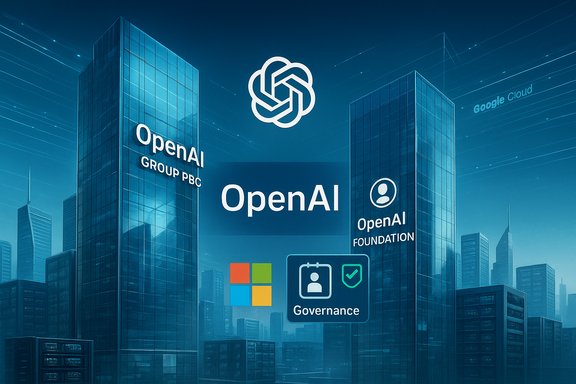
OpenAI began in 2015 as a nonprofit research lab with a singular public‑minded mission: build AGI that benefits all of humanity. Over the past half‑decade that informal mission collided with the practical reality that frontier AI requires eye‑watering capital, bespoke hardware, and continuous engineering scale. The result has been an evolutionary, often fraught, corporate history that moved from nonprofit to a “capped‑profit” subsidiary and — as of October 28, 2025 — to a formal recapitalization that places the operating company into a newly formed Public Benefit Corporation: OpenAI Group PBC, with governance and oversight resting with the reorganized nonprofit, now called the OpenAI Foundation. This is not a simple name change. The legal and commercial architecture of the organization has been rewritten to reconcile three competing forces: the need to preserve a mission and safety guardrails, the need to attract capital and talent through market‑standard equity, and the need to secure massive, timely compute for training next‑generation models.
This is a defining experiment in marrying corporate finance with public benefit. The promise is real: huge philanthropic resources, accelerated scientific capacity, and product innovation anchored to mission language. The perils are equally real: potential mission drift, governance capture, technical fracturing across clouds, and an increasingly contested regulatory environment. The balance between those outcomes will be decided not in press releases but in the details of agreements, regulatory oversight, and the actions of boards, independent panels, and the engineers who deploy these systems into the world.
Major verified developments and figures in this piece were validated against OpenAI’s announcements and Microsoft’s public statement, alongside reporting from established outlets that covered the secondary share sale and the new definitive agreement.
Source: FinancialContent https://markets.financialcontent.co...ship-solidifies-under-public-benefit-mandate/
 Background
OpenAI began in 2015 as a nonprofit research lab with a singular public‑minded mission: build AGI that benefits all of humanity. Over the past half‑decade that informal mission collided with the practical reality that frontier AI requires eye‑watering capital, bespoke hardware, and continuous engineering scale. The result has been an evolutionary, often fraught, corporate history that moved from nonprofit to a “capped‑profit” subsidiary and — as of October 28, 2025 — to a formal recapitalization that places the operating company into a newly formed Public Benefit Corporation: OpenAI Group PBC, with governance and oversight resting with the reorganized nonprofit, now called the OpenAI Foundation. This is not a simple name change. The legal and commercial architecture of the organization has been rewritten to reconcile three competing forces: the need to preserve a mission and safety guardrails, the need to attract capital and talent through market‑standard equity, and the need to secure massive, timely compute for training next‑generation models.What changed — the facts investors, IT teams, and Windows users must know
Below are the load‑bearing facts verified across company statements and independent reporting.- OpenAI completed a recapitalization that converts its commercial arm into OpenAI Group PBC while the nonprofit becomes the OpenAI Foundation and retains controlling oversight.
- Microsoft’s post‑recapitalization economic interest in OpenAI Group PBC is reported at roughly 27%, which Microsoft values at approximately $135 billion. Microsoft says its cumulative investments now exceed $13 billion; independent reporting gives similar tallies.
- OpenAI’s valuation was validated earlier this month by a secondary share sale that enabled employees to sell roughly $6.6 billion of stock at a $500 billion company valuation — a liquidity event widely reported across financial press.
- The new definitive agreement includes a multiyear Azure consumption commitment reportedly valued in the hundreds of billions (public reports cite an incremental $250 billion purchase of Azure services).
- The contract clarifies IP and exclusivity windows: Microsoft retains exclusive IP/distribution rights for certain model/product uses through 2032, while narrower research IP protections persist until 2030 or until an independent expert panel verifies any claim of AGI — the latter a new procedural hiatus intended to avoid unilateral commercial triggers.
- The arrangement formally relaxes strict compute exclusivity: OpenAI can source compute from other partners for many workloads while preserving Azure as the primary channel for API distribution and other product categories.
Why the Public Benefit Corporation (PBC) model matters
What a PBC legally changes
A PBC is a corporate form that allows a company to pursue public benefit objectives alongside financial returns. That legal form matters because it:- Expressly codifies mission into governance documents, rather than leaving mission commitments solely to informal norms.
- Allows conventional equity and market returns to attract institutional capital and to compete in employment markets while providing a statutory pathway for long‑term public benefit priorities.
- Creates a formal channel for the nonprofit (the OpenAI Foundation) to retain controlling oversight and to hold a large equity stake that can fund philanthropic programs.
The Foundation’s initial philanthropy pledge
OpenAI’s board says the OpenAI Foundation will deploy an initial tranche of foundation resources toward two principal areas: health and disease cures and technical work on AI resilience (OpenAI’s own brief references an initial $25 billion commitment for these priorities). This is an attempt to translate equity value into public good at scale. That pledge is notable for its size and for the signaling effect it sends about how a well‑capitalized foundation could shape AI’s social footprint. Caveat: Any large philanthropic commitment of this scale will be executed over many years; the mechanics — governance, grantmaking rules, oversight, and measurable outcomes — are the variables that will decide whether that money meaningfully mitigates AI risks or just creates a high‑profile corporate foundation.The Microsoft deal: what Microsoft gets, what it concedes
Microsoft’s calculus in this agreement is pragmatic and layered.Solidity for Microsoft
- Durable model and product rights: Microsoft’s access to OpenAI’s models and commercial IP is explicitly extended into the early 2030s, preserving the company’s ability to differentiate Windows, Microsoft 365, and enterprise services (including Copilot integrations).
- Deep economic alignment: A roughly 27% stake aligns Microsoft as a principal equity holder; the $135 billion post‑recapitalization figure is consistent with Microsoft’s public commentary.
- Secured channel for enterprise distribution: Azure remains the primary commercial lane for OpenAI’s API products, and Microsoft retains substantial route‑to‑market advantages for embedding models into the Windows and Office ecosystems.
Concessions and strategic hedges
- No absolute cloud exclusivity: Microsoft relinquished blanket exclusivity for compute, allowing OpenAI to run training and specialized workloads on other clouds, third‑party co‑located capacity, or bespoke infrastructure — but the new agreement leaves Microsoft preferential positions (e.g., Azure as the API channel). This move reduces single‑vendor risk for OpenAI at the expense of full Azure control.
- AGI trigger now requires external verification: Microsoft pushed to constrain a previously ambiguous “AGI declaration” trigger that could have suddenly altered commercial rights. That declaration now requires verification by an independent expert panel before AGI‑linked contractual changes occur. This provides Microsoft (and other stakeholders) procedural protections in a scenario with enormous stakes.
What this means for Microsoft’s product stack and Windows users
- Copilot and Microsoft 365 will remain core use cases. Microsoft’s long‑term rights over OpenAI models enable continued, deep Copilot integration across Microsoft 365 and Windows. Expect more aggressive embedding of model capabilities into Office, Windows Copilot, developer tools, and endpoint experiences.
- Enterprise architects should plan for multicloud realities. Training may happen on specialized third‑party capacity while inference and API endpoints remain Azure‑proximate. This hybrid architecture increases the need for standardized model governance, observability, and compliance tooling across providers.
- Developers will see both opportunity and complexity. Joint product development and potential open‑weight releases create pathways for verticalized models and local deployments, but they also raise integration, security, and lifecycle management challenges for Windows‑centric applications.
Market and competitive consequences
For cloud providers
- Azure benefits from guaranteed consumption, but other hyperscalers (AWS, Google Cloud) and specialized providers now have markets to pursue if OpenAI chooses them for training capacity. The deal catalyzes a multicloud infrastructure war for AI‑optimized racks, specialized accelerators, and co‑investment deals.
- Smaller cloud players and colocation specialists will be incentivized to offer differentiated pricing, access to GPUs/TPUs, and operational models to attract frontier AI workloads.
For other AI developers and labs
- OpenAI’s PBC structure and new fundraising flexibility create pressure on competitors to re‑examine governance and funding models. Some labs may emulate hybrid structures; others will lean fully public or private depending on capital needs and regulatory comfort.
- The competitive field for AGI is likely to intensify: multiple commercial models, deeper enterprise integrations, and more rapid productization increase the pace at which incumbents must respond.
Safety, governance, and the AGI verification mechanism
The most consequential governance innovation in the new deal is the independent expert panel required to verify any OpenAI AGI declaration before AGI‑linked commercial clauses are triggered. This procedural buffer attempts to:- Avoid unilateral, self‑serving declarations that would instantly alter commercial arrangements.
- Provide an external, multi‑disciplinary assessment of whether an uploaded milestone qualifies as AGI in a way that materially alters legal obligations.
- Who selects the panel? Composition and selection rules will determine legitimacy and susceptibility to capture.
- What are the verification criteria? Defining AGI precisely enough for adjudication is philosophically and technically fraught.
- How will disputes be resolved? Litigation risk or hard arbitration could follow contested declarations.
Notable strengths of the restructuring
- Realistic capital solution: The PBC model gives OpenAI access to deep pools of capital while attempting to preserve mission control on paper — a pragmatic compromise for an enterprise that consumes unprecedented compute and talent budgets.
- Operational flexibility for scaling: Multicloud and co‑investment paths reduce bottlenecks and accelerate model training cycles, enabling faster iteration and quicker product rollouts.
- Guardrails for existential risk: The AGI verification mechanism and the Foundation’s philanthropic commitments create formal levers for safety‑oriented action and resource allocation to resilience work.
- Commercial clarity for Microsoft and enterprise customers: Extended IP windows give Microsoft predictable access for product roadmaps and allow enterprises to plan around sustained Copilot evolution within Windows and Microsoft 365.
Key risks, unanswered questions, and what to watch
- Mission drift vs. market incentives. A PBC can contain mission language, but market pressures and investor expectations can still push organizations toward profit‑maximizing choices that conflict with public‑interest goals. The degree to which the OpenAI Foundation exercises meaningful constraints — beyond symbolic control — remains to be demonstrated.
- Operational complexity and supply chain risk. Running training across multiple clouds and bespoke infrastructure increases orchestration complexity, security exposure, and vendor management burdens. Misconfiguration or divergence across environments could amplify model‑integrity risks.
- Regulatory and antitrust scrutiny. Long‑range IP arrangements and preferential distribution windows will attract regulator attention in multiple jurisdictions. How the U.S., EU, and other regulators interpret preferential access to foundational models will shape permissible commercial conduct.
- Verification mechanics for AGI. The independent panel’s composition, selection, and decision thresholds are critical design points. Vague standards could lead to paralysis or gaming; overly narrow standards could be misapplied. The panel’s procedural rules must be transparent to gain public trust.
- Unverifiable or evolving figures. Several contract details reported in briefings and press coverage (fine print about research‑category IP carve‑outs, exact timelines for revenue sharing, and the precise cadence for the Foundation’s $25B disbursements) are either summarized in press materials or await publication of full definitive agreements and regulatory filings. Treat those figures as provisional until contracting text is publicly filed or regulators release redacted approvals.
Practical guidance for Windows administrators and enterprise architects
- Audit dependence:
- Catalog where Copilot and Azure OpenAI Service are currently used across endpoints and business processes.
- Identify critical flows that assume single‑cloud continuity.
- Plan for hybrid deployments:
- Design model‑agnostic inference layers that can route calls across providers.
- Standardize observability, logging, and compliance controls that span Azure and non‑Azure inference endpoints.
- Tighten governance:
- Implement model change management and validation pipelines so that model updates from OpenAI can be tested and approved before enterprise rollout.
- Ensure DLP, secrets management, and least privilege controls for any integration that talks to OpenAI APIs.
- Update procurement and legal terms:
- Negotiate Azure contracts with awareness of long‑term consumption commitments and verify exit/transition paths if multicloud inference is required.
- Insist on SLAs for model quality, explainability, and incident response.
- Train staff:
- Provide development and security teams with playbooks for handling model drift, hallucinations, and supply chain vulnerabilities when models run across heterogeneous infrastructure.
Predictions and what to watch next
- Expect a spike in strategic infrastructure deals: hyperscalers, sovereign funds, and specialized co‑location providers will seek to host training clusters or to bid for slices of OpenAI‑scaled capacity.
- OpenAI is likely to accelerate model output cadence; more frequent model refreshes and verticalized partnerships should appear over the next 6–18 months.
- Regulatory and civil society scrutiny will intensify; filings, regulatory approvals, and any litigation (especially from earlier opponents of OpenAI’s conversion) will be the major governance milestones to track.
- Other labs and giants will experiment with hybrid governance models. Watch for announcements that mirror OpenAI’s combination of a philanthropic vehicle plus a capitalized PBC.
Conclusion
The OpenAI recapitalization and the restructured Microsoft partnership mark a major institutional pivot in the AI era. The arrangement binds together mission language, massive capital flows, cloud economics, and a new layer of external verification for the single most consequential milestone in the field — AGI. For Microsoft and Windows users, the near‑term picture is one of continued product advantage and deeper Copilot integration; for the broader ecosystem, it is an acceleration of compute competition, legal complexity, and governance experimentation.This is a defining experiment in marrying corporate finance with public benefit. The promise is real: huge philanthropic resources, accelerated scientific capacity, and product innovation anchored to mission language. The perils are equally real: potential mission drift, governance capture, technical fracturing across clouds, and an increasingly contested regulatory environment. The balance between those outcomes will be decided not in press releases but in the details of agreements, regulatory oversight, and the actions of boards, independent panels, and the engineers who deploy these systems into the world.
Major verified developments and figures in this piece were validated against OpenAI’s announcements and Microsoft’s public statement, alongside reporting from established outlets that covered the secondary share sale and the new definitive agreement.
Source: FinancialContent https://markets.financialcontent.co...ship-solidifies-under-public-benefit-mandate/
