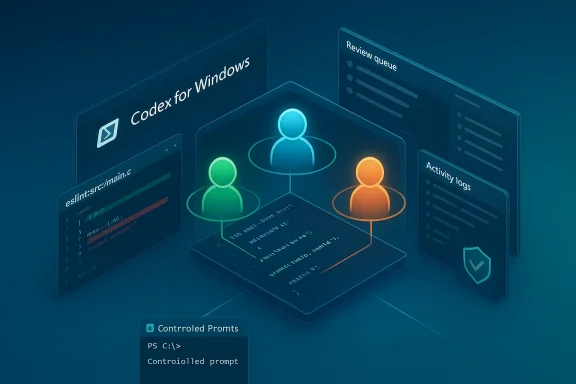
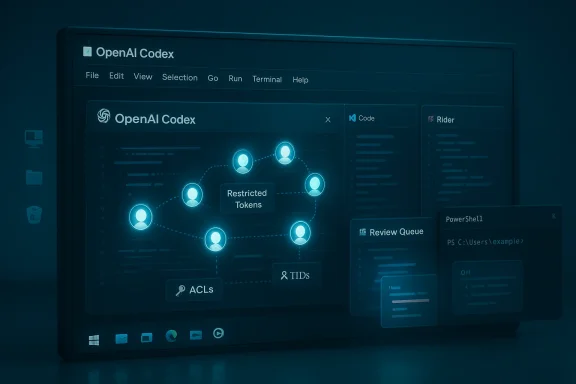
OpenAI’s Codex desktop app has officially arrived on Windows, bringing the company’s agentic coding experience out of macOS and into native Windows developer environments after a rapid rollout that already has the industry talking about adoption, security, and what agentic development means for production software engineering. The Windows version ships with the same multi-agent orchestration, Skills, and Automations that defined the macOS release, but crucially adds a native Windows sandbox and PowerShell-first workflows intended to keep developers working in familiar, secure environments. (openai.com)
When OpenAI first unveiled Codex as an agentic coding product in 2025, the pitch was simple but radical: move beyond single-shot code generation and toward a command center where multiple AI agents can work in parallel, be delegated repeatable tasks, and connect to real developer workflows and external tools. The Codex app for macOS was positioned as the first full-featured desktop client to embody that vision, and OpenAI exapidly—rolling updates, an IDE extension and CLI tools, and public documentation for Skills and Automations. (openai.com)
On March 4, 2026, OpenAI updated its Codex announcement to state that the Codex app is now available on Windows. The Windows release arrives as the broader agentic coding market intensifies, with competitors and integrators—GitHub, Anthropic, and others—moving agent features into IDEs, code hosts, and CI flows. The launch underscores OpenAI’s claim that Codex is intended to work where you develop—in terminals, editors, and desktop workflows—rather than being a browser-only or Mac-only novelty. (openai.com)
Key security and usability goals OpenAI lists:
Multiple news outlets reporting on the Windows release, however, referenced OpenAI’s social posts or company briefings to say the macOS app “topped a million downloads in its first week” and that the Windows waiting list had hundreds of thousands of signups. One independently published roundup cites the Mac app download milestone and claims more than 500,000 developers had signed up for the Windows waiting list before the launch. These figures align with OpenAI’s messaging about rapid uptake, but the precise metric (downloads vs. unique users vs. weekly active users) differs between sources. Readers should treat the exact counts as high-level adoption signals rather than precise telemetry. (the-decoder.com)
In short:
There are practical reasons Windows matters:
I also cross-checked multiple independent news outlets and community posts that reported on download figures and waiting-list sizes. Those outlets rely on OpenAI’s public posts and social statements. The most load-bearing discrepancy concerns the precise meaning of “more than a million” — OpenAI’s post referred to developers using Codex in the past month, while some secondary coverage described macOS downloads hitting one million in a short window. These are consistent signals about rapid adoption, but not identical telemetry; I flag them as such and caution readers that the exact metric varies by statement. (openai.com)
For the Stack Overflow 2025 survey quote about Windows usage, I confirmed that multiple independent summaries of the 2025 Developer Survey report robust Windows usage among developers and that analysts commonly cite figures near the high-40s for professional use and mid-50s for personal use. However, survey sample makeup and question phrasing matter for precise percentages; I therefore recommend treating the Stack Overflow number as directional and consult official survey tables for exact values when making procurement decisions.
That said, the promise of agentic automation comes with real responsibilities:
What to watch in the coming months:
OpenAI’s move to deliver Codex as a first-class Windows app is less a launch than a signal: agentic coding is moving into mainstream developer tooling and enterprises must prepare. Codex bundles a powerful set of primitives—agents, skills, automations—and wraps them in a security-first posture appropriate for Windows environments, but the responsibility for safe, reliable adoption sits squarely with engineering and security teams. Pilot early, govern hard, and measure outcomes—that’s the pragmatic path to capturing the productivity upside without paying the price of operational surprise. (openai.com)
Source: Thurrott.com OpenAI Releases Codex App for Windows
 Background / Overview
When OpenAI first unveiled Codex as an agentic coding product in 2025, the pitch was simple but radical: move beyond single-shot code generation and toward a command center where multiple AI agents can work in parallel, be delegated repeatable tasks, and connect to real developer workflows and external tools. The Codex app for macOS was positioned as the first full-featured desktop client to embody that vision, and OpenAI exapidly—rolling updates, an IDE extension and CLI tools, and public documentation for Skills and Automations. (openai.com)On March 4, 2026, OpenAI updated its Codex announcement to state that the Codex app is now available on Windows. The Windows release arrives as the broader agentic coding market intensifies, with competitors and integrators—GitHub, Anthropic, and others—moving agent features into IDEs, code hosts, and CI flows. The launch underscores OpenAI’s claim that Codex is intended to work where you develop—in terminals, editors, and desktop workflows—rather than being a browser-only or Mac-only novelty. (openai.com)
What’s in the Windows release: features and developer experience
Native Windows sandboxing and PowerShell workflows
One of the defining technical claims for the Windows app is native, system-level sandboxing that OpenAI says mirrors the protections used in the Codex CLI. By default, agents are limited to editing files in the project folder or branch they’re assigned to; they use cached web search results and must explicitly request elevated permissions (for network or system-level commands). For Windows this sandbox is implemented at the OS level and is open-source and configurable, according to OpenAI’s release notes. That design is intended to let agents run inside PowerShell and other Windows-native shells without forcing developers to use WSL or virtual machines for safety reasons. (openai.com) (the-decoder.com)Key security and usability goals OpenAI lists:
- File and branch scoping so agents can only touch a contained part of a repo by default. (openai.com)
- Configurable rules for trusted actions that can be pre-approved for team projects to avoid repetitive permission prompts. (openai.com)
- Open-source sandbox infra so security researchers and IT teams can audit and adapt sandbox behavior. (openai.com)
Multi-agent orchestration, Skills, and Automations
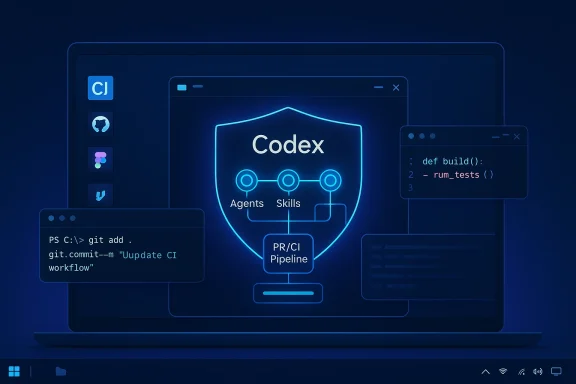
The Codex app is designed around three interlocking primitives:- Agents — independent worker threads that can be orchestrated across a project and run in parallel without blocking a developer’s local work. Agents have histories, produce diffs, and can operate on isolated worktrees. (openai.com)
- Skills — modular packages of instructions, scripts, and resources that let agents connect to tools (CI, issue trackers, cloud hosts, design systems). Skills extend agent capability beyond pure code generation into tasks such as image generation, deployment, test triage, or interaction with Figma and Linear. (openai.com)
- Automations — scheduled or triggerable workflows that let agents run repeatable maintenance tasks (daily triage, CI failure summarization, security scans) and route results into a review queue for a human to inspect. (openai.com)
CLI, IDE, and GitHub integration
Codex is not just a desktop UI. The product strategy explicitly links the Codex app with:- Codex CLI for terminal-first usage and automation.
- IDE extensions (popular editors are supported) so agents can be used inline where engineers edit code.
- GitHub and cloud integration so agent outputs can be turned into PRs, deployments, and issue tracking items.
Confirming the numbers: adoption claims and the data gap
OpenAI’s public post says “in the past month, more than a million developers have used Codex.” That statement refers broadly to Codex usage across the company’s surfaces and does not explicitly equate to macOS downloads. (openai.com)Multiple news outlets reporting on the Windows release, however, referenced OpenAI’s social posts or company briefings to say the macOS app “topped a million downloads in its first week” and that the Windows waiting list had hundreds of thousands of signups. One independently published roundup cites the Mac app download milestone and claims more than 500,000 developers had signed up for the Windows waiting list before the launch. These figures align with OpenAI’s messaging about rapid uptake, but the precise metric (downloads vs. unique users vs. weekly active users) differs between sources. Readers should treat the exact counts as high-level adoption signals rather than precise telemetry. (the-decoder.com)
In short:
- OpenAI: “more than a million developers have used Codex in the past month.” (openai.com)
- Secondary reporting: macOS app download metrics cited as “over one million” and strong Windows waiting-list numbers. These outlets attribute the numbers to OpenAI’s reporting but do not always reproduce the raw data. (the-decoder.com)
Why Windows matters: market context and developer reach
OpenAI framed the Windows release as a strategic step to reach developers where they actually work: not all developers use macOS. OpenAI referenced a Stack Overflow developer survey when discussing developer OS demographics, noting that a substantial share of developers use Windows professionally and personally. Independent summaries of the 2025 Stack Overflow survey also show Windows commanding a large share of professional developer environments—figures reported in secondary coverage place professional Windows usage in the high 40s percent and personal usage above 50 percent in some analyses. Methodology and respondent composition vary across analyses, so the precise percentages are sensitive to survey sample and question wording, but the broad point is clear: Windows is still central to developer workflows.There are practical reasons Windows matters:
- Many enterprise development shops standardize on Windows for .NET, PowerShell-based automation, or Windows-specific tooling.
- Windows remains sizeable in global desktop market share and in corporate endpoints, making a first-class Windows experience critical for enterprise adoption and governance.
Critical analysis: strengths, opportunities, and technical caveats
Strengths
- Native Windows support reduces friction. Allowing agents to run inside PowerShell and a system-level sandbox means developers can integrate agents into existing pipelines without shifting development context to WSL or macOS. That’s an important practical win for developer productivity. (openai.com)
- Modular Skills and Automations map to real operational needs. The product model—agents plus skills plus automations—mirrors common engineering flows: triage, refactoring, test triage, CI failure analysis, and deployment. Skills make agent behavior auditable and shareable across teams. (openai.com)
- Security-by-default posture is a strong baseline. Default file scoping, disabled network access, and configurable approval rules are positive design choices that acknowledge the real risk surface of automated code modifications. Open-sourcing sandbox components invites external audits. (openai.com)
Opportunities
- Teams can embed agentic automation into day-to-day ops. The combination of scheduled automations and review queues is an easy on-ramp to continuous agent-driven maintenance. This could free engineers from repetitive administrative tasks and let them focus on design and complex problem solving. (openai.com)
- Skill-checking into repositories enables reproducibility. Sharing skills as code in repos opens the door to CI-based testing of agent workflows, versioned agent behaviors, and safer rollouts. (openai.com)
Caveats and risks
- Trust-but-verify is still mandatory. Agent-produced code needs the same scrutiny as any external contribution: security review, static analysis, license checks, and human-in-the-loop code review. Automated agents can introduce subtle logic errors or unsafe dependency pulls that static checks may miss. OpenAI’s sandbox and approval flows help, but they are mitigations, not guarantees. (openai.com)
- Supply-chain and dependency risks. Skills and automations that pull public packages, download binaries, or interact with external APIs can inadvertently introduce supply-chain vulnerabilities unless teams enforce strict vetting and pinning of dependencies. (openai.com)
- Operational surprise and over-automation. The ability to run agents asynchronously and to schedule automations can create “automation debt” if teams lack observability, alerting, and clear ownership for agent-driven changes.
- Platform parity and UX edge cases. Early user reports show the Windows release is new enough to have edge-case issues (store-install variations, update flows, encoding quirks when agents run PowerShell vs. WSL). These are expected with a first-class release but matter to engineers shipping production code. Early community threads document installation and runtime quirks that will need attention as the Windows experience matures.
How IT and engineering teams should evaluate Codex for Windows (practical checklist)
- Inventory high-risk touchpoints. Identify repos, CI jobs, deployment pipelines, and credentials an agent could access if granted elevated permissions. Map them to minimal-scope sandbox policies. (openai.com)
- Start with review-only workflows. Use Codex to generate PR drafts and automated diffs routed to a human review queue before any push to trunk. Validate CI and linters as non-bypassable gates. (openai.com)
- Version and pin Skills. Treat Skills like code—store them in repositories, require PR reviews for changes, and pin dependencies to avoid supply-chain drift. (openai.com)
- Audit sandbox and policy settings. Confirm default sandboxing behavior on Windows matches your organizational risk tolerance and test edge-case behavior (file-system scoping, process spawning, network requests). (openai.com)
- Monitor agent outputs in production-adjacent environments. Agents can run long tasks; route their activity through observability dashboards and maintain an audit trail for accountability. (openai.com)
Competition, integration, and the broader agentic landscape
Codex’s Windows launch comes as other players move aggressively into agent-driven developer tooling. Microsoft’s Copilot family and GitHub’s agent integrations have been expanding in IDEs and cloud CI, while Anthropic and other startups push specialized agentic assistants for coding. Notably, third-party platforms are also integrating multiple agent backends so developers can choose which model to use inside GitHub or an IDE. This interoperability trend signals two likely short-term outcomes:- Engineers will prefer agent surfaces that augment their existing toolchains (IDE + terminal + CI) rather than force migration to a single vendor app.
- Security and governance tooling will become differentiators. Vendors that offer strong audit trails, repository-based policies, and easy enforcement will find traction in enterprises.
Community signals and early user feedback
Community reaction to the macOS launch and early Windows availability has been energetic. Forums and social threads show:- Rapid signups and interest from developers who want native Windows workflows and a desktop command center for agentic work. (the-decoder.com)
- Early-adopter pain points around installation source (store vs. standalone installers), Windows-specific encoding in PowerShell, and update flows. These are typical for a 1.0 cross-platform push and are being discussed in developer communities.
Verifications and caveats about the reporting
I verified the core product claims—Windows availability, native Windows sandboxing, Automations, Skills, multi-agent orchestration, and account-level cross-surface usage—directly from OpenAI’s product post that was updated to announce Windows availability on March 4, 2026. Those sections include explicit notes about sandboxing, skill sharing, automations, and availability across account tiers. (openai.com)I also cross-checked multiple independent news outlets and community posts that reported on download figures and waiting-list sizes. Those outlets rely on OpenAI’s public posts and social statements. The most load-bearing discrepancy concerns the precise meaning of “more than a million” — OpenAI’s post referred to developers using Codex in the past month, while some secondary coverage described macOS downloads hitting one million in a short window. These are consistent signals about rapid adoption, but not identical telemetry; I flag them as such and caution readers that the exact metric varies by statement. (openai.com)
For the Stack Overflow 2025 survey quote about Windows usage, I confirmed that multiple independent summaries of the 2025 Developer Survey report robust Windows usage among developers and that analysts commonly cite figures near the high-40s for professional use and mid-50s for personal use. However, survey sample makeup and question phrasing matter for precise percentages; I therefore recommend treating the Stack Overflow number as directional and consult official survey tables for exact values when making procurement decisions.
The verdict: adoption, prudence, and what to watch next
OpenAI’s Codex on Windows is an important milestone for agentic development. It reduces friction for a large portion of the developer population by delivering native sandboxing and PowerShell workflows—two features enterprises will care about for governance and integration. The product’s multi-surface approach (app, CLI, IDE, cloud) and the Skills/Automations model are well-aligned with how teams already build and ship software. (openai.com)That said, the promise of agentic automation comes with real responsibilities:
- Security and supply-chain risk remain front and center. Sandboxing and off-by-default network permissions are necessary but not sufficient guards.
- Teams must establish human-in-the-loop processes, CI gates, and auditability before delegating critical changes.
- Early Windows adoption will reveal platform-specific edge cases—OpenAI and partners will need to iterate quickly on installer and encoding issues flagged by early users.
What to watch in the coming months:
- How enterprises adopt repository-based Skills and whether that practice becomes a default for team governance. (openai.com)
- The degree to which GitHub, Microsoft, and other vendors integrate multiple agent backends and standardize audit/approval APIs.
- OpenAI’s continued transparency around telemetry (downloads vs. active users) and whether third-party auditors can validate sandbox guarantees. (openai.com)
OpenAI’s move to deliver Codex as a first-class Windows app is less a launch than a signal: agentic coding is moving into mainstream developer tooling and enterprises must prepare. Codex bundles a powerful set of primitives—agents, skills, automations—and wraps them in a security-first posture appropriate for Windows environments, but the responsibility for safe, reliable adoption sits squarely with engineering and security teams. Pilot early, govern hard, and measure outcomes—that’s the pragmatic path to capturing the productivity upside without paying the price of operational surprise. (openai.com)
Source: Thurrott.com OpenAI Releases Codex App for Windows