

OpenAI’s promotion of Pragya Misra to Head of Strategy & Global Affairs, India marks a decisive escalation in the company’s India play — and more broadly signals a strategic shift in how frontier AI firms operationalize international growth. The move consolidates product, policy, partnerships and ecosystem development under a single Indian leadership remit at a time when OpenAI is simultaneously localizing pricing, launching education programs, registering a local entity, and preparing a first India office in New Delhi. For WindowsForum’s technically minded audience, this story is about more than personnel: it’s a case study in how platform-scale AI providers balance commercial expansion, regulatory engagement, and operational sovereignty when entering complex, high-growth markets.
Pragya Misra joined OpenAI in 2024 as the company’s first India hire to lead public policy and partnerships. In late 2025 she announced an expanded role — Head of Strategy & Global Affairs, India — tasked with crafting a single, long-term India strategy across product, policy, partnerships and ecosystem-building. This elevation arrives alongside multiple India‑targeted initiatives: the launch of an India-first education program called OpenAI Academy India, tailored commercial pricing with the ChatGPT Go subscription aimed at price‑sensitive users, registration of a local OpenAI entity, and plans to open the company’s first physical office in New Delhi.
Taken together, the initiatives paint a clear picture: OpenAI intends to move beyond exporting U.S.-centric models and instead co-develop with Indian partners to localize access (language, cost, developer support), engage policy makers, and embed AI capacity into national digital-strategy goals such as the IndiaAI Mission.
What this change enables:
Concrete program features include:
Why that matters:
What this accomplishes:
Partner strategies to watch:
The opportunity is immense: talent, scale and a digitally literate population create fertile ground for AI-driven productivity gains across education, healthcare, agriculture and enterprise software. The risks are equally real: regulatory complexity, data sovereignty demands, political scrutiny, and the monetization squeeze of low-price market entry.
For technologists, enterprise buyers and developers in India and beyond, the unfolding months will reveal whether OpenAI’s India-first moves translate into durable infrastructure, responsible governance models, and commercially viable ecosystems — or whether the company, like many global platforms before it, will discover that deep localization requires far more than a country-level pricing tier and a local office. The difference will be in execution: building trust, delivering affordable and safe products, and embedding capabilities that align with India’s national AI ambitions without sacrificing global safety and governance commitments.
Source: Storyboard18 OpenAI elevates Pragya Misra to lead India strategy as the AI firm deepens its focus on India
 Background / Overview
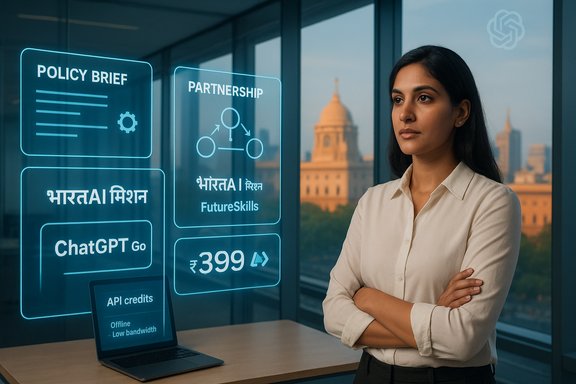
Pragya Misra joined OpenAI in 2024 as the company’s first India hire to lead public policy and partnerships. In late 2025 she announced an expanded role — Head of Strategy & Global Affairs, India — tasked with crafting a single, long-term India strategy across product, policy, partnerships and ecosystem-building. This elevation arrives alongside multiple India‑targeted initiatives: the launch of an India-first education program called OpenAI Academy India, tailored commercial pricing with the ChatGPT Go subscription aimed at price‑sensitive users, registration of a local OpenAI entity, and plans to open the company’s first physical office in New Delhi.Taken together, the initiatives paint a clear picture: OpenAI intends to move beyond exporting U.S.-centric models and instead co-develop with Indian partners to localize access (language, cost, developer support), engage policy makers, and embed AI capacity into national digital-strategy goals such as the IndiaAI Mission.
Why this matters: scale, policy, and product-market fit
India offers a rare combination of scale and structural complexity that makes it both a major market opportunity and a strategic testbed.- Scale: India has one of the world’s largest developer ecosystems and a vast consumer internet population. OpenAI’s leadership has publicly described India as a top-two market by user base, with user adoption reported to have grown multiple times year-over-year.
- Policy: The Indian government is actively shaping an AI industrial strategy through the IndiaAI Mission, emphasizing local capacity building, skills, and trust frameworks. That creates both partnership opportunities and regulatory demands for international AI firms.
- Price sensitivity and localization: Consumer price expectations and regional language requirements necessitate different commercial and product choices than those used in Western markets.
What OpenAI is doing in India: the pillars of the strategy
1) Local leadership and unified strategy
By elevating Pragya Misra into a role that explicitly spans strategy and global affairs, OpenAI signals an intent to coordinate commercial, policy and ecosystem work from a single India-focused locus. That matters operationally: siloed approaches (separate policy, product, partnerships teams) struggle to reconcile tradeoffs between pricing, safety controls, and infrastructure commitments in complex regulatory environments.What this change enables:
- Cross-functional alignment on product localization (languages, offline / low-bandwidth experiences) and pricing tiers tailored for Indian consumers and SMBs.
- Faster, higher-bandwidth engagement with the IndiaAI Mission, state governments, and public-sector skilling initiatives.
- More coherent partnerships with local cloud, telco and infrastructure players for compute and distribution.
2) Education and capacity building: OpenAI Academy India
OpenAI’s first global education rollout in India — the OpenAI Academy — is a central piece of its long-term strategy. The Academy is structured as a hybrid skilling program: online modules in English and Hindi, plans to expand into regional languages, offline workshops in major cities, and integration with government platforms for civil‑service capacity-building.Concrete program features include:
- A memorandum of understanding with IndiaAI to align with the government’s FutureSkills pillar.
- Commitments to training large cohorts of teachers and students, running hackathons across states, and supplying API credit support to vetted startups/fellows.
- Skills-building cements developer adoption and helps establish OpenAI as a partner for national capacity rather than only a vendor.
- Collaboration with government platforms (FutureSkills, iGOT) situates OpenAI inside India’s public-sector education and workforce pipelines — and makes policy alignment easier.
3) Price and product localization: ChatGPT Go and UPI payments
OpenAI launched a country-specific subscription plan for India — ChatGPT Go — positioned as a lower-cost tier priced at ₹399 per month. The offering includes expanded usage quotas relative to the free tier, extended memory, access to newer model variants, and support for local payment rails such as UPI.Why that matters:
- Price is a critical adoption lever in India. Local pricing and UPI integration reduce friction and broaden accessibility to students, creators, and SMBs.
- Country-specific tiers indicate OpenAI is testing regional differentiation as a growth tactic — a departure from a one-size-fits-all pricing strategy.
4) Local entity, office and infrastructure conversations
OpenAI has registered an Indian entity and announced plans to open an office in New Delhi, with active local hiring. At the same time it is exploring partnerships for AI infrastructure development, including broader initiatives to embed foundational AI capacity in national markets.What this accomplishes:
- A local legal entity simplifies commercial contracting, compliance, tax and hiring in India.
- A physical office and local staff enable deeper government engagement — often essential in markets with strong public-sector influence on tech policy.
- Infrastructure talks indicate an interest in on‑shore compute and data capabilities, relevant to data sovereignty and latency-sensitive applications.
Critical analysis — strengths, execution risks, and market dynamics
Strengths
- Clear alignment between policy and product. Centralizing strategy under an India head who blends policy expertise with partnership experience strengthens OpenAI’s ability to respond to regulatory expectations while tailoring product features.
- Smart use of education and credits to bootstrap developer ecosystems. The OpenAI Academy plus API credits targets both the supply side (developers, startups) and demand side (students, teachers) — a measured way to cultivate adoption and native workloads.
- Pricing and payments adapted for local realities. Country-specific pricing and UPI integration remove major adoption barriers; that is a decisive commercial advantage over firms that retain globalized price points.
- Public commitment to local presence. Setting up a local entity and an office demonstrates seriousness to government and partners — not merely a marketing pledge.
Execution risks and friction points
- Regulatory exposure and policy unpredictability. India’s AI regulatory architecture is evolving, and requirements around transparency, safety labeling, data governance, and potential content controls introduce compliance complexity. OpenAI will need robust legal, safety and engineering guardrails localized for Indian law and norms.
- Data localization expectations and national security sensitivities. Any move towards hosting models or data locally will trigger questions around access, audits, and lawful interception. Negotiating data residency without compromising model integrity or global safety commitments is non-trivial.
- Local competition and partnerships with incumbents. Rapid growth has prompted robust home‑grown AI startups, large cloud incumbents, and telcos to propose alternative value chains. OpenAI’s strategy must avoid being boxed into commoditized model-provider roles while allowing partners to retain differentiation.
- Political and reputational risk. Working closely with government initiatives brings benefits but also places firms under public scrutiny. Perceptions of capture, censorship facilitation, or unfair competitive advantage for partner firms could generate backlash.
- Economic sustainability of subsidized pricing. Low-price offerings and extended free promotions accelerate scale but can compress margins and set expectations that are hard to monetize later. India-first low-cost tiers will need clear upgrade paths and enterprise monetization funnels.
Policy and governance considerations: the hard trade-offs
India’s policy environment is at a crossroads: the state is actively seeking to build domestic AI capacity while also implementing safety and trust guardrails. For OpenAI, this creates several policy trade-offs.- Transparency vs. competitive secrecy: regulators and civil society will demand auditability and explainability for high-impact AI deployments. OpenAI must balance model IP protections with sufficient transparency to meet legal and ethical standards.
- Labelling and content governance: proposals to require AI output labelling and takedown mechanisms will force platform-level changes. OpenAI must design systems that can identify AI-generated content at scale and comply with takedown rules without undermining service reliability.
- Data protection and cross-border flows: if India tightens rules on cross-border data transfers or classifies certain datasets as sensitive, multinational model providers will need robust data partitioning and localized model serving strategies.
- Responsible experimentation: open access to powerful models accelerates innovation but increases the risk of misuse (fraud, disinformation, biological risk vectors). Partnering with government and research institutions to create safety-first pathways will be necessary.
Competitive landscape and partner play
OpenAI’s India strategy will play out against active competition:- Global rivals such as Google, Meta, Anthropic and Perplexity are intensifying regional investments and local partnerships.
- Indian incumbents and startups are rapidly developing localized models, often optimized for low-cost inference and regional language support.
- Telcos and cloud providers (including Indian subsidiaries of hyperscalers) are positioning themselves as infrastructure and distribution partners; their role in payments, device bundling and last-mile distribution is strategic.
Partner strategies to watch:
- Telco bundling (preloaded ChatGPT experiences on low-cost devices or telco plans).
- Cloud partnerships for on‑shore inference and enterprise data handling.
- Association with public‑sector procurement for education, healthcare, or agriculture use cases.
Technical and product implications for Windows users and developers
For WindowsForum’s community, the OpenAI India strategy has tangible implications:- Localized model access may improve latency and reduce costs for developers building India-focused Windows apps or cloud-connected productivity tools.
- Lower-cost consumer tiers and UPI support expand the addressable market for app developers monetizing through in-app AI features.
- OpenAI Academy materials and hackathons create a pathway for Windows developers in India to learn model APIs, integrate AI into desktop and cloud applications, and access API credits for prototyping.
- If OpenAI pursues local data centers or inference regions, enterprise Windows deployments requiring data residency may find easier compliance paths for hybrid on-prem + cloud architectures.
- New SDKs or localized endpoints optimized for regional languages and lower compute footprints.
- Billing changes with country-specific tiers and enterprise-reseller models.
- Additional compliance requirements (logging, content labelling, data export controls) to be built into enterprise applications.
What to watch next — milestones and red flags
Key near-term milestones that will validate execution:- Opening of the New Delhi office and hiring of product, engineering and compliance staff in India.
- Scale and uptake metrics from the OpenAI Academy: number of trained teachers, students, and startups awarded API credits.
- Actual enterprise partnerships (telco deals, cloud-hosting agreements, education deployments) that show monetization beyond consumer promotions.
- Product updates demonstrating regional-language improvements and offline/low-bandwidth experiences.
- Regulatory pushback or legal challenges arising from content moderation, data handling or procurement that could slow deployments.
- Rapid churn in India-specific pricing (if subsidies are withdrawn) that dampens user trust.
- Public controversies around misuse of models in the region without clear mitigation frameworks.
Strategic recommendations for stakeholders
For Indian developers and startups:- Leverage the Academy and API credit windows to prototype regionally relevant solutions, but architect systems to be cloud‑agnostic in case vendor dynamics shift.
- Prioritize localization (languages, cultural contexts) and lightweight models to serve low-connectivity users.
- Evaluate hybrid deployment architectures that allow local inference where data residency or latency matter, while keeping global model access for less sensitive workloads.
- Demand contractual clarity on model updates, data use, and auditability when engaging with OpenAI or similar providers.
- Push vendors for transparent, measurable commitments on safety, accountability and equitable access.
- Invest in public‑interest research partnerships that can independently evaluate model behavior in Indian languages and domains.
Conclusion
OpenAI’s elevation of Pragya Misra to a unified India strategy role, paired with concrete local initiatives — from the OpenAI Academy to ChatGPT Go pricing and a new legal presence inside India — represents a mature internationalization approach: marry product adaptation with policy engagement, and build partnerships to co-create demand and supply-side capacity. The strategy recognizes that winning in India is not merely a commercial endeavor but also a governance and ecosystem challenge.The opportunity is immense: talent, scale and a digitally literate population create fertile ground for AI-driven productivity gains across education, healthcare, agriculture and enterprise software. The risks are equally real: regulatory complexity, data sovereignty demands, political scrutiny, and the monetization squeeze of low-price market entry.
For technologists, enterprise buyers and developers in India and beyond, the unfolding months will reveal whether OpenAI’s India-first moves translate into durable infrastructure, responsible governance models, and commercially viable ecosystems — or whether the company, like many global platforms before it, will discover that deep localization requires far more than a country-level pricing tier and a local office. The difference will be in execution: building trust, delivering affordable and safe products, and embedding capabilities that align with India’s national AI ambitions without sacrificing global safety and governance commitments.
Source: Storyboard18 OpenAI elevates Pragya Misra to lead India strategy as the AI firm deepens its focus on India
