
 Nvidia Won the First AI War by Selling the Whole Battlefield
Nvidia’s dominance did not happen simply because it built fast chips. It won because it sold a complete computing platform at exactly the moment deep learning became industrial infrastructure. CUDA, GPUs, high-bandwidth memory, networking, libraries, developer tooling, and a decade of machine-learning familiarity made Nvidia the default answer to a question most companies were barely ready to ask.
That default answer became very expensive. Training frontier models required staggering clusters of H100s and then Blackwell systems, while inference turned into a daily operating cost measured in tokens, latency, watts, racks, and cloud bills. Once AI moved from demo to product, the economics changed. The expensive part was no longer just building the model; it was serving the model every time a user asked for a summary, a code fix, a spreadsheet formula, or an image.
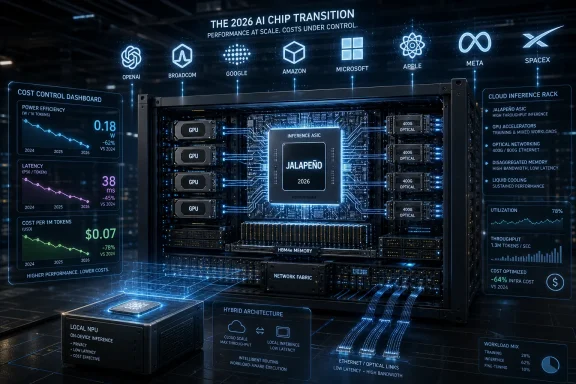
That is why OpenAI’s Jalapeño matters. A custom inference chip built with Broadcom is not primarily a trophy for a company that wants to look like Apple. It is an attempt to bend the cost curve of ChatGPT, Codex, API workloads, and future agentic products by matching silicon to the exact workloads OpenAI expects to run at massive scale.
Nvidia remains the kingmaker. But the biggest AI buyers are no longer content to be merely buyers.
Jalapeño Is a Cost Story Wearing a Strategy Costume
The name is playful; the strategy is not. OpenAI’s first custom chip is aimed at inference, the phase where a trained model generates responses for users. That distinction matters because inference is the part of AI that becomes unavoidable if a product succeeds.
Training is glamorous because it produces the frontier model. Inference is the utility bill. Every ChatGPT answer, every Codex coding session, every API call, every agentic workflow that runs in the background pushes compute consumption from episodic research spending into continuous industrial demand.
A general-purpose GPU is excellent precisely because it can do many things well. A custom inference ASIC can instead decide what it does not need to do. If OpenAI knows the shapes of its models, the memory patterns of its serving stack, the precision formats it prefers, and the latency envelope its products require, it can trade flexibility for efficiency.
That does not make Jalapeño an Nvidia killer. It makes it a pressure valve. OpenAI can use Nvidia GPUs for frontier training and flexible workloads while shifting some high-volume inference onto silicon designed around its own software. In a business where milliseconds, megawatts, and margins compound, that is not a side quest.
The Broadcom partnership also tells us something important about the new AI hardware race. The hyperscalers and model labs may want proprietary chips, but they do not necessarily want to become semiconductor companies from first principles. Broadcom gives them ASIC implementation, networking, connectivity, and production muscle. The customer brings the workload; Broadcom helps turn it into hardware.
The Real Breakup Is With Single-Supplier Thinking
The custom-chip boom is often framed as a campaign to “beat Nvidia,” but that is too simple. What these companies are really attacking is single-supplier risk. Nvidia can remain dominant and still become less central to every incremental AI deployment.
Single-supplier risk has several faces. There is the obvious supply problem: if every major AI company wants the same accelerators, delivery schedules become strategic bottlenecks. There is the pricing problem: when demand runs far ahead of supply, buyers have little leverage. There is the roadmap problem: even a brilliant vendor optimizes for a broad market, not one customer’s exact product architecture.
Then there is the political and operational problem. AI infrastructure now sits at the intersection of export controls, energy constraints, national industrial policy, cloud competition, and corporate survival. No board wants its core product roadmap to depend entirely on one merchant silicon vendor, however capable that vendor may be.
This is why the custom silicon trend spans companies that otherwise look very different. Google has TPUs. Amazon has Trainium and Inferentia. Microsoft has Maia. Meta has MTIA. Apple has turned silicon integration into a corporate doctrine. SpaceX designs chips where power, reliability, radiation tolerance, volume, and vertical control intersect. OpenAI is joining that club because compute is now as strategic to an AI lab as oil reserves are to an energy company.
The shared logic is control. Not total control, because no one fully controls the semiconductor supply chain. But more control than waiting in line.
Apple Showed the Industry What Vertical Integration Can Buy
The obvious comparison is Apple’s break with Intel, and for once the analogy is useful. Apple did not abandon Intel because Intel chips were bad. It moved because owning the silicon roadmap let Apple align performance, battery life, industrial design, operating systems, developer frameworks, and product timing in a way a general-purpose supplier could not.
The AI companies are chasing a similar prize inside the data center. They want accelerators that reflect their models, their compilers, their serving software, their networking assumptions, and their thermal budgets. The gains are not just in raw benchmark numbers. They come from the entire system becoming less generic.
That is especially important for inference. A consumer device feels slow when an app stutters; an AI service feels expensive when every answer consumes too much compute. The equivalent of Apple’s battery-life breakthrough in AI may be lower cost per useful token, higher throughput per watt, and more predictable latency under load.
There is also a cultural lesson. Apple’s silicon transition worked because it controlled the operating system, developer tools, hardware design, and customer experience. AI companies want the same full-stack advantage, but they face a messier environment. Their models change quickly, their workloads are not always stable, and their data centers depend on suppliers for advanced packaging, memory, optics, networking, manufacturing, and power delivery.
Still, the direction is clear. The companies that own the demand are trying to own more of the stack beneath it.
Broadcom Becomes the Arms Dealer of the Anti-Monoculture
If Nvidia is the monarch of merchant AI acceleration, Broadcom is becoming the quiet architect of the custom alternative. That is not a contradiction. Broadcom is not trying to sell every startup a GPU with a developer ecosystem. It is helping the largest infrastructure buyers build bespoke silicon that never needs to appear on a retail price list.
This is a different business model. Nvidia sells a platform that many customers can use. Broadcom helps a small number of very large customers turn predictable, high-volume workloads into custom accelerators and networking systems. The resulting chips may be invisible to ordinary users, but they can reshape the economics of the services those users touch every day.
OpenAI’s Jalapeño follows that pattern. The chip is part of a broader compute platform rather than a standalone component. The surrounding system matters: boards, racks, networking, connectivity, power delivery, and integration with existing data-center partners. In modern AI, the chip is the headline, but the system is the product.
This is also where WindowsForum readers should pay attention. The desktop GPU wars are familiar; the data-center AI wars are increasingly about custom rack-scale systems that ordinary buyers will never purchase directly. Yet these systems will determine the cost, speed, availability, and privacy architecture of the AI features that land in Windows, Office, browsers, IDEs, and cloud services.
The AI PC is only one edge of the story. The bigger fight is over the servers answering the AI PC’s requests.
The Inference Shift Changes Who Has Leverage
During the first phase of the generative AI boom, training dominated the imagination. Bigger clusters, bigger models, bigger benchmark claims, bigger fundraising rounds. That made Nvidia’s most powerful GPUs the scarce resource around which the industry organized itself.
The next phase is less cinematic and more brutal. Once AI products reach hundreds of millions of users, inference becomes the place where profit margins go to be tested. A model that is impressive in a lab can be ruinous in production if every answer costs too much to serve.
That is why inference chips are proliferating. They are not necessarily better at everything. They are better at being boring in exactly the right way: running repeated, known workloads at scale with lower cost and power draw. The less exotic the workload becomes, the more attractive specialization looks.
This is also why custom chips will coexist with GPUs. The frontier keeps moving, and model architectures are still in flux. GPUs remain valuable because flexibility matters when researchers are changing kernels, architectures, precision formats, and training methods. ASICs shine when a company knows enough about its workload to harden assumptions into silicon.
The strategic question is not whether Nvidia disappears. It is how much of the industry’s steady-state AI compute migrates to custom silicon once workloads mature.
Nvidia’s Moat Is Still Real, But It Is No Longer Untouchable
It would be foolish to mistake diversification for defeat. Nvidia still has the strongest software ecosystem, the deepest developer familiarity, and a hardware roadmap built around the needs of AI factories. Its networking assets, rack-scale systems, and CUDA inertia remain formidable.
But moats change when customers become rich enough and motivated enough to build bridges across them. Google did not wait for the GPU market to solve every internal workload. Amazon did not build Trainium and Inferentia for fun. Microsoft did not create Maia because it lacked access to Nvidia. Meta did not invest in MTIA because merchant accelerators suddenly stopped working.
These companies are acting because their scale changes the calculation. For a smaller company, designing a chip is madness. For a hyperscaler running vast internal workloads, shaving cost from inference can justify enormous engineering investment. The larger the workload, the more valuable specialization becomes.
Nvidia’s risk is not that everyone leaves. It is that the best customers become more selective. They buy Nvidia where they need flexibility, peak performance, fast time-to-market, or compatibility, while routing stable high-volume work to internal silicon. That is a subtler threat than a dramatic collapse, but it is exactly the kind of margin pressure that changes a market over time.
The company can respond, and it is already doing so, by selling more complete systems, accelerating roadmaps, and embedding itself deeper into the data-center stack. Nvidia does not need to own every chip socket to remain enormously powerful. But the age when AI infrastructure looked like an almost automatic Nvidia purchase order is fading.
SpaceX Shows the Same Instinct in a Harsher Environment
SpaceX belongs in this conversation not because it is building ChatGPT-style inference silicon, but because it represents the same philosophy taken to an extreme. When hardware is central to your mission and off-the-shelf parts impose too many constraints, you pull more design in-house.
For rockets, satellites, terminals, and communications networks, the constraints are different from an AI data center. Power, cost, reliability, manufacturability, latency, radiation, and volume matter in combinations that ordinary suppliers may not optimize for. SpaceX’s advantage has long been its willingness to treat hardware, software, manufacturing, and operations as one system.
That mindset is now spreading across AI infrastructure. The old enterprise model was to buy servers, install software, and negotiate support contracts. The hyperscaler model is to co-design everything from the chip to the rack to the cooling loop to the data-center power envelope.
This is why the custom silicon trend feels bigger than a chip cycle. It reflects a broader industrial lesson: when a technology becomes core enough, companies stop treating infrastructure as a commodity. They start treating it as product strategy.
For AI labs, compute is no longer just an input. It is a competitive weapon.
The Windows Angle Is Less About GPUs and More About Where AI Runs
For Windows users, the custom-chip story can feel remote. Most people will never touch a Jalapeño board, a Google TPU pod, an AWS Trainium cluster, or a Microsoft Maia rack. But the consequences will show up in familiar places.
AI features in Windows, Microsoft 365, GitHub, Edge, Teams, security tools, and developer workflows increasingly depend on a split between local NPUs and cloud inference. The local NPU handles lightweight, private, latency-sensitive tasks. The cloud handles larger models, heavier reasoning, multimodal generation, and enterprise-scale automation.
If cloud inference gets cheaper, vendors can ship more AI features without charging absurd prices for every interaction. If it stays expensive, AI becomes a metered luxury, bundled into premium subscriptions, throttled by usage caps, or quietly degraded during peak demand. Silicon economics become product policy.
Administrators should care for another reason: infrastructure diversity affects reliability and procurement. A cloud service backed by multiple accelerator types may be more resilient to supply shocks, but it may also behave less predictably across regions and workloads. Performance differences that are invisible in marketing can matter when an enterprise builds workflows around latency, throughput, compliance boundaries, or data residency.
Developers should care because hardware specialization eventually leaks upward. Compilers, runtimes, model formats, quantization strategies, and serving frameworks adapt to the accelerators beneath them. Today’s “cloud AI API” may feel hardware-neutral, but the incentives of the provider are anything but neutral.
Custom Silicon Will Not Save Everyone From the Laws of Physics
There is a danger in treating custom chips as magic. They are not. They do not eliminate the need for advanced manufacturing, high-bandwidth memory, packaging capacity, power infrastructure, cooling, or networking. They also do not remove the execution risk that comes with taping out complex silicon.
A custom chip can be late. It can underperform. It can be hard to program. It can fit yesterday’s model architecture better than tomorrow’s. It can save money in theory and disappoint in production if utilization, software support, or supply-chain assumptions fail.
The AI industry has also entered a phase where power may be as important as silicon. Gigawatt-scale data-center plans are no longer science fiction; they are procurement strategy. A more efficient accelerator helps, but it still needs electricity, land, cooling, grid interconnection, and political permission. The chip is only one bottleneck in a system full of bottlenecks.
That is why Nvidia’s integrated approach remains powerful. Customers do not just buy chips because they like the logo. They buy working systems, software compatibility, predictable performance, and a vendor roadmap that absorbs some integration pain. Custom silicon shifts control back to the buyer, but it also shifts responsibility.
The winners will be companies that can make the whole stack work, not companies that merely announce a chip.
The Software Stack Is the Trap Door Under Every Hardware Plan
Hardware announcements are clean. Software migrations are not. The hardest part of reducing Nvidia dependence is often not the arithmetic of silicon cost; it is the gravity of CUDA, libraries, kernels, developer habits, debugging tools, and production workflows.
Hyperscalers can absorb that pain because they control the workload. If a company owns the model, the serving stack, the scheduler, the compiler path, and the data center, it can make a custom accelerator look invisible to the product team. That is the luxury OpenAI, Google, Amazon, Microsoft, and Meta have.
Everyone else has a harder choice. Enterprises want portability, not a science project. Developers want APIs, not hardware caveats. Startups want to ship, not rewrite kernels for each cloud’s favorite accelerator. That keeps Nvidia in a strong position because the broader ecosystem still rewards the platform with the least friction.
This is where the market may split. Inside the hyperscaler, custom chips eat more work. Outside the hyperscaler, Nvidia remains the common language. The public cloud may expose custom accelerators to customers, but the adoption curve will depend on whether the software experience feels like an upgrade or a tax.
If the industry wants a true Nvidia alternative, it needs not only chips but also boring, reliable, well-supported software paths. Hardware opens the door; software decides who walks through it.
The AI Chip War Is Becoming an Infrastructure Policy Story
There is another layer beneath all this: geopolitics. AI accelerators are now strategic goods. Export controls, domestic manufacturing subsidies, memory supply, Taiwan risk, and national AI ambitions all shape who can buy what, where, and when.
Custom silicon gives American tech giants more leverage, but it does not make them sovereign. Most advanced accelerators still depend on a small set of manufacturing and packaging capabilities. High-bandwidth memory is concentrated among a few suppliers. Cutting-edge production remains exposed to geopolitical risk.
That makes the “build our own chips” narrative slightly misleading. OpenAI can design Jalapeño with Broadcom, but it still participates in a global semiconductor system. Apple can design world-class silicon, but it still depends on foundry execution. SpaceX can vertically integrate aggressively, but it cannot wish away the realities of materials, fabrication, and supply.
The real trend is not self-sufficiency. It is bargaining power. Companies want enough control to shape their own roadmaps, enough supplier diversity to avoid hostage dynamics, and enough internal expertise to know when vendors are solving their problems versus selling whatever is already on the truck.
That is rational. It is also expensive. Only a small number of companies can afford to play this game at the highest level.
The Cloud Giants Are Turning Chips Into Subscription Economics
The most important economic effect of custom silicon may be hidden inside cloud pricing. If AWS can run certain inference workloads more cheaply on Inferentia, it can price services differently, protect margins, or both. If Microsoft can route internal Copilot workloads onto Maia where appropriate, it can reduce dependence on outside GPUs while shaping Azure’s cost base. If Google can use TPUs across Gemini and Cloud customers, it can turn years of silicon investment into platform differentiation.
This is not just about saving money. It is about deciding which AI features can become default. A service that costs too much to run becomes a premium add-on. A service that gets cheap enough becomes part of the operating system, the productivity suite, or the developer platform.
That distinction matters for Windows. Microsoft’s AI ambitions stretch from Copilot+ PCs to Azure OpenAI Service to GitHub Copilot to security products. Some of that will run locally on NPUs, but much of the heavy lifting remains cloud-bound. The economics of Microsoft’s data-center silicon will influence how aggressively it can push AI into everyday workflows.
The same logic applies across the industry. Google wants AI in search, Workspace, Android, Cloud, and developer tools. Apple wants private, trusted AI that can spill into the cloud without feeling like a privacy betrayal. OpenAI wants ChatGPT and API usage to scale without drowning in compute costs. Meta wants AI across feeds, ads, messaging, glasses, and recommendation systems.
The chip becomes the business model’s plumbing.
The Jalapeño Moment Draws the New Map
The concrete lesson from OpenAI’s move is not that Nvidia is doomed. It is that the largest AI companies now see custom silicon as a necessary hedge, not an exotic luxury. Jalapeño marks OpenAI’s entry into a club where the workload owner wants a say in the hardware roadmap.
That club is still small. Most companies will not design accelerators. Most enterprises will consume AI through cloud services, SaaS products, APIs, and devices. But those services will increasingly be shaped by custom infrastructure hidden behind the interface.
For IT pros, the right mental model is hybrid dependency. Nvidia remains central. Broadcom becomes more important. Hyperscaler chips absorb internal workloads. AMD competes for merchant accelerator share. Specialized startups chase niches. Cloud customers see simplified APIs while the underlying hardware becomes more fragmented.
The fragmentation will be mostly invisible until it is not. It may surface in pricing tiers, regional availability, latency differences, model support, compliance guarantees, or vendor lock-in. The cleaner the AI interface looks, the more work is happening underneath to hide a messy hardware market.
The Heat on Nvidia Is Real, but So Is the Dependence
The custom-chip movement puts pressure on Nvidia in three ways. It gives major buyers leverage in negotiations. It moves some high-volume inference off merchant GPUs. It creates alternative centers of innovation around networking, packaging, compilers, and rack-scale design.
But dependence remains real. The frontier training market still prizes flexibility and performance. CUDA remains deeply embedded. Nvidia’s systems approach keeps it relevant even when customers diversify. Many custom-chip programs will supplement Nvidia rather than replace it.
That dual reality is the point. The market is not flipping from monopoly to free-for-all overnight. It is moving from dependence to portfolio management. The biggest players want Nvidia, AMD, internal ASICs, cloud-specific accelerators, and specialized hardware all available as tools.
In that world, Nvidia’s job is no longer simply to be the best accelerator vendor. It must be indispensable enough that even customers with their own chips keep buying heavily. That is a harder position than dominance, but still an enviable one.
For everyone else, the result may be better AI economics but more opaque infrastructure. Users may get faster responses and richer features. Administrators may get new procurement variables. Developers may get more platform-specific performance quirks. Investors may get a market that is harder to model than “Nvidia sells everything.”
The Chip Buyers Are Becoming the Chip Strategists
The near-term picture is less revolutionary than the headlines suggest, but more consequential than a normal product announcement. OpenAI’s Jalapeño is one chip in one part of the AI workload, yet it signals a broader shift in who gets to define the machine.
- OpenAI’s Jalapeño is aimed at inference, which is where AI products incur recurring cost every time users interact with them.
- Nvidia remains dominant because its hardware, software, networking, and developer ecosystem still solve problems that custom ASICs cannot replace wholesale.
- Broadcom is gaining influence by helping hyperscalers and AI leaders turn predictable workloads into bespoke accelerators and rack-scale systems.
- Custom chips are strongest when the buyer controls the workload, the software stack, and enough scale to justify the engineering cost.
- Windows users and IT administrators will feel the effects indirectly through AI pricing, feature availability, cloud performance, and enterprise procurement choices.
- The next phase of AI infrastructure will be defined less by one universal chip and more by portfolios of GPUs, ASICs, NPUs, and cloud-specific accelerators working behind the scenes.
The industry is not entering a post-Nvidia era; it is entering a post-naïve era, where the largest AI players understand that compute strategy is product strategy, margin strategy, and supply-chain strategy all at once. Jalapeño may never become a household name, and most users will never know which accelerator answered their prompt, but that invisibility is exactly the point. The future of AI will be fought in racks, compilers, power contracts, and custom silicon roadmaps long before it appears as a button in Windows or a reply in a chat window.
