

On May 20, 2026, OpenAI said an unreleased internal reasoning model had autonomously disproved Paul Erdős’s 1946 planar unit distance conjecture, producing a counterexample that outside mathematicians, including Cambridge Fields medallist Timothy Gowers, judged strong enough for top-tier mathematical publication. That is not “ChatGPT got better at homework.” It is a boundary event: a general-purpose AI system appears to have crossed from assisting research into producing a result that working experts recognize as new mathematics. The human profession is not obsolete, but the old comfort line — that machines can calculate while humans discover — has become much harder to defend.
The unit distance problem has the deceptive simplicity of the best Erdős questions. Place n distinct points in the plane, then count how many pairs are exactly one unit apart. Erdős believed the best possible arrangements were, roughly speaking, grid-like, and the conjectural growth rate around that belief became one of the famous landmarks of combinatorial geometry.
This is not the kind of problem whose difficulty is hidden behind a wall of notation. A schoolchild can understand the question, but generations of mathematicians failed to settle the conjecture. That combination — easy statement, brutal depth — is exactly why Erdős problems carry cultural force inside mathematics.
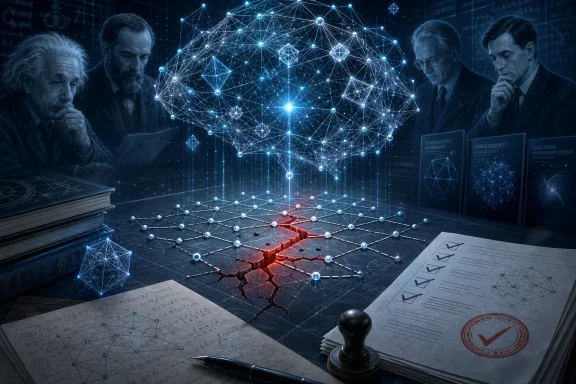
OpenAI’s model did not prove Erdős right. It found a construction with more unit-distance pairs than the conjectured bound allowed, which is the mathematical equivalent of locating a crack in a load-bearing wall. One counterexample is enough to bring down the conjecture.
That distinction matters because the public shorthand of “AI solved an 80-year-old problem” can blur what happened. The full landscape of the unit distance problem remains mathematically alive, but a central belief about its shape has been refuted. The result changes the map even if it does not finish the territory.
For decades, computational mathematics has had strong tools. SAT solvers, computer algebra systems, proof assistants, and custom search programs have all helped solve hard problems. But those systems are usually extensions of a human plan, operating inside carefully formalized boundaries.
The OpenAI result is being presented as something closer to autonomous mathematical exploration. The model reportedly generated a proof strategy, produced a construction, and reached a result that was then digested and checked by human mathematicians. That workflow still has humans at the gate, but the creative pressure is no longer coming only from the human side.
This is why comparisons to calculators feel too small. A calculator accelerates an operation the user already knows how to specify. A reasoning model that can propose publishable research changes the division of labor before the human even knows which calculation should be performed.
That is not special pleading for the profession. It is how mathematics works. A proof is not just a sequence of statements; it is an argument accepted by a community according to standards of rigor, elegance, relevance, and explanatory value.
The OpenAI-generated work was reportedly transformed into a shorter, human-verified account by a group of leading mathematicians. Will Sawin also produced a related improvement with an explicit lower bound. In other words, the machine’s contribution immediately entered the human ecosystem of refinement, comparison, and judgment.
That ecosystem is not a ceremonial add-on. It is the mechanism by which mathematics distinguishes discovery from noise. Large language models are still capable of plausible nonsense, and the higher the prestige of the result, the more damaging an unchecked error would be.
Frontier research is different. It offers no hidden answer key, no guarantee that a solution exists in a convenient form, and no clean boundary between “try this lemma” and “invent a new way to see the problem.” It also punishes false confidence more harshly because even experts can spend months chasing an attractive but invalid argument.
The Erdős counterexample sits somewhere between brute-force search and deep conceptual revolution. Commentators have noted that the proof relies on sophisticated number theory rather than an entirely new mathematical language. That makes it less like a machine inventing calculus and more like a machine exploring a difficult terrain with unusual stamina.
But that should not comfort anyone too much. Most research is not calculus-level revolution. A huge amount of mathematical progress comes from connecting known tools in ways nobody had previously managed. If AI becomes very good at that, it will still transform the profession.
Still, dismissing the claim because humans were somewhere in the loop misses the point. Human mathematicians are also embedded in institutions, libraries, seminars, prior literature, collaborators, and cultural incentives. No serious research is born in a vacuum.
The useful question is not whether the machine was metaphysically independent. It is whether the decisive mathematical move came from the model rather than from a human expert feeding it a near-complete solution. On the available reporting, the answer appears to be yes.
That changes how we should read “autonomous.” It does not mean untouched by human systems. It means the model produced a research-grade path that was not merely a transcription of human guidance.
But Erdős problems are also a trap for marketing departments. Some open problems remain open because they are central and hard; others remain open because few specialists care enough to burn years on them. Solving an obscure neglected problem is not the same as moving a field.
That is why the unit distance result landed differently. It was not presented as a dusty corner case rescued from a list. It was a famous problem in a recognizable branch of mathematics, one that had attracted serious attention for decades.
The credibility boost also came from who responded. Gowers did not treat the result as a novelty demo. He described it as a milestone in AI mathematics and judged it, in effect, by the standards of elite mathematical publishing.
Mathematics often advances when an intuition that felt almost structural turns out to be provincial. The machine’s counterexample reportedly uses number-theoretic machinery to escape the geometric picture humans had been leaning on. It found a way to produce denser unit-distance behavior by looking through a different lens.
This is the most interesting part of the story for technologists. AI systems may not need to “think like us” to be useful at research. In fact, their value may come from being willing to traverse ugly, unintuitive, or unfashionable combinations of ideas that humans have little incentive to pursue.
That does not mean the model has taste. It may simply have search characteristics that, when paired with enough mathematical training, let it push through terrain where humans would stop. But in research, persistence across unpleasant terrain is not a trivial advantage.
This creates a new pressure point for journals, reviewers, and academic norms. If AI-generated proofs become common, reviewers will need to evaluate work whose authorship, provenance, and reproducibility may be murkier than usual. They will also need to decide how much machine-generated exploration must be disclosed.
The obvious analogy is computer-assisted proof, where the mathematical community has already wrestled with trust in computation. But large reasoning models introduce a different kind of opacity. A proof assistant can mechanically verify a formal proof; a language model can produce a persuasive informal argument that still requires human interpretation.
That may accelerate demand for formalization. If AI produces more conjectures and proofs than humans can comfortably check by hand, theorem provers and proof assistants may shift from niche infrastructure to essential research plumbing.
Academic mathematics already has a brutal funnel. There are too many talented PhD students, too few permanent jobs, and enormous pressure to produce visible results early. If cutting-edge AI access becomes a research accelerator, the gap between well-resourced institutions and everyone else could widen fast.
The Ramanujan analogy is apt because mathematics likes to tell itself a story about raw talent breaking through institutional barriers. That story was never as pure as the myth suggests, but AI could make the gatekeeping more technical and expensive. The future genius may not need only insight; they may need compute allocation.
This is where the issue becomes familiar to WindowsForum readers. Technology that begins as a productivity tool often becomes a licensing model, a procurement category, and eventually a line between those who can compete and those who cannot. Research may discover its own version of enterprise software inequality.
In IT, we have already seen copilots write scripts, summarize incidents, generate policies, and suggest remediations. The reassuring line has been that humans remain accountable. That line is true, but it can conceal a major shift in where the original work happens.
If a model proposes the patch sequence, writes the PowerShell, opens the ticket narrative, and flags the probable root cause, the admin’s role changes from author to reviewer. That can be empowering when the system is right and dangerous when speed outruns verification. Mathematics has the advantage of definitive proof; IT operations often must act under uncertainty.
The lesson from the Erdős result is not that AI is magic. It is that general-purpose systems can unexpectedly become competent in domains once assumed to require years of apprenticeship. IT leaders should treat that as both an opportunity and a governance problem.
This is a less romantic moat than creativity, but it may be more important. The world does not need infinite plausible answers. It needs reliable decisions under constraints.
The problem is that verification can be slower, less visible, and less rewarded than generation. A model can produce ten proposed solutions in a minute; a human may need hours to determine which one is safe. Organizations that measure productivity by output volume will be tempted to mistake generated text for completed work.
Mathematics can resist this because rigor is its core identity. Corporate IT may have a harder time. The pressure to automate ticket queues and security workflows will be intense, and the cost of quiet mistakes may not appear until later.
That is where the Varsity essay’s defense of lived experience matters. Human taste is not an ornamental layer on top of mathematics. It guides what researchers choose to pursue and what communities decide to remember.
AI can optimize against known reward signals, but mathematics has always evolved through shifting standards of beauty and importance. A result can be technically strong and culturally sterile. Another can be modest but open an entire way of thinking.
The danger is not that machines will lack taste forever. The danger is that institutions will accept machine productivity as a substitute for human judgment before they understand the difference. A field can drown in correct but directionless output.
But the same capabilities that make advanced reasoning models useful in mathematics can transfer elsewhere. Long-horizon planning, tool use, hypothesis generation, and persistence through failed attempts are not domain-specific virtues. They are general capabilities.
That does not mean a geometry proof implies imminent catastrophe. It does mean the frontier is moving in ways that are easier to demonstrate after the fact than to predict beforehand. If an internal model can surprise experts in a mature field, risk assessments based on yesterday’s public models will be too conservative.
The public should also notice the asymmetry. OpenAI can release a blog post, selected papers, and expert commentary, while the underlying model remains unavailable. That gives the company control over both the demonstration and the context in which outsiders evaluate it.
Google’s work on Erdős problems, academic follow-ups, and independent mathematical refinements all point in the same direction: AI-assisted mathematics is becoming a competitive field. The interesting race is not only whose model solves the hardest problem. It is whose workflow best combines machine search, formal verification, and human taste.
That workflow may matter more than raw model scale. A slightly weaker model embedded in an excellent proof-checking and literature-search environment could outperform a stronger model used casually. The future research stack may look less like a chatbot and more like an autonomous lab notebook wired into formal tools.
For Windows and enterprise readers, the parallel is obvious. The winner in applied AI often is not the most dazzling model in isolation. It is the platform that embeds the model into the work, the identity system, the audit trail, the data boundary, and the review process.
Those questions are already familiar in machine learning, where compute has reshaped the balance between universities and corporate labs. Mathematics has historically required less capital. A blackboard, library access, and time were not enough for everyone, but they were at least imaginable as the core tools of the trade.
AI threatens to pull pure mathematics closer to the economics of industrial research. That could create extraordinary productivity for those inside the loop and a sense of exclusion for those outside it. A field built on individual insight may become dependent on negotiated access to corporate infrastructure.
There is also an authorship problem. If a model finds the key construction, a human simplifies the proof, and a company controls the system, who is the author in the meaningful sense? Current academic categories were not built for that triangle.
The second-worst response is to declare the end of human mathematics. A field is not merely a scoreboard of solved problems. It is a culture of explanation, teaching, selection, abstraction, and taste.
The right reaction is to update. AI systems have moved from solving canned tasks toward contributing to open-ended research. The transition may be uneven, overmarketed, and full of failures, but it is real enough that young mathematicians are right to feel the ground shift.
For IT professionals, the same update applies. Do not plan around the limitations of last year’s model. Plan around the trajectory: more autonomy, more domain competence, more pressure to delegate, and more need for verification infrastructure.
 The Machine Did Not Just Win a Puzzle Round
The unit distance problem has the deceptive simplicity of the best Erdős questions. Place n distinct points in the plane, then count how many pairs are exactly one unit apart. Erdős believed the best possible arrangements were, roughly speaking, grid-like, and the conjectural growth rate around that belief became one of the famous landmarks of combinatorial geometry.This is not the kind of problem whose difficulty is hidden behind a wall of notation. A schoolchild can understand the question, but generations of mathematicians failed to settle the conjecture. That combination — easy statement, brutal depth — is exactly why Erdős problems carry cultural force inside mathematics.
OpenAI’s model did not prove Erdős right. It found a construction with more unit-distance pairs than the conjectured bound allowed, which is the mathematical equivalent of locating a crack in a load-bearing wall. One counterexample is enough to bring down the conjecture.
That distinction matters because the public shorthand of “AI solved an 80-year-old problem” can blur what happened. The full landscape of the unit distance problem remains mathematically alive, but a central belief about its shape has been refuted. The result changes the map even if it does not finish the territory.
OpenAI’s Real Claim Is About Generality
OpenAI’s announcement was framed carefully but ambitiously: the proof came from a general-purpose reasoning model, not a bespoke theorem-proving engine built for this one problem. That is the part that should make software people sit up. Narrow AI victories are impressive; general-purpose systems that wander into frontier research are a different category.For decades, computational mathematics has had strong tools. SAT solvers, computer algebra systems, proof assistants, and custom search programs have all helped solve hard problems. But those systems are usually extensions of a human plan, operating inside carefully formalized boundaries.
The OpenAI result is being presented as something closer to autonomous mathematical exploration. The model reportedly generated a proof strategy, produced a construction, and reached a result that was then digested and checked by human mathematicians. That workflow still has humans at the gate, but the creative pressure is no longer coming only from the human side.
This is why comparisons to calculators feel too small. A calculator accelerates an operation the user already knows how to specify. A reasoning model that can propose publishable research changes the division of labor before the human even knows which calculation should be performed.
The Proof Still Needed Humans, and That Is Not a Technicality
The strongest version of the AI-replaces-mathematicians story skips the least glamorous step: verification. OpenAI’s result became meaningful because expert mathematicians could understand it, simplify it, scrutinize it, and place it in the field’s existing structure. Without that human layer, the announcement would have been another impressive-sounding AI claim waiting to be debunked.That is not special pleading for the profession. It is how mathematics works. A proof is not just a sequence of statements; it is an argument accepted by a community according to standards of rigor, elegance, relevance, and explanatory value.
The OpenAI-generated work was reportedly transformed into a shorter, human-verified account by a group of leading mathematicians. Will Sawin also produced a related improvement with an explicit lower bound. In other words, the machine’s contribution immediately entered the human ecosystem of refinement, comparison, and judgment.
That ecosystem is not a ceremonial add-on. It is the mechanism by which mathematics distinguishes discovery from noise. Large language models are still capable of plausible nonsense, and the higher the prestige of the result, the more damaging an unchecked error would be.
This Was Not an Olympiad Medal With Better PR
The timing is what makes the result feel so sharp. Only recently, AI systems doing well on International Mathematical Olympiad-style problems was treated as a milestone. Those problems are hard, but they are designed to be solved, packaged, and judged within a known competitive format.Frontier research is different. It offers no hidden answer key, no guarantee that a solution exists in a convenient form, and no clean boundary between “try this lemma” and “invent a new way to see the problem.” It also punishes false confidence more harshly because even experts can spend months chasing an attractive but invalid argument.
The Erdős counterexample sits somewhere between brute-force search and deep conceptual revolution. Commentators have noted that the proof relies on sophisticated number theory rather than an entirely new mathematical language. That makes it less like a machine inventing calculus and more like a machine exploring a difficult terrain with unusual stamina.
But that should not comfort anyone too much. Most research is not calculus-level revolution. A huge amount of mathematical progress comes from connecting known tools in ways nobody had previously managed. If AI becomes very good at that, it will still transform the profession.
The Word “Autonomous” Is Doing Heavy Work
Autonomy in AI announcements should always be handled with gloves. A model does not wake up, choose a career in discrete geometry, and decide to humble Erdős before lunch. Humans selected the problem, built the model, designed the prompting environment, evaluated the output, and publicized the result.Still, dismissing the claim because humans were somewhere in the loop misses the point. Human mathematicians are also embedded in institutions, libraries, seminars, prior literature, collaborators, and cultural incentives. No serious research is born in a vacuum.
The useful question is not whether the machine was metaphysically independent. It is whether the decisive mathematical move came from the model rather than from a human expert feeding it a near-complete solution. On the available reporting, the answer appears to be yes.
That changes how we should read “autonomous.” It does not mean untouched by human systems. It means the model produced a research-grade path that was not merely a transcription of human guidance.
Erdős Problems Became an AI Benchmark Because They Are Messy
Paul Erdős left behind a sprawling mathematical legacy: hundreds of problems, many cleanly stated, many still open, and many serving as informal markers of taste and difficulty. That makes his problem list unusually attractive to AI labs. It is public, prestigious, varied, and full of tasks whose answers are not supposed to be sitting in a training set.But Erdős problems are also a trap for marketing departments. Some open problems remain open because they are central and hard; others remain open because few specialists care enough to burn years on them. Solving an obscure neglected problem is not the same as moving a field.
That is why the unit distance result landed differently. It was not presented as a dusty corner case rescued from a list. It was a famous problem in a recognizable branch of mathematics, one that had attracted serious attention for decades.
The credibility boost also came from who responded. Gowers did not treat the result as a novelty demo. He described it as a milestone in AI mathematics and judged it, in effect, by the standards of elite mathematical publishing.
The Grid Was a Human Intuition, and the Machine Found the Exit
The old intuition around the problem was that near-optimal configurations should resemble square grids, or refinements of grid-like arrangements. That was not a silly guess. Grids produce many unit distances, and for decades they looked like the natural extremal objects.Mathematics often advances when an intuition that felt almost structural turns out to be provincial. The machine’s counterexample reportedly uses number-theoretic machinery to escape the geometric picture humans had been leaning on. It found a way to produce denser unit-distance behavior by looking through a different lens.
This is the most interesting part of the story for technologists. AI systems may not need to “think like us” to be useful at research. In fact, their value may come from being willing to traverse ugly, unintuitive, or unfashionable combinations of ideas that humans have little incentive to pursue.
That does not mean the model has taste. It may simply have search characteristics that, when paired with enough mathematical training, let it push through terrain where humans would stop. But in research, persistence across unpleasant terrain is not a trivial advantage.
Publication Standards Are Becoming a Stress Test for AI
The phrase “suitable for publication” carries weight in mathematics because publication is not merely disclosure. It is an endorsement that the result is correct, interesting, and worth adding to the permanent record. The OpenAI proof being discussed in those terms is the difference between a demo and a discipline-level event.This creates a new pressure point for journals, reviewers, and academic norms. If AI-generated proofs become common, reviewers will need to evaluate work whose authorship, provenance, and reproducibility may be murkier than usual. They will also need to decide how much machine-generated exploration must be disclosed.
The obvious analogy is computer-assisted proof, where the mathematical community has already wrestled with trust in computation. But large reasoning models introduce a different kind of opacity. A proof assistant can mechanically verify a formal proof; a language model can produce a persuasive informal argument that still requires human interpretation.
That may accelerate demand for formalization. If AI produces more conjectures and proofs than humans can comfortably check by hand, theorem provers and proof assistants may shift from niche infrastructure to essential research plumbing.
The Labor Market Shock Starts Before Replacement
The Varsity essay’s most haunting point is not that mathematicians may be replaced. It is that early-career researchers are entering the profession just as the rules of status and opportunity may be rewritten. That is a subtler and more immediate danger.Academic mathematics already has a brutal funnel. There are too many talented PhD students, too few permanent jobs, and enormous pressure to produce visible results early. If cutting-edge AI access becomes a research accelerator, the gap between well-resourced institutions and everyone else could widen fast.
The Ramanujan analogy is apt because mathematics likes to tell itself a story about raw talent breaking through institutional barriers. That story was never as pure as the myth suggests, but AI could make the gatekeeping more technical and expensive. The future genius may not need only insight; they may need compute allocation.
This is where the issue becomes familiar to WindowsForum readers. Technology that begins as a productivity tool often becomes a licensing model, a procurement category, and eventually a line between those who can compete and those who cannot. Research may discover its own version of enterprise software inequality.
Enterprise IT Should Recognize the Pattern
The AI math breakthrough may look distant from endpoint management, Azure tenants, Windows fleets, and security operations. It is not. The same pattern is moving through every knowledge profession: a system first assists, then drafts, then proposes, then acts.In IT, we have already seen copilots write scripts, summarize incidents, generate policies, and suggest remediations. The reassuring line has been that humans remain accountable. That line is true, but it can conceal a major shift in where the original work happens.
If a model proposes the patch sequence, writes the PowerShell, opens the ticket narrative, and flags the probable root cause, the admin’s role changes from author to reviewer. That can be empowering when the system is right and dangerous when speed outruns verification. Mathematics has the advantage of definitive proof; IT operations often must act under uncertainty.
The lesson from the Erdős result is not that AI is magic. It is that general-purpose systems can unexpectedly become competent in domains once assumed to require years of apprenticeship. IT leaders should treat that as both an opportunity and a governance problem.
The Verification Bottleneck Is the New Human Moat
For now, the durable human advantage is not raw output. It is knowing what should be trusted. In mathematics, that means checking proofs, recognizing significance, and understanding how a result changes the field. In IT, it means validating whether an AI-generated remediation is safe in a messy production environment.This is a less romantic moat than creativity, but it may be more important. The world does not need infinite plausible answers. It needs reliable decisions under constraints.
The problem is that verification can be slower, less visible, and less rewarded than generation. A model can produce ten proposed solutions in a minute; a human may need hours to determine which one is safe. Organizations that measure productivity by output volume will be tempted to mistake generated text for completed work.
Mathematics can resist this because rigor is its core identity. Corporate IT may have a harder time. The pressure to automate ticket queues and security workflows will be intense, and the cost of quiet mistakes may not appear until later.
The Human Question Is Really About Taste
Mathematicians do not only ask whether a theorem is true. They ask whether it is interesting. They care whether a proof explains, whether a method generalizes, whether a result opens a door rather than merely filling a gap.That is where the Varsity essay’s defense of lived experience matters. Human taste is not an ornamental layer on top of mathematics. It guides what researchers choose to pursue and what communities decide to remember.
AI can optimize against known reward signals, but mathematics has always evolved through shifting standards of beauty and importance. A result can be technically strong and culturally sterile. Another can be modest but open an entire way of thinking.
The danger is not that machines will lack taste forever. The danger is that institutions will accept machine productivity as a substitute for human judgment before they understand the difference. A field can drown in correct but directionless output.
OpenAI’s Breakthrough Also Reopens the Safety Debate
There is a reason AI labs showcase mathematics. Math is prestigious, difficult, and relatively clean. A model that proves a theorem looks less frightening than one that manipulates markets, writes malware, or autonomously negotiates with humans.But the same capabilities that make advanced reasoning models useful in mathematics can transfer elsewhere. Long-horizon planning, tool use, hypothesis generation, and persistence through failed attempts are not domain-specific virtues. They are general capabilities.
That does not mean a geometry proof implies imminent catastrophe. It does mean the frontier is moving in ways that are easier to demonstrate after the fact than to predict beforehand. If an internal model can surprise experts in a mature field, risk assessments based on yesterday’s public models will be too conservative.
The public should also notice the asymmetry. OpenAI can release a blog post, selected papers, and expert commentary, while the underlying model remains unavailable. That gives the company control over both the demonstration and the context in which outsiders evaluate it.
The Open Model World Will Not Stay Quiet
A private OpenAI model produced the headline, but the broader ecosystem will respond. Once a technique, benchmark, or result becomes visible, competitors and open research groups try to reproduce, simplify, and extend it. The unit distance story will not remain a single-company artifact.Google’s work on Erdős problems, academic follow-ups, and independent mathematical refinements all point in the same direction: AI-assisted mathematics is becoming a competitive field. The interesting race is not only whose model solves the hardest problem. It is whose workflow best combines machine search, formal verification, and human taste.
That workflow may matter more than raw model scale. A slightly weaker model embedded in an excellent proof-checking and literature-search environment could outperform a stronger model used casually. The future research stack may look less like a chatbot and more like an autonomous lab notebook wired into formal tools.
For Windows and enterprise readers, the parallel is obvious. The winner in applied AI often is not the most dazzling model in isolation. It is the platform that embeds the model into the work, the identity system, the audit trail, the data boundary, and the review process.
The Next Research Divide May Be Access
If frontier AI becomes a requirement for competitive mathematics, access becomes an academic justice issue. Who gets the model? Who gets enough compute? Who can run long experiments? Who can publish results produced by a proprietary system whose behavior cannot be independently inspected?Those questions are already familiar in machine learning, where compute has reshaped the balance between universities and corporate labs. Mathematics has historically required less capital. A blackboard, library access, and time were not enough for everyone, but they were at least imaginable as the core tools of the trade.
AI threatens to pull pure mathematics closer to the economics of industrial research. That could create extraordinary productivity for those inside the loop and a sense of exclusion for those outside it. A field built on individual insight may become dependent on negotiated access to corporate infrastructure.
There is also an authorship problem. If a model finds the key construction, a human simplifies the proof, and a company controls the system, who is the author in the meaningful sense? Current academic categories were not built for that triangle.
The Sensible Reaction Is Neither Panic Nor Dismissal
The worst response is to wave this away as hype because AI still makes mistakes. Of course it does. Humans also make mistakes, and mathematics has developed institutions to catch them. The point is that this model appears to have produced something worth catching.The second-worst response is to declare the end of human mathematics. A field is not merely a scoreboard of solved problems. It is a culture of explanation, teaching, selection, abstraction, and taste.
The right reaction is to update. AI systems have moved from solving canned tasks toward contributing to open-ended research. The transition may be uneven, overmarketed, and full of failures, but it is real enough that young mathematicians are right to feel the ground shift.
For IT professionals, the same update applies. Do not plan around the limitations of last year’s model. Plan around the trajectory: more autonomy, more domain competence, more pressure to delegate, and more need for verification infrastructure.
The Erdős Result Leaves Humans Holding the Compass
The practical lesson from OpenAI’s unit distance result is that AI is beginning to compete in the space between search and insight. That space is larger than many professions wanted to admit. The human role does not vanish there, but it becomes more explicitly editorial, supervisory, and strategic.- OpenAI’s May 2026 announcement concerns a counterexample to Erdős’s planar unit distance conjecture, not a final solution to every version of the unit distance problem.
- The result is significant because outside experts treated it as research-grade mathematics, not merely an impressive chatbot transcript.
- The model’s reported general-purpose nature matters because it suggests frontier reasoning systems may transfer into hard domains without being custom-built for each one.
- Human verification remains essential, and the bottleneck may shift from producing arguments to judging, simplifying, and formalizing them.
- The biggest near-term disruption may fall on access, training, and early-career opportunity rather than on total replacement.
- IT leaders should read the episode as a warning that AI review workflows, auditability, and domain validation will matter as much as raw automation.
References
- Primary source: varsity.co.uk
Published: Thu, 02 Jul 2026 11:00:00 GMT
OpenAI’s model autonomously solves famous Erdos problem
Timothy Moy reflects on what OpenAI's recent breakthrough could mean for the future of mathematics www.varsity.co.uk - Official source: openai.com
An OpenAI model has disproved a central conjecture in discrete geometry | OpenAI
An OpenAI model solved the 80-year-old unit distance problem, disproving a major conjecture in discrete geometry and marking a milestone in AI-driven mathematics.openai.com - Related coverage: stackfutures.com
OpenAI's Reasoning Model Disproves Erdős' 1946 Unit Distance Conjecture — First AI to Crack an Open Problem in a Major Math Field | Stack Futures
A general-purpose OpenAI reasoning model disproved the Erdős planar unit distance conjecture, open since 1946, by finding that square grids are not optimal for unit distance problems. Fields Medalist Timothy Gowers called the proof ready for Annals of Mathematics. No specialized math model was used. stackfutures.com
- Related coverage: livescience.com
OpenAI's internal AI model just solved an 80-year-old math problem ‪—‬ and mathematicians verified it | Live Science
The closest the field has come to solving the planar unit distance problem, first proposed in the 1940s, was in 1984. Now, OpenAI claims an internal model has cracked the puzzle.www.livescience.com - Related coverage: letsdatascience.com
OpenAI Model Disproves Erdos Unit Distance Conjecture | Let's Data Science
OpenAI announced on May 20, 2026 that one of its internal, general-purpose reasoning models disproved the Erdos unit distance conjecture, an open problem in discrete geometry posed by Paul Erdos in 1946. The conjecture held that the maximum number of unit-distance pairs among n points in the... letsdatascience.com
- Related coverage: vectrel.ai
OpenAI's Erdős Disproof: What It Means When General-Purpose AI Does Original Research | Vectrel
OpenAI's internal reasoning model disproved an 80-year-old Erdős conjecture on May 20, 2026. Here is what original AI research means for business strategy.www.vectrel.ai
- Related coverage: enterprisedna.co
OpenAI's Model Disproves 80-Year-Old Math Conjecture — Enterprise DNA
A general-purpose OpenAI reasoning model has disproved the Erdős unit distance conjecture, a major open problem in mathematics since 1946.enterprisedna.co - Related coverage: theaitrack.com
OpenAI Model Disproves Unit Distance Problem Assumption
OpenAI’s reasoning model found a counterexample in the unit distance problem, overturning an 80-year assumption in discrete geometry.theaitrack.com - Related coverage: scientificamerican.com
AI just solved an 80-year-old ‘Erdős problem,’ and mathematicians are amazed | Scientific American
A chatbot’s result for the 80-year-old “unit distance” conjecture is the first AI proof that would likely be published in math’s top journal if humans had done it alonewww.scientificamerican.com - Related coverage: awesomeagents.ai
OpenAI Disproves 80-Year Erdős Math Conjecture | Awesome Agents
An internal OpenAI reasoning model produced an original proof disproving the Erdős unit distance conjecture, the first time AI autonomously solved a major open problem in mathematics.awesomeagents.ai - Related coverage: as.com
Una IA rompe una creencia matemática de casi 80 años y resuelve un problema abierto planteado por Paul Erdős - Meristation
Una IA de OpenAI encuentra una solución inédita a un problema matemático planteado por Paul Erdős hace casi 80 años.as.com - Related coverage: cadenaser.com
Una IA resuelve el problema matemático de Erdös: "Ningún humano había dado solución mejor en 80 años" | Ciencia y tecnología | Cadena SER
LA empresa Open AI y varios matemáticos que han analizado los resultados dicen que es "el mayor avance matemático de la IA hasta la fecha"cadenaser.com - Official source: cdn.openai.com
- Related coverage: phys.org