

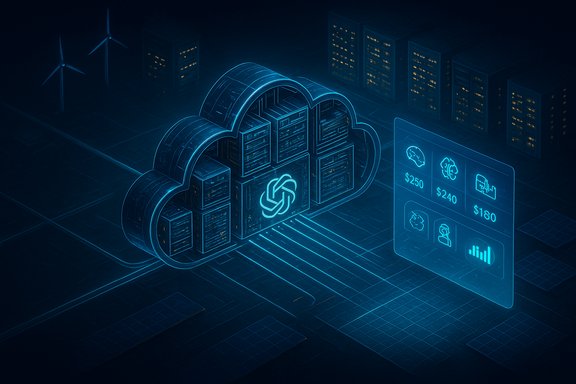
OpenAI’s brief but consequential public hint that it plans to “sell compute capacity” and build an “AI cloud” marks a strategic inflection: the company is signaling a potential transition from being the world’s most important buyer of GPU farms to becoming a vendor of them, a move that could reshape cloud economics, hyperscaler competitive dynamics, and how enterprises procure AI infrastructure.
OpenAI’s rise over the past five years has been defined by two linked realities: unprecedented demand for model compute and deep partnerships with cloud providers and hardware vendors to meet that demand. The company’s flagship products — ChatGPT, enterprise APIs, and model families that sit at the center of modern generative AI stacks — consume extraordinary GPU hours and networking capacity. Historically, that demand was satisfied primarily through close relationships with hyperscalers and specialist providers; but in 2025 OpenAI began publicly broadening its compute sourcing and announcing large infrastructure programs under the “Stargate” banner. Senior leadership has been explicit about the scale problem. CEO Sam Altman’s recent public remarks quantify that ambition and the company’s response: an annualized revenue run‑rate in the tens of billions, multi‑year infrastructure commitments that aggregate into the low trillions, and a willingness to reconsider OpenAI’s role in the market for raw compute. Those statements — and the line about selling compute more directly to “companies (and people)” — are small in words but large in consequence.
Key attributes that would differentiate an “AI cloud” offering include:
For the industry, the prospect of an OpenAI‑led AI cloud accelerates a broader transition: cloud providers will sharpen their AI offerings, enterprises will gain more specialized compute procurement choices, and hardware suppliers will face even greater demand intensity. The gamble is audacious — and whether it becomes a competitive shock or an evolutionary step will depend on financing, execution, and how effectively OpenAI turns compute into a product that customers trust and pay for.
Source: Lapaas Voice OpenAI to sell its 'AI cloud' compute capacity
 Background
OpenAI’s rise over the past five years has been defined by two linked realities: unprecedented demand for model compute and deep partnerships with cloud providers and hardware vendors to meet that demand. The company’s flagship products — ChatGPT, enterprise APIs, and model families that sit at the center of modern generative AI stacks — consume extraordinary GPU hours and networking capacity. Historically, that demand was satisfied primarily through close relationships with hyperscalers and specialist providers; but in 2025 OpenAI began publicly broadening its compute sourcing and announcing large infrastructure programs under the “Stargate” banner. Senior leadership has been explicit about the scale problem. CEO Sam Altman’s recent public remarks quantify that ambition and the company’s response: an annualized revenue run‑rate in the tens of billions, multi‑year infrastructure commitments that aggregate into the low trillions, and a willingness to reconsider OpenAI’s role in the market for raw compute. Those statements — and the line about selling compute more directly to “companies (and people)” — are small in words but large in consequence. What OpenAI means by “AI cloud”: definition and product shapes
At its simplest, an “AI cloud” is a cloud‑style service optimized specifically for training and running large AI models — a product where compute, networking, software orchestration, billing, and enterprise guarantees are designed for high‑density accelerator workloads rather than generic CPU/VM use.Key attributes that would differentiate an “AI cloud” offering include:
- Accelerator‑first hardware: racks and pods built around GPU/accelerator families (e.g., NVIDIA Blackwell‑class or custom ASICs) with low‑latency interconnects.
- Model‑aware orchestration: schedulers, autoscaling and placement policies optimized for large‑batch training and sub‑millisecond inference.
- Bundled model + compute: packaged offers that combine model access, fine‑tuning, and colocated compute with SLAs.
- Vertical integrations: co‑designed hardware and software to reduce cost per token / training hour and to offer performance characteristics not available on commodity cloud instances.
The strategic rationale: why sell compute?
OpenAI’s public reasoning for exploring compute sales is straightforward and threefold.- Economics and utilization: Large fixed data‑center investments become economical only with high utilization. Monetizing spare or excess capacity against third‑party demand converts idle capital into recurring revenue and shortens payback horizons.
- Operational sovereignty and IP protection: Running first‑party infrastructure reduces reliance on partners that have been learning from OpenAI’s operations — a concern voiced internally and publicly. Owning the stack reduces leakage of operational know‑how and gives OpenAI more control over co‑designing hardware and scheduling for its models.
- Strategic alignment with product roadmap: Future model families, agentic services, and device + cloud combos are easier to deliver when latency, cost, and scheduling are controlled end‑to‑end. Owning compute enables performance guarantees and bundled products that general clouds may not prioritize.
What the public record actually says (numbers and claims verified)
Several high‑profile claims from OpenAI’s leadership and corporate announcements anchor this discussion. These are not speculation — they are public statements and corporate reports that have been widely covered.- Sam Altman publicly stated that OpenAI is “looking at ways to more directly sell compute capacity” and used the phrase “AI cloud” to describe the market opportunity.
- Altman and company communications have described aggregate infrastructure targets that include commitments that, when summed over multi‑year horizons, reach roughly $1.4 trillion. Multiple outlets reported the figure after Altman’s comments. Those numbers aggregate many kinds of commitments (consumption contracts, co‑investment pledges, project budgets) and should be read as planning totals rather than single transferable liabilities.
- OpenAI has publicly stated a year‑end expectation to exceed a roughly $20 billion annualized revenue run‑rate, a marker widely reported by technology press outlets. That estimate is part of the company narrative used to justify large infrastructure investments.
- The Stargate initiative, OpenAI’s multi‑partner program focused on U.S. AI infrastructure, has announced several large site commitments (Abilene, Texas and additional sites) and partner deals with Oracle and SoftBank under a multi‑hundred‑billion dollar program aiming to deliver gigawatt‑scale capacity. OpenAI’s own blog, Reuters, CNBC and other outlets document these partnerships.
- OpenAI has also signed large consumption commitments with third parties — reporting indicates a multiyear AWS consumption arrangement in the tens of billions of dollars (widely reported as a ≈$38B commitment), and expanded deals with specialist providers such as CoreWeave that together compose its multi‑vendor sourcing strategy.
How OpenAI could sell compute: three pragmatic go‑to‑market paths
If OpenAI moves from intention to product, three implementation pathways are most plausible, each with different timeframes, capital needs and competitive trade‑offs.- Reseller/Marketplace (near term)
- OpenAI aggregates third‑party capacity (AWS, Oracle, CoreWeave, specialized GPU clouds), optimizes packaging and offers an “AI‑optimized” marketplace.
- Pros: Fast time‑to‑market, low capex, leverages existing capacity.
- Cons: Margins squeeze, continued supplier dependence, limited differentiation from incumbents.
- Likely first step: OpenAI could brand and tier compute bundles, offering preferred runtimes and bundled model access while continuing to run core services on its partners.
- Co‑build / Whitebox partnerships (medium term)
- Targeted first‑party sites co‑developed with partners (e.g., Stargate partners Oracle, SoftBank). These would support latency‑sensitive or proprietary workloads while bulk capacity remains sourced externally.
- Pros: Partial control, improved economics on strategic workloads.
- Cons: Complexity of joint operations and partial operational exposure to partners.
- This model aligns with existing Stargate announcements and co‑investor models.
- Full first‑party AI cloud (long term)
- Build and operate a global network of OpenAI‑owned data centers, custom accelerators and a full cloud stack.
- Pros: Maximum differentiation, direct capture of infrastructure margins, tight model–hardware co‑design.
- Cons: Massive capex, long ramp, supply‑chain and regulatory complexity; direct competition with AWS/Azure/Google.
- This is highest reward but also highest risk and would make OpenAI a true hyperscaler competitor if achieved.
Implications for cloud incumbents, enterprises and the wider market
For hyperscalers (AWS, Azure, Google Cloud)
- New competition for high‑end AI workloads could accelerate pricing and product innovation for GPU‑optimized instances and managed model services.
- Hyperscalers may respond by:
- Deepening hardware discounts or capacity guarantees for strategic customers.
- Expanding managed model bundles and developer tooling to lock in enterprise customers.
- Accelerating custom silicon and datacenter optimization to defend margins.
For enterprises and AI users
- Short term: more procurement options and specialized AI‑optimized instances; potential for better price/perf for high‑value training or low‑latency inference.
- Medium term: enterprises will have to weigh trade‑offs — new provider economics vs. incumbents’ ecosystem depth (global footprint, compliance, integrated services).
- Integration complexity may increase: multi‑cloud stacks will be more common, requiring stronger engineering and governance at enterprise level.
For the AI ecosystem and hardware suppliers
- Demand concentration for high‑end accelerators (NVIDIA Blackwell family and successors) will remain a bottleneck; vendor leverage increases.
- OpenAI’s pursuit of custom accelerators or co‑design with Broadcom and others (announced or reported) could shift supply dynamics and introduce new hardware suppliers into the AI data‑center market.
Risks and execution challenges — why this is far from a guaranteed success
Becoming a credible cloud provider is materially different from building great models. The principal challenges are:- Capital intensity and timeline: Gigawatt‑scale data centers take years and hundreds of billions to build; the timing between capex outlays and monetization is long. Public headline figures aggregate many items and obscure the near‑term cash profile.
- Supply chain and vendor concentration: Advanced accelerators have long lead times and are concentrated among a few vendors. Securing sustainable supply without recreating new single‑vendor dependencies is hard.
- Operational maturity: Enterprises expect multi‑region redundancy, SLAs, certification and incident response at hyperscaler scale — capabilities OpenAI will need to build or acquire. Software maturity (billing, multi‑tenant isolation, observability) is nontrivial.
- Regulatory and political exposure: Large, national‑scale infrastructure projects attract scrutiny on energy use, export controls, antitrust and national security. Public statements about potential government “backstops” have already provoked political attention; OpenAI has publicly disavowed any desire for government guarantees, but the political lens will remain.
- Channel conflict and partner friction: Selling compute directly places OpenAI in partial competition with its own partners and customers; Microsoft, Oracle, AWS and others may recalibrate their commercial relationships in response. Managing those conflicts will be delicate.
- Environmental and grid constraints: Gigawatt‑scale facilities require significant energy commitments and local grid upgrades, which can become bottlenecks and political flashpoints at the municipal and regional level.
What success looks like — three plausible winning scenarios
- Hybrid marketplace + strategic first‑party sites
- OpenAI starts by reselling and packaging third‑party capacity, then brings online select proprietary Stargate campuses for premium enterprise services; monetization is progressive, risk‑adjusted, and becomes a meaningful revenue line.
- Bundled model+compute premium
- OpenAI differentiates by offering tight bundles (SLA‑backed inference, latency‑guaranteed deployments, private fine‑tuning clusters) where customers accept a premium for predictability and performance. This avoids direct head‑to‑head breadth competition and focuses on vertical use cases.
- Full cloud conversion (long horizon)
- If supply, capital and operational scale all align, OpenAI could become a vertically integrated AI cloud operator — a multiyear outcome requiring near‑flawless execution and continued demand growth that sustains high utilization. This is the highest reward path but the least likely in any short time window.
Immediate practical takeaways for enterprise IT teams
- Reassess multi‑cloud AI procurement strategies: expect more specialized AI cloud SKUs and potential price competition for GPU hours.
- Build portability and exit clauses into model contracts: new compute options are coming, but vendor lock‑in risks remain.
- Tighten observability and cost attribution for AI workloads: as suppliers proliferate, TCO comparisons will rely on rigorous telemetry.
- Watch for bundled offerings: SLAs that combine models and compute could simplify adoption but increase vendor stickiness.
What to watch next (milestones that will validate or refute the thesis)
- Official product announcements and pricing: a branded OpenAI “AI cloud” product with published tiers would be decisive evidence of market entry.
- Early customer wins or pilot programs: which enterprises adopt OpenAI’s compute first, and for what workloads? Publicized references indicate early traction or show conservative uptake.
- Infrastructure ownership signals: announcements of OpenAI‑owned data‑center campuses, energy purchase agreements, or regional certificates would signal movement toward first‑party capacity.
- Hardware and supply contracts: disclosure of long‑term accelerator supply agreements or custom silicon initiatives will illuminate the supply risk profile.
- Commercial reactions from hyperscalers: pricing adjustments, new AI‑optimized SKUs, or widened enterprise incentives will show incumbents’ strategic responses.
Conclusion
OpenAI’s public intention to sell compute and build an “AI cloud” is a logical strategic extension of its product and infrastructure trajectory — a move designed to capture more margin, protect operational IP, and convert gargantuan capital commitments into recurring revenue streams. The company already has the demand pull, brand recognition and partner ecosystem to make a credible attempt. Yet the path from intent to a profitable, enterprise‑grade cloud offering is narrow and rocky. The space requires not only racks of accelerators but years of operational maturity, resilient supply chains, regulatory navigation, and careful partner management. The most likely near‑term outcome is a staged approach: branded reselling and marketplace packaging, selective first‑party Stargate campuses for premium workloads, and incremental expansion if utilization and unit economics prove favorable.For the industry, the prospect of an OpenAI‑led AI cloud accelerates a broader transition: cloud providers will sharpen their AI offerings, enterprises will gain more specialized compute procurement choices, and hardware suppliers will face even greater demand intensity. The gamble is audacious — and whether it becomes a competitive shock or an evolutionary step will depend on financing, execution, and how effectively OpenAI turns compute into a product that customers trust and pay for.
Source: Lapaas Voice OpenAI to sell its 'AI cloud' compute capacity
