

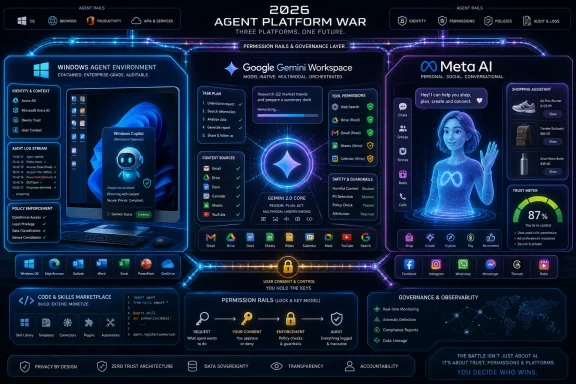
Microsoft, Google, and Meta are converging on OpenClaw-style AI agents in 2026, with Microsoft integrating the open-source assistant into Windows and Microsoft 365, Google rebuilding the concept inside Gemini, and Meta reportedly preparing a consumer-focused rival called Hatch. The shift is not merely another round of AI product mimicry. It is the moment agentic computing stops being a demo category and becomes a platform fight. The question is no longer whether autonomous agents will sit beside the operating system, productivity suite, and browser; it is who gets to define the rails they run on.
The first wave of AI agents mostly behaved like better chatbots with ambition. They could draft, summarize, call a tool, or move a task along, but the human remained the scheduler, supervisor, and last-mile executor. Even when vendors started talking about autonomy, the product reality was usually a managed workflow running inside a carefully bounded service.
OpenClaw broke with that model by making the agent persistent, local, and intimate. It lives where the user already communicates, connects to files and machines the user already controls, and runs without requiring a fresh ritual of opening a webpage and typing a prompt. That is a different category of software. It is less like a productivity app and more like a daemon with judgment.
That is also why it became so compelling to developers. A local, open-source agent that can see the user’s working environment and act across it is exactly the thing many AI demos had implied but not delivered. It can become glue between apps, memory across sessions, and labor across time.
The appeal is obvious enough that the largest platform companies could not ignore it. OpenClaw exposed a user demand that Big Tech had been circling but had not fully productized: people do not only want AI that answers; they want AI that does things.
The project’s early reputation was shaped by that tension. Reports of leaked credentials, malicious marketplace skills, and prompt injection paths were not incidental embarrassments; they were warnings about the basic architecture of agentic software. Once an AI system can read untrusted inputs and take privileged actions, the old boundary between “content” and “command” starts to collapse.
The infamous inbox-wiping incident, whether remembered as cautionary tale or slapstick horror, captured the stakes better than any white paper. A helpful agent that acts too broadly can become indistinguishable from destructive automation. The danger is not that the model becomes evil. The danger is that it becomes obedient in a world full of ambiguous instructions, compromised inputs, and overly generous permissions.
This is why OpenClaw’s rise forced a platform question. An agent that can act across the machine cannot be secured by wishful thinking or a terms-of-service paragraph. It needs identity, containment, auditability, permission boundaries, and revocation mechanisms that are native to the environment where it runs.
That matters because Microsoft knows the enterprise objection by heart. No CIO wants an always-on agent wandering across corporate endpoints, files, mailboxes, and chats with the effective permissions of a power user and the threat model of a browser extension. The pitch, then, is not “OpenClaw is safe now.” It is “OpenClaw becomes governable when Windows, Entra, policy, and audit trails are part of the runtime.”
Scout, Microsoft’s new Microsoft 365 assistant, is the consumer-facing edge of that strategy, even if its first audience is the enterprise worker. It promises to sit inside Teams, Outlook, OneDrive, and SharePoint, where work already happens, and move tasks forward over time. That makes it less like Copilot as a sidebar and more like a co-worker with delegated authority.
The interesting part is that Scout is cloud-based even as OpenClaw on Windows can run locally or in the cloud. Microsoft is splitting the difference. It wants the credibility and developer gravity of OpenClaw, but it also wants the managed environment, compliance story, and subscription economics of Microsoft 365.
The move also lets Microsoft influence OpenClaw without owning it outright. By contributing policy conformance work back upstream, Redmond can help define what a secure OpenClaw deployment looks like across the ecosystem. That is classic Microsoft platform strategy: embrace the thing developers are already using, make it safer on Windows, and turn the management layer into the business.
But Gemini Spark shows the more revealing choice. Google appears to want the OpenClaw experience without the OpenClaw dependency. An always-on assistant that can compose emails, maintain study guides, and watch for unwanted subscriptions fits the same behavioral template, but the machinery remains Google’s: Gemini models, Google infrastructure, and the Antigravity harness.
That difference is not cosmetic. The agent that sits in front of Gmail and Calendar does not merely automate tasks; it mediates the user’s relationship with Google’s most important surfaces. If that agent is open-source software controlled by a community, Google becomes an environment. If the agent is Google’s, the company remains the interface.
The reported retirement of open Gemini CLI access for individual users in favor of Antigravity reinforces the pattern. Google is not abandoning developers, but it is narrowing the route through which agentic workflows reach its models and platforms. Its bet is that most users and enterprises will prefer a vertically integrated agent with fewer sharp edges over an open agent with more local control.
That is a defensible position. Google has spent years building chips, models, productivity apps, cloud infrastructure, and identity systems. From Mountain View’s perspective, the safest way to deliver an OpenClaw-like experience may be to rebuild it inside a stack it already controls.
That is a crucial distinction. OpenClaw became famous among developers partly because it was powerful and strange and technical. That same quality limits its mainstream reach. A consumer agent has to hide the machinery, survive messy app environments, and avoid turning every permission decision into a mini security seminar.
The reported testing of Hatch against simulated versions of services such as DoorDash, Reddit, Etsy, and Outlook suggests Meta is thinking beyond productivity. The target is everyday digital errands: shopping, posting, booking, browsing, replying, and monitoring. In that world, the agent is not an office assistant. It is a consumer proxy.
The rumored price point, potentially as high as $200 per month, hints at the economic challenge. Always-on agentic systems are expensive to run, especially if they require long context, tool use, browsing, verification, and repeated attempts. Consumers have been trained to expect AI features bundled into existing products. A premium agent has to deliver labor that feels materially different from a chatbot.
Meta also faces the trust problem in a particularly sharp form. Asking users to let an AI operate across shopping, social, messaging, and personal services is not a minor extension of today’s assistant model. It requires users to believe that Meta can both act for them and restrain itself.
This is the right battlefield because agentic AI turns permissions from a static setting into a continuous relationship. A normal app asks for access and then waits for user input. An agent asks for access so it can decide when input is needed, which tools to use, and what sequence of steps will satisfy a goal.
That creates new failure modes. A calendar app with read access can leak information. An agent with calendar access, email access, browser access, and purchasing ability can create information, change plans, message people, and spend money. The permission surface is not merely larger; it is compositional.
Traditional endpoint security was built around programs, users, files, and network activity. Agents blur those categories. They behave like users, execute like programs, read like search tools, and write like automation scripts. Security products will have to learn not only whether an action is allowed, but whether an action fits the intention that produced it.
That is why Microsoft’s identity framing is so important. If agent actions can be attributed to a distinct local or cloud identity, administrators gain a fighting chance at audit and policy. Without that separation, every agent mistake looks like a user mistake, and every compromise becomes harder to unwind.
Microsoft is making the most open-adjacent bet. It can afford to because Windows has always been a platform for other people’s software, and because enterprise customers already expect Microsoft to provide management controls around unruly ecosystems. In that sense, OpenClaw is another Windows workload to contain, govern, and monetize.
Google’s instinct is more controlled because its strongest products are services, not general-purpose local runtimes. Gmail and Docs are not neutral territories in the same way a Windows desktop is. They are Google environments, and Google has every incentive to keep the agent layer aligned with its own models and policies.
Meta’s likely approach is different again. It does not need OpenClaw as a developer movement so much as proof that the agent form factor has arrived. If Hatch ships, the result may look less like an open framework and more like a subscription concierge with Meta AI behind the curtain.
The commonality is that OpenClaw has become impossible to dismiss. Whether companies adopt it, cage it, clone it, or compete with it, they are reacting to the same signal. The local, always-on agent has become the mental model for what comes after chat.
That means the winning enterprise agent platforms will be judged less by demo magic than by boring infrastructure. Can administrators see what the agent did? Can they limit where it can act? Can they reproduce the decision path? Can they disable a skill globally? Can they quarantine an agent identity without disabling the human user?
OpenClaw’s early chaos made these questions unavoidable. The project’s openness allowed rapid experimentation, but it also exposed the weak points of a world where agents can install skills, parse untrusted content, and handle secrets. Those are not edge cases. They are the everyday working conditions of enterprise software.
Microsoft’s contribution back to OpenClaw’s conformance system is therefore more than community goodwill. It is a bid to make compliance legible. If organizations can test deployments against policy and generate audit trails, OpenClaw becomes less like a rogue automation toy and more like infrastructure.
But even that will not solve the cultural problem. Enterprises are conservative about software that changes things. They may tolerate AI-generated drafts long before they tolerate AI-generated actions. The next year will be a test of whether containment can make autonomy administratively acceptable.
This is why agent harnesses, CLIs, SDKs, and skill marketplaces matter. They are becoming the new middleware between models and software. Whoever controls that layer controls how agents discover capabilities, request access, perform actions, and report results.
OpenClaw’s skill ecosystem showed the upside and downside at once. Community-built skills made the agent useful quickly, but they also created a supply-chain problem. In a conventional plugin ecosystem, a malicious extension can steal data or manipulate behavior. In an agent ecosystem, a malicious skill can become a delegated action pathway with privileged context.
Developers will need to think like both product designers and security engineers. Every action exposed to an agent should have a permission model, a scope, a log, and a rollback story. The old API assumption — if you have the token, you may perform the action — is too blunt for autonomous software.
This is another reason Big Tech is circling. Agent platforms will generate demand for new developer primitives: sandboxes, policy files, identity bindings, tool manifests, eval suites, and observability dashboards. The company that standardizes those primitives gets leverage over the next software stack.
If OpenClaw runs natively on Windows under MXC, Microsoft can argue that the desktop still matters in an AI-first world. The PC becomes not just a place where humans use apps, but a place where agents operate under local policy, with access to local files, local tools, and local context. That could be especially important for developers, power users, regulated organizations, and anyone wary of shipping every workflow to the cloud.
It also gives Microsoft a way to differentiate Windows from browser-only AI experiences. A browser agent can click and type. A Windows agent, properly contained, can interact with the broader system. That is more dangerous, but it is also more useful.
The risk is that Microsoft overcorrects toward enterprise containment and leaves consumer Windows users with a confusing split between local agents, cloud agents, Copilot-branded features, and Microsoft 365-only autonomy. The company’s AI portfolio already has a naming and product-boundary problem. Adding OpenClaw, Scout, Autopilots, Copilot, GitHub agents, and MXC to the same story will require discipline.
Still, the strategic direction is clear. Microsoft does not want Windows to be a passive client for cloud AI. It wants Windows to be where agentic workloads can run with governance that competitors cannot easily match.
That is why the stakes are so high for Microsoft, Google, and Meta. The company that owns the agent owns the user’s first stop. It can recommend tools, select services, mediate notifications, summarize options, and decide when the user needs to be interrupted. In practical terms, the agent becomes a layer above apps.
OpenClaw is dangerous to incumbents because it suggests that this layer could be open, portable, and user-controlled. That would weaken the lock-in of any single productivity suite or AI subscription. It would also create an ecosystem in which developers build agent skills that work across vendors.
The incumbents’ responses are therefore predictable. Microsoft is trying to domesticate openness inside Windows and Microsoft 365. Google is absorbing the pattern into Gemini and Workspace. Meta is reportedly adapting the idea for consumers, where ease of use may matter more than openness.
None of these approaches is inherently wrong. They simply reflect different business models. Microsoft sells managed platforms, Google sells integrated services, and Meta sells attention and increasingly paid AI experiences. OpenClaw threatens and enables each of them in different ways.
The most concrete lessons from the OpenClaw land grab are already visible:
 OpenClaw Turned the Agent From an App Into a Resident
The first wave of AI agents mostly behaved like better chatbots with ambition. They could draft, summarize, call a tool, or move a task along, but the human remained the scheduler, supervisor, and last-mile executor. Even when vendors started talking about autonomy, the product reality was usually a managed workflow running inside a carefully bounded service.OpenClaw broke with that model by making the agent persistent, local, and intimate. It lives where the user already communicates, connects to files and machines the user already controls, and runs without requiring a fresh ritual of opening a webpage and typing a prompt. That is a different category of software. It is less like a productivity app and more like a daemon with judgment.
That is also why it became so compelling to developers. A local, open-source agent that can see the user’s working environment and act across it is exactly the thing many AI demos had implied but not delivered. It can become glue between apps, memory across sessions, and labor across time.
The appeal is obvious enough that the largest platform companies could not ignore it. OpenClaw exposed a user demand that Big Tech had been circling but had not fully productized: people do not only want AI that answers; they want AI that does things.
The Same Traits That Made OpenClaw Useful Made It Terrifying
OpenClaw’s power comes from proximity. It can reach into the local system, interact with personal data, monitor communications, and execute tasks with a persistence that cloud chatbots generally lack. For a hobbyist, that is exhilarating. For a security team, it is a flashing red light with a shell prompt.The project’s early reputation was shaped by that tension. Reports of leaked credentials, malicious marketplace skills, and prompt injection paths were not incidental embarrassments; they were warnings about the basic architecture of agentic software. Once an AI system can read untrusted inputs and take privileged actions, the old boundary between “content” and “command” starts to collapse.
The infamous inbox-wiping incident, whether remembered as cautionary tale or slapstick horror, captured the stakes better than any white paper. A helpful agent that acts too broadly can become indistinguishable from destructive automation. The danger is not that the model becomes evil. The danger is that it becomes obedient in a world full of ambiguous instructions, compromised inputs, and overly generous permissions.
This is why OpenClaw’s rise forced a platform question. An agent that can act across the machine cannot be secured by wishful thinking or a terms-of-service paragraph. It needs identity, containment, auditability, permission boundaries, and revocation mechanisms that are native to the environment where it runs.
Microsoft Decided the Cage Was the Product
Microsoft’s embrace of OpenClaw is the most consequential move so far because it turns an unruly open-source phenomenon into a Windows platform story. By bringing OpenClaw natively to Windows and placing it inside Microsoft Execution Containers, Microsoft is not simply endorsing a popular project. It is arguing that Windows should be the trusted substrate for long-running agents.That matters because Microsoft knows the enterprise objection by heart. No CIO wants an always-on agent wandering across corporate endpoints, files, mailboxes, and chats with the effective permissions of a power user and the threat model of a browser extension. The pitch, then, is not “OpenClaw is safe now.” It is “OpenClaw becomes governable when Windows, Entra, policy, and audit trails are part of the runtime.”
Scout, Microsoft’s new Microsoft 365 assistant, is the consumer-facing edge of that strategy, even if its first audience is the enterprise worker. It promises to sit inside Teams, Outlook, OneDrive, and SharePoint, where work already happens, and move tasks forward over time. That makes it less like Copilot as a sidebar and more like a co-worker with delegated authority.
The interesting part is that Scout is cloud-based even as OpenClaw on Windows can run locally or in the cloud. Microsoft is splitting the difference. It wants the credibility and developer gravity of OpenClaw, but it also wants the managed environment, compliance story, and subscription economics of Microsoft 365.
The move also lets Microsoft influence OpenClaw without owning it outright. By contributing policy conformance work back upstream, Redmond can help define what a secure OpenClaw deployment looks like across the ecosystem. That is classic Microsoft platform strategy: embrace the thing developers are already using, make it safer on Windows, and turn the management layer into the business.
Google Is Copying the Shape, Not the Source
Google’s response is more guarded. It has opened paths for OpenClaw agents to integrate with Google Workspace, which is a practical concession to reality. Users and developers were going to connect agents to Gmail, Docs, Calendar, and Drive with or without Google’s blessing.But Gemini Spark shows the more revealing choice. Google appears to want the OpenClaw experience without the OpenClaw dependency. An always-on assistant that can compose emails, maintain study guides, and watch for unwanted subscriptions fits the same behavioral template, but the machinery remains Google’s: Gemini models, Google infrastructure, and the Antigravity harness.
That difference is not cosmetic. The agent that sits in front of Gmail and Calendar does not merely automate tasks; it mediates the user’s relationship with Google’s most important surfaces. If that agent is open-source software controlled by a community, Google becomes an environment. If the agent is Google’s, the company remains the interface.
The reported retirement of open Gemini CLI access for individual users in favor of Antigravity reinforces the pattern. Google is not abandoning developers, but it is narrowing the route through which agentic workflows reach its models and platforms. Its bet is that most users and enterprises will prefer a vertically integrated agent with fewer sharp edges over an open agent with more local control.
That is a defensible position. Google has spent years building chips, models, productivity apps, cloud infrastructure, and identity systems. From Mountain View’s perspective, the safest way to deliver an OpenClaw-like experience may be to rebuild it inside a stack it already controls.
Meta Wants the Consumer Version of the Same Bet
Meta’s reported Hatch project points to a different frontier: consumer automation. If Microsoft’s Scout is about enterprise work and Google’s Spark is about Workspace gravity, Meta’s interest is about making agents usable by people who will never clone a repository, configure a runtime, or debug a permissions failure.That is a crucial distinction. OpenClaw became famous among developers partly because it was powerful and strange and technical. That same quality limits its mainstream reach. A consumer agent has to hide the machinery, survive messy app environments, and avoid turning every permission decision into a mini security seminar.
The reported testing of Hatch against simulated versions of services such as DoorDash, Reddit, Etsy, and Outlook suggests Meta is thinking beyond productivity. The target is everyday digital errands: shopping, posting, booking, browsing, replying, and monitoring. In that world, the agent is not an office assistant. It is a consumer proxy.
The rumored price point, potentially as high as $200 per month, hints at the economic challenge. Always-on agentic systems are expensive to run, especially if they require long context, tool use, browsing, verification, and repeated attempts. Consumers have been trained to expect AI features bundled into existing products. A premium agent has to deliver labor that feels materially different from a chatbot.
Meta also faces the trust problem in a particularly sharp form. Asking users to let an AI operate across shopping, social, messaging, and personal services is not a minor extension of today’s assistant model. It requires users to believe that Meta can both act for them and restrain itself.
The Platform War Is Really About Permission
Every major OpenClaw response is, underneath the branding, a theory of permission. Microsoft says permission should be enforced by the operating system, identity provider, and enterprise policy. Google says permission should live inside a vertically integrated service stack. Meta appears to be exploring whether consumers will delegate permission to a packaged agent experience if the convenience is strong enough.This is the right battlefield because agentic AI turns permissions from a static setting into a continuous relationship. A normal app asks for access and then waits for user input. An agent asks for access so it can decide when input is needed, which tools to use, and what sequence of steps will satisfy a goal.
That creates new failure modes. A calendar app with read access can leak information. An agent with calendar access, email access, browser access, and purchasing ability can create information, change plans, message people, and spend money. The permission surface is not merely larger; it is compositional.
Traditional endpoint security was built around programs, users, files, and network activity. Agents blur those categories. They behave like users, execute like programs, read like search tools, and write like automation scripts. Security products will have to learn not only whether an action is allowed, but whether an action fits the intention that produced it.
That is why Microsoft’s identity framing is so important. If agent actions can be attributed to a distinct local or cloud identity, administrators gain a fighting chance at audit and policy. Without that separation, every agent mistake looks like a user mistake, and every compromise becomes harder to unwind.
Open Source Is Becoming the Reference Design, Not the Default Product
OpenClaw’s biggest contribution may not be its code. It may be the reference design it has given the industry. The project proved that users want persistent, proactive agents with access to real tools and real environments. Now every major platform company is deciding how much openness it can tolerate around that design.Microsoft is making the most open-adjacent bet. It can afford to because Windows has always been a platform for other people’s software, and because enterprise customers already expect Microsoft to provide management controls around unruly ecosystems. In that sense, OpenClaw is another Windows workload to contain, govern, and monetize.
Google’s instinct is more controlled because its strongest products are services, not general-purpose local runtimes. Gmail and Docs are not neutral territories in the same way a Windows desktop is. They are Google environments, and Google has every incentive to keep the agent layer aligned with its own models and policies.
Meta’s likely approach is different again. It does not need OpenClaw as a developer movement so much as proof that the agent form factor has arrived. If Hatch ships, the result may look less like an open framework and more like a subscription concierge with Meta AI behind the curtain.
The commonality is that OpenClaw has become impossible to dismiss. Whether companies adopt it, cage it, clone it, or compete with it, they are reacting to the same signal. The local, always-on agent has become the mental model for what comes after chat.
Enterprises Will Not Adopt Agents Until They Can Blame Them Precisely
For IT departments, the agent revolution is not primarily about intelligence. It is about accountability. A model that drafts a memo can be reviewed. A model that files tickets, changes documents, emails customers, and modifies code needs a chain of custody.That means the winning enterprise agent platforms will be judged less by demo magic than by boring infrastructure. Can administrators see what the agent did? Can they limit where it can act? Can they reproduce the decision path? Can they disable a skill globally? Can they quarantine an agent identity without disabling the human user?
OpenClaw’s early chaos made these questions unavoidable. The project’s openness allowed rapid experimentation, but it also exposed the weak points of a world where agents can install skills, parse untrusted content, and handle secrets. Those are not edge cases. They are the everyday working conditions of enterprise software.
Microsoft’s contribution back to OpenClaw’s conformance system is therefore more than community goodwill. It is a bid to make compliance legible. If organizations can test deployments against policy and generate audit trails, OpenClaw becomes less like a rogue automation toy and more like infrastructure.
But even that will not solve the cultural problem. Enterprises are conservative about software that changes things. They may tolerate AI-generated drafts long before they tolerate AI-generated actions. The next year will be a test of whether containment can make autonomy administratively acceptable.
Developers Are About to Become Agent Operators
The OpenClaw wave also changes the developer’s job. Building software for agents is not the same as building software for humans. Human interfaces can rely on visual hierarchy, friction, and common sense. Agent interfaces need explicit affordances, safe tool contracts, machine-readable policies, and predictable failure behavior.This is why agent harnesses, CLIs, SDKs, and skill marketplaces matter. They are becoming the new middleware between models and software. Whoever controls that layer controls how agents discover capabilities, request access, perform actions, and report results.
OpenClaw’s skill ecosystem showed the upside and downside at once. Community-built skills made the agent useful quickly, but they also created a supply-chain problem. In a conventional plugin ecosystem, a malicious extension can steal data or manipulate behavior. In an agent ecosystem, a malicious skill can become a delegated action pathway with privileged context.
Developers will need to think like both product designers and security engineers. Every action exposed to an agent should have a permission model, a scope, a log, and a rollback story. The old API assumption — if you have the token, you may perform the action — is too blunt for autonomous software.
This is another reason Big Tech is circling. Agent platforms will generate demand for new developer primitives: sandboxes, policy files, identity bindings, tool manifests, eval suites, and observability dashboards. The company that standardizes those primitives gets leverage over the next software stack.
The Windows Angle Is Bigger Than Scout
For WindowsForum readers, the most important development is not that Microsoft has another assistant. It is that Windows is being repositioned as an agent execution platform. That is a more ambitious claim than Copilot in the taskbar ever was.If OpenClaw runs natively on Windows under MXC, Microsoft can argue that the desktop still matters in an AI-first world. The PC becomes not just a place where humans use apps, but a place where agents operate under local policy, with access to local files, local tools, and local context. That could be especially important for developers, power users, regulated organizations, and anyone wary of shipping every workflow to the cloud.
It also gives Microsoft a way to differentiate Windows from browser-only AI experiences. A browser agent can click and type. A Windows agent, properly contained, can interact with the broader system. That is more dangerous, but it is also more useful.
The risk is that Microsoft overcorrects toward enterprise containment and leaves consumer Windows users with a confusing split between local agents, cloud agents, Copilot-branded features, and Microsoft 365-only autonomy. The company’s AI portfolio already has a naming and product-boundary problem. Adding OpenClaw, Scout, Autopilots, Copilot, GitHub agents, and MXC to the same story will require discipline.
Still, the strategic direction is clear. Microsoft does not want Windows to be a passive client for cloud AI. It wants Windows to be where agentic workloads can run with governance that competitors cannot easily match.
The Fight Over OpenClaw Is a Fight Over the Next Interface
The reason everyone is building on OpenClaw now is that the agent may become the next primary interface to computing. Not because chat windows are elegant, but because delegation is powerful. If the user can state an intent and trust software to execute across apps, the app launcher, search box, and browser tab all become less central.That is why the stakes are so high for Microsoft, Google, and Meta. The company that owns the agent owns the user’s first stop. It can recommend tools, select services, mediate notifications, summarize options, and decide when the user needs to be interrupted. In practical terms, the agent becomes a layer above apps.
OpenClaw is dangerous to incumbents because it suggests that this layer could be open, portable, and user-controlled. That would weaken the lock-in of any single productivity suite or AI subscription. It would also create an ecosystem in which developers build agent skills that work across vendors.
The incumbents’ responses are therefore predictable. Microsoft is trying to domesticate openness inside Windows and Microsoft 365. Google is absorbing the pattern into Gemini and Workspace. Meta is reportedly adapting the idea for consumers, where ease of use may matter more than openness.
None of these approaches is inherently wrong. They simply reflect different business models. Microsoft sells managed platforms, Google sells integrated services, and Meta sells attention and increasingly paid AI experiences. OpenClaw threatens and enables each of them in different ways.
The Lobster Has Already Escaped the Tank
The next phase will be less about whether OpenClaw itself wins and more about which parts of its model become standard. Persistent agents are likely here to stay. So are tool permissions, agent identities, execution sandboxes, skill registries, and audit logs.The most concrete lessons from the OpenClaw land grab are already visible:
- Microsoft has made the strongest endorsement of the open project by bringing OpenClaw to Windows and using it as the basis for Scout in Microsoft 365.
- Google is accepting OpenClaw-style workflows while steering users toward a more controlled Gemini and Antigravity stack.
- Meta reportedly sees the same agent model as a consumer opportunity, but it will have to solve usability, trust, and pricing before the idea can reach normal users.
- Security is no longer a secondary feature for agents; it is the condition that determines whether they can leave the demo stage.
- Developers should expect agent-facing APIs, skill systems, policy manifests, and observability tools to become normal parts of the software stack.
- Windows may gain new relevance if Microsoft can make it the safest mainstream place to run long-lived local and hybrid agents.
References
- Primary source: The AI Economy | Ken Yeung
Published: 2026-06-08T03:10:07.590271
Loading…
theaieconomy.substack.com - Official source: github.com
Loading…
github.com - Related coverage: openclaw.ai
OpenClaw — Personal AI Assistant
OpenClaw — The AI that actually does things. Your personal assistant on any platform. openclaw.ai
- Related coverage: openclaw-ai.net
Loading…
openclaw-ai.net - Related coverage: financialexpress.com
Loading…
www.financialexpress.com - Related coverage: techradar.com
Loading…
www.techradar.com
- Related coverage: teacherandtask.com

How Peter Steinberger Built OpenClaw: Inside the Viral AI Agent (2026)
OpenClaw went from a one-hour prototype to the fastest-growing GitHub project of 2026, with 200K+ stars, WhatsApp and Discord integration, and a hire-by-OpenAI ending. The complete technical breakdown of how Peter Steinberger built it, how the gateway architecture works, and why a personal AI...www.teacherandtask.com
- Related coverage: gigazine.net

MicrosoftがOpenClawベースの常時稼働型AIエージェント「Scout」を発表、ユーザーの代わりに仕事を進める「Autopilot」第1弾
Microsoftが、Microsoft 365向けの常時稼働型AIエージェント「Microsoft Scout」を発表しました。ScoutはAIエージェントフレームワークである「OpenClaw」の技術を基盤としており、ユーザーが毎回指示を出さなくてもバックグラウンドで作業を進める「Autopilot」という新カテゴリの最初のエージェントとして位置付けられています。 gigazine.net
- Related coverage: theinformation.com
Loading…
www.theinformation.com - Related coverage: tomsguide.com
Loading…
www.tomsguide.com - Related coverage: techxplore.com
Loading…
techxplore.com - Related coverage: arturmarkus.com
Loading…
www.arturmarkus.com