

OpenSC contains a subtle ASN.1-parsing bug that was assigned CVE‑2023‑2977 and can cause a heap-based out‑of‑bounds read in the pkcs15 pkcs15-cardos codepath — a defect that has led multiple Linux distributors to ship security updates and prompted source‑level fixes in downstream package trees.
OpenSC is an open‑source suite of tools and libraries used to interact with smart cards and PKCS#15 token formats. It is widely bundled in Linux distributions and consumed by services that handle authentication, code signing, and certificate‑based access. The flaw tracked as CVE‑2023‑2977 arises in the pkcs15 implementation, specifically inside the function cardos_have_verifyrc_package, which attempts to detect a vendor‑specific “verifyRC” package on CardOS‑family smart cards.
The vulnerability is not a remote network bug — exploitation requires local access to a smart card (or to a crafted smart card package that a process consumes). Because OpenSC routinely parses potentially malformed or exotic ASN.1 structures from cards and packages, this parsing code is an attack surface. The National Vulnerability Database entry and multiple vendor advisories describe the issue as a buffer overrun / out‑of‑bounds read where the ASN.1 remaining‑length calculation is wrong after the code moves its starting pointer. The error can trigger crashes when builds include AddressSanitizer (ASAN), and in more realistic builds can lead to information disclosure or further memory corruption in dependent processes.
Note: I reviewed the files you uploaded and the repository of provided document snippets; they did not contain additional technical details beyond the public advisories and patches summarized above.
CVE‑2023‑2977 is a textbook example of how minor pointer arithmetic errors in parsing code can create outsized security problems. The corrective patch is simple and already propagated through vendor channels; the sensible next steps for defenders are to patch quickly, harden parsing surfaces, and add targeted detection for crashes and memory‑leak behaviors in services that handle smart cards.
Source: MSRC Security Update Guide - Microsoft Security Response Center
 Background / Overview
OpenSC is an open‑source suite of tools and libraries used to interact with smart cards and PKCS#15 token formats. It is widely bundled in Linux distributions and consumed by services that handle authentication, code signing, and certificate‑based access. The flaw tracked as CVE‑2023‑2977 arises in the pkcs15 implementation, specifically inside the function cardos_have_verifyrc_package, which attempts to detect a vendor‑specific “verifyRC” package on CardOS‑family smart cards.The vulnerability is not a remote network bug — exploitation requires local access to a smart card (or to a crafted smart card package that a process consumes). Because OpenSC routinely parses potentially malformed or exotic ASN.1 structures from cards and packages, this parsing code is an attack surface. The National Vulnerability Database entry and multiple vendor advisories describe the issue as a buffer overrun / out‑of‑bounds read where the ASN.1 remaining‑length calculation is wrong after the code moves its starting pointer. The error can trigger crashes when builds include AddressSanitizer (ASAN), and in more realistic builds can lead to information disclosure or further memory corruption in dependent processes.
The bug — what exactly goes wrong
ASN.1 parsing and pointer math: a fragile surface
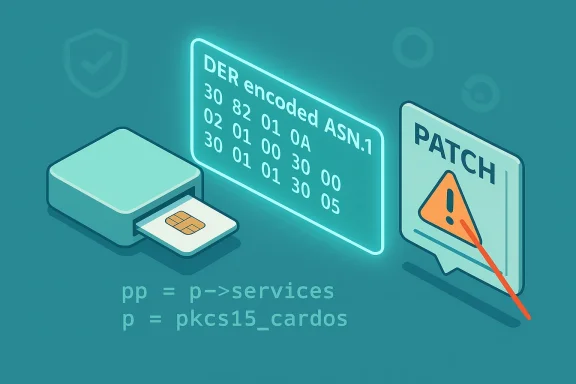
ASN.1 DER parsing is simple conceptually but unforgiving in practice: code must track buffer start, current pointer, and remaining length precisely. The vulnerable function scans an ASN.1 buffer for two nested tags (an outer tag that wraps a package list and inner tags that identify manufacturer ID and package number). In the existing code path the parser updates its current pointer and then reuses the old pointer value when calculating the remaining length for the nested search. That mismatch — searching inside a slice defined by one pointer while calculating length relative to another — produces an incorrect remaining‑length that can point past the end of the heap buffer. A read past that boundary constitutes a heap OOB read.Evidence from the patch: a one‑line logic fix
Downstream patches that remedied the flaw make the mistake clear. The fix changes calls like:- q = sc_asn1_find_tag(card->ctx, p, tlen, 0x01, &ilen);
- q = sc_asn1_find_tag(card->ctx, pp, tlen, 0x01, &ilen);
pp that holds the correct entry point for nested searches — i.e., the pointer returned by the initial sc_asn1_find_tag call. This small but crucial change ensures that the inner tag search is bounded by the correct start pointer and the expected remaining length, preventing the parser from reading outside the allocated buffer. The patch and associated packaging updates are visible in multiple vendor and build patches.Affected components and vendor response
- Affected component: OpenSC (pkcs15 module; pkcs15-cardos.c implementation). CVE metadata and vendor advisories list the primary affected upstream release as versions around 0.23.0 (distribution packages vary).
- Vendor and distribution advisories: Ubuntu published USNs updating opensc; Debian issued LTS advisories and backports; Red Hat tracked the issue and raised errata; SUSE and other enterprise distributions shipped fixes or backported changes into their opensc packages. Those vendors emphasize that updating the opensc package to a patched build is the recommended remediation.
- Upstream code changes: multiple downstream package managers and build systems applied the pointer‑fix patch and bumped packaging to include the correction (examples appear in Buildroot and meta‑oe patches). This demonstrates that the community recognized the root cause and applied a minimal, targeted fix.
Impact and risk model
What an attacker can and cannot do
- Attack vector: local — the attacker must cause a process linked against OpenSC to parse a crafted smart card package or supply a malicious ASN.1 blob. This can happen if an attacker can present a tampered card to a system or if a process reads an untrusted token file. Vendor trackers classify the attack vector as local with low complexity and low privileges required for some contexts.
- Primary consequences:
- Availability: repeated exploitation or ASAN‑enabled builds can crash processes that parse the malformed structure, causing denial of service for applications that rely on OpenSC. Distributors have documented crashes as a concrete effect.
- Confidentiality: the bug is an out‑of‑bounds read — that means the parser could leak heap contents from the hosting process. Memory leakage can reveal sensitive material such as private keys, session tokens, or other secrets if they happen to be resident in memory near the parsed buffer. Several advisories mark confidentiality impact as high.
- Integrity: publicly available records do not indicate an immediate arbitrary write primitive tied to this bug; integrity impact is therefore assessed as low/none by several trackers.
Exploitability and real‑world risk
- Exploit complexity: low to moderate, depending on context. Because the bug can be triggered simply by feeding a crafted ASN.1 structure, exploit developers with local access to a target system or to a card reader could craft inputs to trigger out‑of‑bounds reads and attempt to leak memory contents. However, turning an OOB read into targeted disclosure or code execution is non‑trivial and environment‑dependent.
- Scope: local scope — the flaw does not allow remote exploitation over a network by itself unless the attacker controls a remote smart card emulator or file input that a networked service will parse. In practice many production systems that interact with tokens are local or semi‑local (smart card readers, HID middleware, background daemons), so the operational exposure depends on how tokens are consumed in the target environment.
- Likelihood of active exploitation: no public proof‑of‑concepts were broadly published at disclosure time, and major tracking services rate the EPSS/active‑exploit signal as low. Distributions prioritized backports and updates to eliminate the risk surface.
How it was fixed — code‑level explanation
Pointer semantics matter
The vulnerable pattern can be summarized:- Find outer tag in buffer using function sc_asn1_find_tag(ctx, p, len, outer_tag, &tlen). That function returns a pointer within the buffer (or NULL) and sets tlen to the length of the tag payload.
- Without capturing the returned pointer into a separate variable, the code reused
pand then called sc_asn1_find_tag with the originalpand tlen to locate the inner tag. But because sc_asn1_find_tag had advanced or otherwise required a different base for the inner search, the length calculation (tlen) no longer matched the pointer supplied. The mismatch produced an off‑by‑pointer scenario and allowed the inner call to read past the intended bounds. - The fix stores the pointer returned by the outer search into
ppand then usesppas the start pointer for the nested inner search, keeping the start and length consistent.
Detection, hunting, and mitigation steps for administrators
Immediate actions (ordered)
- Inventory: quickly identify systems where OpenSC is installed or where applications rely on OpenSC (authentication services, smart‑card middleware, hardware token managers, workstation authentication agents). Use your package manager query tools to list installed opensc packages.
- Patch: apply vendor updates. Ubuntu, Debian, Red Hat, SUSE and others released updated packages or backports to remediate CVE‑2023‑2977; apply the appropriate distribution erratum (for example, Ubuntu USNs and Debian LTS advisories). If you build OpenSC from source, update to a version that includes the pointer‑fix patch or apply the known patch to pkcs15-cardos.c.
- Temporarily limit exposure: where patching is infeasible immediately, implement compensating controls:
- Restrict access to card readers and token files to trusted users.
- Disable or stop non‑essential services that parse smart card packages from untrusted sources.
- If a particular application calls OpenSC on behalf of networked users, restrict that interface until a patch is applied.
- Rebuild with hardening (where possible): enable ASAN or similar memory‑sanitizers in test builds to detect crashes during testing — note that ASAN‑enabled builds may expose the crash more obviously (they will fail on OOB reads), which is useful for QA but may not be desirable in production. Use secure build options like stack canaries and fortify_source where feasible.
Detection / hunting indicators
- Look for process crashes or core dumps from applications that use OpenSC or pkcs15 tools (e.g., pkcs15‑tool, opensc‑daemon, smartcard middleware). ASAN logs and crash traces referencing sc_asn1_find_tag or pkcs15‑cardos.c are strong indicators.
- Audit logs for unexpected smart card reads, device attachments, or token file imports. Correlate with user activity that involves inserting or provisioning tokens.
- Where possible, run fuzzing and sanitizer testing on token parsing code paths in a staging environment; malformed ASN.1 testcases that cause crashes can be used to validate that patches are effective.
For developers and packagers: review checklist
- Ensure the patched logic uses consistent pointer/length pairs for nested ASN.1 searches (the
ppvspcorrection). - Add unit‑tests that feed crafted ASN.1 sequences to the CardOS pkcs15 parser to confirm no OOB reads or crashes occur. Regression tests should include truncated and intentionally malformed DER structures that exercise nested tags.
- Consider refactoring ASN.1 parsing to use a small, well‑tested DER reader abstraction that returns explicit slices (pointer + length) rather than relying on repeated pointer arithmetic across calls.
- For projects embedding OpenSC or shipping third‑party token handlers, verify that your bundled OpenSC copy is updated; avoid embedding outdated copies without a documented patch pipeline.
Timeline and vendor advisories (summary)
- The issue was reported and tracked as CVE‑2023‑2977 with public entries in the NVD and many distribution trackers. Distributors like Ubuntu and Debian published advisories (USN / DLA) that describe the vulnerability and ship fixes; Red Hat created Bugzilla and errata entries, and SUSE included the fix in their security update announcements. Build systems and downstream packaging applied the pointer fix in patches and version bumps. These coordinated updates took place in mid‑2023 and were backported into multiple series by distribution maintainers.
Practical attack scenarios and limitations
- Practical attack scenario: an attacker with physical presence or the ability to insert a tampered token into a target system could present a malformed smart card package that triggers the OOB read in any process that automatically parses token metadata. On shared workstations or kiosk systems that accept arbitrary tokens, this is the most realistic exposure.
- Limitations: turning an OOB read into a remote code‑execution chain is not straightforward. The bug produces a read—not a write—so the most obvious result is memory disclosure or a crash. Many modern applications separate cryptographic material into dedicated processes or hardware modules (e.g., smartcard readers or HSMs), which reduces the chance that leaked memory will contain high‑value secrets. Nevertheless, memory disclosures can be valuable, and repeated small leaks can be aggregated.
Why this matters beyond the immediate bug
ASN.1 is a legacy serialization format that still underpins certificates and many smart card formats. Parsing code for ASN.1 is frequently written in C and is therefore vulnerable to pointer arithmetic bugs. CVE‑2023‑2977 is yet another reminder that:- Low‑level parsing code must be treated as hostile‑input surfaces.
- Small pointer/length mistakes can lead to information leakage across many systems because libraries like OpenSC are reused across distributions and applications.
- Supply‑chain hygiene (keeping downstream builds up to date) and thorough regression tests that include malformed data are essential defenses.
Recommendations — a concise checklist for operators
- Patch opensc packages immeddates (Ubuntu/Debian/Red Hat/SUSE) or apply the pointer‑fix patch if you build from source.
- Limit who can insert cards or upload token files; add policy controls around physical token use.
- Monitor for crashes from OpenSC consumers and enable core‑dump capture for forensic analysis.
- Add ASN.1 fuzz testcases to your CI for software that calls into OpenSC.
- Where feasible, minimize privileged processes that parse untrusted token inputs; isolate token parsing into constrained, audited components.
Closing analysis and caveats
CVE‑2023‑2977 is a high‑quality, narrow bug: it’s conceptually simple (a pointer/length mismatch) but consequential because OpenSC runs in many environments handling security tokens. The fix is small and well understood; the primary risk for operators is lagging patch deployment. Organizations that process untrusted smart cards — public kiosks, shared workstations, or automated card provisioning services — should prioritize updates and add runtime monitoring to detect crashes or anomalous token activity.Note: I reviewed the files you uploaded and the repository of provided document snippets; they did not contain additional technical details beyond the public advisories and patches summarized above.
CVE‑2023‑2977 is a textbook example of how minor pointer arithmetic errors in parsing code can create outsized security problems. The corrective patch is simple and already propagated through vendor channels; the sensible next steps for defenders are to patch quickly, harden parsing surfaces, and add targeted detection for crashes and memory‑leak behaviors in services that handle smart cards.
Source: MSRC Security Update Guide - Microsoft Security Response Center
