

OpenSky’s widened partnership with XLReporting marks a pragmatic, Microsoft-aligned push to modernize financial planning and reporting for publicly funded agencies — combining OpenSky’s Finance Navigator with XLReporting’s cloud-native CPM tools to deliver stronger forecasting, consolidation, and audit-ready stakeholder reporting for health, local authority, and social services clients.
OpenSky is a Ireland‑headquartered digital transformation specialist that focuses on government and healthcare customers, offering cloud, data, process automation and modernization services and a dedicated product called Finance Navigator for funded agencies. The Finance Navigator product is designed to centralize budgets, forecasts and grant-tracking for organisations that rely on multiple income streams and strict compliance rules. XLReporting is a Netherlands‑based planning-and-reporting platform used to consolidate, report and forecast financials, with multi-region hosting and a feature set aimed at replacing fragile spreadsheet processes with a controlled CPM workflow. XLReporting publicly describes itself as a finance‑expert team offering a one‑stop planning and reporting platform and supports regional hosting options (US / Europe / Asia) and ISO‑style security controls. The announcement reported by industry outlets positions the tie-up as a deeper technical and go‑to‑market integration: XLReporting’s planning and reporting engine will be embedded more tightly into Finance Navigator to improve financial planning capabilities, strengthen forecasting and analytics, and provide more sophisticated, auditable reporting for stakeholders and compliance purposes. The public statement frames this as a direct response to rising transparency and accountability expectations in the public sector. (Consultancy.eu coverage provided by the user.
Flag: vendor claims about immediate reduction in close‑time or rapid ROI should be treated as pilot hypotheses until validated on an agency’s live dataset. Public materials often report impressive percent reductions and time savings, but those metrics depend on preexisting data quality and the scope of automation. Demand measurable KPIs in the contract and verify them in a controlled pilot.
For agencies that are already Microsoft tenants, an Azure‑centric delivery that surfaces reports and forecasts into Excel or Power BI dashboards delivers immediate usability benefits. That said, close coupling with a single cloud provider introduces portability questions — agencies should negotiate exit and data portability clauses as part of procurement.
However, measurable success hinges on three non‑negotiables: clean master data, rigorous governance and clear contractual protections around data residency, portability and audit evidence. Agencies that treat vendor ROI claims as pilot hypotheses, insist on immutable provenance and retain human sign‑off for statutory outputs will capture the benefits without exposing themselves to the common pitfalls of rapid digitalisation.
OpenSky’s sector pedigree and Microsoft alignment, together with XLReporting’s cloud consolidation and reporting features, create a practical path for public finance modernization — provided procurement, IT and finance leaders embed the right controls and acceptance criteria into the pilot and rollout.
Acknowledgement of unverifiable claims: some headline efficiency figures and ROI assertions quoted in vendor materials and press releases were not independently verifiable in public materials at the time of review; these should be validated by agencies during a scoped pilot and contractually required metrics.
Source: Consultancy.eu Irish Microsoft partner OpenSky expands collaboration with XLReporting
 Background / Overview
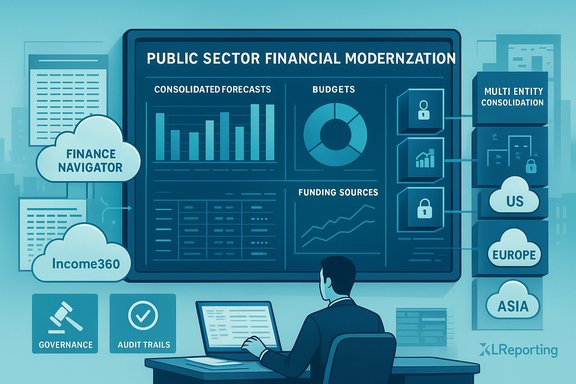
OpenSky is a Ireland‑headquartered digital transformation specialist that focuses on government and healthcare customers, offering cloud, data, process automation and modernization services and a dedicated product called Finance Navigator for funded agencies. The Finance Navigator product is designed to centralize budgets, forecasts and grant-tracking for organisations that rely on multiple income streams and strict compliance rules. XLReporting is a Netherlands‑based planning-and-reporting platform used to consolidate, report and forecast financials, with multi-region hosting and a feature set aimed at replacing fragile spreadsheet processes with a controlled CPM workflow. XLReporting publicly describes itself as a finance‑expert team offering a one‑stop planning and reporting platform and supports regional hosting options (US / Europe / Asia) and ISO‑style security controls. The announcement reported by industry outlets positions the tie-up as a deeper technical and go‑to‑market integration: XLReporting’s planning and reporting engine will be embedded more tightly into Finance Navigator to improve financial planning capabilities, strengthen forecasting and analytics, and provide more sophisticated, auditable reporting for stakeholders and compliance purposes. The public statement frames this as a direct response to rising transparency and accountability expectations in the public sector. (Consultancy.eu coverage provided by the user.Why this matters for public sector finance teams
Publicly funded agencies face three persistent tensions: the need for granular, auditable reporting to satisfy funders and auditors; the widespread use of spreadsheets as de facto reporting engines; and limited IT budgets that make bespoke ERP replacements impractical. OpenSky’s Finance Navigator targets that exact intersection by providing a domain‑aware front end for funded agencies that can integrate with existing ledgers while adding governance, driver‑based budgets and Income‑360 style tracking for restricted funding. XLReporting adds a lightweight CPM layer that can consolidate multiple entities, maintain forecast scenarios and publish management and statutory packs. The combination is aimed at replacing brittle Excel chains with a controlled, cloud‑hosted consolidation and reporting flow — a common objective for public sector bodies looking to reduce spreadsheet risk and speed up month‑end reporting. Key, immediate benefits claimed by both vendors include:- Improved reporting and analytics through consolidated models and dashboarding.
- Stronger oversight and forecasting with driver-based budgeting and scenario modelling.
- Better auditability by linking reported figures to source transactions and funding rulings.
These outcomes directly address auditors’ expectations around provenance, traceability and retention of financial evidence in regulated public finance contexts.
What each party brings to the table
OpenSky — sector domain, delivery, and Microsoft alignment
OpenSky brings sector knowledge, implementations for health, local government and justice sectors, and a productized approach with Finance Navigator designed specifically for grant‑funded organisations. The vendor has an extensive public‑sector customer history and a set of modular services—data integration, Income360 functionality for tracking restricted funds, and role‑based editing and approvals—designed for the special-purpose workflows of funded agencies. OpenSky also positions itself as a Microsoft‑centric delivery partner: it has documented Azure capabilities, Microsoft specialisations for migration, and G‑Cloud listings for public procurement, which matter when agencies evaluate cloud residency, identity and procurement flows. That Microsoft alignment simplifies integration into Azure‑based tenants and Microsoft identity stacks used by many public organisations.XLReporting — cloud CPM, consolidation, and integrations
XLReporting supplies the planning, consolidation and reporting engine: a cloud SaaS product that can consolidate multi‑entity financials, drive multi‑scenario forecasts and publish interactive and paginated reports. XLReporting advertises integrations with 40+ accounting systems and a lightweight, configurable platform aimed at replacing spreadsheet-based reporting. The vendor’s hosting regions and security posture (regional hosting and ISO-style guarantees) provide flexibility for organisations with regional data‑residency and uptime needs.Technical integration and deployment considerations
Integrating a third‑party CPM into a sector-specific product is straightforward in concept but operationally nuanced. The partnership will require careful design across these areas:- Data integration: mapping chart‑of‑accounts, dimension harmonisation and master‑data reconcilement are prerequisites. Without a robust master‑data clean‑up, consolidation engines and driver models will produce inconsistent outputs.
- Identity and security: tighter Microsoft alignment reduces friction, but agencies should ensure that authentication, role‑based access and least‑privilege controls are enforced via their Azure AD/Entra configurations.
- Audit trails and provenance: Finance Navigator needs to preserve or expose the XLR (XLReporting) consolidation lineage and tie outputs back into the agency’s official ledgers and supporting documents.
- Hosting and residency: XLReporting offers multiple hosting regions; procurement teams must confirm chosen regions and SLAs align with statutory retention and data residency policies.
Governance, auditability and compliance — a closer look
The public sector operates under strict audit windows and regulatory scrutiny. Any new reporting stack must demonstrate:- Immutable logs linking consolidation results to source transactions.
- Retention of prompt and transformation metadata for audit review.
- Human‑in‑the‑loop approvals for high‑impact journal entries and external filings.
Flag: vendor claims about immediate reduction in close‑time or rapid ROI should be treated as pilot hypotheses until validated on an agency’s live dataset. Public materials often report impressive percent reductions and time savings, but those metrics depend on preexisting data quality and the scope of automation. Demand measurable KPIs in the contract and verify them in a controlled pilot.
Procurement and commercial points public agencies must verify
- Licensing and procurement route: confirm whether XLReporting is purchased directly or via OpenSky’s bundled offering and whether purchases can be processed through public procurement frameworks.
- Data residency and hosting SLAs: verify XLReporting region choice and backup/restore guarantees that meet statutory retention schedules. XLReporting advertises US, Amsterdam and Singapore host regions; select the region aligned to legal requirements.
- Export and exit terms: insist on clear data export formats and runbooks so that agencies can migrate off the platform if required.
- Security attestations: request SOC 2, ISO‑27001 certificates and independent penetration testing results where possible.
- Support and SLA during month‑end peaks: ensure the support model covers close windows and includes escalation matrices.
The market context — why Microsoft alignment matters
The ecosystem that supports financial planning and reporting is gravitating toward tight integrations with Microsoft productivity tools (Excel, Power BI, Teams, Copilot) and Azure hosting because many finance teams’ day‑to‑day work happens in Excel and Microsoft 365. Vendors that integrate with Microsoft can reduce friction by embedding outputs into familiar workflows and leveraging Entra/Azure identity, which simplifies governance. Recent vendor moves across the finance vendor landscape underscore this trend and the related governance tradeoffs.For agencies that are already Microsoft tenants, an Azure‑centric delivery that surfaces reports and forecasts into Excel or Power BI dashboards delivers immediate usability benefits. That said, close coupling with a single cloud provider introduces portability questions — agencies should negotiate exit and data portability clauses as part of procurement.
Strengths of the OpenSky — XLReporting combination
- Domain fit: Finance Navigator is purpose‑built for funded agencies and can incorporate Income360‑style tracking for restricted funding, which reduces the modelling complexity needed to prove compliance.
- Faster adoption: delivering planning functionality through a known sector partner that also delivers implementation reduces the “IT to business” friction often seen in CPM projects.
- Microsoft ecosystem benefits: Azure alignment reduces identity and procurement friction for Microsoft-first agencies and allows reuse of existing governance controls.
- Practical CPM features: XLReporting’s lightweight consolidation, scenario modelling and reporting templates reduce the time required to create board and funder packs compared with bespoke Excel processes.
Potential risks and mitigations
- Data quality: the most common failure mode is poor master data. Mitigation: budget a pre‑project master‑data remediation sprint and require test KPIs before go‑live.
- Overstated vendor ROI claims: vendor materials often cite significant efficiency gains; treat these as testable hypotheses and require pilot metrics and an acceptance sign‑off.
- Vendor lock‑in and portability: ensure contractual rights to extract consolidation rules, mapping tables and raw data in open formats.
- Audit trail completeness: confirm that the combined solution preserves transaction‑level evidence and that logs are tamper‑evident and exportable for external auditors.
- Cost surprises: cloud‑based CPM usage and integration workloads can generate unexpected charges. Insist on a cost pilot and FinOps visibility into consumption and connectors.
Practical rollout checklist for procurement and IT teams
- Confirm objectives and KPIs: reduction in manual report hours, forecast cycle time, and reconciliation error rates.
- Run a 60–90 day pilot on a single programme or fund with defined acceptance criteria.
- Map data lineage: capture exactly where each reported figure originates and who can change it.
- Validate hosting region and SLAs: select XLReporting hosting aligned with statutory requirements.
- Demand security artefacts: SOC/ISO attestation, penetration test results and an on‑demand export of logs.
- Agree exit and portability terms: export formats for chart of accounts, mappings, and consolidated outputs.
- Train finance users on new approval flows and ensure human sign‑off gates for statutory outputs.
Cross-checks and verifications performed
- OpenSky’s Finance Navigator product and Income360 funding features are publicly documented on OpenSky’s site, where the company outlines its capabilities for funded agencies.
- XLReporting lists its platform capabilities, regional hosting and security posture on its corporate site, confirming it provides consolidation, forecasting and integrations.
- OpenSky’s Microsoft specialisation and G‑Cloud procurement listings confirm the company’s Microsoft alignment and public‑sector procurement readiness.
- Broader finance‑technology vendor patterns — particularly the push to embed finance AI, agents and provenance tooling into Microsoft productivity surfaces — were cross‑referenced against recent industry analyses to validate governance and audit recommendations.
What success looks like — measurable outcomes to insist on
- Reduced month‑end compilation time (targeted reduction measured in days or hours).
- Consistent, auditable reports where each figure can be traced to a ledger ID and supporting invoice.
- Forecasts that are versioned, scenario‑tagged and available to budget holders for what‑if modelling.
- A demonstrable reduction in spreadsheet‑based manual interventions and the elimination of critical spreadsheet dependencies for statutory outputs.
Conclusion — measured optimism with guardrails
The OpenSky / XLReporting integration is a sensible tactical move for funded agencies wrestling with spreadsheet fragility, complex funding rules and growing transparency demands. It combines a sector‑savvy delivery partner with a flexible cloud CPM engine, which can shorten implementation timelines and increase adoption because the solution surfaces where finance teams already work.However, measurable success hinges on three non‑negotiables: clean master data, rigorous governance and clear contractual protections around data residency, portability and audit evidence. Agencies that treat vendor ROI claims as pilot hypotheses, insist on immutable provenance and retain human sign‑off for statutory outputs will capture the benefits without exposing themselves to the common pitfalls of rapid digitalisation.
OpenSky’s sector pedigree and Microsoft alignment, together with XLReporting’s cloud consolidation and reporting features, create a practical path for public finance modernization — provided procurement, IT and finance leaders embed the right controls and acceptance criteria into the pilot and rollout.
Acknowledgement of unverifiable claims: some headline efficiency figures and ROI assertions quoted in vendor materials and press releases were not independently verifiable in public materials at the time of review; these should be validated by agencies during a scoped pilot and contractually required metrics.
Source: Consultancy.eu Irish Microsoft partner OpenSky expands collaboration with XLReporting
