

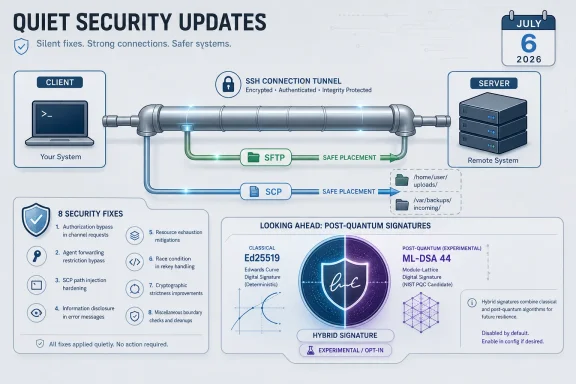
As detailed in the official OpenSSH release notes and summarized by Help Net Security and How2Shout, version 10.4 is best understood as a hygiene release with two audiences. The first is every administrator who should patch because small file-transfer bugs and authentication edge cases are exactly the kind of defects that become regrettable later. The second is the smaller group already planning for post-quantum cryptography, because 10.4 moves OpenSSH’s quantum story beyond key exchange and into signatures — experimentally, cautiously, and very much on purpose.
OpenSSH’s Quiet Releases Are the Ones Administrators Should Not Ignore
OpenSSH does not behave like a commercial browser vendor announcing a bundle of branded CVEs with colored severity badges and emergency update banners. Its release notes are terse, technical, and sometimes understated to the point of seeming casual. That makes them easy to skim past, especially when there is no known mass exploitation campaign and no “critical” label demanding immediate board-level attention.
That would be the wrong lesson from 10.4. The security fixes here are not all equal, and several are hardening measures rather than remotely exploitable catastrophe material. But OpenSSH sits at a uniquely sensitive boundary: it is both a user-facing client and an internet-facing daemon, and it frequently runs in environments where administrators have normalized trust relationships that deserve less trust than they get.
The most interesting part of this release is that its risks are lopsided. The server-side fixes matter, but the more practically awkward bugs live on the client side, in the file-transfer paths where users and scripts interact with machines they may not fully control. That is a useful reminder that SSH security is not only about preventing strangers from logging into your servers; it is also about what happens when your workstation, CI runner, backup job, or admin laptop talks to a server that behaves maliciously.
There is also a packaging reality behind this story. Most WindowsForum readers who run Linux servers will not fetch a tarball from OpenSSH mirrors and compile 10.4 by hand. They will wait for Debian, Ubuntu, Fedora, Arch, Red Hat, SUSE, Alpine, Homebrew, MacPorts, or a vendor appliance update to absorb the release, backport selected patches, or document why a particular exposure does not apply. That distribution layer is not bureaucracy; it is how OpenSSH safely reaches production.
The Real Risk Is Not a Hollywood SSH Takeover
The two file-transfer bugs credited to the Swival Security Scanner are the fixes most administrators should mentally underline. One affects sftp downloads where a malicious server could cause a file to be placed somewhere other than the user intended. The other affects scp when copying between two remote hosts, where a malicious server could write into the parent of the intended target directory.
Those descriptions sound less dramatic than a remote-code-execution vulnerability, but they live in a dangerous neighborhood. File placement bugs become serious when they intersect with automation, predictable paths, shell startup files, deployment directories, cron-managed locations, or scripts that assume “downloaded successfully” also means “downloaded exactly where I expected.” The attacker does not need to break SSH encryption if they can abuse trust at the application layer after the secure channel is established.
The modern scp story makes this more subtle. OpenSSH has spent years moving away from legacy SCP protocol semantics and toward SFTP-backed behavior, precisely because the older model left too much room for server-side weirdness. Yet file-transfer tools remain hard to secure perfectly because their job is to translate names, paths, globbing expectations, local directories, remote directories, and user intent across a trust boundary.
This is where routine patching beats panic. If your users only pull files from your own fleet, your risk profile is different from a developer who regularly retrieves artifacts from customer servers, lab machines, test boxes, partner systems, or disposable cloud hosts. But “different” is not “zero,” and administrators have learned the hard way that internal machines sometimes become malicious machines after compromise.
The client-side use-after-free fix belongs in the same practical bucket. According to the OpenSSH release notes, the bug could be triggered if a server changed its host key during a key re-exchange. That is an odd edge case, not a common operational pattern, but SSH clients are exposed to arbitrary servers by design. Fixing memory-safety defects in that path is exactly what you want from a mature security toolchain.
Server-Side Fixes Reward the Boring Configuration Choices
The server-side item likely to attract the most attention is a potential pre-authentication denial of service involving GSSAPI authentication. The important caveat is that GSSAPI authentication is disabled by default. That does not make the bug irrelevant, but it moves the center of gravity away from the average internet-facing sshd instance and toward environments that deliberately enable Kerberos-style enterprise authentication.
This is a familiar pattern in infrastructure security. Optional features often carry the most interesting attack surface because they serve specialized environments, integrate with older systems, or depend on complex authentication flows. GSSAPI is not inherently reckless; in the right organization, it is a sensible part of single sign-on architecture. But the OpenSSH 10.4 fix is a reminder that every enabled mechanism is a promise to parse more input before the user has authenticated.
The release also fixes several cases where the minimum authentication delay was not being enforced. That delay is not glamorous, but it is one of the small pieces of friction that makes brute-force attempts less efficient. If authentication failures can return too quickly in certain paths, an attacker gets a better testing loop, and defenders lose one of the cheap throttles built into the daemon.
Another server-side correction involves forwarding controls. The release notes say DisableForwarding=yes did not override PermitTunnel as documented. This is the kind of bug administrators hate because it undermines a mental model rather than merely breaking a command. Security configuration is only as good as the operator’s confidence that the words in the file mean what the manual says they mean.
That forwarding fix matters in bastion-host and restricted-account designs. Many organizations use SSH accounts that are supposed to do one narrow thing: accept a Git operation, run a backup command, tunnel to a controlled destination, or provide emergency console access without turning into a general-purpose pivot point. If a broad “disable forwarding” directive fails to dominate a narrower tunnel setting, the configuration language becomes a trap.
Memory-Wasting Peers Meet a Stricter Transport Layer
OpenSSH 10.4 also changes transport behavior by disconnecting peers that send non-key-exchange messages during a post-authentication rekey. The release notes frame this as closing a path where a malicious peer could waste server memory. That is not a cinematic vulnerability, but it is exactly the kind of protocol hygiene that keeps internet-facing daemons boring.
Rekeying is normal. Long-lived SSH sessions periodically refresh cryptographic material so that a connection does not depend forever on the same keys. But normal protocol complexity creates liminal moments, and liminal moments are where attackers like to linger: after authentication but during a state transition, inside code that is supposed to be temporary, rare, and carefully sequenced.
The fix says something about OpenSSH’s posture. It is not enough for the daemon to remain cryptographically correct; it also needs to be stingy with memory, strict about message ordering, and suspicious of peers that behave creatively. In network security, “creative” is rarely a compliment.
There is a small compatibility warning embedded here, too. Stricter protocol handling can expose broken clients, unusual middleware, old libraries, or embedded SSH implementations that got away with sloppy behavior because servers were forgiving. Most users will never notice. The few who do should treat the breakage as useful telemetry: something in the stack was depending on tolerance it should not have needed.
The Post-Quantum Headline Is Real, but It Is Not the Patch Reason
The most forward-looking change in OpenSSH 10.4 is experimental support for a composite post-quantum signature scheme combining ML-DSA 44 with Ed25519. In plain English, that means OpenSSH can now test an authentication signature that pairs a newer quantum-resistant algorithm with a well-established classical elliptic-curve signature. The scheme is off by default, and administrators must explicitly enable the relevant algorithm lists and generate keys with ssh-keygen -t mldsa44-ed25519.
This is the right kind of conservatism. Post-quantum cryptography is not a single switch the industry flips one Tuesday afternoon. It is a migration process involving standards, implementations, interoperability testing, performance measurements, key sizes, hardware support, compliance interpretation, and years of operational habit.
The composite design is especially revealing. By pairing ML-DSA 44 with Ed25519, OpenSSH is not asking administrators to bet the house on a relatively new post-quantum signature alone. It is taking the belt-and-suspenders route: a signature should remain trustworthy unless both halves fail in a way that matters. That is attractive during a transition period when new algorithms need real-world testing but old algorithms still carry deep implementation confidence.
It is also important to separate signatures from key exchange. OpenSSH has already been moving on hybrid post-quantum key exchange, including default use in recent releases for the part of SSH that protects session secrecy against future quantum decryption threats. The new 10.4 work is different. It concerns authentication — proving the identity of a host or user — not merely agreeing on keys for an encrypted session.
That distinction matters because the threat models differ. Hybrid post-quantum key exchange is often discussed in terms of harvest now, decrypt later, where an adversary records encrypted traffic today in hopes of decrypting it once quantum computers mature. Post-quantum signatures address a different future: one where attackers may be able to forge identities if classical signature schemes become breakable. Both matter, but they do not arrive in production at the same speed.
Experimental Means Experimental, Especially for Fleets
No administrator should read “post-quantum” and immediately redeploy host keys across a production fleet. The 10.4 signature option is experimental, opt-in, and best suited for labs, test bastions, interoperability experiments, and organizations that already have a cryptographic migration program. For everyone else, the correct reaction is curiosity, not a change freeze-breaking rollout.
The operational questions are not trivial. Will your SSH clients support the new signature scheme? Will your configuration management tools parse and distribute the new key type correctly? Will your privileged access management system, hardware-backed key workflow, scanning platform, audit tooling, or old appliance firmware understand what it sees? Will compliance teams bless it, ignore it, or panic because a scanner does not recognize the algorithm string?
Those questions are not arguments against post-quantum readiness. They are arguments for starting the paperwork and testing early, while the feature is explicitly experimental and nobody is pretending the whole industry has converged. Cryptographic transitions fail when administrators wait until a deadline, then discover that the weakest link is not OpenSSH but an abandoned network switch, vendor appliance, jump-box product, or brittle audit parser.
There is also a user-experience problem. SSH’s trust-on-first-use model is already confusing to non-specialists, and host-key changes remain one of the few security warnings ordinary developers actually see. Introducing new key types into mixed environments must be done carefully, because a badly planned host-key migration can train users to ignore warnings or delete known-hosts entries reflexively.
The best near-term use of the 10.4 post-quantum signature work is therefore measurement. Generate keys in a lab. Test against current clients. Check logs. See what scanners report. Observe whether your automation assumes a fixed list of key types. The point is not to be first; the point is to avoid being surprised.
The Packaging Layer Will Decide How Fast This Actually Reaches You
OpenSSH upstream released 10.4 on July 6, but most users will encounter it through their operating system vendor, not the upstream tarball. That creates a familiar lag between “released” and “installed,” and the lag is not inherently bad. Linux and Unix-like distributions routinely backport fixes, preserve ABI expectations, adjust build options, and integrate patches into supported release branches rather than pushing every upstream version wholesale.
For rolling-release users, 10.4 may arrive quickly and visibly. For enterprise Linux users, the version string may not change to 10.4 at all, even after the relevant fixes are included. That is the perennial scanner problem: a naive vulnerability report sees an old OpenSSH version and declares a machine vulnerable, while the vendor package has quietly carried the fix for months.
Administrators should resist both extremes. Do not ignore the release because your distribution has not shipped the exact upstream version number. Do not assume you are vulnerable because your scanner compares strings instead of reading vendor advisories. The sane path is to track the package advisory from your distribution and verify whether the specific fixes have been backported.
Windows users are in a slightly different position. Microsoft ships OpenSSH components in Windows, and many administrators also install OpenSSH through optional features, PowerShell workflows, Git tooling, WSL distributions, MSYS2, Cygwin, or third-party bundles. The practical advice remains the same: know which OpenSSH you are actually invoking. On a developer workstation, ssh -V can tell a story more complicated than “Windows has SSH.”
That complexity matters because OpenSSH is not only a server package. A developer may patch their Linux VM while still using an older client from a separate toolchain. A CI runner may use the base image’s OpenSSH. A Windows admin may connect through the built-in client, a Git-bundled client, or an enterprise remote-management product. The client-side fixes in 10.4 make inventory more than a server checklist.
The Security Story Is Modest, Which Is Why It Is Credible
Security coverage often rewards drama. A release with eight fixes and post-quantum cryptography practically invites inflated headlines about critical vulnerabilities and quantum-proof SSH. The actual story is better because it is more restrained: OpenSSH 10.4 fixes real bugs, tightens protocol behavior, and exposes an experimental path toward future authentication schemes without pretending the future has already arrived.
That restraint is part of OpenSSH’s value. The project has been willing to remove weak algorithms, change defaults, adopt hybrid key exchange, and harden behavior over time, but it generally does so with release notes that expect administrators to read closely. The result is not always convenient, and sometimes compatibility breaks. But secure infrastructure is built through accumulated boring decisions, not only emergency patches.
For enterprises, the main risk is not that 10.4 demands immediate overnight work. It is that organizations will file it under “not urgent” and never return. That is how small issues turn into inherited exposure: the package waits for the next maintenance window, the maintenance window slips, an appliance never gets updated, and a client-side bug remains on the laptop used for the weird one-off vendor transfer nobody documented.
For home lab users and enthusiasts, the lesson is simpler. Update when your distribution provides the package. Avoid copying files from untrusted servers with old clients. Treat post-quantum options as a lab project unless you know exactly why you are enabling them. And remember that SSH security is partly about the client you carry into other people’s environments, not only the daemon you expose to the internet.
The Practical Reading of 10.4 Is Smaller Than the Headline and Bigger Than a Patch Note
OpenSSH 10.4 deserves neither panic nor indifference. It is a maintenance release with enough security substance to justify prompt adoption and enough cryptographic experimentation to show where the project is heading. The release is especially relevant for administrators who use SFTP and SCP in automated workflows, run GSSAPI-enabled SSH servers, depend on forwarding restrictions for containment, or maintain long-lived sessions where protocol edge cases matter.
The most concrete takeaways are straightforward:
- OpenSSH 10.4 was released on July 6, 2026, and includes eight security fixes across client, server, file-transfer, and agent-related code paths.
- The most practically important fixes involve SFTP and SCP cases where malicious servers could influence where files are written.
- The GSSAPI pre-authentication denial-of-service issue matters mainly to environments that enabled GSSAPI authentication, because it is not on by default.
- The new ML-DSA 44 plus Ed25519 signature scheme is experimental, opt-in, and best tested in labs before any production rollout.
- Administrators should update through their operating system or vendor package channel rather than reflexively compiling upstream OpenSSH by hand.
- Windows, WSL, Git, CI, and third-party toolchains may each carry different OpenSSH clients, so checking the actual client version matters.
OpenSSH 10.4 is ultimately a reminder that the security of remote administration advances in two tempos at once: the immediate rhythm of patching small, concrete bugs before they become someone’s clever exploit chain, and the slower rhythm of preparing for cryptographic assumptions that may not hold forever. The right response is to do the boring thing now — patch through trusted channels, verify configurations, test where necessary — while treating the post-quantum work as an early signal that SSH’s next decade is already being designed in public.
References
- OpenSSH 10.4 Lands With Eight Security Fixes and Experimental Post-Quantum Signatures H2S Media · 2026-07-07T05:20:08.947965