

Operation Winter SHIELD arrives with a simple, urgent thesis: the cyber problem isn’t a shortage of guidance — it’s a failure to turn guidance into enforceable, repeatable protections. Launched as a focused, nine‑week effort beginning February 2, 2026, the initiative reframes the debate from “what we should know” to “what we must do,” and it asks defenders to stop debating frameworks and start delivering guardrails that hold under real‑world attacker pressure. Microsoft’s public endorsement and operational contribution — most visibly through practical guidance and platform capabilities such as Baseline Security Mode — make this more than another awareness push. It’s a practical, enforcement‑first playbook aimed squarely at the execution gap that threat actors exploit most reliably.
Every major incident over the last several years — from supply‑chain compromises to enterprise ransomware — shares a common root: fundamental controls were known but not consistently applied. Stolen credentials remain the most frequent initial access vector. Legacy authentication protocols and end‑of‑life systems continue to exist in production. Administrators often tolerate exceptions and temporary workarounds that never get closed. Attackers don’t need novel zero‑days when the basics are left unlocked.
Operation Winter SHIELD synthesizes investigative insights into ten high‑impact defensive actions and pushes organizations to prioritize implementation over theory. The FBI’s campaign reframes resilience as an operational metric: not whether controls exist on paper, but whether they are enforced in production and whether they stand up to active threat behavior. Microsoft’s contribution is to demonstrate how platform defaults and guardrails can make those defensive actions practical to deploy at scale.
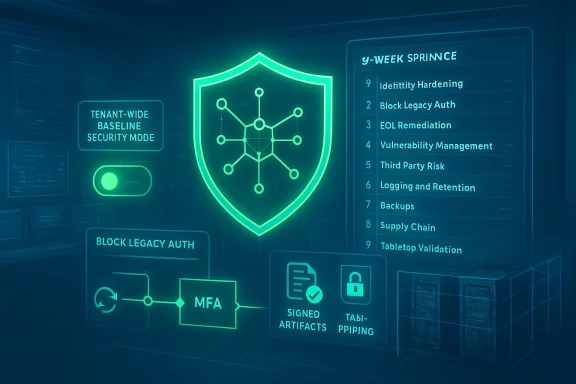
Week 1: Identity hardening — admin MFA, remove shared admin accounts.
Week 2: Block legacy authentication — run impact reports and remove basic auth flows.
Week 3: EOL remediation — identify and isolate end‑of‑life systems.
Week 4: Vulnerability management — authenticated scans and rapid remediation SLAs.
Week 5: Third‑party risk — inventory vendors and restrict external access.
Week 6: Logging and retention — centralize and protect audit trails.
Week 7: Backup and restore — implement offline immutable backups and test recovery.
Week 8: Supply chain — enforce signed artifacts and CI policy gates.
Week 9: Tabletop and validation — run exercises and validate all enforcement rules.
This cadence converts campaign momentum into measurable weekly progress.
In short: knowing what matters is table stakes. Operation Winter SHIELD is valuable because it insists on doing what matters — at scale, with accountability, and with guardrails that remain effective when adversaries are present. The work ahead is practical, messy, and institutionally challenging. It will require sustained investment and a willingness to prioritize enforcement over convenience. But if the goal is to make cybercrime feel costlier and less reliable for attackers, this initiative is precisely the kind of concentrated, operational push that can move the needle.
Join the shift: treat the next nine weeks as a sprint to durable guardrails, not a public relations calendar. Inventory what you can fix, bind it to owners and deadlines, and put the controls in production. Turn recommendations into enforced outcomes, and make the gap between knowing and doing smaller every day.
Source: Microsoft The security implementation gap: Why Microsoft is supporting Operation Winter SHIELD | Microsoft Security Blog
 Background: why the implementation gap matters
Every major incident over the last several years — from supply‑chain compromises to enterprise ransomware — shares a common root: fundamental controls were known but not consistently applied. Stolen credentials remain the most frequent initial access vector. Legacy authentication protocols and end‑of‑life systems continue to exist in production. Administrators often tolerate exceptions and temporary workarounds that never get closed. Attackers don’t need novel zero‑days when the basics are left unlocked.Operation Winter SHIELD synthesizes investigative insights into ten high‑impact defensive actions and pushes organizations to prioritize implementation over theory. The FBI’s campaign reframes resilience as an operational metric: not whether controls exist on paper, but whether they are enforced in production and whether they stand up to active threat behavior. Microsoft’s contribution is to demonstrate how platform defaults and guardrails can make those defensive actions practical to deploy at scale.
Overview of the initiative and Microsoft’s role
Operation Winter SHIELD is deliberately practical. Its objectives:- Focus attention on a short list of high‑impact controls informed by real investigations.
- Reduce the decision burden on defenders by advocating secure defaults and automation.
- Provide hands‑on, implementation‑focused resources — not just checklists.
- Block legacy authentication paths that frequently bypass MFA protections.
- Require phish‑resistant multifactor authentication for administrators.
- Surface end‑of‑life systems and other unsupported assets for remediation or isolation.
- Enforce least‑privilege access patterns and reduce administrative overreach.
What investigative telemetry tells us about failures
Law enforcement and incident responders see recurring patterns that turn manageable incidents into crises:- Nation‑sponsored actors probe and exploit unsupported infrastructure that no longer receives patches.
- Criminal operators use credential stuffing and over‑privileged accounts to move laterally and escalate.
- CI/CD and build systems are trusted implicitly and often lack the same governance as production, making them an ideal path for escalation.
- Detection windows are shrinking and attacker playbooks move faster than typical patch cycles or bureaucratic approvals.
Strengths of the Microsoft + FBI guardrail approach
1. Secure‑by‑default reduces cognitive load
When controls are enforced by default, defenders don’t need to make dozens of risk decisions under pressure. Secure defaults remove many human error pathways and shrink the effective attack surface overnight.2. Operational, not academic, focus
The initiative targets how to implement controls — timelines, exception management, telemetry — not only which controls to apply. That emphasis on operational guidance makes it actionable for busy teams.3. Platform enforcement accelerates scale
Built‑in platform features (for example, tenant‑wide blocks for legacy auth or admin MFA enforcement) allow organizations to apply high‑impact protections across broad estates without bespoke integrations.4. Investigative data informs priorities
Prioritizing based on how attackers actually behave — stolen credentials, legacy paths, EOL systems — ensures limited resources target the highest return controls first.Risks and practical limitations — what defenders must watch for
No program scales without tradeoffs. The following are the most important operational risks that could blunt the initiative’s impact if not managed proactively.1. Migration and compatibility pain for legacy environments
Large, regulated, or highly‑customized environments often run legacy workflows that cannot be migrated instantly. Blocking legacy authentication, enforcing new MFA modalities, or disabling deprecated services can cause business disruption unless migration paths and temporary compensating controls are explicitly planned.2. Exceptions become permanent compromises
Organizations frequently create temporary exceptions to avoid outages. Without strict governance — recorded owners, defined expiration dates, and compensating controls — exceptions become the very backdoors attackers exploit.3. Resource constraints and prioritization
Smaller teams lack the staffing to inventory EOL systems, test modern authentication across all clients, or retool CI/CD pipelines. The initiative’s success depends on translating priority actions into small, immediate steps organizations can staff and budget.4. False sense of security from defaults alone
Enabling secure defaults is powerful, but not sufficient. Attackers adapt; telemetry, monitoring, and incident readiness must complement guardrails. Secure defaults reduce risk significantly, but do not eliminate the need for detection and response capabilities.5. Governance and accountability gaps
Technical controls matter only when enforced by a governance engine that includes ownership, exception handling, and reporting. Without centralized accountability, “who’s responsible?” becomes the attack vector.What the ten high‑impact actions mean in practice
Operation Winter SHIELD codifies ten action areas. Translated into operational steps, they look like this:- Adopt phish‑resistant authentication: prioritize admins, execs, and high‑impact accounts for FIDO2 security keys or device‑bound passkeys. Remove SMS and other weak second factors where possible.
- Implement a risk‑based vulnerability management program: asset inventory, authenticated scanning, and SLAs that measure remediation in days for critical systems.
- Track and retire end‑of‑life technology on a rolling schedule with quarterly reviews and enforced isolation for assets that cannot be retired immediately.
- Manage third‑party risk: single registry of vendors, enforce strong authentication and least‑privilege for external accounts, contractually require rapid breach notification.
- Protect logs and preserve them: centralized SIEM ingestion, immutable exports for retention, and 12‑month baseline retention for critical audit trails.
- Maintain offline, immutable backups and perform restoration tests regularly using the 3‑2‑1 rule.
- Secure the software supply chain: isolate CI identities, sign artifacts, require provenance, and enforce gated builds.
- Segment networks and reduce lateral movement: microsegmentation and strict ACLs for management and critical systems.
- Practice and test incident response with tabletop exercises and runbooks that include supply chain and compromise scenarios.
- Hunt proactively and validate controls: continuous validation, red team exercises, and automation to detect misconfigurations.
Baseline Security Mode: what it offers and how to approach it
Baseline Security Mode is Microsoft’s practical pattern for turning guidance into guardrails. Key characteristics:- Tenant‑level controls intended to be toggled on with clear impact reporting.
- A phased approach so teams can run impact reports, identify dependencies, and remediate blockers before enforcing defaults.
- Specific settings to block legacy protocols, enforce phish‑resistant MFA for admins, and isolate or flag EOL systems.
- Built‑in reporting to reveal who, what, and where legacy or risky connections remain.
- Run the impact reporting tools immediately to create a migration backlog.
- Prioritize remediation where Baseline settings show zero impact first — these are low‑risk wins.
- Where dependencies exist, plan short, measurable remediation sprints and document exceptions with expiration.
- Use phased enforcement to avoid mass outages: pilot → selective enforcement → tenant‑wide enforcement.
- Pair Baseline toggles with enhanced telemetry and SIEM rules to detect any attempts to bypass new controls.
Securing the software supply chain: guardrails that scale
Microsoft and the FBI both highlight CI/CD and build systems as frequent intrusion points. To reduce supply chain risk, organizations should:- Enforce identity isolation for build agents and developers: short‑lived tokens, MFA, and least privilege for publishing artifacts.
- Require signed artifacts and provenance for any release artifact promoted to production.
- Harden pipelines with ephemeral build runners and automated policy gates that reject unsigned or unproven artifacts.
- Generate and store an SBOM (software bill of materials) for each release and attach provenance metadata to artifacts.
- Log and retain pipeline and artifact publishing events in an immutable store to support fast scoping during an incident.
Practical, prioritized checklist — what to do in the next 90 days
- Inventory (Day 1–14)
- Create a definitive list of privileged accounts, EOL systems, build systems, and third‑party entrants.
- Tag owners and business criticality for each asset.
- Enforcement (Day 15–45)
- Enforce phish‑resistant MFA for administrators and critical service accounts.
- Block legacy authentication where possible; use allow‑lists for truly necessary exceptions.
- Vulnerability management (Day 30–60)
- Implement authenticated scans and enforce SLA remediation timelines by severity.
- Prioritize internet‑facing and high‑business‑impact systems.
- Supply chain hardening (Day 45–75)
- Require artifact signing and provenance in pipelines.
- Rotate and shorten token lifetimes; isolate CI/CD credentials.
- Logging and backups (Day 30–90)
- Centralize logs, export daily snapshots to immutable storage, and test restoration from offline backups.
- Governance (Continuous)
- Assign centralized ownership for security configuration and exception processes.
- Run weekly validation reports and escalate issues that remain unresolved beyond defined SLAs.
Week‑by‑week playbook aligned to Operation Winter SHIELD
Operation Winter SHIELD intends to focus on one control area each week. A sample playbook teams can adopt:Week 1: Identity hardening — admin MFA, remove shared admin accounts.
Week 2: Block legacy authentication — run impact reports and remove basic auth flows.
Week 3: EOL remediation — identify and isolate end‑of‑life systems.
Week 4: Vulnerability management — authenticated scans and rapid remediation SLAs.
Week 5: Third‑party risk — inventory vendors and restrict external access.
Week 6: Logging and retention — centralize and protect audit trails.
Week 7: Backup and restore — implement offline immutable backups and test recovery.
Week 8: Supply chain — enforce signed artifacts and CI policy gates.
Week 9: Tabletop and validation — run exercises and validate all enforcement rules.
This cadence converts campaign momentum into measurable weekly progress.
Governance, metrics, and how to measure success
Security maturity is no longer a theoretical rating on a chart — it’s enforced behavior. Meaningful metrics include:- Percentage of privileged accounts protected with phish‑resistant MFA.
- Reduction in the number of accounts using legacy authentication.
- Mean time to remediate critical vulnerabilities (days).
- Percentage of production artifacts signed and accompanied by SBOM/provenance metadata.
- Count of EOL systems remaining in production and the proportion with compensating controls.
- Visibility metrics: log centralization coverage and immutable exports in place.
Final assessment: why this approach can change outcomes — and what will make it stick
Operation Winter SHIELD marks an important pivot. It recognizes that the large, cross‑sector problem isn’t a shortage of standards — it’s an implementation deficit. The combination of FBI investigative input and Microsoft’s platform guardrails addresses both the “what” and the “how” by:- Prioritizing controls attackers actually exploit.
- Providing practical, platform‑level enforcement mechanisms.
- Emphasizing governance, ownership, and measurable remediation.
In short: knowing what matters is table stakes. Operation Winter SHIELD is valuable because it insists on doing what matters — at scale, with accountability, and with guardrails that remain effective when adversaries are present. The work ahead is practical, messy, and institutionally challenging. It will require sustained investment and a willingness to prioritize enforcement over convenience. But if the goal is to make cybercrime feel costlier and less reliable for attackers, this initiative is precisely the kind of concentrated, operational push that can move the needle.
Join the shift: treat the next nine weeks as a sprint to durable guardrails, not a public relations calendar. Inventory what you can fix, bind it to owners and deadlines, and put the controls in production. Turn recommendations into enforced outcomes, and make the gap between knowing and doing smaller every day.
Source: Microsoft The security implementation gap: Why Microsoft is supporting Operation Winter SHIELD | Microsoft Security Blog
