

Oracle’s sudden rise in the AI-infrastructure conversation isn’t the result of luck; it’s the product of an aggressive data-center buildout, a multicloud strategy that embeds Oracle software into rival clouds, and a string of headline-grabbing contracts that together have convinced Wall Street and many enterprise buyers that Oracle Cloud Infrastructure (OCI) can be more than a niche challenger — it could become the dominant AI cloud for certain classes of workloads by 2031.
Oracle announced a dramatic change in its long-term cloud guidance during its fiscal Q1 2026 reporting cycle, disclosing a remaining‑performance‑obligations (RPO) backlog of roughly $455 billion and a multi‑year plan that would grow OCI revenue from roughly $10 billion in fiscal 2025 to as much as $144 billion by fiscal 2030. That roadmap — and the large, multiyear customer commitments supporting it — is the single most important datum reshaping the AI‑cloud narrative around Oracle.
At the same time, multiple reputable outlets reported that OpenAI, one of the highest‑profile AI companies in the world, signed a multiyear computing contract with Oracle worth roughly $300 billion over five years. Whether the exact headline figure will be fully realized in cash or is an accounting built from long‑term commitments and capacity targets, the existence of a very large deal between OpenAI and Oracle is widely reported and materially changes perception of OCI’s potential.
To give context: AWS’s quarterly reporting shows AWS was generating roughly $30–31 billion per quarter in mid‑2025 (so over $60 billion in the first half of 2025), Microsoft’s Intelligent Cloud business reported about $106.3 billion for fiscal 2025, and Alphabet’s Google Cloud generated roughly $12.3 billion in Q1 2025 and additional strength in Q2, producing an estimated ~$26 billion in the first half of 2025. Those are the incumbent baselines Oracle says it can challenge for AI workloads.
Strengths:
Caveats to emphasize:
Benefits for AI workloads:
Key operational implications:
That said, the path to becoming the top AI cloud by 2031 is narrow and littered with execution challenges: capital intensity, supply constraints, concentration risk around marquee customers, and the need to convert contracts into durable consumption. The incumbents — AWS, Microsoft Azure, and Google Cloud — are not standing still; they possess scale, integrated AI ecosystems, and deep pockets. For Oracle to win in AI it must demonstrate consistent delivery, stable customer monetization, and a resilient balance sheet while continuing to outcompete on price‑performance in meaningful, measured benchmarks.
Readers should treat the headline forecasts and reported deal values as signals of momentum rather than guaranteed outcomes. For IT leaders choosing cloud platforms, the pragmatic approach is to benchmark representative AI workloads, understand data governance and latency implications, and structure engagements that maintain flexibility as the market evolves. For investors, Oracle is an asymmetric, high‑variance wager — potentially transformative if the story plays out, but dependent on many moving parts that can and will change over the decade ahead.
Source: AOL.com Prediction: Oracle Will Surpass Amazon, Microsoft, and Google to Become the Top Cloud for Artificial Intelligence (AI) By 2031
 Background / Overview
Oracle announced a dramatic change in its long-term cloud guidance during its fiscal Q1 2026 reporting cycle, disclosing a remaining‑performance‑obligations (RPO) backlog of roughly $455 billion and a multi‑year plan that would grow OCI revenue from roughly $10 billion in fiscal 2025 to as much as $144 billion by fiscal 2030. That roadmap — and the large, multiyear customer commitments supporting it — is the single most important datum reshaping the AI‑cloud narrative around Oracle.At the same time, multiple reputable outlets reported that OpenAI, one of the highest‑profile AI companies in the world, signed a multiyear computing contract with Oracle worth roughly $300 billion over five years. Whether the exact headline figure will be fully realized in cash or is an accounting built from long‑term commitments and capacity targets, the existence of a very large deal between OpenAI and Oracle is widely reported and materially changes perception of OCI’s potential.
To give context: AWS’s quarterly reporting shows AWS was generating roughly $30–31 billion per quarter in mid‑2025 (so over $60 billion in the first half of 2025), Microsoft’s Intelligent Cloud business reported about $106.3 billion for fiscal 2025, and Alphabet’s Google Cloud generated roughly $12.3 billion in Q1 2025 and additional strength in Q2, producing an estimated ~$26 billion in the first half of 2025. Those are the incumbent baselines Oracle says it can challenge for AI workloads.
Why the Oracle AI‑Cloud Thesis Is Gaining Traction
1) A huge, booked backlog: revenue visibility (for better or worse)
Oracle’s reported RPO of roughly $455 billion is the clearest piece of evidence for the company’s AI‑cloud momentum. RPO measures committed future revenue under contract; it’s not all recognized today, but it reflects legally binding commitments that executives argue will convert into consumption and ongoing revenue as customers ramp usage. Oracle’s management has explicitly tied much of its RPO growth to AI compute bookings and long‑term arrangements with hyperscalers and AI firms.Strengths:
- RPO is forward‑looking and shows demand that precedes infrastructure deployment.
- Large contractual commitments allow Oracle to plan capacity and capital spending with customers’ needs in sight.
- RPO is not the same as revenue or cash collected today; contract timing, outages, cancellations, or renegotiations can materially alter realized revenue.
- Heavy reliance on a small number of massive contracts concentrates execution and counterparty risk (more below).
2) The OpenAI anchor — credibility and concentration
Landing OpenAI as a customer — with media reports of a multiyear $300B computing commitment — is both a credibility signal and a concentration risk. On the signal side, OpenAI choosing OCI for large chunks of its training and inference footprint validates Oracle’s claims about performance and enterprise data integration. On the risk side, a forecast that depends materially on one or a few hyperscale AI customers is fragile if those customers change strategy, encounter funding problems, or shift workloads to other providers.Caveats to emphasize:
- Multiple outlets report the OpenAI number; some reporting described the figure as based on people familiar with the matter. Independent confirmation of precise payment schedules and firm cash flows is limited in the public record. That makes the headline figure something to treat with caution rather than as settled fact.
3) Native multicloud embedding — Oracle inside other clouds
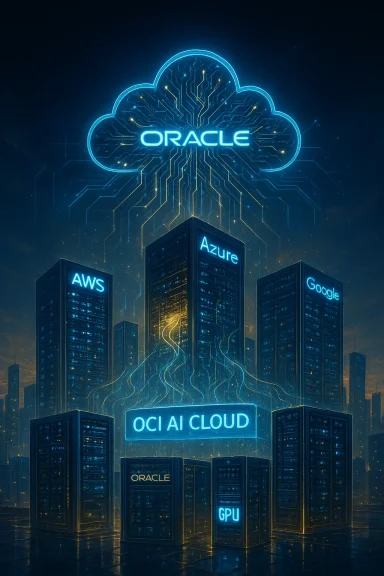
Oracle has pursued a multicloud strategy that goes beyond orchestration: Oracle is embedding native instances of Oracle database and Exadata services directly inside rival cloud regions (Oracle Database@AWS, Oracle Database@Azure, Oracle Database@Google Cloud). That positioning gives the company a unique integration story: customers can use the best of multiple clouds while running Oracle’s database stack with low latency and a unified support/billing experience. This reduces migration friction for enterprises that depend on Oracle databases and creates a differentiated on‑ramp for AI workloads that need tight data proximity.Benefits for AI workloads:
- Lower data transfer latency between database storage and GPU clusters — which matters when training and fine‑tuning large models on private enterprise data.
- Tighter SLAs and co‑engineered stacks where Oracle supplies database + infrastructure layers optimized for AI pipelines.
4) Purpose‑built infrastructure for high‑performance AI
Oracle’s public statements and investor presentations emphasize that OCI is being engineered with modern networking, GPU farms, and optimizations for large model training and inference. Oracle claims substantial price‑to‑performance gains for certain HPC and AI workflows (figures like “50% better price‑to‑performance” or “3.5× time savings” appear in coverage of Oracle’s messaging). Those vendor metrics must be validated on a case‑by‑case basis — but they reflect a strategy: co‑design hardware and software to lower the total cost and time to train.The Buildout — Numbers, pace, and what they mean
Oracle has publicly described an aggressive buildout of multicloud data centers embedded within third‑party clouds. Coverage varies by outlet: reported counts include figures like “34 data centers built with 37 more coming,” “23 built and 47 being built,” and executive statements that reference a program of roughly 70–72 multicloud datacenters in total. The plurality of reporting suggests the exact count is changing rapidly as construction moves on; in other words, Oracle is executing a high‑velocity rollout that industry reporters and analysts are tracking in near real time. That fast cadence — nearly one data center per week by some counts — signals ambitious execution but also raises obvious delivery and capital‑intensity questions.Key operational implications:
- Building dozens of embedded datacenters inside other clouds requires coordination with the hyperscalers and tight supply‑chain logistics for power, cooling, networking, and NVIDIA‑class GPUs.
- The time from contract to production is not zero; Oracle must convert pipeline and RPO into running capacity and then into consumption revenue.
Critical analysis — strengths and the hard realities
Strengths that could propel OCI in AI
- Enterprise data moat: Oracle manages massive volumes of enterprise transactional and analytical data; if OCI offers better, low‑latency access to that private data for model training and reasoning, it becomes attractive for companies wary of moving sensitive data to third parties.
- Vertical integration: Oracle controls database, middleware, applications, and the infrastructure layer — a stack that can be co‑optimized for AI workloads requiring secure access to data and auditable pipelines.
- Contract momentum: The RPO and reported OpenAI deal create near‑term visibility that makes financiers and suppliers take Oracle’s AI ambitions seriously — enabling additional capacity planning and vendor commitments.
Execution and financial risks
- Capital intensity: Building tens of datacenters and populating them with GPUs and networking at hyperscale is hugely expensive. Oracle is taking on significant capital expenditure and, by some accounts, additional borrowing. If capacity is delayed or demand doesn’t materialize at expected rates, the balance sheet implications could be severe.
- Concentration risk: A business plan that is heavily dependent on one or a few very large customers (e.g., OpenAI) is exposed to strategic shifts by those customers. OpenAI’s own funding, cash burn, and business model are under constant scrutiny; if OpenAI reduces demand, Oracle’s ramp could slow abruptly.
- Execution risk across many fronts: Oracle is simultaneously scaling datacenters, negotiating embedded operations across AWS/Azure/Google regions, and standing up new cloud‑native services — all while migrating a legacy installed base and preserving margins. Hyperscalers have already learned how to do some of these things at enormous scale; Oracle must prove it can do them as quickly and resiliently.
- Supply chain and energy constraints: GPUs, memory, and stable grid power are finite resources. Oracle’s timetable has to compete for these same constrained inputs with Amazon, Google, Microsoft, numerous cloud GPU specialists, and national projects. Failure to secure timely GPU supply or power capacity will throttle growth.
The OpenAI deal: reality check
The headlines about a $300 billion OpenAI–Oracle deal have had a major market impact. Multiple major outlets reported a multiyear OpenAI commitment to Oracle that is astronomical in magnitude and unmatched by any single previous cloud agreement. But a few caveats are essential:- Reporting about the $300B figure generally cites “people familiar with the matter” rather than public contract filings, so the exact cash flows, start dates, and payment schedules are not fully public. Treat the headline as evidence of a very large arrangement rather than incontrovertible, contractually enforceable annual cash receipts at face value.
- OpenAI’s own financial picture in 2025 included very high projected cash burn and material outside funding rounds. For OpenAI to consume hundreds of billions of dollars of compute, it will need robust and sustained monetization or additional capital inflows — factors outside Oracle’s control. That creates a counterparty funding risk for Oracle if the book-to-bill of usage fails to match contracted capacity targets.
How realistic is the 2031 “top AI cloud” prediction?
Let’s unpack the timeline and what “top cloud for AI” means in practice.- Market size and incumbency: AWS, Microsoft Azure, and Google Cloud each have years of head start, massive customer relationships, and global datacenter footprints. By revenue, they remain substantially larger across general cloud services. Oracle’s OCI could become the top destination for certain AI workloads — training large models, private‑data inference, and enterprise AI pipelines — without surpassing the hyperscalers across all cloud categories. The forecast to reach $144 billion in OCI revenue by fiscal 2030 is ambitious but anchored in RPO and large customer commitments; converting that into net revenue and profit depends on execution, customer consumption patterns, and competitive responses.
- Time and execution: Hitting multi‑year targets requires uninterrupted expansion of datacenter capacity, uninterrupted procurement of GPUs at scale, and net‑new consumption from enterprise customers beyond the headline deals. The incumbents will aggressively defend AI workloads via their own differentiated hardware, large AI service portfolios, and integrated developer ecosystems. Oracle’s ability to win will depend on: (a) delivering verified performance and cost advantages, (b) reliably integrating customers’ private data with AI pipelines, and (c) maintaining price and support models that customers prefer.
- Competitive dynamics: Expect hyperscalers to respond with (a) price and capacity competition, (b) accelerated investments in proprietary silicon and interconnects, and (c) enterprise deals that tie AI products to broader SaaS or productivity suites (where Microsoft in particular has structural advantages through Microsoft 365 and Azure). Oracle will have to sustain better-than-expected growth to displace these incumbents meaningfully in AI share.
Practical implications for enterprises and IT decision makers
- If you run large Oracle databases and want low‑latency AI reasoning against private enterprise data, OCI’s native embedding in hyperscaler regions and Exadata/Autonomous Database integration are compelling reasons to evaluate Oracle’s stack.
- For general-purpose model hosting, developer tooling, and broad ecosystem reach, existing hyperscalers still offer the deepest portfolios and most mature developer ecosystems.
- Enterprises should test and benchmark AI training and inference in representative workloads (not vendor slides) across providers. Measure total cost of ownership, including data egress, interconnect latency, and operational support for private datasets. Oracle’s claims about price‑to‑performance must be validated in real workloads before committing long term.
Investment lens — what investors should watch
- Bookings to revenue conversion: Monitor how Oracle converts RPO into recognized revenue and recurring consumption. A large RPO is valuable only if customers consume capacity and pay ovnding cadence and usage: OpenAI’s cash position and revenue trajectory will materially affect Oracle’s realized intake from that account.
- Capex discipline vs. speed: Watch Oracle’s capital spending and funding sources. Overextension or rising leverage without clear near‑term revenue growth would heighten financial risk.
- Customer diversification: Track whether Oracle can add significant, diversified AI customers beyond one or two anchor deals. A broader mix reduces concentration risk.
- Supply chain and energy constraints: GPU deliveries, power provisioning, and data‑center build timelines will show up quickly in capacity‑availability updates and should be watched quarterly.
Conclusion — a high‑risk, high‑reward narrative
Oracle’s strategy is audacious: leverage database dominance, multicloud embedding, and aggressive datacenter scale to capture the revenue streams of generative‑AI training and enterprise inference. The company’s reported $455 billion RPO and the headline OpenAI commitment fundamentally changed how investors and competitors view OCI’s potential, and Oracle’s claims are supported by a flurry of industry coverage and management disclosures.That said, the path to becoming the top AI cloud by 2031 is narrow and littered with execution challenges: capital intensity, supply constraints, concentration risk around marquee customers, and the need to convert contracts into durable consumption. The incumbents — AWS, Microsoft Azure, and Google Cloud — are not standing still; they possess scale, integrated AI ecosystems, and deep pockets. For Oracle to win in AI it must demonstrate consistent delivery, stable customer monetization, and a resilient balance sheet while continuing to outcompete on price‑performance in meaningful, measured benchmarks.
Readers should treat the headline forecasts and reported deal values as signals of momentum rather than guaranteed outcomes. For IT leaders choosing cloud platforms, the pragmatic approach is to benchmark representative AI workloads, understand data governance and latency implications, and structure engagements that maintain flexibility as the market evolves. For investors, Oracle is an asymmetric, high‑variance wager — potentially transformative if the story plays out, but dependent on many moving parts that can and will change over the decade ahead.
Source: AOL.com Prediction: Oracle Will Surpass Amazon, Microsoft, and Google to Become the Top Cloud for Artificial Intelligence (AI) By 2031