
Oracle’s E‑Business Suite team published an updated OA Framework (OAF) patch matrix in August 2025 that lists the most recent cumulative Bundle Patches (BPs) and consolidated updates for EBS Release 12.2 — including new BPs for 12.2.14, 12.2.13 and several earlier 12.2.x releases — and reiterated the supported patching model and best practice to apply the latest bundle or consolidated patch as soon as practical.
Web‑based content in Oracle E‑Business Suite (EBS) Release 12.2 is delivered by the Oracle Application Framework (OAF, sometimes shown as FWK or OAF/FWK), which supplies the UI libraries, rendering and personalization framework that drives the EBS browser experience. Oracle publishes OAF updates in three packaging styles:
This approach balances the security and stability benefits of keeping OAF current with the operational discipline required to avoid the well‑known pitfalls of EBS patching.
Conclusion
Oracle’s August 2025 OA Framework bulletin is a clear call to action for EBS teams: verify the OAF bundle applicable to your 12.2 release, run ETCC, confirm prerequisites (OPatch, JavaVM and any paired RUs), execute staged testing, and then apply the bundle as part of a controlled maintenance window. The public bulletin, MOS/readme guidance, and field‑level ETCC/operational artifacts together give a repeatable path — but only if teams follow the pre‑patch validation steps and respect release‑specific constraints.
Source: Oracle Blogs https://blogs.oracle.com/ebstech/oa-framework-12-2-latest-bundles-available-nov-2025/
 Background / Overview
Web‑based content in Oracle E‑Business Suite (EBS) Release 12.2 is delivered by the Oracle Application Framework (OAF, sometimes shown as FWK or OAF/FWK), which supplies the UI libraries, rendering and personalization framework that drives the EBS browser experience. Oracle publishes OAF updates in three packaging styles:- Cumulative Release Update Packs (RUPs) — larger, release‑specific cumulative updates.
- Cumulative Bundle Patches (BPs, “Bundles”) — the most frequently issued type of OAF update; cumulative for a given EBS release.
- Consolidated Patches — sometimes published immediately after a major EBS release and before numbered Bundles are available.
What changed in August 2025 (the practical headlines)
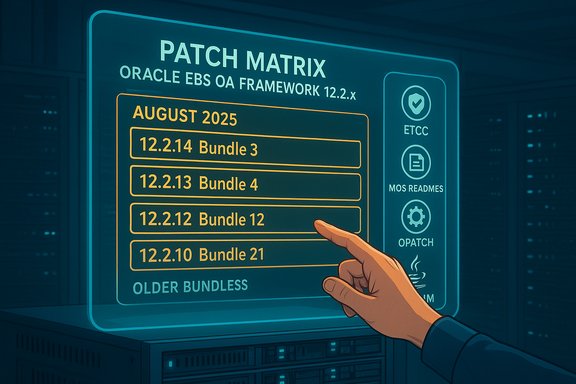
The Oracle EBS Technology blog entry dated August 8, 2025 lists the current OAF bundles available at that time. Key entries from the August table include:- 12.2.14 — Bundle 3 (Patch 37907177:R12.FWK.C) — Aug 2025.
- 12.2.13 — Bundle 4 (Patch 37421868:R12.FWK.C) — Jun 2025.
- 12.2.12 — Bundle 12 (Patch 37920492:R12.FWK.C) — Jul 2025.
- 12.2.10 — Bundle 21 (Patch 36967243:R12.FWK.C) — Jul 2025.
- Several older 12.2.x releases remain on their respective latest bundles (for example 12.2.9 Bundle 19, 12.2.8/12.2.7 Bundle 25 at the time).
Why these bundles matter — technical and security context
- Cumulative nature: Because bundles are cumulative, installing the latest bundle for your specific EBS release means you receive fixes from prior bundles for that release without having to install each intermediate bundle separately. This simplifies remediation planning and reduces the chance of missing prerequisite fixes.
- Performance, stability and security: OAF bundles regularly include bug fixes that address UI correctness (rendering, personalization, LOVs), Java/Forms compatibility, regressions in advanced table behavior, and sometimes fixes tied to security‑sensitive functionality in the application tier. Applying current bundles reduces exposure to known bugs and makes later troubleshooting simpler.
- Release lock: Bundles and RUPs are release‑locked — they must be applied to the EBS release they target; they are not interchangeable across codelines. That prevents unintended cross‑release state corruption but requires careful mapping and version control across environments.
Verification and cross‑checking (how I validated the claims)
To confirm the August 2025 bulletin and to validate operational guidance, three independent verifications were used:- The Oracle EBS Technology blog announcement that lists the OAF bundle table and the explicit guidance to apply latest BPs. This is Oracle’s public notification channel for OAF bundle availability.
- Oracle documentation and install‑guide references that describe patch application patterns for EBS (for example, the official Oracle docs that cover applying additional EBS patches and the MOS readmes). These corroborate the how of patch application and prerequisites like OPatch/JDeveloper pairing requirements.
- Practical operational analysis and community patching logs that highlight the operational failure modes (ETCC mapping, JavaVM parity, build string caveats, OPatch/tool compatibility) and recommended testing steps. Those practical notes — derived from field playbooks and ETCC analysis uploaded as operational guidance — reinforce the blog’s recommendations and list common pitfalls teams must address before production rollout.
Critical analysis — strengths, limitations and operational risks
Strengths
- Clear cumulative model — Oracle’s use of cumulative bundles simplifies update planning for each release stream: you can deploy the latest bundle and inherit previous fixes for that release without installing intermediate artifacts. This reduces patch churn and the number of discrete installs required.
- Frequent, targeted fixes — Bundles are produced frequently and tend to address narrow, actionable issues in the UI / framework layer, allowing teams to remediate specific regressions quickly without waiting for a large RUP. This makes the patch cycle operationally nimble for UI and personalization problems.
- Public, documented guidance — Oracle publishes bundle tables and points to MOS notes and ETCC as pre‑patch verification tools, enabling a repeatable, documented approach for release managers and DBAs.
Limitations and risks
- Release‑specific constraints create complexity for heterogenous environments: If an organization runs several EBS 12.2 sub‑releases (for instance, a mix of 12.2.10, 12.2.12 and 12.2.14 across different lines of business), each environment requires its own bundle sequence. Coordinating those parallel patch tracks increases governance complexity and testing overhead.
- JavaVM parity and ETCC‑paired artifacts: Some database or middleware updates require matching JavaVM component RUs; ETCC results and MOS readmes must be followed to avoid Java runtime mismatches. The field experience repeatedly shows mismatched JavaVM levels cause JVM errors inside the DB/application runtime. Apply JavaVM and any paired components together when ETCC flags them.
- Build string and patch artifact ambiguity: Community trackers and ETCC/MOS can show slightly differing build suffixes and internal markers for the same RU or BP family. The exact MOS patch number and build string you download must match the Oracle Home and expected prerequisites or the install may fail or produce a partially patched state. Always validate the MOS patch page prior to download.
- OPatch / tooling fragility: Patching utilities (OPatch and its successors) themselves have version dependencies. Using the wrong OPatch version or incorrect patch sequence is a common cause of failed installs and extended recovery windows. Oracle documentation and ETCC guidance list these prerequisites for a reason; ignore them at your peril.
- Exadata vs non‑Exadata divergence: If your EBS DB runs on Exadata, you may have a different RU/certified mapping than non‑engineered Linux hosts. ETCC explicitly separates Exadata RU entries (for example, separate RU families). Treat Exadata as its own engineering track.
Practical pre‑patch checklist (recommended sequence)
- Run ETCC (EBS Technology Codelevel Checker) to generate the canonical inventory for your application and DB homes; save the dated output for change records.
- Verify the Oracle blog / MOS patch page for the target release to confirm the exact bundle patch number and the patch README (download the correct Patch ID).
- Confirm OPatch (or the required patch tool) version and that your patching utility is at the required minimum. Update tools if necessary.
- Confirm JavaVM parity (when ETCC lists a JavaVM RU) and gather any other paired middleware or DB level prerequisites. Plan to apply them in the same maintenance window or in a validated sequence.
- Build a roll‑forward and roll‑back plan: take cold backups and, for large environments, verify restore/recovery rehearsal steps in a non‑production clone before touching production.
- Create a staged test plan: unit smoke tests → full functional regression in a clone → pre‑production soak (multi‑day) → production cutover with rollback rehearsed. Automate acceptance smoke tests for key transactions and personalizations.
Smoke tests and verification after applying a bundle
- Validate the web tier: login, navigate to common forms, check favorites and homepage personalization, verify LOVs and QBE filters.
- Validate personalization: import/export personalizations (Functional Administrator flows), confirm customizations still compile and render.
- Validate WebLogic/Forms/Reports (if used): restart services and confirm no runtime Java errors in logs.
- Run ETCC again post‑patch to confirm expected patch levels and absence of missing prerequisites.
Troubleshooting and when to escalate to My Oracle Support (MOS)
- If ETCC post‑patch shows missing prerequisites or build‑string mismatches, gather OPatch logs, ETCC output and the pre/post run inventory and open an MOS SR immediately — these artifacts speed resolution.
- If UI regressions appear that were not flagged in pre‑production testing, reproduce in a clone and capture UI logs, browser console logs, and OAF diagnostic traces before contacting MOS. Oracle engineers will typically request the exact patch number, ETCC output and sample repro steps.
Recommended governance and rollout policy (practical, low‑risk approach)
- Adopt a “latest BP for release” policy: For each EBS 12.2 release in your estate, treat the most recent BP or consolidated patch as the baseline to aim for in quarterly maintenance windows. This reduces backward‑compatibility complexity and minimizes time spent chasing old fixes across multiple patch sets.
- Staged adoption: Pilot the latest bundle on a non‑production clone first, then a small production pilot (low‑impact business unit) before broad rollout. Use automation to replay critical business transactions as part of the pilot.
- Maintain dated ETCC outputs: Keep the ETCC and pre‑patch inventory in your change record; it’s invaluable for forensic work and a MOS SR.
- Track platform targets separately: If you run EBS on Exadata and on generic Linux servers, track those environments separately and follow the RU mappings appropriate to each platform.
Checklist for teams who must act now
- Confirm which EBS 12.2 sub‑releases you have across dev/test/stage/prod and map each to the Oracle blog table and MOS patch IDs.
- Schedule patch windows that include sufficient time for post‑install smoke tests and a prearranged rollback.
- Prepare ETCC output and ensure the patching/OPatch tools are ready; pre‑download the exact MOS patch files once the correct Patch ID is confirmed to avoid last‑minute artifact mismatches.
Final assessment and closing guidance
Oracle’s August 2025 OAF bulletin is a routine but important update point for EBS administrators: it lists the latest OAF bundles for each 12.2 sub‑release and restates the cumulative, release‑specific nature of these updates. Applying the latest BP or consolidated patch for your exact EBS release reduces risk, addresses cumulative bug and security fixes, and aligns your environment with Oracle’s supported configuration matrix. However, applying a bundle without following ETCC/MOS prerequisites, verifying OPatch/toolchain versions, or ensuring JavaVM parity substantially increases the risk of partial installs, runtime Java errors, or unsupported states on non‑certified platforms — particularly on heterogeneous estates that include Exadata or other engineered systems. Practical rule: treat Oracle’s blog and MOS readme as the authoritative starting point, but treat ETCC output and your own automated functional regression tests as the decision gate before production deployment. If anything in the published patch table or readmes cannot be verified in MOS or your ETCC scan (for example, build string variances, or apparent mismatches between ETCC and public trackers), escalate the discrepancy to MOS with collected ETCC and OPatch logs — MOS is the final arbiter for authoritative artifacts.This approach balances the security and stability benefits of keeping OAF current with the operational discipline required to avoid the well‑known pitfalls of EBS patching.
Conclusion
Oracle’s August 2025 OA Framework bulletin is a clear call to action for EBS teams: verify the OAF bundle applicable to your 12.2 release, run ETCC, confirm prerequisites (OPatch, JavaVM and any paired RUs), execute staged testing, and then apply the bundle as part of a controlled maintenance window. The public bulletin, MOS/readme guidance, and field‑level ETCC/operational artifacts together give a repeatable path — but only if teams follow the pre‑patch validation steps and respect release‑specific constraints.
Source: Oracle Blogs https://blogs.oracle.com/ebstech/oa-framework-12-2-latest-bundles-available-nov-2025/
