

Oracle’s recent roller-coaster is a reminder that headline-grabbing AI partnerships and megaprojects do not automatically translate into the kind of structural dominance Nvidia built on its commodity-defining GPU moat.
Oracle’s pivot to hyperscale AI infrastructure — anchored by the Stargate initiative and a multi-year cloud contract with OpenAI — has reshaped the company’s growth narrative and investor expectations. The market’s reaction has been dramatic: an explosive run-up earlier in 2025 that briefly crowned Oracle as an AI story to watch, followed by a harsh re-pricing as the balance-sheet realities and execution gaps came into focus. The central tension is simple: Oracle is now placing very large, near-term capital bets on AI data centers and a narrow set of anchor deals while competitors and the market reward diversified, capital-light positions in AI compute and chips. This piece examines the facts behind the narrative, verifies the most consequential claims with public filings and reputable reporting, and offers a clear-eyed analysis of where Oracle’s strategy might succeed and where it faces acute risks.
The reversal — the multi‑week/month sell-off — reflects three forces interacting:
But scale, headline megadeals and impressive technical roadmaps do not erase the fundamental finance and execution questions that modern markets care about. The difference between Oracle and Nvidia is not a matter of popularity; it is a difference in business model, risk profile and unit economics. Oracle’s model now requires it to deliver capital‑intensive infrastructure on time, at the right price, and at utilization levels that meaningfully outpace capex — a tall order in the current financing and supply chain environment. For investors and IT executives, the right posture is cautious curiosity: recognize the upside if Oracle executes and market demand remains robust, but respect the tail risks from leverage, concentration and the long lead times required to turn silicon — and promises — into durable cash flow. This is high-stakes poker, not the sure‑thing surge Nvidia experienced as GPUs became the plumbing of modern AI.
Source: 24/7 Wall St. Here's Why Oracle Is Not the Next Nvidia
 Background
Oracle’s pivot to hyperscale AI infrastructure — anchored by the Stargate initiative and a multi-year cloud contract with OpenAI — has reshaped the company’s growth narrative and investor expectations. The market’s reaction has been dramatic: an explosive run-up earlier in 2025 that briefly crowned Oracle as an AI story to watch, followed by a harsh re-pricing as the balance-sheet realities and execution gaps came into focus. The central tension is simple: Oracle is now placing very large, near-term capital bets on AI data centers and a narrow set of anchor deals while competitors and the market reward diversified, capital-light positions in AI compute and chips. This piece examines the facts behind the narrative, verifies the most consequential claims with public filings and reputable reporting, and offers a clear-eyed analysis of where Oracle’s strategy might succeed and where it faces acute risks.What happened: the headlines and the numbers
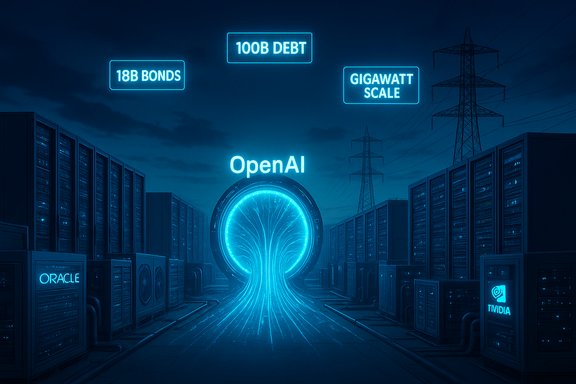
Oracle’s AI pivot gained public prominence with the Stargate project — an initiative tied to OpenAI, SoftBank and others that was presented as a multibillion-dollar (and, in public framing, up-to-$500 billion) push to build gigawatt-scale AI data centers across the U.S. Reuters and other major outlets reported the expansion of Stargate and its stated $500 billion commitment to build up to 10 gigawatts of capacity. On the financing side, multiple reports (syndicated through Bloomberg and other outlets) document that Oracle issued large bond packages to fund its buildout — about $18 billion in investment-grade notes in late 2025 — and that project-level financing arrangements totaling many billions have been tied to data-center campuses where Oracle will be an anchor tenant. Those moves, combined with reported additional loan packages, pushed Oracle’s reported total debt above $100 billion in some coverage. Oracle’s fiscal results and investor materials give concrete figures that help quantify the business effect of that investment surge: management reported a trailing-four-quarter free cash flow that swung to a negative figure (roughly -$5.9 billion on a trailing basis as cited in recent investor materials), a massive jump in capital expenditures (tens of billions), and an RPO (remaining performance obligations/backlog) that exploded into the hundreds of billions after large multi‑year contracts were booked. Oracle’s reported cloud revenue for a recent period was about $7.2 billion, up strongly year-over-year. These plumbing facts — big debt, negative near-term FCF, heavy capex, and a concentrated backlog — explain why markets that once cheered Oracle’s AI pivot are now wrestling with the risk profile embedded in the company’s balance sheet and forward commitments.The financing math: how big is the bill?
The core claims
- Oracle issued roughly $18 billion in long-term bonds in late 2025 to fund cloud/data-center expansion.
- Reports link Oracle to an additional large loan or project financing packages (figures cited in coverage include a referenced $38 billion package tied to specific data-center projects). Those arrangements, plus other financings, pushed total reported debt in media coverage to the ~ $100–110 billion range.
- Trailing free cash flow swung negative on a 12-month basis as capex ramped, and management flagged a multi-decade capex profile to support multi‑gigawatt data-center campuses.
Independent verification
Public-company filings, quarterly reports and Oracle’s investor presentation confirm the scale of capex and the dramatic shift in free cash flow dynamics (for example, an $8.5 billion capex quarter and trailing FCF swings cited in Oracle’s own Q1 FY2026 commentary). That matches independent reporting which cites the $18 billion bond issue and the broader market’s observation that hyperscalers and AI-focused companies have issued tens of billions in debt during the same stretch. Where the line blurs is the precise composition of “total debt” headlines (some outlets aggregate project-financing commitments, SPV obligations, and leases into a single figure), so the widely quoted “nearly $104 billion” or “above $100 billion” totals are best treated as aggregated media estimates rather than a single balance‑sheet line item you’ll find in a 10‑Q with identical formatting. Oracle’s filings and presentations are the authoritative source for reported debt balances at quarter-end; syndicated news coverage reflects additional financing commitments and market perceptions. Treat the headline “>$100B in debt” as directionally correct and significant — but parse it against official filings for exact classification.Concentration risk: one big partner vs. diversified demand
One of the most important strategic points is that Oracle’s public AI narrative has become tightly coupled to OpenAI and Stargate. That has powerful upside — an anchor tenant of OpenAI’s scale can meaningfully underwrite massive capacity deployments — but it also concentrates counterparty and execution risk.- A single, outsized customer commitment inflates Oracle’s RPO and revenue visibility, but it increases execution, timing, and credit exposure if that customer changes course, delays ramp, or renegotiates terms. Oracle’s RPO reportedly jumped to the high hundreds of billions after the OpenAI bookings, and the market is paying close attention to how much of that backlog is contracted, how much is contingent on milestones, and how quickly it will convert to recognized revenue.
- By contrast, Nvidia’s revenue base is diversified across hyperscalers, cloud providers, enterprise AI labs, automotive and other industries. Nvidia’s addressable market is broad and product-driven (GPUs that are purchased by thousands of customers), which spreads cyclical and customer concentration risk. That difference — product ubiquity vs. single-anchor cloud revenue concentration — is a central reason investors treat Nvidia and Oracle as fundamentally different risk-return propositions.
How Oracle’s story differs from Nvidia’s
At a high level, Nvidia built a durable franchise by being the indispensable hardware supplier across thousands of customers and industries. Oracle is trying to build a vertical stack: data centers, networking fabrics, cloud services and long-term contracts for compute capacity. The economics, risks and timing profiles of these models are quite different.- Revenue model: Nvidia sells high-margin hardware and associated software that scales with demand. Oracle is buying and building capital‑intensive infrastructure that amortizes over long horizons and must generate utilization to justify the capex.
- Financial leverage: Nvidia’s business model produced extraordinary free cash flow over multiple years, whereas Oracle’s recent pivot intentionally increases leverage and reduces near-term FCF due to accelerated capex and bond issuance. That shift amplifies financial risk when macro or demand assumptions disappoint.
- Counterparty risk: Nvidia supplies broadly. Oracle’s headline AI story is heavily linked with OpenAI/Stargate, meaning the success of Oracle’s bets depends materially on a few external parties’ execution and finances.
Execution risks and operational questions
Oracle’s technical announcements (Zettascale, Acceleron RoCE fabric, multi‑vendor GPU deployments including large AMD Instinct and NVIDIA Blackwell orders) present impressive aspirations — but they also raise measurable execution questions.- Multi‑gigawatt campuses require long lead times for power, land, environmental permits, cooling and power-purchase agreements. Achieving the promised density and utilization profiles depends on securing those inputs long before revenue flows. Oracle’s marketing materials highlight designs and vendor relationships, but independent verification of PUE, vendor delivery timelines and third‑party benchmarks will be decisive as pilots scale to production.
- Procurement constraints for next‑generation GPUs and NICs mean timing risk: even if orders are placed, vendor supply, delivery cadence and competitor demand can shift the effective go‑to‑market window. Oracle publicly stated multi‑vendor strategies (NVIDIA + AMD) to mitigate single‑vendor risk, but that only reduces—not eliminates—supply and integration complexity.
- Price competitiveness: Oracle must win customers on price‑per‑token or price‑per-training‑hour versus AWS, Azure and GCP. Those incumbents already host most AI workloads and have operating and scale advantages, including distribution of marginal costs across a broader base of services. Pricing, SLA structures, and the real dollar economics for large AI customers will determine adoption speed.
Market reaction: why the stock ripped and then reversed
Oracle’s stock surge in mid‑2025 reflected a narrative change: the company was no longer “just a database play” but a plausible hyperscaler that might win a large share of AI compute spend. That narrative drove rapid re-rating as investors priced in outsized forward growth.The reversal — the multi‑week/month sell-off — reflects three forces interacting:
- Balance-sheet fatigue: Investors began to price in the higher debt loads, interest expense and negative near-term FCF. The optics of ultra-long bonds and project finance packages drove a reassessment of credit risk and valuation.
- Concentration and delivery skepticism: Large RPO figures look great on slides but require execution. Questions about how quickly OpenAI and other customers will consume capacity, and whether Oracle can deploy facilities fast enough, pressured sentiment.
- Wider AI financing scrutiny: Bank of America and other credit analysts flagged an “AI cash crunch” as tech firms issued large sums to finance data centers, increasing scrutiny of the sector’s reliance on debt markets. That macro narrative increased risk premiums for corporate bonds and equities of highly levered AI infrastructure plays.
What’s verifiable and what is not
A responsible analysis separates what is documented in filings and reputable reporting from market aggregation or estimate-based claims.- Verifiable: Oracle’s Q1 FY2026 figures for revenue, capex and trailing FCF; the existence of large bond offerings (e.g., an $18 billion bond issuance reported by multiple outlets); Reuters’ reporting on Stargate site expansions and the public framing of the $500 billion Stargate initiative. These are supported by company releases and major news organizations.
- Partially verifiable / aggregated: Headlines that compress project financing, SPV obligations, and multi‑party loan commitments into a single “total debt” figure (for example, “Oracle has nearly $104 billion of total debt”) are based on combining corporate debt with associated project financing and market expectations. They are directionally useful but should be reconciled with the company’s balance‑sheet reporting for precise classification.
- Unverifiable or contested claims: certain round numbers attributed to OpenAI’s losses (e.g., blanket claims like “OpenAI loses $5 billion annually” or precise profitability timetables) vary across reporting and are sensitive to internal accounting choices at private firms. Where reporting cites OpenAI loss estimates, those figures derive from leaks, investor models or partial disclosures and should be treated with caution. There is not a single, public audited ledger disclosing the full scope of OpenAI’s cash flows the way a public S‑1 would. Flag: treat privately reported OpenAI profit/loss claims as estimates rather than hard facts.
Upside scenarios: when Oracle’s bet pays off
If the following conditions materialize, Oracle’s AI pivot could yield substantial upside:- Sustained, material demand from OpenAI and other AI customers that converts backlog into high‑margin recurring revenue faster than anticipated.
- Oracle achieves high utilization on deployed capacity and proves competitive price/performance versus AWS/Azure/GCP, attracting multi‑tenant workloads beyond anchor deals.
- Supply chains and vendor partnerships (AMD, NVIDIA, networking vendors) deliver on schedule and Oracle proves operational excellence at multi‑gigawatt scale.
- Interest rates ease and credit markets re-open, reducing Oracle’s financing cost and allowing capex to translate into positive free cash flow as revenue ramps.
Downside scenarios: how the bet can hurt shareholders
Oracle’s strategy exposes it to several downside vectors that are credible and historically observed in capital-intensive tech expansions:- Demand shortfall: If OpenAI or other anchor tenants slow consumption, Oracle could be stuck with underutilized, high‑cost capacity and long-term debt service.
- Interest-rate or credit shock: A persistently higher-for-longer rate environment increases interest expense and the cost of rolling or issuing additional debt, compressing margins.
- Overcapacity and price competition: If hyperscalers undercut prices or if new compute efficiency techniques materially reduce effective GPU demand, realized price‑per‑token could fall short of projections.
- Execution delays and supply bottlenecks: Delays in data center commissioning, hardware deliveries, or permitting can push revenue recognition out and increase carrying costs.
Practical takeaways for readers and investors
- Distinguish backlog from cash: RPO and backlog are valuable leading indicators, but conversion to revenue and cash depends on delivery and customer ramp. Large RPO is not a substitute for healthy free cash flow.
- Parse debt headlines: The “>$100B debt” framing is meaningful but blends corporate debt with project-level financing in some reports. Check the company’s 10‑Q/10‑K for precise classifications.
- Compare business models, not buzzwords: Nvidia’s durable moat is hardware ubiquity. Oracle’s target is vertical integration of cloud infrastructure and contracts. Both play in AI, but they are structurally different investments.
Conclusion: high-stakes poker, not a sure‑thing march
Oracle’s bet on AI infrastructure is one of the boldest corporate strategy moves in recent enterprise‑software history. The company has converted narrative into tangible commitments: large data-center plans, multi-vendor hardware strategies, and multi‑year contracts with AI leaders. That is not trivial — it changes Oracle’s addressable market and product positioning.But scale, headline megadeals and impressive technical roadmaps do not erase the fundamental finance and execution questions that modern markets care about. The difference between Oracle and Nvidia is not a matter of popularity; it is a difference in business model, risk profile and unit economics. Oracle’s model now requires it to deliver capital‑intensive infrastructure on time, at the right price, and at utilization levels that meaningfully outpace capex — a tall order in the current financing and supply chain environment. For investors and IT executives, the right posture is cautious curiosity: recognize the upside if Oracle executes and market demand remains robust, but respect the tail risks from leverage, concentration and the long lead times required to turn silicon — and promises — into durable cash flow. This is high-stakes poker, not the sure‑thing surge Nvidia experienced as GPUs became the plumbing of modern AI.
Source: 24/7 Wall St. Here's Why Oracle Is Not the Next Nvidia
