

The Odisha Staff Selection Commission’s (OSSC) Combined Graduate Level (CGL) syllabus and exam pattern for the 2026 recruitment cycle have been clarified in a series of official and widely reported updates — the most consequential being the Commission’s Regulation 3 of 2025 that revises Paper‑I of the Mains and a confirmed two‑stage selection structure (Preliminary + Mains) for Group B and Group C posts; candidates should download the official notification and syllabus PDF from the OSSC portal and prepare against the updated, largely objective format.
The OSSC CGL (Combined Graduate Level Recruitment Examination) is the principal statewide recruitment gateway for a wide range of Group B and Group C positions in Odisha government departments. The 2025–26 recruitment notification (Advt. No. 5751/OSSC) sets out the vacancy matrix and the selection stages; the Commission’s portal and multiple exam‑prep portals have published the updated syllabus and exam pattern that will apply to the 2026 recruitment. Two broad, verifiable facts anchor preparation strategy:
(End of feature)
Source: Jagran Josh https://www.jagranjosh.com/articles/ossc-cgl-syllabus-2026-prelims-mains-pdf-download-1800007568-1]
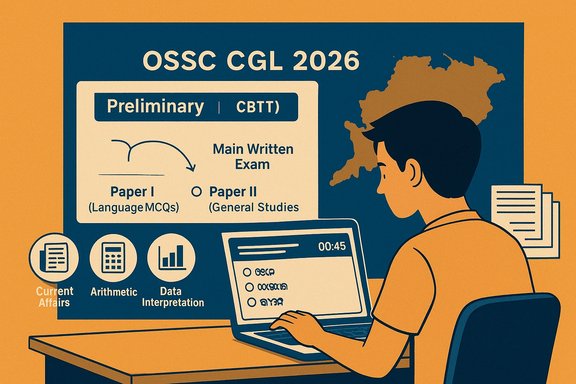 Background / Overview
The OSSC CGL (Combined Graduate Level Recruitment Examination) is the principal statewide recruitment gateway for a wide range of Group B and Group C positions in Odisha government departments. The 2025–26 recruitment notification (Advt. No. 5751/OSSC) sets out the vacancy matrix and the selection stages; the Commission’s portal and multiple exam‑prep portals have published the updated syllabus and exam pattern that will apply to the 2026 recruitment. Two broad, verifiable facts anchor preparation strategy:- The selection process for most advertised posts follows a three‑stage flow: Preliminary (objective MCQ) → Main written examination → Document verification / skill tests where applicable.
- Regulation 3 of 2025 formalizes a key structural change to Paper‑I of the Main Written Examination: descriptive‑type questions have been substantially reduced or replaced by objective items, making the Mains more objective‑focused and time‑efficient. Candidates should treat that as a central planning input.
What changed: Regulation 3 of 2025 and the shift toward objective Mains
Summary of the revision
The OSSC’s Regulation 3 of 2025 revises Paper‑I of the Main Written Examination for CGL so that language testing (Odia and English) emphasizes comprehension, grammar, vocabulary and usage through objective questions rather than lengthy descriptive answers and essays. The practical outcome is:- Paper‑I remains 100 marks but the bulk of those marks will be awarded via MCQs (with a reduced or constrained descriptive component limited to short translation/precis or brief writing where retained).
Why this matters
This is an operational shift with immediate consequences for study plans:- Time allocation during the Mains will shift toward rapid MCQ response skills (speed + accuracy) rather than extended composition and manual writing practice.
- Grading will be more granular and easier to standardize across large candidate cohorts, which affects boundary scores and cutoff modeling for aspirants and coaches alike.
Official exam structure (how OSSC has organized selection for 2026)
Note: the official advertisement and the OSSC “What’s New” portal contain the authoritative details; summaries below combine the official listings with corroborating exam‑prep pages. Where sources diverge on specific numbers, candidates must consult the OSSC advertisement PDF first.Stage I — Preliminary Examination (Objective / CBT)
- Format: Computer‑based test (MCQ).
- Total marks and duration: Most reporting indicates 150 marks and 150 minutes for the Prelims, with 1 mark per question and a negative marking of 0.25 marks for each wrong answer. Multiple independent exam sites and the OSSC notification summary support this configuration.
- Subjects typically covered (subject‑wise topics are expanded in the next section):
- Arithmetic & Data Interpretation
- Logical Reasoning & Analytical Ability
- Current Affairs & General Awareness
- Computer & Internet Awareness
- Odisha‑specific GK and Geography
- Objective level: Generally aligned with 10th–12th standard knowledge for numerical, reasoning and language comprehension items; Odisha GK emphasizes state budgets, polity, geography and culture.
Stage II — Main Written Examination (Paper I and Paper II)
- Paper‑I: Language paper (Odia and English) — revised to an objective‑heavy format under Regulation 3 of 2025 (80 MCQs + limited brief translation/precis questions in some editions). Total marks: 100. Time: 2.5 hours.
- Paper‑II: General Studies / Domain topics — 100 marks, 2.5 hours; includes General Knowledge, Arithmetic Ability, Computer Awareness, Data Interpretation and Reasoning as objective questions.
- Additional/qualifying tests: Role‑specific tests such as Mathematics Test (for certain technical posts like Auditor) or Computer Skill Test where applicable; these may be qualifying in nature with fixed minimum standards.
Stage III — Document verification / Skill tests
- Shortlisted candidates are called for verification of original documents and, where required, a computer skills evaluation or trade test for specific posts.
Detailed subject‑wise syllabus (how topics are mapped across Prelims and Mains)
Below is a subject‑wise breakdown combining the official syllabus language and consolidated listings used by major preparatory portals. Use these as a study checklist and cross‑verify any edge‑case topics directly with the OSSC syllabus PDF for your specific post.Arithmetic & Numerical Ability
- Number system, HCF/LCM, divisibility rules
- Percentage, ratio & proportion, alligation
- Profit, loss & discount
- Time, work & pipes; speed, distance & average
- Simple & compound interest
- Mensuration (area, volume), partnership, mixtures
- Age problems, averages, elementary algebra and inequalities
Data Interpretation
- Tables, bar/pie/line charts
- Tabular data interpretation; reading and inference
- Case‑based DI (small passage + data sets)
Logical Reasoning & Analytical Ability
- Verbal and non‑verbal reasoning
- Series (number/letter/figure), analogies, classification
- Syllogisms, inequalities, logical puzzles
- Seating arrangement, blood relations, direction sense
Current Affairs & General Knowledge
- National and international current affairs (last 12 months focus)
- Odisha state affairs: budget, administration, schemes, major events
- Indian polity and governance basics
- Environment and climate policy (basic level)
Computer & Internet Awareness
- Basic hardware/software concepts, OS fundamentals
- MS Office/useful applications, internet fundamentals, email
- Database basics (conceptual), basic networking terms
- IT security fundamentals (antivirus, firewall, safe practices)
Language Papers — Odia & English (Paper‑I of Mains)
- Odia: grammar, sandhi, samas, taddhita/krudanta, comprehension, vocabulary, idioms, usage, précis (where specified as short writing), translation (to/from Odia), common errors, idiomatic usage. (10th standard level emphasis for grammar).
- English: reading comprehension (Plus Two / 12th standard level), grammar (tenses, voice, narration), vocabulary (one‑word substitutions, synonyms/antonyms), sentence correction, fill‑in‑the‑blanks, précis & short translation tasks where retained.
General Studies (Paper‑II of Mains)
- Indian polity and constitution, Indian economy basics, Odisha economy & budget
- Indian & world geography, history of India and history of Odisha, art & culture with Odisha emphasis
- Environment & biodiversity, climate change basics
- Applied GK items relevant to administration and public policy
Confirmed numerical details and important clarifications
- Multiple credible exam portals and the OSSC advisory note report the Prelims total as 150 marks with 150 minutes and negative marking of 0.25; candidates should plan using these numbers while verifying exact post‑wise variations in the official advertisement PDF.
- The Mains have two papers totaling 200 marks (Paper‑I: 100 marks; Paper‑II: 100 marks), and Paper‑I has been revised under Regulation 3 of 2025 toward objective assessment for language competence.
- Where third‑party summaries differ (for example, reporting 120 objective Qs vs 150), treat the OSSC advertisement as final and note that preparatory sites sometimes condense or reformat earlier cycles’ details — always cross‑check the official PDF before booking travel or high‑stakes deadlines. Any conflicting numerical claims are flagged as unverifiable until matched to the official advertisement PDF.
How to prepare: an evidence‑based study plan for OSSC CGL 2026
The revised objective Mains and the standard CBT Prelims reward accuracy, speed and topic coverage. Below is a practical 12‑week plan that synthesizes best practices used by experienced coaching providers and aligns with the OSSC syllabus.12‑week high‑intensity plan (compact, realistic)
- Weeks 1–2 — Syllabus mapping & baseline diagnostics
- Download the official OSSC CGL notification and syllabus PDF; map each exam domain to study modules.
- Take one full‑length diagnostic mock (timed) to establish baseline speed and weak areas.
- Weeks 3–6 — Core subject blocks (Arithmetic, Reasoning, Language basics)
- Daily targeted drills for arithmetic topics (focus on speed + accuracy); alternate with reasoning sets.
- Language: regular passage reading, vocabulary drills and grammar exercises (English & Odia where applicable).
- Weeks 7–8 — Current affairs + Odisha GK, Computer basics
- Build a rolling current affairs log (monthly + topic‑wise); focus on state budget, schemes and administrative orders for Odisha.
- Short computer concept labs: practice MS Office tasks and basic computer troubleshooting questions.
- Weeks 9–10 — Full syllabus mock tests & remediation loop
- Take full CBT mocks under timed conditions; convert every wrong answer into a short remediation note and one 20–30 minute practice drill.
- Weeks 11–12 — Final polish & Mains simulation
- Practice Paper‑I style objective language sets and precision translation/précis exercises if retained.
- Run two full Mains simulations (Paper‑I + Paper‑II) in exam timing; finalize exam logistics (admit card, location, ID).
Tactical test tips
- Treat negative marking conservatively: eliminate clearly wrong options before guessing.
- For MCQs, allocate a per‑question time budget (Prelims: 150 questions in 150 minutes → ~1 minute per question with buffer for review).
- Build small, verifiable artifacts: a one‑page Odisha GK crib, a one‑page formula sheet for arithmetic, and a short folder of solved DI sets — useful for last‑minute scanning.
Recommended resources and practice materials
- Official OSSC PDF (detailed advertisement & syllabus) — authoritative; verify dates, negative marking and post‑specific qualifications there.
- Reputable exam portals and test series (Testbook, ExamUpdates, regional coaching houses) for timed mock tests and detailed answer explanations — use these as diagnostic tools rather than verbatim question banks.
- Standard arithmetic and reasoning practice books (topic‑wise MCQs) and Odisha‑specific current affairs digests for state GK.
- For language papers: grammar workbooks, past‑year OMR/MCQ practice sets, and short translation/précis exercises (if your post’s Paper‑I retains any brief descriptive parts).
Critical analysis: strengths, opportunities and risks in the 2026 format
Strengths (what the revised pattern rewards)
- Objective Mains reduces subjectivity in marking and speeds up result processing; this benefits candidates who master speed‑accuracy trade‑offs.
- A unified MCQ emphasis across stages increases predictability: aspirants can align practice to a single test style (CBT + MCQ).
- Explicit Odisha GK emphasis rewards regionally focused study that confers a higher marginal return for state specialists.
Risks and potential downsides
- Overreliance on MCQs: objective formats can encourage shallow preparation (rote option elimination). Deep conceptual mastery and practical reasoning remain essential for higher cutoffs.
- Market for question banks and dumps: third‑party sellers often claim “actual exam” PDFs; using such materials carries ethical and career risks — rely instead on reputable test providers that explain answers and update frequently.
- Information drift: when multiple prep portals publish contradictory numeric details (question counts, timing), candidates may plan incorrectly — always verify with the official OSSC advertisement PDF. Any conflicting numeric claims should be treated as uncertain until confirmed on ossc.gov.in.
Practical advice for coaches and hiring stakeholders
- Coaching programs should emphasize the remediation loop: every wrong answer converts into a 20–60 minute lab or practice drill that addresses the underlying concept.
- Hiring managers who use OSSC CGL cutoffs as a hiring filter should request demonstrable skills and short practical tests for selected hires, because MCQ success alone does not always equal on‑the‑job competence.
Common points of confusion (clarifications)
- Conflicting question counts or marks reported on some sites — e.g., one summary described 120 objective questions for 150 marks while other, more widely corroborated summaries describe 150 questions for 150 marks; candidates must consult the OSSC advertisement PDF for the authoritative scheme applicable to the post they’re applying for. This discrepancy is flagged as unverifiable in secondary sources and should be resolved from the official PDF.
- The role‑specific qualifying tests (mathematics/computer skill tests) vary by post; do not assume uniformity across all vacancies — check the post‑wise annexures in the detailed advertisement.
Quick checklist before you sit any OSSC CGL stage
- Download and re‑download the official OSSC notification and syllabus PDF; confirm:
- Prelims marks, duration and negative marking rules for your post.
- Mains structure (whether Paper‑I retains any descriptive elements for your post).
- Post‑specific qualifying tests and minimum scores (e.g., skill tests for Auditor posts).
- Build a timed test schedule (mocks every two weeks at minimum).
- Keep a compact Odisha GK sheet updated to the last 90 days before exam.
- Avoid unverified “actual exam” PDFs or dump sites — choose reputable practice partners who provide explanations and update cadence.
Conclusion
The OSSC CGL 2026 cycle brings a clearly signposted shift toward objective assessment in both Prelims and Mains — driven principally by Regulation 3 of 2025 that retool Paper‑I into an MCQ‑centric language test. This format rewards disciplined, time‑efficient study routines, high‑quality, updated mock tests and state‑centric current affairs mastery. Candidates must prioritize the official OSSC advertisement and syllabus PDF for definitive numbers and post‑wise rules and should use reputable practice vendors for simulations and targeted remediation rather than relying on unverified question collections. Preparing with measurable goals (mock score targets, remediation artifacts, and a short Odisha GK crib) will deliver the best ROI in a system that increasingly favors speed, accuracy and domain coverage.(End of feature)
Source: Jagran Josh https://www.jagranjosh.com/articles/ossc-cgl-syllabus-2026-prelims-mains-pdf-download-1800007568-1]