Overcut: Enterprise-Grade Agentic Automation on Azure

  • Thread Author
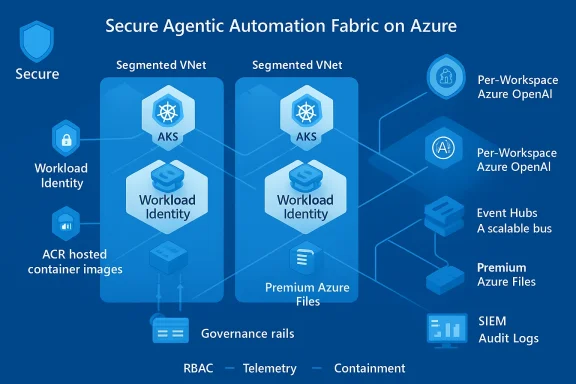
Overcut’s approach to agentic automation is a study in restraint: deliver autonomous, multi‑step workflows that actually fit inside enterprise operational boundaries rather than promising unbounded autonomy. The company builds its execution plane on Azure primitives—AKS for orchestration, Azure AD identities for workload access, ACR for verified runtimes, Event Hubs for the workflow bus, Premium Azure Files for shared storage, and a per‑workspace Azure OpenAI deployment for model reasoning—so each agent runs inside an observable, identity‑driven, network‑segmented environment that enterprises already understand and can govern.

Diagram of Secure Agentic Automation Fabric on Azure with segmented VNets and workload identities.Background / Overview​

Enterprises face a familiar paradox: they need the speed and creativity that agentic automation delivers, yet they cannot accept the operational and compliance risks that often come with early AI systems. Overcut positions itself not as a developer productivity toy but as a controlled automation fabric for the software development lifecycle (SDLC)—ticket triage, root cause analysis, test generation, remediation, release preparation, migrations, and documentation—where each agent is a short‑lived worker that must be auditable, isolated, and identity‑bound. This design decision follows an industry pattern where enterprise adoption is driven less by model quality and more by governance, integration, and lifecycle controls. Microsoft’s emerging agent ecosystem and enterprise primitives—tenant‑scoped grounding, agent identities, private network options, and observability—are central operational. Several vendor and platform analyses reinforce that enterprises need a management plane for agents—cataloging, RBAC, telemetry and remediation—before agent fleets can move from pilots to production.

Why Azure as the foundation​

Overcut’s choice to build natively on Azure is pragmatic and tactical. Azure supplies a broad set of managed services that remove infrastructure plumbing from the product roadmap while providing enterprise‑grade controls:
  • Identity and least‑privilege through Microsoft Entra / Azure AD and workload identity patterns.
  • Isolated networking via Azure Virtual Network (VNet), private endpoints, and managed NAT for predictable egress IPs.
  • Managed compute and storage (AKS, Azure Files Premium, ACR, Azure Database for PostgreSQL Flexible Server) for production reliability and regional data residency.
  • Managed AI with per‑workspace Azure OpenAI deployments to confine AI processing to a tenant and region.
Those choices remove many enterprise objections to autonomous systems: they another service in the tenant—provisioned, monitored, access‑reviewed, and auditable. Microsoft’s own messaging about isolating AI interactions to VNets and agent control planes (Bring Your VNet, Foundry/Agent governance) underscores the industry direction for agentic deployments that respect tenant boundaries.

Architecture: Controlled autonomy by design​

Overcut’s architecture centers on a single operating principle: agents must be powerful, but never uncontrolled. Below is a concise breakdown of the core infrastructure choices and how they map to enterprise requirements.

Azure Kubernetes Service (AKS) — orchestration backbone​

Overcut runs its execution engine and microservices on Azure Kubernetes Service (AKS) to orchestrate and scale agent workloads. AKS provides elasticity for spikes (incident response, mass migrations) and lets Overcut run thousands of isolated agents in parallel. Importantly, Overcut uses workload identity patterns rather than long‑lived static secrets—AKS integrates with Microsoft Entra Workload ID so pods can securely obtain Azure tokens without credential files. This reduces secret sprawl and simplifies rotation. Key operational benefits:
  • Dynamic scaling to match workflow demand.
  • Identity‑based access for platform components (no embedded secrets).
  • Reduced operational overhead compared to VM fleets.
Caveat: AKS workload identity and identity binding features have operational limits and specific prerequisites (cluster and CLI versions), so teams must align cluster versions and automation with platform requirements.

Network isolation — VNets and NAT Gateway​

Every Overcut component lives in segmented subnets with Network Security Groups enforcing east‑west rules. Outbound traffic is normalized through an Azure NAT Gateway so customer allow‑lists and external integrations see consistent IP addresses. This network‑first posture matches expectations for regulated environments where egress control and private interconnects are mandatory. Azure’s NAT Gateway and managed NAT options support AKS clusters directly, which simplifies creating deterministic outbound paths for ephemeral agents.

Container images — Azure Container Registry (ACR)​

Agent runtimes are delivered as container images stored and signed in Azure Container Registry. Overcut relies on federated pull identities so AKS can retrieve images securely without embedded credentials, preserving image provenance and reducing tamper risk. Managed identity‑based ACR pulls are a common enterprise best practice that avoids static secrets and enables RBAC on registries.

Durable state — Azure Database for PostgreSQL Flexible Server​

Workflow metadata, agent state, and execution history need durability and regional residency guarantees. Overcut uses Azure Database for PostgreSQL Flexible Server, which provides managed patching, automated backups, zone‑redundant high availability (where available), and private endpoint support for VNet‑only access. This keeps audit trails inside the tenant’s network while giving operational resilience for production workloads. Operational note: Flexible Server supports high‑availability modes and private endpoints, but specifics such as AZ support and maintenance windows must be validated per region and SKU during procurement and architecture reviews.

High‑performance shared storage — Azure Files Premium (CSI)​

Agentic workflows often mount large code repositories and temporary state across containers. Overcut uses Azure Files Premium accessed through the CSI driver to provide low‑latency, persistent shared volumes across pods. The AKS‑native CSI support and Premium storage classes reduce I/O bottlenecks in parallel executions and enable efficient cache reuse between ephemeral agents.

Event-driven orchestration — Azure Event Hubs (Kafka‑compatible)​

For a scalable internal workflow bus, Overcut leverages Azure Event Hubs with its Kafka‑compatible interface. This permits reuse of existing Kafka producers/consumers and gives elastic throughput for event‑driven agent orchestration. Event Hubs’ managed service model reduces operational overhead compared to self‑hosted Kafka while preserving familiar developer APIs.

Private, compliant AI — Azure OpenAI per workspace​

Crucially, Overcut assigns each customer workspace a dedicated Azure OpenAI deployment scoped to a region. That approach keeps prompts, embeddings, and inference within a defined geographic boundary, simplifies regulatory compliance, and reduces cross‑tenant data leakage risk. Microsoft’s enterprise guidance emphasizes that Azure OpenAI resources remain under tenant control and are not used to train foundation models without explicit agreement—an important contractual and operational boundary for regulated customers.

Front‑end and CI/CD — Azure Static Web Apps and GitHub Actions​

The user interface and tenant portal are hosted via Azure Static Web Apps, with CI/CD pipelines delivered through GitHub Actions for staged, zero‑downtime releases. Static Web Apps automates global distribution, SSL management, and staging environments for pull requests—helping Overcut ship UI changes quickly while preserving a predictable release model.

What Overcut automates (real enterprise workflows)​

Overcut focuses on enterprise SDLC processes rather than single‑user prompts. Key workflow templates it supports include:
  • Ticket triage, prioritization, and assignment across Jira/Azure DevOps.
  • Root cause analysis and automated runbook suggestions during incidents.
  • Test generation and automated test orchestration integrated with CI systems.
  • Remediation and patch candidate generation with human approval gates.
  • Migrations and large‑scale refactor orchestration with dependency analysis.
  • Release preparation work: changelogs, release notes, and preflight checks.
Each workflow is executed by agents that have a clear remit, scoped tool access, and audit trails. The idea is to move from point automations to repeatable, auditable organizational processes that can be governed at scale.

Security, governance, and observability — the operational controls​

The difference between an interesting demo and production adoption is governance. Overcut centers these controls:
  • Identity‑first security: agents and services run with Entra identities and workload identity tokens, which allows access reviews, conditional access, and lifecycle management similar to human or service identities.
  • Network isolation: VNets, private endpoints, and managed NAT give predictable egress and ensure traffic flows follow enterprise policy.
  • Tamper‑resistant images: images are stored and governed in ACR with role assignments instead of secret pull keys.
  • Auditable state: persistent state and logs live in managed services with backup and HA guarantees (PostgreSQL Flexible Server, Event Hubs).
  • Model confinement: per‑workspace OpenAI deployments keep data residency tight and inference within the chosen region.
  • Observability: traces, spans, and tool calls are surfaced to enterprise monitoring so decisions and tool invocations can be reconstructed for audits. This mirrors Microsoft’s agent telemetry themes and industry guidance for agent traceability.

Strengths: why this approach resonates with enterprises​

  • Operational parity with existing systems
    By using the same identity, networking, and observability primitives that enterprises already operate, Overcut reduces the conceptual and compliance gap between traditional services and agentic automation. Enterprises can treat agent runs like any other service activity.
  • Deterministic governance
    Agents are short‑lived, identity‑bound, and run in segmented networks—this makes it feasible to enforce least‑privilege, revoke access, or quarantine an agent without disrupting unrelated workloads.
  • Scalable orchestration
    AKS + Event Hubs enables parallel execution at scale while preserving telemetry and audit records, which is crucial for mass rollout across multiple teams and projects.
  • Regional compliance and latency
    Per‑workspace Azure OpenAI deployments deliver predictable inference latency and help satisfy data‑residency constraints that regulated customers require.
  • Faster GTM and reduced infra work
    Building on managed services accelerates product development and reduces the team’s burden to maintain edge infrastructure—important for startups scaling into enterprise sales.

Risks, limitations, and pragmatic trade‑offs​

No architecture is without trade‑offs. The key risks organizations and founders should weigh:
  • Model risk and hallucinations
    Agents that synthesize remediation steps, write code, or alter configurations can produce incorrect or risky outputs. Overcut’s architecture mitigates this with guardrails and human‑in‑the‑loop validations, but the underlying model behavior remains a risk that must be managed with verification steps and safety checks.
  • Cost and runaway compute
    Agentic systems can spawn many parallel model calls and container workloads. Without strict quotas, environment‑level budgets, or rate limits, customers risk unexpected bills. Implement usage caps, shadow deployments, and cost‑alerting during pilots.
  • Supply‑chain and image security
    Although ACR with federated pull reduces credential risk, image provenance and supply‑chain integrity still require signing, vulnerability scanning, and runtime attestation to prevent compromised agents from executing. Use image signing, vulnerability scanning, and runtime policies.
  • **Operational complexity o
    Workload identity and identity binding features introduce new operational artefacts (federated credentials, service account mappings). Large platform deployments must account for quotas and automation required to provision identity bindings at scale. Validate limits and automation paths during design.
  • Data residency and regulatory nuance
    Per‑workspace OpenAI deployments are a big step toward compliance, but customers must verify processing vs. storage locality, logging policies, and contractual commitments (DPA/ADD) when subject matter is regulated. Microsoft’s commitments are explicit, but organizational legal and security teams must validate contracts and configurations.
  • Edge cases and human escalation
    Agents are good at routine, repeatable work; they struggle with ambiguous, context‑heavy edge cases. Overcut’s platform includes human gates, but designing those handoffs and fail‑safe playbooks is nontrivial and must be part of project scoping.
  • Vendor lock‑in and integration risk
    Building tightly on Azure simplifies operations for Azure‑first customers but raises migration frictiohybrid estates, teams should evaluate abstraction patterns (APIs, MCP servers) and a clear export path for workflows and data.

Practical checklist for enterprise adopters​

  • Secure the agent identity model
  • Use workload identity, policy‑driven RBAC, and automated provisioning/rotation. Validate federated identity quotas and cluster requirements.
  • Build deterministic network egress and allow‑lists
  • Assign NAT gateways and document egress IPs for external integrations. Test connectivity with production endpoints early.
  • Constrain model consumption and cost
  • Implement rate limits, quota alerts, and plan for tiered model routing (cheap models for routine tasks, high‑quality models for critical operations). Consider shadow routing trials.
  • Harden container supply chain
  • Sign and scan images in ACR; enforce pull policies via managed identities.
  • Validate data residency end‑to‑end
  • Confirm where prompts, embeddings, and logs are processed and retained for Azure OpenAI and any retrieval stores. Review contractual data protections.
  • Define human‑in‑the‑loop policies and SLAs
  • Specify when manual validation is required, how to escalate, and retention policies for audit trails.
  • Monitor and rehearse incident playbooks
  • Ensure observability surfaces (traces, Event Hubs topics, DB logs) are integrated with SIEM and incident runbooks for rapid triage.

Developer and product lessons for founders building agentic SDLC platforms​

  • Enterprise adoption is governed by trust, not novelty. Teams will prioritize identity, audibility, and predictable costs over flashier model demos. Overcut’s emphasis on controlled autonomy is a pragmatic blueprint for founder teams aiming for enterprise customers.
  • Build with platform primitives in mind. Foundational services (AKS, ACR, managed databases, VNet primitives, per‑tenant AI deployments) accelerate procurement and reduce surprises during security reviews. Document exactly how you use each primitive so procurement and cloud teams can audit decisions quickly.
  • Offer integration patterns, not just connectors. Enterprises value well‑defined patterns—prebuilt workflow templates, a policy catalog, and deterministic handoff behaviors—over bespoke integrations that become operational nightmares.
  • Design for observability from day one. Trace model calls, tool invocations, data retrievals, and agent state transitions. Make these trails queryable in the tenant’s monitoring tooling.
  • Prepare for compliance and procurement friction. Legal and security teams will request data maps, retention policies, and DPA addenda for model and telemetry storage. Early alignment prevents long procurement cycles.

Conclusion​

Overcut’s Azure‑native fabric is a pragmatic answer to a hard enterprise problem: how to bring goal‑driven, agentic automation into SDLC workflows without sacrificing control. The platform’s design—identity‑bound agents, network isolation, verified runtimes, managed model deployments, and durable telemetry—targets the precise objections that prevent pilots from scaling into production. By leaning on managed Azure services, Overcut shortens operational lead time and gives buyers the guardrails they require.
At the same time, enterprises and founders must not mistake platform foundations for finished governance. Model behavior, cost management, supply‑chain security, and identity bookkeeping remain active operational responsibilities. In sum, the path to enterprise‑ready agentic automation is less about the size of the model and more about the quality of the controls—and Overcut’s architecture shows one practical way to build that control plane on Azure.
Source: Microsoft Design enterprise‑ready agentic workflows on Azure with Overcut
 

Researchers have disclosed a sweeping set of vulnerabilities in dormakaba’s exos 9300 physical access control ecosystem that — if left unaddressed — could let attackers with network access open doors, extract access PINs, reconfigure controllers, and escalate privileges across enterprise-grade door access deployments.

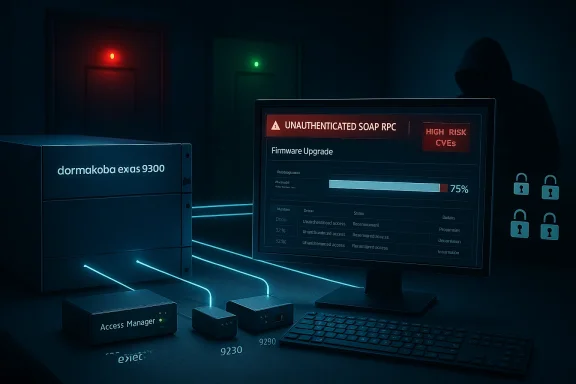
Hooded figure in a dark data center monitors an unauthenticated RPC firmware upgrade on a glowing screen.Background​

The flaws were uncovered and responsibly disclosed by SEC Consult’s vulnerability research team and published publicly in late January 2026. The findings cover three closely related components in dormakaba’s enterprise access stack: the central Kaba exos 9300 management server, the dormakaba Access Manager hardware (92xx/9230/9290 families running “exos Client”), and the registration/reader units used for keypad or biometric enrollment. In response, dormakaba published coordinated security advisories and firmware updates on 26 January 2026 and has issued guidance for mitigations and hardening.
This is not a minor firmware cleanup. SEC Consult catalogued more than twenty distinct CVEs across the product family — including multiple issues rated Critical — that together form attack chains capable of remote door control when the vulnerable services are reachable. Dormakaba’s advisories confirm the problems and publish fixed firmware versions and configuration hardening steps. Independent security outlets also reported on the research and vendor response the same week.

Overview of what was found​

SEC Consult’s research and dormakaba’s advisories show a mix of classic and systemic issues across the stack:
  • Missing authentication and insecure defaults: Several network services accept commands without any authentication by default. Notably, a SOAP configuration channel used to send config updates to Access Managers can be invoked without authentication unless secure tunnelling (IPsec/mTLS) is explicitly configured.
  • Hardcoded credentials and secrets: Legacy, hardcoded accounts and static cryptographic keys exist in binaries and services, enabling authenticated operations merely by presenting those embedded credentials.
  • Weak or recoverable password derivation: A database connection password derivation approach relies on locally readable values and predictable inputs, allowing an attacker with host read access to reconstruct the MSSQL connection secret.
  • Exposed debug and trace endpoints: A trace/debug TCP socket broadcasts sensitive runtime data — including card IDs and PIN entry events — without authentication.
  • Path traversal and database export weaknesses: The embedded web server permits path traversal and unauthenticated access to exported SQLite database files that can contain badge data, PINs, and encryption artifacts.
  • Local privilege escalation and scheduling abuse: System management components allow scheduling arbitrary executables to run with SYSTEM privileges.
  • Registration unit hardware manipulation: Older registration units (serials/firmware prior to a specific threshold) leak debug data over UART or can be physically manipulated in ways that expose credential material, although exploitation requires local access to the device.
Collectively, these problems mean that an attacker who attains network-level access to the exos management server or to exposed Access Managers — whether by lateral movement inside a corporate LAN or through internet-exposed devices — can perform a wide range of hostile actions that directly impact physical security.

Technical deep dive: key vulnerabilities and their implications​

The vendor and SEC Consult mapped the most consequential issues to published CVE identifiers and severity scores. Below are the most load-bearing technical points that administrators must understand.

Unauthenticated SOAP API and remote reconfiguration (high/critical)​

  • The exos 9300 server uses a SOAP-based channel to push full configuration updates to Access Managers. By default this channel is not protected by authentication; secure operation requires administrators to enable IPsec (for K5 devices) or mTLS/HTTPS (for K7 devices).
  • Impact: an attacker with network connectivity to the SOAP port can:
  • Reconfigure Access Managers to change door behaviors.
  • Open relays to unlock doors permanently or for defined intervals.
  • Disable alarm or tamper detection logic.
  • Modify admin credentials stored on devices.
  • Dormakaba’s mitigation is explicit: update Access Manager firmware and encrypt the management channel. The default insecure configuration is the root cause here.

Hardcoded legacy accounts and embedded secrets (critical)​

  • Multiple legacy credentials embedded in the exos binaries permit signing into a datapoint service (ports typically 1004/1005) used to relay statuses and commands to Access Managers.
  • Impact: these credentials can be used to send authorized control commands — including door opening commands — to Access Managers and peripherals.
  • In addition, some DLLs use a weak XOR-based “encryption” key (reportedly based on a founder’s name) to obfuscate user PINs stored in the database; the implementation and static key make it straightforward to recover PINs if the binary or database is obtained.

Unauthenticated RPC service and trace socket (high)​

  • An RPC service (reported on a service port such as 4000) and a trace/debug socket broadcast status data without authentication. The trace output can contain card IDs and keypad presses.
  • Impact: an attacker could intercept PINs entered at registration units or capture card identifiers and use them to spoof credentials.

Insecure password derivation for MSSQL connection (high)​

  • The system generates a database password by combining static random values and a machine-specific component that is readable from the registry. An attacker with read access to the server’s registry can derive the MSSQL account password (Exos9300Common) and thereby read or write exos database tables.
  • Impact: with database access an attacker can enumerate badge records, PINs, scheduled access rules, and can insert or alter records to grant themselves access.

Path traversal, unauthenticated DB export, and session mismanagement​

  • The embedded CompactWebServer is susceptible to path traversal attacks, allowing an unauthenticated user to read arbitrary files (including Database.sq3) from the filesystem.
  • A web-export feature writes a copy of the SQLite DB to disk and attempts to serve it; under certain conditions the exported file remains accessible without authentication.
  • Session handling is IP-address-based: once an IP has successfully authenticated, subsequent requests from that IP are treated as authenticated, a brittle approach that is exploitable via IP spoofing or proxying.

Exposure and exploitation scenarios​

SEC Consult’s research included internet scanning and fingerprinting. They reported finding clusters of Access Managers and management endpoints visible on the public internet, particularly in specific European countries. When such devices expose both the login/web interface and the SOAP/API port (for example, port 8002 for SOAP), attackers can directly send commands to relays and doors.
Important operational points:
  • Dormakaba and SEC Consult consistently note that exploitation generally requires prior access to a customer network or to poorly segmented hardware. The vendor’s advisories emphasize that many issues are only exploitable from internal networks unless devices are misconfigured and internet-exposed.
  • However, multiple organizations have historically left access-control hardware or management endpoints reachable from the internet for remote maintenance or misconfigured VPNs. Where that happens, the “internal network” requirement becomes moot: the internet-facing device becomes the entry vector.
  • A published proof-of-concept video demonstrates door-opening via crafted SOAP requests in a lab setting, underscoring that these are not purely theoretical issues.
Caveat: counts of affected customers reported in media coverage (phrases like “several thousand customers”) appear in vendor statements relayed by journalists, but the vendor advisories themselves do not publish an exact customer count. Organizations should treat such figures as indicative but verify impact via their own vendor communications.

Vendor response, patches, and timelines​

Dormakaba coordinated and published multiple advisories on 26 January 2026 covering:
  • Kaba exos 9300 (update to at least exos 4.4.1 recommended for some fixes).
  • Access Manager firmware: K5 devices should be updated to XAMB 04.06.212 RA or later; K7 devices to BAME 06.00 RA or later (specific CVEs map to particular minimum firmware releases).
  • Registration units: certain 9002 units with serials older than a specific threshold require replacement or onsite checks; firmware 0039 is noted as the cutoff for fixes.
Dormakaba’s advisories include mitigation steps in addition to firmware: enable encryption (IPsec/mTLS), close or firewall exposed management ports, change default or documented passwords, and follow the company’s hardening guide for exos installations.
SEC Consult and dormakaba report that the vendor has spent the last 18 months addressing issues discovered during coordinated research. Many CVEs were assigned and several fixes shipped in the referenced firmware releases. Dormakaba’s advisory language repeatedly recommends immediate patching for high/critical items.

Practical remediation checklist (for IT and physical security teams)​

If your organization uses dormakaba exos 9300, Access Managers (92xx/9230/9290), or registration units, treat this as an urgent operational priority. Follow these steps in sequence:
  • Inventory and discovery
  • Enumerate all exos 9300 servers, Access Managers, and registration units (model, firmware, serial).
  • Verify which devices run older, vulnerable firmware (exos < 4.4.0; Access Manager K5/K7 versions below the vendor minimums).
  • Isolate and segment
  • Immediately ensure management servers and Access Managers are inside a hardened management VLAN.
  • Block inbound access from untrusted networks (internet-facing) to the management and device APIs and ports.
  • If devices are internet-exposed, take them offline or restrict access via a jump host or dedicated VPN until patched.
  • Patch and upgrade
  • Apply dormakaba’s recommended firmware and exos server updates (e.g., exos 4.4.1 or later; specified XAMB/BAME firmware for Access Managers).
  • Confirm upgrades in a controlled test environment before mass rollout where possible.
  • Strengthen communication confidentiality
  • Configure IPsec for K5 Access Managers and mTLS/HTTPS for K7 devices as recommended.
  • Where supported, enable HTTPS and certificate-based verification for management channels.
  • Rotate credentials and secrets
  • Replace any default or documented passwords and remove legacy/hardcoded accounts where the vendor allows.
  • If possible, rotate sitekeys, encryption keys, and database connection credentials after upgrading and hardening.
  • Audit and monitor
  • Review exos and Access Manager logs for anomalous commands or unexpected configuration changes.
  • Monitor for suspicious SOAP or RPC activity; alert on attempts to access debug or trace sockets.
  • Protect database secrets
  • Restrict access to the MSSQL instance and registry; ensure only authorized service accounts can read application-specific registry values.
  • Consider encrypting backups and applying DB access controls to limit reading of badge/PIN tables.
  • Physical device validation
  • For registration units older than the fixed serial/firmware threshold, perform on-site checks; replace or update units that are vulnerable to local manipulation.
  • Third-party validation
  • If you use managed-services or integrators for your access systems, verify they have applied vendor patches and hardening guidance.
  • Incident readiness
  • Prepare a response plan for scenarios where an attacker has abused access-control services (e.g., forced door opens, badge cloning, altering time schedules). This plan should include lock-down, physical security augmentation, and forensic collection on exposed systems.

Risk assessment: who is most at risk and why​

  • Organizations with insufficient network segmentation that allow maintenance or management channels to be reachable from general corporate networks or external connectivity are highest risk.
  • Critical infrastructure operators — energy firms, logistics hubs, airports — were specifically called out as common dormakaba customers and therefore have heightened impact if breached.
  • Facilities that rely on older, disconnected hardware (devices that cannot receive over-the-air updates) face remediation friction; physical replacement or on-site firmware installs may be required.
  • Attackers range from opportunistic criminals seeking access to property, through insiders who can reach management hosts, up to well-resourced adversaries (nation-state or APT actors) who can leverage access into lateral movement and physical sabotage.
  • The fact that many vulnerabilities require network access tempers the immediate external threat, but the presence of misconfigured, internet-exposed Access Managers means remote exploitation is practicable in mismanaged environments.

Why this matters: the convergence of IT and physical security​

This incident is a textbook example of how IT vulnerabilities can have direct physical consequences. Access control systems are no longer isolated electromechanical stacks; they are networked, software-defined, and integrated into corporate IT. That convergence delivers benefits — centralized management, audit logs, remote provisioning — but also concentrates attack surface.
  • Weaknesses in management protocols (SOAP, RPC) and embedded web servers bring web-application class problems into the physical security domain.
  • Embedded devices and firmware often lag in secure-by-default configuration; in this case, dormakaba’s reliance on optional IPsec/mTLS configuration meant insecure defaults were widely deployed.
  • The presence of hardcoded secrets and ad-hoc cryptographic approaches (custom XOR-based “encryption”) illustrates the perennial risk of non-standard crypto and secret management in legacy control systems.
Regulators are watching this space. In Europe, NIS2 and other operational resilience directives increasingly expect stronger controls on networked physical infrastructure. Security teams that treat badge systems as peripheral will find themselves in the crosshairs of auditors after incidents.

Operational and procurement lessons​

  • Insist on secure defaults in procurement: verify that new physical access products ship with encrypted management channels enabled and no hardcoded backdoor accounts.
  • Demand a CVE and security support lifecycle: vendors should publish disclosure policies, timely firmware updates, and a clear upgrade path for end-of-life hardware.
  • Integrators and facilities teams must adopt patch management for physical security stacks just like they do for servers and network gear.
  • Exercise fail-safe procedures: ensure that manual override, on-site guards, and emergency lockdown protocols exist and are tested in case central access-control servers are compromised.

What defenders should tell executives now​

  • This is an urgent, actionable operational risk with immediate mitigations: patching, network segmentation, and credential rotation materially reduce the attack surface.
  • While exploitation requires network access in most cases, several devices were found internet-exposed in public scans — that gap turns a local attack into a remote one.
  • The business impact is direct: unauthorized access to facilities, theft, sabotage, and regulatory exposure. Treat remediation efforts as a priority across IT, physical security, and compliance teams.
  • Procurement and asset-inventory deficits often create the exposure; allocate resources for discovery and replacement of legacy registration units that cannot be secured via firmware.

Caveats and verification notes​

  • The technical details in this article are drawn from SEC Consult’s vulnerability research and dormakaba’s official security advisories published on 26 January 2026. Those advisories contain the CVE numbers, affected version ranges, and vendor-recommended firmware releases.
  • Media reports citing vendor statements — for example, characterizations that “several thousand customers were affected” — appear to be based on vendor communications reported by press outlets; the official dormakaba advisories do not enumerate exact customer counts. Treat such population estimates as reported by the vendor in press coverage rather than enumerated in the advisory documents.
  • Where applicable, administrators should validate firmware checksums and firmware release notes provided in vendor support channels prior to installation and test upgrades in a lab environment when possible.

Final analysis: strengths, risks, and what comes next​

Strengths:
  • The vulnerabilities were responsibly disclosed and coordinated between SEC Consult and dormakaba.
  • Dormakaba published multiple advisories and concrete firmware versions to remediate issues across the product family.
  • The research highlights systemic weak points that, once fixed, will materially raise the security posture of exos-based deployments.
Risks and challenges:
  • Many enterprises have historically accepted less-rigorous hardening for access systems; bringing these systems up to secure-by-default posture requires operational work, firmware management, and sometimes hardware replacement.
  • Legacy devices and disconnected registration units are the hardest to remediate at scale — replacements or on-site firmware upgrades may be required.
  • The window between vulnerability disclosure and threat actor exploitation is narrowing in today’s environment. Organizations with weak segmentation or internet-exposed management interfaces are most at risk for immediate compromise.
What should happen next:
  • Rapid, prioritized patching for high/critical CVEs; immediate network-level mitigations for any internet-exposed assets.
  • Programmatic inventory and remediation for all physical access control systems; include vendors and integrators in remediation plans.
  • Longer-term: insist on secure defaults, vendor transparency about hardcoded credentials or crypto practices, and contractual requirements for coordinated vulnerability disclosure and timely security updates.
The dormakaba exos 9300 findings are a wake-up call: physical security systems are now software systems and must be secured, maintained, and monitored with the same rigor as your most critical servers and network infrastructure. Failure to do so turns badge credentials and door relays into an attacker’s direct avenue into your organization’s assets.

Source: Security Affairs Dormakaba flaws allow to access major organizations’ doors
 

Back
Top