

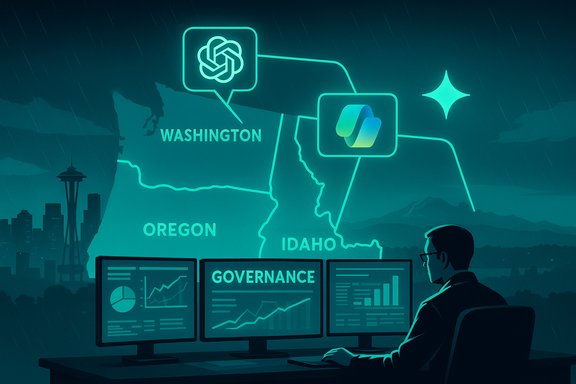
A new regional snapshot of American curiosity about artificial intelligence shows the Pacific Northwest deepening its attachment to AI tools — and prompts a necessary re‑examination of what search-volume studies actually tell us about adoption, readiness, and risk. Washington state sits high on recent lists of AI interest, while Oregon and Idaho register strong growth; at the same time, different studies produce different rankings and sharply different per‑capita figures, underscoring how sensitive these “most AI‑obsessed” lists are to methodology, keyword selection, and timeframe.
Background / Overview
The headline claim circulating in regional coverage is straightforward: residents of Washington, Oregon, and Idaho are searching for AI tools — ChatGPT, Gemini, Character.ai, Microsoft Copilot and others — at elevated rates, with Washington often appearing inside the national Top 10 for AI‑related searches per capita. That reality aligns with a broader national pattern in which highly digital states and major tech hubs lead in AI queries, while many less‑densely populated states lag. Multiple independent analyses of Google search volumes and keyword sets show California, New York, and other dense tech markets ranking at or near the top for AI interest, with the Pacific Northwest consistently registering above average curiosity. But “search interest” and “adoption” are not the same thing. A close look at the methods behind these studies shows how headline rankings can be produced — and how they can be misleading if read as direct measures of economic transformation or workforce penetration. This feature unpacks the underlying claims, evaluates the data and methodology issues that matter most to Windows‑focused IT leaders and local policymakers, and highlights practical implications for IT teams, businesses, and civic planners across the region.What the recent reports say — the numbers in context
The reported findings (what you probably read)
- Washington has been portrayed as one of the country’s most AI‑curious states, often landing inside the Top 10 on per‑capita AI search rankings. Some regional articles report Washington registering tens of thousands of AI‑searches per 100,000 residents and millions of monthly searches for major tools like ChatGPT.
- Oregon and Idaho show strong momentum in the same analyses, with Oregon sometimes placed well inside the Top 20 and Idaho showing rapid growth in search activity as the state’s population increases and remote workers relocate there.
- Nationally, large states with dense tech ecosystems — California, New York, Massachusetts, New Jersey and Virginia — tend to top these lists when total search volume is considered; per‑capita rankings shift that picture, elevating smaller but highly engaged states.
Cross‑checks and variations
Multiple agencies and outlets have run similar analyses over the past two years using Google Keyword and related search‑volume APIs, but results vary substantially:- One study that aggregated thousands of AI‑related keyword queries placed states like California and Washington at the top in different configurations, with per‑100k figures reported differently across publications.
- Another independent media summary used a different keyword list and produced an alternate ranking that still showed strong Pacific Northwest interest but with different absolute values.
How these studies work — dissecting the methodology
Keywords, timeframe, and normalization: the levers that move the needle
Most of the published analyses rely on three core design choices:- The keyword universe (which AI terms were included; benign variants and brand names matter a lot).
- The time window (a 12‑month moving window, a fixed range tied to specific product launches, or an intense short window around a new model release).
- The normalization method (searches per capita, per 100,000 residents, or raw totals).
Common blind spots and bias vectors
- Urban news‑cycle bias: Tech hubs are home to more influencers, journalists, and early adopters, who both search more and create news that triggers additional searches. That feedback loop can exaggerate real adoption beyond daily workflows.
- Bot and automation noise: Some automated services or scraping activities can artificially inflate search volumes for certain queries. Good studies apply noise filters; weaker ones do not.
- Population churn: States with significant inbound migration from tech centers (e.g., Californians moving to Oregon or Idaho) can see per‑capita spikes that reflect the habits of newcomers rather than organic local adoption.
- Topic ambiguity: Generic terms ("AI generator", "AI image maker") may capture diverse intents — curiosity, research, hiring — making interpretation fraught unless studies disaggregate intent.
Why Washington, Oregon, and Idaho show strong AI search activity
Washington: the home of hyperscalers and productivity tooling
Washington’s high placement in many AI‑search rankings is unsurprising given the concentration of major tech employers and developer communities in the state. Microsoft’s global headquarters in Redmond and Amazon’s huge Puget Sound presence anchor an ecosystem of startups, contractors, and research labs that both build AI tech and drive public curiosity about it. These employers also embed AI in widely used productivity tools — from Microsoft 365 Copilot to AWS‑backed services — which boosts searches as employees learn, troubleshoot, and evaluate features. The state’s tech workforce, plus a dense set of universities and research centers, creates both supply (developers and researchers) and demand (users and customers) for AI tools — a double effect that search‑volume analyses tend to capture. Local forums and discussions echo this dynamic: regional posts often frame Seattle as balancing large AI infrastructure buildouts with ongoing workforce disruption and retraining debates.Oregon: startup momentum and a Portland tech scene
Portland’s growing startup community and expanding remote‑work population help explain Oregon’s solid per‑capita search numbers. Tech migration trends and a rising number of SaaS and creative‑industry shops using generative tools (for design, marketing, and prototyping) surface in search data. In short: Oregon’s AI interest is diffuse across the state and not just Portland‑centric, reflecting both enterprise curiosity and consumer experimentation.Idaho: demographic shifts and remote‑worker effects
Idaho’s placement in some rankings reflects another phenomenon: remote workers relocating from coastal tech centers bring their digital habits with them. When thousands of remote software engineers and product people settle in Boise or other Idaho metros, they carry tool‑usage patterns that show up in local search statistics, schooling/searching for AI resources, and small‑business experimentation with AI services. That creates a pattern where search interest outpaces local enterprise scale — an early‑adopter signal more than an index of in‑state industrial AIization.What these search patterns mean for IT teams and local policymakers
Practical takeaways for Windows‑centric IT leaders
- Expect rising grassroots experimentation: Elevated search activity typically signals more employees experimenting with consumer and desktop AI tools — from ChatGPT for drafting to Copilot for email summarization. That increases the need for approved‑endpoint strategies, DLP controls, and clear acceptable‑use policies.
- Prepare for “shadow AI”: When staff use public assistants without governance, sensitive IP and customer data can be exposed. IT should prioritize private endpoints, non‑training agreements with vendors, and prompt logging for auditability. These are not optional afterthoughts in a region where curiosity is high.
- Measure impact, not just adoption: Pilot programs should define measurable business outcomes (error rates, time saved on specific processes, cycle‑time reduction), not just headline time‑savings claims. Instrumentation and telemetry matter — especially in enterprise Windows environments where compliance and audit trails are required.
Policy and civic infrastructure implications
- Skilling and retraining: Regions with high search interest should couple curiosity with training pipelines for MLOps, data engineering, and model governance. Public–private training partnerships, community colleges and employer‑led microcredential programs will convert curiosity into durable local economic benefit.
- Energy and data center planning: Hyperscaler infrastructure and AI compute footprints increase local grid demand and land‑use pressure. Regional planners should anticipate data‑center siting debates and factor resilience and sustainability into permitting frameworks.
- Regulatory readiness: States with strong AI interest will need to balance innovation with consumer protections — privacy rules, procurement guardrails for public agencies, and sectoral standards for health and finance.
Critical analysis: strengths and risks of using search‑volume rankings
Notable strengths (what these studies do well)
- Early signal detection: Search volumes capture nascent interest before large procurement projects or formal adoption, acting as a real‑time thermometer of public curiosity.
- Comparative per‑capita view: Normalizing by population surfaces pockets of intensity in smaller states that raw totals would obscure.
- Tool‑level granularity: Breaking down searches by brand (ChatGPT, Gemini, Copilot) helps identify which vendor ecosystems are gaining traction in which markets.
Key limitations and risks (what the rankings miss or can mislead)
- Method sensitivity: Rankings are highly sensitive to the composition of the keyword list, timeframe chosen, and whether brand terms are included. That can flip a state’s rank without any deeper change on the ground.
- Ambiguity of intent: A spike in “ChatGPT” searches could come from tech journalists, hobbyists, students, or enterprises piloting integrations — the intent spectrum is wide and often indistinguishable from search counts alone.
- Media and news effects: Major product announcements, pricing changes, or local news coverage can produce temporary search spikes that don’t translate into sustained usage.
- Unverifiable proprietary datasets: Several headlines attribute precise numerical claims (for example, a specific number of searches per 100,000 residents or aggregate monthly totals by brand) to vendor studies that are not always publicly archived. Where the underlying datasets or methodologies are not available for inspection, take those absolute numbers with caution. Efforts to locate the original state‑by‑state dataset for one such recent analysis (the claimed 2,630‑term review covering November 2024–September 2025) did not produce a publicly available, reproducible dataset at the time of research; that claim should therefore be treated as provisional until the raw data or a detailed methodology is published.
Recommendations: how to interpret and act on state AI search studies
- Use search‑volume rankings as an early alert, not a policy map. Treat them as a signal that motivates follow‑up: surveys, procurement audits, and funded pilots.
- Demand methodological transparency. When a study releases rankings, it should publish the keyword list, date range, normalization method, and any noise‑filtering applied. If those elements are missing, downgrade confidence in precise numbers.
- Combine signals. Pair search‑volume insights with vendor telemetry, developer‑tooling adoption metrics (e.g., package downloads, cloud usage), and enterprise procurement data for a fuller picture.
- Prioritize governance and tooling where curiosity is high. Regions that show elevated search interest are likely to encounter shadow AI, data leakage risks, and governance gaps — plan accordingly with private endpoints, DLP, and human‑in‑the‑loop review for high‑risk tasks.
Case study: ChatGPT, Gemini and Copilot search trends — what the brands reveal
- ChatGPT typically appears as the single largest driver of search volume in nearly every state‑level study; its consumer penetration and immediate, low‑friction productivity use cases make it the most visible signal of interest. This is echoed across many independent analyses.
- Gemini and Google‑branded assistants generate substantial interest in states with strong Android and Google Cloud footprints, and often spike during new model releases or product announcements.
- Microsoft Copilot searches tend to cluster in enterprise‑dense markets and in states where Microsoft’s productivity stack has daily traction, which helps explain why Washington’s Copilot searches feature prominently in regional reporting. Microsoft and Amazon’s local campus presence also amplifies corporate curiosity and internal pilot programs.
Final assessment: a measured view of the Pacific Northwest’s AI moment
The Pacific Northwest’s place among “AI‑curious” states is real: tech clusters, university ecosystems, and inbound migration patterns all drive higher per‑capita search activity for AI tools. That matters — elevated curiosity reduces friction for pilot projects, supports talent flows, and encourages vendor attention. But raw search rankings do not, on their own, prove broad enterprise adoption or economic transformation. They are an indispensable early indicator that requires follow‑up with transparent methodology, cross‑referenced datasets, and targeted local policy responses.For Windows administrators, IT leaders, and local policymakers, the practical imperative is clear: convert curiosity into capability while managing risk. That means investing in secure, enterprise‑grade AI endpoints; establishing logging and audit trails; running measurable pilots with production intent; and partnering with education providers to build the workforce pipeline that will turn high search interest into lasting regional advantage. Ignoring the signals risks a patchwork of shadow AI usage, data exposure, and missed economic opportunity — but overreading a headline ranking risks misallocating resources to noisy rather than structural problems.
Washington, Oregon, and Idaho are at an inflection point: the search data points to a culture eager to experiment, and that curiosity can be the seedbed for productive AI adoption — provided it is nurtured with governance, training, and transparent measurement.
Conclusion
Search‑based rankings telling us which states are “most AI‑obsessed” are useful and newsworthy, but they are not a substitute for reproducible evidence of economic transformation. The Pacific Northwest shows high levels of AI curiosity, driven by major tech employers, startup ecosystems, and migration patterns, yet precise numeric claims in single studies can be fragile and dependent on methodological choices. The responsible response from IT leaders and policymakers is pragmatic: treat search data as a call‑to‑action, pair it with rigorous local assessment, and invest in governance and skilling so that curiosity becomes capability rather than a headline.
Source: seattlered.com Washington ranks among most AI-obsessed states
