

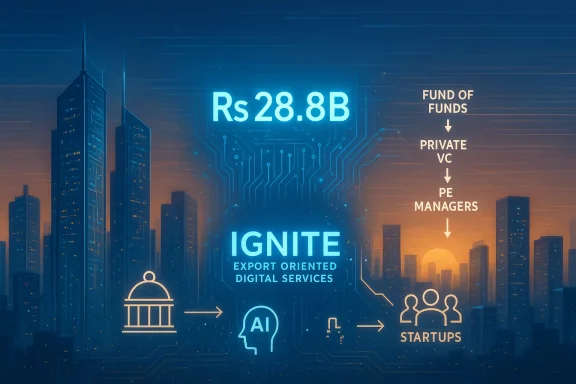
The federal government has proposed a new Pakistan Emerging Technology and AI Fund — a National Fund‑of‑Funds pegged at Rs 28.8 billion — intended to catalyze venture and growth capital flows into AI, advanced digital solutions, and innovation‑led startups. The proposal, placed under the IGNITE programme, includes an initial budget line of Rs 3 billion for FY2026–27 and envisions a 60‑month operational horizon from 2026 through 2031, with funds deploying through private‑sector led venture capital and private equity vehicles. This package is being positioned as a bridge for early‑stage financing gaps, a lever for export growth, and a building block for a knowledge‑based economy — but its impact will depend heavily on governance design, transparency, and execution.
Pakistan has over the past decade pursued a mix of government programs and donor‑backed initiatives to stimulate the country’s startup ecosystem, digital skills, and exportable IT services. IGNITE — the National Technology Fund administered under the Ministry of Information Technology and Telecommunication — is the principal vehicle for federal innovation grants, incubation networks, and national skills programs. The new fund is described as an IGNITE initiative, which would place it within an existing structure that already operates national incubation centers, training programs and the Pakistan Startup Fund. IGNITE’s public materials and recent activity show an organization actively engaged in ecosystem building, though not without operational challenges in recent years.
Under the Public Sector Development Programme (PSDP) the fund is currently listed as a new initiative with cumulative expenditure at zero and is slated for review during federal budget consultations for FY2026–27. The Ministry’s budget and PSDP process will determine whether the initial Rs 3 billion allocation is approved and how the multi‑year programme is funded across the 2026–2031 period.
Source: TechJuice Government Launches National AI and Innovation Fund Worth Rs 28.8 Billion for Tech Growth
 Background / Overview
Pakistan has over the past decade pursued a mix of government programs and donor‑backed initiatives to stimulate the country’s startup ecosystem, digital skills, and exportable IT services. IGNITE — the National Technology Fund administered under the Ministry of Information Technology and Telecommunication — is the principal vehicle for federal innovation grants, incubation networks, and national skills programs. The new fund is described as an IGNITE initiative, which would place it within an existing structure that already operates national incubation centers, training programs and the Pakistan Startup Fund. IGNITE’s public materials and recent activity show an organization actively engaged in ecosystem building, though not without operational challenges in recent years.Under the Public Sector Development Programme (PSDP) the fund is currently listed as a new initiative with cumulative expenditure at zero and is slated for review during federal budget consultations for FY2026–27. The Ministry’s budget and PSDP process will determine whether the initial Rs 3 billion allocation is approved and how the multi‑year programme is funded across the 2026–2031 period.
What exactly is being proposed?
Key facts (as reported so far)
- Proposed name: Pakistan Emerging Technology and AI Fund (sometimes referred to as a National AI and Innovation Fund).
- Total proposed size: Rs 28.8 billion over a 60‑month period (2026–2031).
- Initial allocation requested for FY2026–27: Rs 3 billion (subject to approval in the federal budget process).
- Structure: National Fund of Funds — the government seed capital would be used to mobilize private capital by investing into local venture capital (VC) funds, private equity (PE) vehicles, and potentially co‑investing with other funds in high‑potential startups.
- Implementation: The initiative is included under IGNITE (the National Technology Fund), which already runs national incubators, grant programs, and the Pakistan Startup Fund.
What a “Fund of Funds” model means here
A National Fund‑of‑Funds does not typically invest directly in startups; instead it commits capital to licensed and vetted fund managers (VCs/PEs), leveraging their deal‑sourcing, due diligence, and portfolio management expertise. The government’s role becomes catalytic — providing anchor capital, sharing downside risk, and offering incentives for local and international investors to back Pakistani tech companies. In principle, this model can accelerate capital formation, professionalize fund management, and scale the pipeline of later‑stage financings.Why the government is pitching this now
Strategic objectives listed by proponents
- Address early‑stage and growth‑stage financing gaps that constrain startup scaling.
- Mobilize private capital into Pakistan’s technology sector by using public money as anchor investment.
- Strengthen emerging technology ecosystems, with a named emphasis on artificial intelligence, advanced digital solutions, and innovation‑driven enterprises that could feed export growth.
- Support the shift to a knowledge‑based economy, increasing high‑value services and product exports rather than relying solely on commodity or low‑value service sectors.
Macroeconomic and policy context
Pakistan’s public development spending and PSDP priorities have emphasized digital capacity building in recent budgets and economic plans, while IGNITE’s mandate explicitly targets tech‑led growth and skills development. A government‑backed fund aims to tie those policy goals to concrete capital flows that can help startups reach scale and build exportable software and digital services. However, turning strategic intent into measurable export outcomes requires careful alignment of incentives, monitoring, and ecosystem coordination.Potential benefits — what could go right
- Catalysing private investment: Public anchor capital can reduce perceived risks for institutional and international investors, increasing the pool of capital for local VCs and follow‑on rounds. A properly structured Fund‑of‑Funds can recruit experienced fund managers into Pakistan and attract cross‑border LPs.
- Improved startup survival and scaling: Increased access to growth capital improves runway for promising startups, enabling hiring, product development, and market expansion that otherwise stall due to lack of financing. Over time, higher survival and scale rates can build a pipeline of exits and domestically‑managed unicorns.
- Export diversification: If capital is directed toward export‑ready SaaS, fintech, healthtech, agritech and other tradable digital services, Pakistan could raise IT exports and foreign exchange inflows, supporting macroeconomic resilience. Targeted fund mandates can prioritize export orientation.
- Professionalization of the investment ecosystem: A Fund‑of‑Funds can create incentives for higher governance, compliance, and fund management standards among local VCs — vital for institutional investor confidence.
- Regional and skill spillovers: Beyond fundraising, the fund could drive mentoring, knowledge transfer, and linkages between startups, universities, and corporates — strengthening the domestic innovation infrastructure that IGNITE already supports.
Where the risks and weaknesses lie
The proposal’s promise is real — but so are several clear and foreseeable risks. Any assessment must weigh the potential upside against governance failures, political interference, and operational missteps that have historically undermined public innovation funds worldwide.1) Single‑source reporting and transparency gaps
At the time of reporting, primary public coverage of the fund’s Rs 28.8 billion figure and the 60‑month plan appears limited to the initial media write‑up. Official line items and detailed operational documents are not yet publicly available beyond the PSDP entry that lists the initiative; this creates a transparency gap that should be resolved before funds are committed. Where a new multibillion‑rupee program is proposed, full disclosure of objectives, KPIs, governance rules, and procurement/management processes is essential for accountability. Limited early reporting increases the risk of misunderstanding scope and timelines.2) Implementation capacity at IGNITE
IGNITE is the natural administrative home for such a fund, but the organization has faced leadership and governance headwinds in recent years. Reporting has documented an extended absence of a permanent CEO and stalled board activity — factors that can slow approvals, delay procurement, and weaken oversight. Running a national Fund‑of‑Funds requires robust legal, financial, and investment governance capacity that must be demonstrably in place before capital is committed. Without that, the fund risks becoming a politically managed pool rather than a professionally run catalytic vehicle.3) Risk of crowding out vs. catalysing private capital
A government fund designed to catalyze the private sector can instead crowd out private investors if it distorts market terms, offers overly generous subsidies, or selects managers based on political connections rather than performance. The right balance is to provide anchor, first‑loss, or co‑investment incentives that attract new capital rather than replace it.4) Weak pipeline and exit environment
Locking capital into funds is half the battle; founders also need an ecosystem that supports scaling, from talent availability to access to global markets and a healthy IPO or M&A exit market. Pakistan’s local exit ecosystem is still maturing; without regional or global exit pathways, returns may be delayed or limited — which in turn will affect future fundraising and sustainability of the model.5) Corruption, misuse and political interference
Any large public fund is vulnerable to capture. Strict procurement rules, transparent fund manager selection, conflict‑of‑interest policies, independent audit and performance reporting are non‑negotiable if the fund is to achieve investor confidence and policy legitimacy.What good implementation should look like
To achieve the goals stated, the Fund requires a careful operational design guided by international best practice and local realities.Governance and legal structure (must‑haves)
- Legally ring‑fenced vehicle: Clear statutes that prevent arbitrary diversion of capital and establish the Fund’s mandate, objectives, and sunset clauses.
- Independent investment committee: A committee composed of seasoned local and international investors, technologists and economists to set investment policy and approve fund managers.
- Competitive, transparent selection of fund managers: Open RFPs with published scoring criteria, conflict‑of‑interest disclosures, and independent evaluation.
- Robust monitoring and evaluation (M&E): KPIs for jobs created, revenue growth, export receipts, follow‑on financing raised, and exits — reported publicly on a quarterly or semi‑annual basis.
- Audited financials and public reporting: External audits and disclosure of portfolio performance to promote investor confidence.
Financial design choices
- Co‑investment and first‑loss tranches: Use structures that attract private LPs, such as partial first‑loss or co‑investment windows, rather than blanket grants that distort returns.
- Stage‑targeted mandates: Allocate tranches specifically for seed, Series A, and growth to ensure coverage across the lifecycle, or employ blended finance that pairs concessional capital with market returns.
- Foreign investor onboarding: Create clear terms and predictable exit frameworks to invite diaspora and international funds as limited partners.
Ecosystem integration
- Linkage with skills and incubators: Tie investments to IGNITE’s incubators and DigiSkills programs to ensure startups can recruit trained talent and scale more efficiently.
- Export facilitation: Pair funding with trade promotion, regulatory support for cross‑border payments, and market access programs to convert capital deployment into foreign revenue.
A note on accountability and political economy
Public innovation funds succeed when they are structured to depoliticize investment decisions and operate with predictable, rule‑based governance. Recent reporting about IGNITE’s internal governance challenges — including prolonged CEO vacancies and board inactivity — underlines why independent, professional oversight is not an optional detail; it’s central to the fund’s credibility. Policymakers should prioritize board stabilization, clear SOPs for fund management, and early public disclosure of procurement documents before substantive capital is disbursed.International lessons for Pakistan
Governments worldwide have experimented with public venture capital vehicles and Fund‑of‑Funds models. When structured well, they can attract experienced fund managers and scale the ecosystem; when structured poorly, they can become sources of fiscal waste and market distortion. Key lessons for Pakistan include:- Keep the government’s role catalytic and limited to anchoring capital and de‑risking investments, while letting professional fund managers run investment decisions.
- Require performance‑linked contracts for fund managers that emphasize returns coupled with measurable development outcomes.
- Ensure transparency at every stage, including published fund prospectuses, manager selection rationales, and realised returns.
Short‑term roadmap and near‑term checkpoints
If the fund is to move from PSDP entry to fully operational, the following sequential checkpoints should be clear and timebound:- Budget approval for FY2026–27: Confirm whether the initial Rs 3 billion is approved in the federal budget. This is the gating item for start‑up activity.
- Public release of fund mandate and governance documents: Publish the legal framework, operational mandate, and procurement timetable.
- Formation of an independent investment committee: Recruit external investment professionals with clear performance metrics and conflict‑of‑interest rules.
- RFP for fund managers and selection process: Run transparent, competitive procurement to appoint VC and PE managers with stage‑specific mandates.
- First close and co‑investment framework: Define LP terms, co‑investment windows, and first‑loss protections if any.
- Quarterly public reporting: Begin a cadence of performance reporting and M&E from the start.
What stakeholders should demand now
- Investors (domestic and diaspora) should ask for clarity on the fund’s governance, fund manager selection criteria, and performance incentives; they should condition participation on transparent reporting and reasonable commercial terms.
- Startups should demand predictable, stage‑appropriate instruments and fast decision cycles — public funds should not substitute for fast VC responses.
- Civil society and media must insist on public disclosure of the PSDP line items, procurement documents, and audited performance once funds are committed.
- International development partners and bilateral investors can play a role by offering blended capital or technical assistance to strengthen governance and fund operations.
Conclusion
A Pakistan Emerging Technology and AI Fund at Rs 28.8 billion is an ambitious attempt to translate public policy into catalytic capital for startups, AI ventures, and digital exporters. If designed and executed with professional governance, transparency, and a clear catalytic logic, the Fund‑of‑Funds model could materially increase access to growth capital, improve startup survival rates, and help Pakistan diversify into higher‑value, exportable digital services. However, the proposal as reported remains in an early and partially documented stage; critical details — from legal structure and governance to operational safeguards — are not yet publicly available. Until those documents are disclosed and independent oversight is demonstrably in place, stakeholders should treat headline numbers as indicative rather than definitive and press for the accountability mechanisms that will ultimately determine whether this becomes a durable engine for tech‑led growth or another under‑resourced public program.Source: TechJuice Government Launches National AI and Innovation Fund Worth Rs 28.8 Billion for Tech Growth