

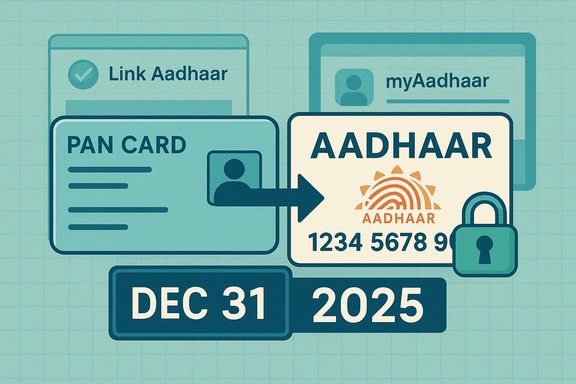
Only 48 hours remain before the December 31, 2025 deadline for a targeted group of PAN holders to replace an Aadhaar Enrolment ID (AEID) with their permanent Aadhaar number — and the practical consequences of missing that deadline are immediate and real for those affected.
The Central Board of Direct Taxes (CBDT) issued Notification No. 26/2025 on April 3, 2025, under Section 139AA(2A) of the Income‑tax Act. The notice requires every person who was allotted a PAN on the basis of an Aadhaar enrolment ID (AEID) generated before October 1, 2024 to intimate their actual Aadhaar number to the tax administration on or before December 31, 2025. This is a narrow, retroactive clean‑up step aimed at replacing enrolment placeholders with issued Aadhaar numbers. This deadline is not a fresh universal mandate for every PAN holder—most PAN holders were already required to link Aadhaar under earlier rules and many PANs were made inoperative for lack of linkage as far back as July 1, 2023. The recent CBDT notification applies specifically to PANs issued using the AEID (the temporary enrolment identifier given before UIDAI issues an Aadhaar number) and gives that set of taxpayers a final window to supply the actual Aadhaar number. At the same time, the Unique Identification Authority of India (UIDAI) rolled out changes effective November 1, 2025, that simplify Aadhaar updates: the myAadhaar portal now supports online demographic updates (name, address, date of birth, mobile) using inter‑database verification, while biometric updates still require an in‑person visit to an Aadhaar centre. That modernization aims to reduce friction for people who must now locate and use their Aadhaar number.
(Act now: check Link Aadhaar Status on the Income‑tax e‑Filing portal and confirm whether your PAN needs the AEID → Aadhaar update before December 31, 2025.
Source: ET Now Aadhaar-PAN link deadline: Only 48 hours left! What will happen if you don’t link it now?
 Background / Overview
The Central Board of Direct Taxes (CBDT) issued Notification No. 26/2025 on April 3, 2025, under Section 139AA(2A) of the Income‑tax Act. The notice requires every person who was allotted a PAN on the basis of an Aadhaar enrolment ID (AEID) generated before October 1, 2024 to intimate their actual Aadhaar number to the tax administration on or before December 31, 2025. This is a narrow, retroactive clean‑up step aimed at replacing enrolment placeholders with issued Aadhaar numbers. This deadline is not a fresh universal mandate for every PAN holder—most PAN holders were already required to link Aadhaar under earlier rules and many PANs were made inoperative for lack of linkage as far back as July 1, 2023. The recent CBDT notification applies specifically to PANs issued using the AEID (the temporary enrolment identifier given before UIDAI issues an Aadhaar number) and gives that set of taxpayers a final window to supply the actual Aadhaar number. At the same time, the Unique Identification Authority of India (UIDAI) rolled out changes effective November 1, 2025, that simplify Aadhaar updates: the myAadhaar portal now supports online demographic updates (name, address, date of birth, mobile) using inter‑database verification, while biometric updates still require an in‑person visit to an Aadhaar centre. That modernization aims to reduce friction for people who must now locate and use their Aadhaar number. Who is affected — and who isn’t
The narrow target group
- PANs issued on the basis of an Aadhaar Enrolment ID (AEID) prior to October 1, 2024. These PANs may contain an AEID instead of the final 12‑digit Aadhaar number. The CBDT’s April 2025 notification singles out this set for mandatory intimation of the Aadhaar number by December 31, 2025.
The larger context
- For most taxpayers the general Aadhaar–PAN linking requirement has been in force for years. Many taxpayers who missed earlier windows saw their PANs rendered inoperative from July 1, 2023, under existing rules; those taxpayers have already experienced the operational disruptions associated with inoperative PANs.
Exemptions (limited categories)
Certain categories are exempted under the law and related clarifications. The exemptions include:- Residents of specified states where Aadhaar coverage and enrollment logistics have been historically constrained (for example, Assam, Jammu & Kashmir and Meghalaya in previous government guidance).
- Non‑residents (NRIs) as defined under the Income‑tax Act.
- Persons who are not Indian citizens (foreign nationals).
- Individuals aged 80 years or older during the relevant financial year.
What will happen if you don’t link (or don’t intimate) by the deadline?
For those in the specific AEID cohort who fail to provide their Aadhaar number by December 31, 2025, the likely operational effect is that their PAN will be declared inoperative from January 1, 2026 — with the same practical consequences that inoperative PANs have carried since 2023. The CBDT notification itself instructs intimation but does not spell out language of every consequence; nevertheless government guidance and tax authority practice show the following material outcomes for an inoperative PAN. Key consequences (short to medium term)- Income‑tax refunds will not be processed for an inoperative PAN and interest on those refunds will not be paid for the period the PAN remains inoperative. This has affected taxpayers who had filed returns or were awaiting refunds while their PAN became inoperative.
- Higher TDS and TCS rates will apply. Deductors/collectors are required to deduct or collect tax at higher default rates (including statutory back‑stop rates) where the payee’s PAN is not available or deemed not furnished. This can materially reduce cashflow for the payee until the PAN is restored.
- ITR validity and processing issues. Returns filed quoting a PAN that is later declared inoperative may face processing problems; earlier clarifications treated such ITRs as invalid in certain contexts until the PAN is made operative. Pending returns may not be processed and refunds may be withheld.
- Operational blocks on transactions that legally require PAN. Although the immediate statutory effects focus on taxation, banks and other financial intermediaries rely on PAN status for KYC and compliance. An inoperative PAN has led, in practice, to refusals or delays in processing certain transactions that require valid PAN identification (for example high‑value investments, some tax‑sensitive banking operations). These downstream disruptions are real even if they are implemented through operational controls rather than an explicit statutory ban.
How to check whether your PAN is already linked (and how to fix it now)
The Income‑tax Department’s e‑Filing portal provides an online status check and the standard linking workflow. Follow these steps carefully — do not share OTPs or sensitive selfies with anyone claiming to “help” you over the phone. Use only official portals.- Visit the official Income‑tax e‑Filing portal and click Link Aadhaar under Quick Links (pre‑login) or login and use Link Aadhaar in your Profile (post‑login).
- To view status (pre‑login): choose Link Aadhaar Status, enter your PAN and Aadhaar number and submit. The portal will indicate whether the PAN is linked, pending, or not linked.
- To submit a link request (pre‑login): enter PAN and Aadhaar, validate details, follow OTP verification on the Aadhaar‑linked mobile, and — if required — make a small fee payment through e‑Pay Tax, then submit. The portal will confirm submission and you can track status.
- If the portal reports “payment details not found” follow the e‑Pay Tax instructions; the Income‑tax portal may require a nominal fee in specific late‑linking flows.
- If the portal reports that your request is pending with UIDAI, wait 48–72 hours and recheck; UIDAI validation is a separate step.
- If your Aadhaar is already linked to a different PAN or your PAN is linked to someone else’s Aadhaar, you will need to contact the jurisdictional Assessing Officer for delinking/remediation. The e‑Filing portal flag will show the required steps.
Step‑by‑step: link your PAN with Aadhaar (concise, action‑oriented)
- Open the Income‑tax e‑Filing portal (official URL via government domain).
- On the homepage, click Link Aadhaar (Quick Links).
- Enter your PAN, Aadhaar number (or AEID if you only have that on record), and name exactly as on Aadhaar.
- Validate via Aadhaar OTP sent to the mobile number registered with UIDAI.
- If the system prompts, pay the prescribed fee via e‑Pay Tax and continue.
- Note and retain the transaction reference or Update Request Number for tracking.
- Revisit Link Aadhaar Status to confirm the status; allow up to a few working days if validation is pending.
Re‑activation mechanics and fees (if PAN becomes inoperative)
If your PAN becomes inoperative because the Aadhaar was not intimated in time, the standard pathway to make it operative again has been: intimate Aadhaar to the prescribed authority and, where required, pay a fee (commonly referred to in public guidance as around ₹1,000). Once the intimation and payment are processed, the PAN is normally restored to operative status within a specified administrative window — historically about 30 days from the date of intimation. That mechanism has been used since the 2023 inoperative enforcement. Important nuance: the CBDT’s April 2025 special window for AEID holders was announced as a compliance opportunity; tax experts have noted that the notification itself did not restate every procedural detail (for instance specific language about penalties), but practice indicates no additional punitive penalty will be imposed for using the special window — the intent is to convert AEIDs to Aadhaar numbers and avoid creating new inoperative PANs where taxpayers take the step within the prescribed period. Nonetheless, taxpayers who miss the window remain subject to the usual inoperative consequences until they rectify the position.Why the government is enforcing AEID→Aadhaar intimation now (analysis)
- Data integrity and de‑duplication. PANs issued using AEIDs create a partial reference state in the tax database; replacing AEIDs with final Aadhaar numbers strengthens the tax‑identity mapping and reduces the scope for duplicate or fraudulent PAN records.
- Operational clarity. Many PANs were issued during the Aadhaar rollout while applicants waited for the final 12‑digit Aadhaar; bringing those records up to final Aadhaar promotes consistent KYC and reduces friction across banking and tax systems.
- Compliance completion. The move is a targeted completion step — not a brand‑new mass imposition — intended to close a specific administrative gap created during phased enrolment and PAN issuance.
Implementation strengths — what’s working
- Online Aadhaar updates reduce friction. UIDAI’s November 1, 2025 changes let many demographic updates happen without an in‑person visit, making it simpler for taxpayers to find, confirm, and use their Aadhaar number when interacting with the Income‑tax portal. This will materially reduce one major barrier that previously caused delays.
- Clear, time‑bound government notice. The CBDT notification supplies an unambiguous deadline for the AEID population, which is preferable to vague or rolling enforcement. Having a fixed target date creates urgency and enables taxpayers to prioritize compliance activities.
- Established reactivation procedure. The administration has already used the inoperative/reactivate mechanism since 2023, so processes exist to restore PANs — albeit with a fee and delay. That gives a pragmatic safety valve for late filers.
Risks, frictions, and open problems — why this matters beyond the headline
- Scams and social‑engineering risk. Deadlines create fertile ground for fraudsters posing as government agents offering “fast linking” or “waiver” services. The OTP‑based flow and requirement not to reveal OTPs must be emphasized; citizens must use only official portals and the official myAadhaar/income‑tax websites. Past enforcement rounds saw a spike in spoofing attempts and phishing. This is a non‑trivial risk as the deadline approaches.
- Operational system lags. Past waves of late fee payments and link requests led to portal glitches and delays in capturing e‑Pay challans. Some taxpayers who paid late fees reported difficulty retrieving payment confirmations; the Income‑tax Department responded by instructing users to check e‑Pay Tax tabs and contact jurisdictional officers where needed. Expect delays and allow time.
- NRIs and exempt persons still face practical problems. Despite formal exemptions, non‑resident taxpayers and others have encountered bureaucratic hiccups when their PANs were marked inoperative due to system mismatches. Resolving such mismatches sometimes requires emailing system teams or filing requests with local assessing officers — a time‑consuming process for someone abroad.
- Downstream KYC friction for banks and intermediaries. While the statutory focus is tax, banks and financial institutions use PAN status for KYC and transaction screening. An inoperative PAN can block or delay important transactions (mutual fund redemptions, portfolio transfers, large property closings) even if the underlying legal issue is simply an administrative gap. Expect operational denial until the PAN is restored.
- Edge‑case uncertainty in the notification text. The CBDT notification prescribes intimation but leaves some procedural specifics to later CBDT directions or portal mechanisms; this creates brief uncertainty for taxpayers who fall into borderline categories (for example, AEID holders who later obtained Aadhaar overseas, or those with mismatches in name formatting). Tax professionals recommend acting early to avoid reliance on case‑by‑case remediation.
Practical checklist for the next 48 hours
- Confirm: check Link Aadhaar Status on the Income‑tax e‑Filing portal right now. Do this from a secure device and the official government site.
- If you get OTP failures: confirm the mobile number registered with UIDAI; use the myAadhaar portal to update your mobile if needed (after following the UIDAI online update flow).
- If your PAN shows an AEID rather than a 12‑digit Aadhaar: follow the Link Aadhaar flow and supply the Aadhaar number now — do not wait.
- Avoid intermediaries offering to “expedite” by taking your OTP or documents. Government portals will never ask you to hand over OTPs or passwords to a third party.
- If you are outside India and do not have an Aadhaar (NRI, foreign national), verify whether you are formally exempt. If exempt but your PAN was made inoperative, e‑mail the address published by the Income‑tax systems team and contact your Jurisdictional Assessing Officer for correction. Expect to provide proof of NRI status or other documentary evidence.
Bottom line and timeline
This is a targeted, administratively necessary cleanup: the CBDT’s April 2025 notification gives a clear window that specifically addresses PANs issued against Aadhaar Enrolment IDs filed before October 1, 2024. For people who fall into that category and who have not yet supplied the 12‑digit Aadhaar, the deadline is December 31, 2025 — after which the PAN will likely be declared inoperative from January 1, 2026 unless the taxpayer has already intimated the Aadhaar. If you are uncertain about whether the notification applies to you, the safe operational choice is simple and immediate: check the Income‑tax e‑Filing portal’s Link Aadhaar Status, and if necessary follow the Link Aadhaar workflow this week. If you discover problems — AEID vs Aadhaar mismatches, mobile‑OTP failures, or exemption claims — start the remediation now; the reactivation route exists but can take weeks and may require fee payment and manual intervention by the tax office.Final editorial assessment — strengths, shortcomings, and risks
Strengths- The government’s approach is administratively rational: convert temporary AEIDs to final Aadhaar numbers to strengthen databases and reduce duplication. UIDAI’s simultaneous modernization (online updates) lowers the friction that previously slowed compliance.
- The deadline cycle creates operational shocks for taxpayers who miss it. Past rounds showed delays in refunds, higher TDS, and significant distress for NRIs and elderly taxpayers who face practical barriers. The administrative remedy (fee + wait) is workable but blunt.
- Communication and portal reliability have been recurring issues. When volumes spike near a deadline, the government’s online infrastructure has experienced friction in the past; taxpayers should not assume instant reconciliation after payment or submission.
- Privacy‑sensitive risk: OTP flows and online update windows can be exploited by social engineers near deadlines. Public awareness campaigns stressing “never share OTPs” are necessary but may be insufficient if scammers target vulnerable populations.
- The AEID intimation requirement and UIDAI’s online update rules are both sensible and necessary moves that improve data hygiene and individual convenience over the medium‑term. Practically, however, the deadline will generate tight three‑day implementation pressure on a specific, identifiable cohort. For anyone in the AEID cohort, or anyone who has not verified their Aadhaar–PAN link since November’s UIDAI changes, the recommendation is immediate, binary action: check the Link Aadhaar Status on the e‑Filing portal now and complete the link if needed. The alternative is avoidable pain: withheld refunds, higher withholding tax, and administrative hassle in reactivating your PAN.
(Act now: check Link Aadhaar Status on the Income‑tax e‑Filing portal and confirm whether your PAN needs the AEID → Aadhaar update before December 31, 2025.
Source: ET Now Aadhaar-PAN link deadline: Only 48 hours left! What will happen if you don’t link it now?
