

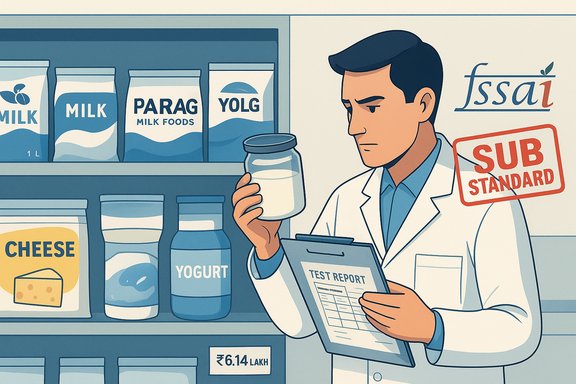
Parag Milk Foods has been hit with penalty orders totalling Rs 6.14 lakh by the Food Safety and Standards Authority of India (FSSAI) after samples taken from retail outlets were judged fit for human consumption but below prescribed standards, the company disclosed in stock‑exchange filings this week.
Parag Milk Foods Limited is one of India’s better‑known dairy brands, with product lines spanning milk powders, cheese, ghee and value‑added dairy beverages. The company informed investors that it received two separate penalty orders from FSSAI divisions — Rs 1.14 lakh from the Udaipur division and Rs 5.00 lakh from the Lunawada division — and that the orders were received on November 3–4, 2025. The firm said the payments will not have a material effect on operations and that it reserves the right to appeal the orders. This action adds to a stream of regulatory scrutiny aimed at packaged food companies in recent months, where the regulator has stepped up sampling and enforcement around labelling, labelling claims and product standards. FSSAI’s heightened activity has included enforcement on misleading claims such as A1/A2 milk labelling and fines against other consumer goods firms for alleged misbranding.
For the broader industry, the episode reinforces three clear lessons: (1) compliance with specification and labelling rules is now an active enforcement priority, (2) marketing claims must be technically defensible and coordinated with QA, and (3) timely and transparent remedial measures plus cogent appeals strategies are essential to mitigate reputational harm. In short, the fine is a small docket item, but its ripples are a reminder that food‑safety compliance remains a board‑level issue for manufacturers who want to protect consumer trust and long‑term shelf presence.
Source: Storyboard18 Parag Milk Foods fined Rs 6.14 lakh by FSSAI over substandard product claims
 Background
Parag Milk Foods Limited is one of India’s better‑known dairy brands, with product lines spanning milk powders, cheese, ghee and value‑added dairy beverages. The company informed investors that it received two separate penalty orders from FSSAI divisions — Rs 1.14 lakh from the Udaipur division and Rs 5.00 lakh from the Lunawada division — and that the orders were received on November 3–4, 2025. The firm said the payments will not have a material effect on operations and that it reserves the right to appeal the orders. This action adds to a stream of regulatory scrutiny aimed at packaged food companies in recent months, where the regulator has stepped up sampling and enforcement around labelling, labelling claims and product standards. FSSAI’s heightened activity has included enforcement on misleading claims such as A1/A2 milk labelling and fines against other consumer goods firms for alleged misbranding. What the orders say: an overview of the FSSAI findings
Two separate orders, same statutory anchor
According to the company disclosure, the Udaipur order imposed Rs 1.14 lakh under Section 51 of the Food Safety and Standards Act, 2006 after a sample taken from a retail outlet was found to be fit for consumption but not meeting prescribed standards. A second order from the Lunawada office imposed Rs 5 lakh on “similar grounds.” The company classed the penalties as limited in financial impact and stated it will pursue available legal remedies, including appeal.What “fit for consumption but below prescribed standards” means
Under FSSAI practice and judicial interpretation, the term “sub‑standard” refers to food that fails to meet applicable specification thresholds while not necessarily being unsafe to eat. The Act’s penalty provision for sub‑standard food appears at Section 51, which allows adjudicating officers to levy monetary penalties (up to a statutory maximum) where food does not meet specified standards but is not contaminated or hazardous in a way that renders it unsafe. Case law and adjudication orders clarify that Section 51 is the common legal tool used when laboratory parameters fall short of normative specifications without moving into the more serious territory of adulteration or contamination prosecutions.Regulatory and corporate context
FSSAI’s recent enforcement posture
FSSAI has been more active in policing packaged‑food claims and product compliance. The regulator has issued show‑cause notices and penalties across multiple FMCG categories and has clarified rules on marketing claims such as A1/A2 milk labels — instructing companies and e‑commerce platforms to remove such claims from packaging as they do not conform to current regulations. Parag Milk Foods’ own leadership publicly welcomed that clarification in the past, describing certain A1/A2 marketing as a “marketing gimmick.”Parag Milk Foods’ recent regulatory history
This FSSAI action arrives against a busy backdrop of regulatory notices for Parag. The company has faced multiple administrative and tax proceedings in 2024–2025: orders from Additional District Magistrates and adjudicating authorities under Section 51 for separate matters were reported earlier in 2025, and the Income‑Tax department has issued penalty orders in different years and assessment for alleged procedural violations. Parag has consistently said it will appeal adverse orders and that such monetary exposures are not material to its core operations.Why this matters: consumer trust, labelling and corporate risk
Consumer trust and the “sub‑standard” designation
Even when samples are adjudged fit for consumption, the label “sub‑standard” can be damaging for a food brand. Consumers equate quality with safety and, in markets where brand selection is closely tied to perceived purity and nutrition, a shortfall against prescriptive standards can translate into lost shelf‑space, reduced retailer confidence and reputational damage.- Perception risk: a regulatory finding—even for non‑hazardous deviations—frequently generates negative headlines that erode brand confidence.
- Retailer response: modern retail chains are sensitive to regulatory flags and may respond with increased auditing, temporary delisting or tighter supplier conditions.
- Investor signalling: multiple regulatory orders in a short period raise questions among investors about compliance culture and quality‑control consistency.
Financial and legal exposure
The amounts here (Rs 6.14 lakh in aggregate) are small relative to Parag’s revenue base, and the company has explicitly said the orders do not materially affect operations. Nonetheless, there are second‑order costs to consider:- Administrative and legal fees to contest orders and pursue appeals.
- Potential for escalated penalties or corrective actions if follow‑up inspections find recurring non‑compliance.
- The long‑term cost of rebuilding consumer trust and possible marketing/packaging changes to pre‑empt future action.
Sectoral signal
FSSAI’s recent actions — including orders against other large consumer brands on labelling and misbranding — signal a regulator prioritising clarity in marketing claims and technical compliance with standards. This is especially relevant where product claims touch on health or nutrition, or where packaging implies benefits that current regulations do not recognise. Market participants should treat this as a reminder that labelling and specification compliance are active enforcement priorities.Technical reading: Section 51 and the “sub‑standard” construct
Legal mechanics in plain language
- Section 51, Food Safety and Standards Act, 2006: provides for penalties where an article of food is determined to be sub‑standard — i.e., it fails to meet prescribed specifications but is not necessarily unsafe. Adjudicating officers (often Additional District Magistrates in local administrations) are empowered to levy monetary penalties under this provision. Court decisions and adjudication orders interpret this provision and the connected definitional clauses (for example, Section 2(zx) defining sub‑standard) when assessing compliance and penalty quantum.
- Typical enforcement pathway: sample collection at retail or wholesale; laboratory analysis against standards and regulations (e.g., Food Products Standards & Additives Regulations or Packaging & Labelling Regulations); show‑cause notice; adjudication and order; opportunity to appeal to a higher administrative forum or court.
Why “fit for consumption” is not the same as “compliant”
Laboratory parameters may show a product’s constituents are within safe thresholds, yet still outside the precise numeric or compositional specifications the law or standards prescribe for a labelled product. Examples include moisture content, fat percentage in milk powders, or declared ingredient levels that fall below required minima for a given label claim. These distinctions drive the legal classification of sub‑standard rather than adulterated or unsafe.Parag Milk Foods’ corporate posture and likely next steps
What the company has said
Parag’s stock‑exchange disclosure framed the matter narrowly: the financial impact is limited to the monetary penalties; there is no material operational effect; and the firm intends to pursue appeal remedies. That is the standard corporate response in such scenarios and is consistent with previous disclosures where the company faced regulatory or tax orders.Probable short‑term actions
- Internal audit: the company is likely to run immediate batch‑level reviews and root‑cause analysis on the specific SKUs and production lines implicated.
- Regulatory engagement: filing an appeal and preparing documentation (test reports, sample‑chain evidence, corrective action reports) for adjudicatory hearings.
- Communications: preparing investor and retailer communications to contain reputational fallout while signalling remediation steps.
Deeper analysis: strengths, shortcomings and strategic risks
Strengths in Parag’s position
- Scale and capability: as an established dairy producer, Parag has the manufacturing scale and technical capability to respond with corrective quality control measures that can be implemented quickly.
- Track record of contesting orders: the company has a history of appealing administrative orders and working through adjudicatory processes — which suggests it will pursue appeals effectively.
Weaknesses and operational red flags
- Multiple regulatory exposures: a cluster of administrative orders (FSSAI penalties, district magistrate penalties, tax penalties) within a limited period raises the spectre of systemic compliance gaps rather than isolated incidents.
- Reputational sensitivity: dairy is trust‑sensitive; repeated regulatory flags can have an outsized reputational impact on margins and pricing power.
- Label and claims exposure: given FSSAI’s stricter posture on marketing claims (for example, A1/A2 and “100% fruit juice” labelling), any legacy packaging or promotional claims could attract further scrutiny.
Strategic risks to watch
- Retail de‑listing risk if a major national chain escalates action after FSSAI findings.
- Class actions or consumer complaints multiplying on social platforms, translating regulatory action into broad consumer distrust.
- Escalation of penalty quantum if subsequent sampling finds repeat deviations, or if regulators treat the matter as persistent non‑compliance.
What this episode means for the broader packaged‑food sector
- Compliance budget is not optional: with FSSAI signalling tougher enforcement, investment in robust QA lab facilities, third‑party validation and stronger packaging controls is now a business imperative.
- Marketing teams must coordinate with compliance: claims about health benefits, protein types, or unique formulation categories (for example, A1/A2) must be validated against current regulatory recognition and scientific consensus to avoid being labelled misleading.
- Regulators and courts will refine standards through orders and case law: operators should track not only the letter of regulations but also evolving adjudicatory interpretations under the FSS Act.
Practical checklist for food businesses to reduce FSSAI exposure
- Conduct a comprehensive label‑claim audit across products and SKUs to ensure every claim has documentary technical support.
- Strengthen retail sampling traceability: maintain clear batch, dispatch and retailer supply‑chain records to rapidly demonstrate compliance history.
- Update quality‑control thresholds to align with the most conservative specification where tolerance bands are narrow.
- Train marketing and product teams on regulatory red‑flags (e.g., health claims not recognised by FSSAI) and require legal sign‑off before new claims launch.
- Maintain a litigation and appeals playbook, including pre‑prepared technical dossiers, test‑lab relationships, and external legal counsel experienced in FSS Act adjudications.
Final assessment
Parag Milk Foods’ Rs 6.14 lakh penalty from FSSAI is small in absolute financial terms but meaningful as a regulatory signal. The orders—one modest and one larger—point to the regulator’s granular approach: sampling at the retail level and enforcement where prescribed product standards are not met, even if the product is fit for consumption. For Parag, the immediate commercial impact appears limited, but repeated regulatory notices heighten reputational and operational risk.For the broader industry, the episode reinforces three clear lessons: (1) compliance with specification and labelling rules is now an active enforcement priority, (2) marketing claims must be technically defensible and coordinated with QA, and (3) timely and transparent remedial measures plus cogent appeals strategies are essential to mitigate reputational harm. In short, the fine is a small docket item, but its ripples are a reminder that food‑safety compliance remains a board‑level issue for manufacturers who want to protect consumer trust and long‑term shelf presence.
Source: Storyboard18 Parag Milk Foods fined Rs 6.14 lakh by FSSAI over substandard product claims
