

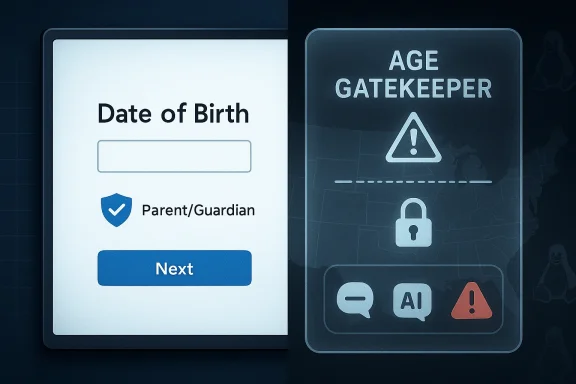
A proposed federal bill could push Windows 11, macOS, Linux, and other operating systems into a new role: acting as the first gatekeeper for age verification before a user even reaches the desktop. The Parents Decide Act, introduced in the House on April 13, 2026, would require operating system providers to collect a user’s date of birth during setup and make it available to apps in order to verify that user’s age. That sounds simple on paper, but the implications for privacy, platform design, and the future of local accounts are anything but simple.
Age verification has moved from a niche compliance issue into a central fight over how modern devices should work. For years, the debate mostly focused on individual apps and websites asking users to confirm they were old enough to access certain content. The logic behind those checks was straightforward: if minors can lie about their age, then online services need stronger signals than a self-entered birthday. But as lawmakers have looked for broader solutions, the pressure has shifted downward from apps to operating systems themselves.
That shift matters because the OS is the layer that sits underneath everything else. If age data is captured at setup, the system can potentially pass a trusted age flag to apps, games, social platforms, and AI tools without each service re-asking the same question. Supporters argue this is the only way to make parental controls meaningful at scale. Critics see it as a major expansion of device-level surveillance, especially if the system must collect more than a simple birthday and expose that data to downstream developers.
The federal bill is not the only pressure point. California’s Digital Age Assurance Act has already created a template for OS-level age handling, and recent reporting indicates it will require operating system providers to collect age information during account setup and share an age-bracket signal with app developers. That state approach gives lawmakers elsewhere a model, and it also creates a compliance path that could spread beyond California if more states adopt similar rules.
At the same time, Microsoft has spent months tightening control over Windows 11 setup, including the push toward Microsoft account sign-in during installation. That creates an awkward backdrop for this debate. If the company is already moving away from frictionless offline setup, a new age-verification mandate could add another layer of account pressure to a process many users already consider intrusive. Recent reporting also suggests Microsoft may be reconsidering the mandatory Microsoft account requirement, which makes the policy timing especially interesting.
That last clause is where privacy advocates are likely to focus their objections. The bill does not simply say the OS should know a user’s age. It says the OS should develop a system that lets app developers access “any information as is necessary” to verify the date of birth, which could be interpreted broadly by regulators. In other words, the law’s practical privacy footprint would depend heavily on future implementation rules and technical standards.
Supporters will argue the bill is narrowly tailored to a real problem: children can easily enter a fake birthday and bypass age gates on apps and AI services. That is the core argument made in the sponsor’s announcement, which frames the legislation as a way to give parents the final say over what children can access. The bill’s logic is that the OS is the only place where age can be verified once and then used consistently everywhere else.
That’s why the headline resonates beyond legal circles. The real fear is not just that Windows 11 would ask for a birthday. It’s that Windows might become the place where identity, parental controls, app permissions, and age-based policy all converge before the user is even allowed to log in. For a consumer OS, that is a substantial shift in power.
A more subtle issue is trust. Users may be more willing to share an age bracket than a full identity document, but they still need confidence that the OS won’t expose sensitive personal data to every app on the machine. If the system is perceived as a universal identity broker, it could trigger backlash from consumers who already dislike the Microsoft account model. That would be especially true on home PCs, where users often want the simplest possible path from hardware to desktop.
That makes enforcement messy. The bill speaks in terms of “operating system providers,” but that phrase is much easier to define for Microsoft or Apple than for the Linux world. Is the provider the upstream project, the distribution maintainer, the company packaging the distro, or the mirror host? In open-source land, the regulatory target is not always obvious.
This creates a real policy dilemma. If the law is enforced strictly, regulators may end up pressuring distribution maintainers to add account layers that users never asked for. If it is enforced loosely, then Linux becomes the obvious escape hatch for privacy-minded users who do not want OS-level age collection. Either outcome reveals the same weakness: the law assumes a level of platform uniformity that does not exist.
Once one large state mandates OS-level age assurance, product teams have to think nationally. A company that ships one Windows build, one macOS build, or one Android-based stack may have little interest in maintaining special-case logic for California, but legal reality can force exactly that kind of fragmentation. The result is a familiar modern pattern: a state rule starts local, then becomes a de facto national specification because software vendors hate shipping different products in different markets.
This also explains why opponents are talking about “digital ID” concerns even when the law does not literally create a government identity document. The fear is architectural rather than procedural: once age becomes a platform attribute, app developers and regulators alike will keep asking for more detailed signals. That is how a simple compliance feature turns into infrastructure.
The strange part is that Microsoft now appears to be pulling in two different directions. On one side, the company has closed off some local-account workarounds in Windows 11, reinforcing the idea that the platform should be more connected and more identifiable. On the other side, recent reporting suggests Microsoft leadership may be “working on” reducing the Microsoft account requirement. If true, a federal age-verification mandate could arrive just as Microsoft is trying to soften user frustration around setup.
That would not be popular with users who want Windows to feel less like a service portal and more like a local device. It would also raise questions about whether Microsoft, by necessity, becomes the broker for age data in a broader ecosystem. For a company already struggling with trust issues around setup, that is a delicate position.
The bigger argument is that parents need a centralized, trustworthy mechanism. If age is verified once at the operating system level, then an app can make decisions based on that signal without repeatedly asking the user to prove the same thing over and over. In theory, that reduces friction while making age restrictions more consistent. It also gives parents a single place to set limits rather than forcing them to manage dozens of separate app-level controls.
That said, “obvious” does not always mean “clean.” The fact that the operating system can centralize the problem does not mean it should absorb all of the privacy risk. Still, the bill’s supporters will likely frame the tradeoff as necessary friction in exchange for better child safety.
The concern is not only about what data is collected, but what happens when the standard expands. If age verification becomes normal at the OS layer, then the next regulatory demand may be to verify location, parental status, school status, or residency. Once the platform is used as a proof engine, every new policy need can be funneled through it. That is the classic function-creep problem.
That is why some privacy-first platforms have already signaled resistance. GrapheneOS, for example, has publicly said it will remain usable without requiring personal information or an account, even if that means devices cannot be sold in certain regions. That sort of stance highlights the coming divide: some vendors will treat compliance as mandatory, while others will treat privacy as the product itself.
For developers, the bill could create both an opportunity and a burden. A trusted age signal could simplify compliance for apps that need to restrict minors. But it also creates a dependency on platform providers and forces developers to trust the OS vendor’s implementation, APIs, and data-handling rules. That centralizes power in the operating system layer, which many developers may not welcome.
For platform vendors, the biggest issue is implementation cost. A secure age-verification system must be robust, auditable, and privacy-preserving, or else it risks becoming another compliance layer that users resent and regulators question. In that sense, the bill may be less about a single feature and more about who gets to define the identity layer of computing.
The other big question is whether Microsoft responds defensively or opportunistically. If the company does relax its Microsoft account requirement, it could frame age verification as a distinct, privacy-aware feature rather than a lock-in mechanism. But if the company leans harder into account-based identity, users may interpret the new law as proof that Windows is becoming less personal and more policy-driven.
The most likely outcome is not a single dramatic flip but a slow normalization of age-aware platforms, state by state and feature by feature. That may satisfy lawmakers looking for stronger child protections, but it will also force consumers, developers, and platform vendors to confront a new reality: the next big fight over Windows, Linux, and the PC itself may be about who gets to know your age before you ever see your desktop.
Source: Windows Central A new bill could force your Windows 11 PC to collect "any information as is necessary" to verify your age
 Background
Age verification has moved from a niche compliance issue into a central fight over how modern devices should work. For years, the debate mostly focused on individual apps and websites asking users to confirm they were old enough to access certain content. The logic behind those checks was straightforward: if minors can lie about their age, then online services need stronger signals than a self-entered birthday. But as lawmakers have looked for broader solutions, the pressure has shifted downward from apps to operating systems themselves.That shift matters because the OS is the layer that sits underneath everything else. If age data is captured at setup, the system can potentially pass a trusted age flag to apps, games, social platforms, and AI tools without each service re-asking the same question. Supporters argue this is the only way to make parental controls meaningful at scale. Critics see it as a major expansion of device-level surveillance, especially if the system must collect more than a simple birthday and expose that data to downstream developers.
The federal bill is not the only pressure point. California’s Digital Age Assurance Act has already created a template for OS-level age handling, and recent reporting indicates it will require operating system providers to collect age information during account setup and share an age-bracket signal with app developers. That state approach gives lawmakers elsewhere a model, and it also creates a compliance path that could spread beyond California if more states adopt similar rules.
At the same time, Microsoft has spent months tightening control over Windows 11 setup, including the push toward Microsoft account sign-in during installation. That creates an awkward backdrop for this debate. If the company is already moving away from frictionless offline setup, a new age-verification mandate could add another layer of account pressure to a process many users already consider intrusive. Recent reporting also suggests Microsoft may be reconsidering the mandatory Microsoft account requirement, which makes the policy timing especially interesting.
What the Parents Decide Act Actually Says
The text of H.R. 8250 is more direct than the headlines suggest. It requires an operating system provider to make every user provide a date of birth in order to set up an account and use the operating system. If the user is under 18, the bill further requires a parent or legal guardian to verify that date of birth. It also directs the provider to create a system allowing app developers to access whatever information is necessary to verify a user’s date of birth for the developer’s app.That last clause is where privacy advocates are likely to focus their objections. The bill does not simply say the OS should know a user’s age. It says the OS should develop a system that lets app developers access “any information as is necessary” to verify the date of birth, which could be interpreted broadly by regulators. In other words, the law’s practical privacy footprint would depend heavily on future implementation rules and technical standards.
Why the wording matters
The phrase “any information as is necessary” is doing a lot of work. It suggests flexibility for developers and regulators, but flexibility in compliance law often becomes ambiguity in engineering. If app makers demand more detailed signals, or if OS vendors build richer identity layers to reduce liability, the result could be more data collection than the public expects.Supporters will argue the bill is narrowly tailored to a real problem: children can easily enter a fake birthday and bypass age gates on apps and AI services. That is the core argument made in the sponsor’s announcement, which frames the legislation as a way to give parents the final say over what children can access. The bill’s logic is that the OS is the only place where age can be verified once and then used consistently everywhere else.
- The bill requires birthdate collection at OS setup.
- It extends to using the operating system, not just creating an account.
- It adds parental verification when the user is under 18.
- It creates a path for app developer access to age-related data.
- Enforcement would treat violations as unfair or deceptive practices under FTC authority.
Why This Becomes a Windows 11 Story
Even though the bill would apply to operating systems broadly, Windows 11 is the easiest place to imagine the practical consequences. Microsoft has already made the Windows 11 setup experience more account-centric, and users have spent years complaining about the shrinking space for local, offline setup. When an OS already nudges users toward online identity, a mandated age-verification layer looks less like a hypothetical and more like an incremental redesign.That’s why the headline resonates beyond legal circles. The real fear is not just that Windows 11 would ask for a birthday. It’s that Windows might become the place where identity, parental controls, app permissions, and age-based policy all converge before the user is even allowed to log in. For a consumer OS, that is a substantial shift in power.
The setup experience could change again
Windows 11 setup has already become one of the most controversial parts of the platform. Many users dislike being forced to connect to the internet and sign in with a Microsoft account during installation, and Microsoft’s own community forums show that this remains a live frustration point. If age verification becomes mandatory, the setup flow could gain another required step, another disclosure, and another reason for users to feel boxed in.A more subtle issue is trust. Users may be more willing to share an age bracket than a full identity document, but they still need confidence that the OS won’t expose sensitive personal data to every app on the machine. If the system is perceived as a universal identity broker, it could trigger backlash from consumers who already dislike the Microsoft account model. That would be especially true on home PCs, where users often want the simplest possible path from hardware to desktop.
- Windows 11 is already sensitive to account-policy debates.
- The bill could add a new required field during setup.
- Users may fear a broader identity pipeline, not just age checks.
- Local-account advocates could see this as another step toward lock-in.
- Enterprise environments may tolerate it more easily than home users.
The Linux Problem
The hardest part of this policy is not Windows. It is Linux. Windows and macOS are centralized ecosystems with company-controlled setup flows, account infrastructure, and update channels. Linux, by contrast, is a family of distributions with different installers, different identity models, and different philosophies about user control. A one-size-fits-all law collides immediately with that diversity.That makes enforcement messy. The bill speaks in terms of “operating system providers,” but that phrase is much easier to define for Microsoft or Apple than for the Linux world. Is the provider the upstream project, the distribution maintainer, the company packaging the distro, or the mirror host? In open-source land, the regulatory target is not always obvious.
Decentralization is not a footnote
Linux distributions are built, remixed, mirrored, and modified in ways that make centralized age-check architecture difficult. Some distros are commercial products, some are community projects, and many can be downloaded and installed without any account at all. A mandate designed around a single setup funnel may break down when the platform itself is a network of projects rather than a single vendor.This creates a real policy dilemma. If the law is enforced strictly, regulators may end up pressuring distribution maintainers to add account layers that users never asked for. If it is enforced loosely, then Linux becomes the obvious escape hatch for privacy-minded users who do not want OS-level age collection. Either outcome reveals the same weakness: the law assumes a level of platform uniformity that does not exist.
- Linux is not one product; it is an ecosystem.
- Many distros do not rely on a single centralized account system.
- Open-source modification complicates compliance.
- Enforcement may vary by distributor, maintainer, or region.
- A weak rule could push privacy users toward Linux as a workaround.
California’s Precedent Changes the Conversation
The federal bill would be attention-grabbing on its own, but California’s age-assurance framework is arguably the more important precedent. Reporting on the Digital Age Assurance Act indicates that California signed it into law in October 2025 and set it up to require operating system providers to collect age information and pass a standardized signal to app developers, with compliance taking effect in 2027. That means the industry is not debating a theoretical future anymore; it is already preparing for a compliance regime.Once one large state mandates OS-level age assurance, product teams have to think nationally. A company that ships one Windows build, one macOS build, or one Android-based stack may have little interest in maintaining special-case logic for California, but legal reality can force exactly that kind of fragmentation. The result is a familiar modern pattern: a state rule starts local, then becomes a de facto national specification because software vendors hate shipping different products in different markets.
The state model is more than a warning
California’s law is not just another privacy headline. It shows how regulators are trying to move age checks away from individual apps and into the platform layer. That approach is attractive to lawmakers because it promises consistency, but it also centralizes risk. If the OS becomes the source of truth for age, the OS becomes a high-value target for abuse, over-collection, and function creep.This also explains why opponents are talking about “digital ID” concerns even when the law does not literally create a government identity document. The fear is architectural rather than procedural: once age becomes a platform attribute, app developers and regulators alike will keep asking for more detailed signals. That is how a simple compliance feature turns into infrastructure.
- California creates a real-world test case for OS-level age verification.
- The law pressures vendors to build platform-wide age signaling.
- Developers may treat California behavior as the national baseline.
- A centralized age layer invites more requests for data over time.
- Privacy debates are now tied to deployment, not just theory.
Microsoft’s Account Strategy Makes the Timing Sensitive
Microsoft has spent years strengthening the connection between Windows and a Microsoft account. That made sense from a product strategy standpoint: cloud sync, device backup, OneDrive, Xbox, Microsoft 365, and easier service integration all benefit when the user is signed in. But the move has also created a longstanding source of friction, especially for home users who want a local account and a more traditional PC experience.The strange part is that Microsoft now appears to be pulling in two different directions. On one side, the company has closed off some local-account workarounds in Windows 11, reinforcing the idea that the platform should be more connected and more identifiable. On the other side, recent reporting suggests Microsoft leadership may be “working on” reducing the Microsoft account requirement. If true, a federal age-verification mandate could arrive just as Microsoft is trying to soften user frustration around setup.
A policy collision, not just a product tweak
The potential collision here is between choice and compliance. Microsoft can decide to loosen account requirements if it wants to improve goodwill, but a law that requires verified age collection could push the company in the opposite direction. If that happens, the company may have to choose whether the easiest path to compliance is to deepen account integration rather than reduce it.That would not be popular with users who want Windows to feel less like a service portal and more like a local device. It would also raise questions about whether Microsoft, by necessity, becomes the broker for age data in a broader ecosystem. For a company already struggling with trust issues around setup, that is a delicate position.
- Microsoft has incentives to keep Windows tightly integrated with identity services.
- Users have repeatedly pushed back against mandatory sign-in.
- A new age-law could harden the setup flow again.
- Compliance pressure may outweigh UX improvements.
- Public trust will matter as much as legal compliance.
What Supporters Say the Bill Solves
Supporters of the Parents Decide Act are not arguing out of nowhere. Their case is that the current internet model relies too heavily on self-attestation, which is easily defeated. In the sponsor’s announcement, Gottheimer’s office says children routinely bypass age limits by typing in a different birthday, then gain access to apps and AI systems that were never designed for them. That is a real weakness in the current system.The bigger argument is that parents need a centralized, trustworthy mechanism. If age is verified once at the operating system level, then an app can make decisions based on that signal without repeatedly asking the user to prove the same thing over and over. In theory, that reduces friction while making age restrictions more consistent. It also gives parents a single place to set limits rather than forcing them to manage dozens of separate app-level controls.
The strongest pro-law argument
The strongest argument in favor of the bill is that modern devices are no longer just tools for browsing and messaging. They are personal computing hubs that mediate social media, AI chat, games, commerce, and school. If lawmakers believe the danger to minors is systemic, then they will naturally look for a systemic control point. The OS is the most obvious control point available.That said, “obvious” does not always mean “clean.” The fact that the operating system can centralize the problem does not mean it should absorb all of the privacy risk. Still, the bill’s supporters will likely frame the tradeoff as necessary friction in exchange for better child safety.
- Self-reported birthdays are easy to fake.
- Parents want a single place to manage controls.
- OS-level verification could reduce repetitive prompts.
- AI and social apps may need clearer age signals.
- Supporters see the bill as a child-safety baseline.
Why Privacy Advocates Are Alarmed
Privacy critics are likely to see the same architecture and come to the opposite conclusion. If the operating system must verify age and then distribute that signal to apps, the device effectively becomes a data relay for one of the most sensitive personal attributes a user has: age. That may sound harmless compared with a full identity document, but it still creates a durable profile about the user and the household.The concern is not only about what data is collected, but what happens when the standard expands. If age verification becomes normal at the OS layer, then the next regulatory demand may be to verify location, parental status, school status, or residency. Once the platform is used as a proof engine, every new policy need can be funneled through it. That is the classic function-creep problem.
The slippery slope is technical, not rhetorical
A lot of public debate around age verification gets stuck on slogans, but the technical issue is simple: data collected for one purpose is often reused for another. If an OS knows your date of birth, then app developers may infer age brackets, parental permissions, or risk categories from that information. Even if the system tries to minimize exposure, the existence of the pipeline changes incentives for developers and regulators alike.That is why some privacy-first platforms have already signaled resistance. GrapheneOS, for example, has publicly said it will remain usable without requiring personal information or an account, even if that means devices cannot be sold in certain regions. That sort of stance highlights the coming divide: some vendors will treat compliance as mandatory, while others will treat privacy as the product itself.
- Age data is still personal data.
- OS-level pipelines encourage reuse beyond the original purpose.
- Developers may ask for more than the law first intended.
- Privacy-first vendors may refuse compliance.
- Users could face fragmented access depending on region and platform.
Enterprise, Consumer, and Developer Impact
The business impact of this bill would not be uniform. Enterprise IT may be able to absorb age-verification workflows more easily because organizations already manage identity, device enrollment, and policy enforcement. Consumer PCs are a different story. A family buying a laptop at retail does not want a setup experience that feels like opening a bank account.For developers, the bill could create both an opportunity and a burden. A trusted age signal could simplify compliance for apps that need to restrict minors. But it also creates a dependency on platform providers and forces developers to trust the OS vendor’s implementation, APIs, and data-handling rules. That centralizes power in the operating system layer, which many developers may not welcome.
Different users, different pain points
Families are likely to care about convenience and transparency. They will want to know what age data is collected, where it is stored, and who can access it. Businesses, by contrast, may focus on whether a controlled system reduces legal risk and simplifies app-policy enforcement for managed devices. Those are different goals, and the bill’s broad language does not fully reconcile them.For platform vendors, the biggest issue is implementation cost. A secure age-verification system must be robust, auditable, and privacy-preserving, or else it risks becoming another compliance layer that users resent and regulators question. In that sense, the bill may be less about a single feature and more about who gets to define the identity layer of computing.
- Enterprises may integrate the rule into existing management systems.
- Consumers may view it as a setup hurdle.
- Developers could gain a cleaner age signal.
- Platform vendors would inherit the security burden.
- Managed devices and personal devices will not feel the same.
Strengths and Opportunities
The strongest argument for OS-level age verification is that it addresses a real, persistent flaw in today’s digital environment: self-attested birthdates are not enough when the goal is to protect minors across apps, games, and AI systems. If designed carefully, the model could create a consistent standard that reduces repetitive checks and gives parents clearer control. It could also help app developers comply without inventing their own fragmented verification logic.- Creates a single trusted signal instead of repeated prompts.
- Gives parents a clearer role in setting device-level controls.
- Reduces reliance on fake birthdays and self-reporting.
- Could simplify compliance for apps with age-sensitive content.
- May standardize policy across social, gaming, and AI platforms.
- Could improve consistency for managed or family devices.
- May reduce the need for every app to build its own verification stack.
Risks and Concerns
The biggest risk is that a child-safety system becomes a broad personal-data pipeline. The bill’s language is broad enough that implementation details will determine whether the result is a narrow age signal or a far more intrusive identity layer. There is also a serious interoperability problem: one law may not map cleanly onto Windows, macOS, Android, iOS, and the distributed Linux ecosystem.- Broad wording could enable data creep.
- App developers may ask for more data than intended.
- Linux compliance may be inconsistent or impractical.
- Users may reject more setup friction on personal PCs.
- Privacy-first vendors may refuse to ship in some regions.
- Different state laws could fragment the market.
- The system could normalize platform-level identity checks.
What to Watch Next
The next phase will be defined less by slogans and more by implementation. If the bill advances, lawmakers will have to clarify what data must be collected, what can be shared with apps, and how much discretion platform vendors have in designing the verification layer. That will determine whether this becomes a lightweight compliance standard or a much broader identity architecture for consumer computing.The other big question is whether Microsoft responds defensively or opportunistically. If the company does relax its Microsoft account requirement, it could frame age verification as a distinct, privacy-aware feature rather than a lock-in mechanism. But if the company leans harder into account-based identity, users may interpret the new law as proof that Windows is becoming less personal and more policy-driven.
Key things to watch
- Whether the House committee advances the Parents Decide Act beyond referral.
- Whether bill language is narrowed around minimum necessary data collection.
- How Microsoft, Apple, and Google describe their compliance posture.
- Whether Linux distributors propose a viable, decentralized implementation.
- Whether California’s model becomes the template for other states.
The most likely outcome is not a single dramatic flip but a slow normalization of age-aware platforms, state by state and feature by feature. That may satisfy lawmakers looking for stronger child protections, but it will also force consumers, developers, and platform vendors to confront a new reality: the next big fight over Windows, Linux, and the PC itself may be about who gets to know your age before you ever see your desktop.
Source: Windows Central A new bill could force your Windows 11 PC to collect "any information as is necessary" to verify your age
