

Opto 22’s groov View platform has a serious information‑disclosure flaw that can leak API keys and other sensitive metadata from the users endpoint — a weakness tracked as CVE-2025-13084 and described in a coordinated advisory that urges an immediate update to patched software and firmware.
Opto 22’s groov View and the underlying groov platform (including groov EPIC and groov RIO devices) provide web UIs and REST APIs used by engineers and automation systems to monitor and control industrial processes. These management APIs are intended to be accessed by authenticated accounts (often via API keys) and therefore carry high privilege when used by administrative roles. The advisory that accompanies this disclosure explains that one of the groov View REST API endpoints — the users endpoint — returns user metadata that includes API keys, exposing them to any account that can call that endpoint with an Editor role.
This exposure has been assigned CVE‑2025‑13084 and was coordinated between security researchers and government stakeholders. The advisory includes CVSS assessments (both v3.1 and v4) that reflect network‑accessible exploitability and meaningful confidentiality impact because API keys equate to operational credentials for the platform.
Key immediate takeaways:
Opto 22’s groov ecosystem is a critical control plane for many operational environments; fixing this metadata exposure and shoring up operational practices reduces the likelihood that a simple leak of metadata becomes an enterprise‑level compromise. Prioritize patching, credential hygiene, and coordinated IT/OT response to close this gap.
Source: CISA Opto 22 groov View | CISA
 Background / Overview
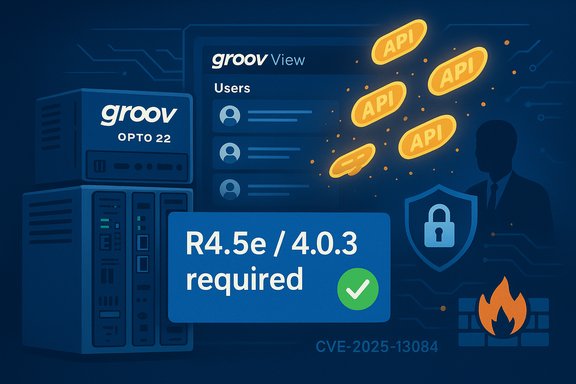
Opto 22’s groov View and the underlying groov platform (including groov EPIC and groov RIO devices) provide web UIs and REST APIs used by engineers and automation systems to monitor and control industrial processes. These management APIs are intended to be accessed by authenticated accounts (often via API keys) and therefore carry high privilege when used by administrative roles. The advisory that accompanies this disclosure explains that one of the groov View REST API endpoints — the users endpoint — returns user metadata that includes API keys, exposing them to any account that can call that endpoint with an Editor role.This exposure has been assigned CVE‑2025‑13084 and was coordinated between security researchers and government stakeholders. The advisory includes CVSS assessments (both v3.1 and v4) that reflect network‑accessible exploitability and meaningful confidentiality impact because API keys equate to operational credentials for the platform.
Executive summary of the advisory
- Vulnerability: Exposure of sensitive information through metadata — the users API returns API keys for all accounts.
- Affected components: groov View Server for Windows (R1.0a → R4.5d) and EPIC firmware branches GRV‑EPIC‑PR1 / PR2 firmware versions prior to 4.0.3 (vendor advisories list precise SKU thresholds).
- Impact: Credential and key exposure, enabling privilege escalation and further operational compromise if keys are abused.
- Exploitability: The endpoint requires an Editor role to access, but Editor access in real environments can be obtained via credential theft, misconfiguration, or compromised engineering hosts; the advisory therefore treats the risk as practical and urgent.
- Remediation: Opto 22 published updates; the vendor recommends groov View Server for Windows R4.5e and GRV‑EPIC Firmware 4.0.3 as the baseline fixes.
Why this matters: technical and operational risk
Sensitive material is effectively credentials
API keys are not inert metadata — they are bearer tokens that grant programmatic access to management APIs. If an API key for an Administrator account is leaked, an attacker can call endpoints that perform file operations, change I/O, or reconfigure devices. The advisory shows that the users endpoint returns API keys for all users, including Administrators, when queried by an Editor‑privileged account. That design decision dramatically increases the damage surface.Attack chain and realistic threat vectors
The flaw itself is an information disclosure, not directly a command‑injection. However, information disclosure of API keys is a classic escalation enabler:- An attacker who gains Editor credentials (phishing, stolen workstation, exposed jump host) can call the users endpoint to retrieve Administrator API keys.
- With Administrator API keys in hand, the attacker can perform privileged actions via the API (file writes, configuration changes, I/O operations), which may lead to process manipulation, firmware changes, or persistence.
Severity scoring and what it reflects
The coordinated advisory provides both CVSS v3.1 and CVSS v4 vectors. The CVSS v3.1 assessment included a base score in the high‑to‑critical range for confidentiality impact; the advisory’s scoring reflects network attackability with low complexity in realistic deployments. The v4 scoring (also calculated for CVE‑2025‑13084) reflects similar concerns around confidentiality (API keys) and the potential for privilege escalation. These formal scores are useful for risk prioritization in patch cycles and incident response planning.Affected products and versions (practical checklist)
- groov View Server for Windows: Versions R1.0a through R4.5d are reported as affected; upgrade to R4.5e per vendor guidance.
- GRV‑EPIC‑PR1 and GRV‑EPIC‑PR2 firmware: versions prior to 4.0.3 are in scope; upgrade to 4.0.3 or later. Confirm exact SKU/version mapping on the vendor firmware portal.
Mitigation and remediation guidance
Immediate corrective actions (ordered)
- Upgrade: Apply the vendor‑released groov View Server for Windows R4.5e and device firmware GRV‑EPIC 4.0.3 or later. Confirm checksums and vendor authenticity before installation.
- Rotate keys and credentials: After upgrading, rotate all API keys and administrative credentials that could have been exposed. Treat any key that existed prior to the patch as suspect.
- Audit access and logs: Look for anomalous API usage, unusual Editor/Administrator sessions, or calls to the users endpoint; export and preserve logs for forensic analysis.
Compensating controls if immediate patching is delayed
- Minimize network exposure: Ensure groov management interfaces are not accessible from the internet. Place these devices behind strict firewalls and access control lists. Isolation reduces the chance of remote abuse.
- Restrict remote access: When remote management is necessary, require secure jump hosts, multi‑factor authentication, and endpoint posture checks on any host that can reach groov devices. Recognize VPNs are not a silver bullet and require hardening.
- Harden roles: Limit Editor+ roles to the smallest set of identities needed; remove shared accounts and enforce unique, audited credentials.
Detection and hunting pointers
- Search for API calls to the users endpoint and any POST/GET that returns user metadata. Unusual frequency, large user lists returned to non‑expected clients, or requests originating from atypical hosts should be investigated.
- Correlate vault and Windows jump‑host logs: because engineering workstations are often Windows systems that hold keys or act as management jump hosts, look for anomalous local logins, scheduled tasks, or suspicious downloads on those Windows hosts.
Critical analysis: strengths, gaps, and residual risks
Notable strengths in the coordinated response
- The vulnerability was handled via coordinated disclosure, with vendor patches and government advisories recommending remediation steps. That coordination accelerates patch distribution and gives operators actionable guidance on versions to target.
- The advisory clearly describes the root problem (users endpoint returns API keys) and the immediate fix path (specific groov View and firmware versions), making remediation straightforward for teams with disciplined update workflows.
Design and architectural weaknesses revealed
- Returning API keys in user metadata is an example of excessive disclosure — metadata designed for UI convenience should never expose bearer tokens. This indicates fragile separation between display metadata and secret/credential storage.
- Role definitions that allow Editors to see keys create an unnecessary privilege coupling. Proper least‑privilege design would clearly separate user‑viewable metadata from sensitive tokens and restrict access to token management endpoints only to tightly controlled, audited administrative operations.
Residual operational risks after patching
- Patching addresses the direct disclosure, but organizations must assume some keys were exposed prior to remediation. That residual risk requires credential rotation and post‑patch forensics.
- If engineering workstations, jump hosts, or cloud services were compromised earlier, an attacker could have exported keys or created persistent backdoors that survive device firmware updates. A patch-only strategy without investigation and credential rotation is insufficient.
Points that require verifier caution
- Some public summaries and internal threads describe broader groov Manage REST API command‑injection issues affecting related SKUs. Those are separate classes of flaws (command injection vs. information disclosure) and must be treated distinctly; confirm the specific CVE and advisory text for each issue before assuming RCE risk from the users endpoint disclosure alone. Where public feeds diverge, operators should verify the exact nature of each CVE and the recommended firmware baseline.
Practical playbook for Windows and IT teams supporting OT
Why Windows teams must act
Windows engineering workstations commonly host the IDEs, jump boxes, and scripts used to interact with groov devices. A compromise on a Windows host is frequently the initial step in retrieving Editor or Administrator API keys. Therefore, Windows administrators are central to containment and recovery.Step‑by‑step remediation checklist for mixed IT/OT environments
- Inventory: Identify all groov View Servers, groov EPIC and groov RIO devices, and their firmware versions. Document management endpoints and which Windows hosts can reach them.
- Isolate: Temporarily restrict network paths from general corporate networks to the OT management plane. Implement firewall/ACL rules to confine access to approved jump hosts.
- Patch: Upgrade groov View Server to R4.5e and device firmware to 4.0.3 (or vendor‑specified fixed versions) in a test environment first, then in production. Validate behavior and rollback plans.
- Rotate: Recreate API keys and rotate any credentials used by automation scripts. Update credential stores and secrets managers used by Windows automation tasks.
- Hunt: Search for signs of prior key exfiltration on Windows hosts (unusual outbound traffic, tools that access API endpoints, copies of configuration files containing keys). Preserve artifacts for forensic review.
- Harden: Enforce least privilege on API tokens, monitor for privileged API token creation, and enable centralized logging/alerting for unusual API calls.
Detection, logging and forensics — operational guidance
- Enable comprehensive logging on groov management interfaces and retain logs for a period consistent with your threat model. Export logs to a centralized SIEM where Windows event logs and network telemetry can be correlated.
- Look specifically for: API calls to /users (or similar user‑list endpoints), API key retrieval events, and unexpected Administrator‑level API calls from Editor‑privileged accounts.
- On Windows hosts: inspect scheduled tasks, Powershell histories, and any automation scripts for embedded keys or calls to groov APIs. Search for suspicious encodings or off‑hour activity that may indicate exfiltration.
Final assessment and recommendations
This vulnerability is a high‑impact operational risk because it exposes API keys — the very credentials that grant programmatic control of industrial controllers. The vendor has provided a clear remediation path; organizations should prioritize the patch, rotate all relevant credentials, and perform cross‑domain incident response involving both OT and Windows IT teams.Key immediate takeaways:
- Apply vendor patches (groov View R4.5e, GRV‑EPIC firmware 4.0.3) as soon as practical.
- Assume prior exposure of keys and rotate credentials.
- Harden network access, enforce least privilege, and correlate Windows and OT logs for post‑incident validation.
Opto 22’s groov ecosystem is a critical control plane for many operational environments; fixing this metadata exposure and shoring up operational practices reduces the likelihood that a simple leak of metadata becomes an enterprise‑level compromise. Prioritize patching, credential hygiene, and coordinated IT/OT response to close this gap.
Source: CISA Opto 22 groov View | CISA
