

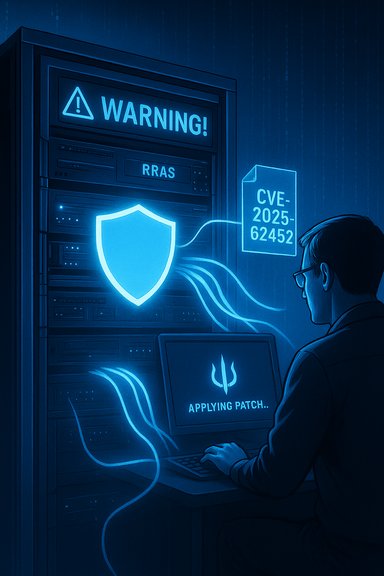
Microsoft has published a security update addressing CVE-2025-62452, a heap-based buffer overflow in the Windows Routing and Remote Access Service (RRAS) that Microsoft describes as allowing an attacker to execute arbitrary code on vulnerable systems reachable over the network — administrators must treat RRAS-enabled servers, especially those exposed to untrusted networks, as high-priority for immediate patching and exposure reduction.
Routing and Remote Access Service (RRAS) is a long-running Windows Server role used for VPN termination (PPTP, L2TP/IPsec, SSTP), NAT, routing and legacy remote access functions. Because RRAS routinely parses complex, attacker-controlled network input and typically runs with elevated privileges, memory-safety defects in RRAS frequently carry outsize operational impact: a remote flaw can yield SYSTEM-level compromise on a perimeter gateway, enabling credential theft, lateral movement and ransomware deployment. Multiple RRAS CVEs were disclosed across 2025, and CVE-2025-62452 joins that cluster as an urgent remediation item.
Important high-level points:
Treat this advisory as a reminder that optional but widely deployed services like RRAS remain high-value targets for opportunistic adversaries. Rapid patching, accurate inventory, and layered containment controls are the practical, effective defenses available today.
Source: MSRC Security Update Guide - Microsoft Security Response Center
 Background / Overview
Routing and Remote Access Service (RRAS) is a long-running Windows Server role used for VPN termination (PPTP, L2TP/IPsec, SSTP), NAT, routing and legacy remote access functions. Because RRAS routinely parses complex, attacker-controlled network input and typically runs with elevated privileges, memory-safety defects in RRAS frequently carry outsize operational impact: a remote flaw can yield SYSTEM-level compromise on a perimeter gateway, enabling credential theft, lateral movement and ransomware deployment. Multiple RRAS CVEs were disclosed across 2025, and CVE-2025-62452 joins that cluster as an urgent remediation item.Important high-level points:
- Vulnerability: heap-based buffer overflow in Windows RRAS that can lead to remote code execution (RCE) when exploited.
- Attack vector: network — exploitation requires sending specially crafted RRAS protocol messages to an RRAS listener.
- Impact: attacker-controlled code execution in RRAS process context (often SYSTEM), with full confidentiality/integrity/availability consequences for affected hosts.
Technical analysis
What the bug is (plain English)
CVE-2025-62452 is reported as a heap-based buffer overflow in RRAS packet- or field-parsing logic. In practice, a malformed RRAS protocol message can cause RRAS to copy or write beyond an allocated buffer on the heap. With carefully crafted input an attacker may corrupt heap metadata or function pointers and redirect execution to attacker-controlled data, producing remote code execution. Modern mitigations (ASLR, DEP, heap hardening, CFG) increase the difficulty of exploitation but do not eliminate the real risk when a privileged, long-running network service like RRAS is involved.Root cause class
Public vendor and independent trackers describe the root issue class for the recent RRAS cluster as either:- Heap-based buffer overflow (CWE-122) — for RCE-capable entries.
- Out-of-bounds read / use of uninitialized resource (CWE-125 / CWE-908) — for information-disclosure variants in the same family.
Affected components and typical protocol endpoints
RRAS implements multiple VPN and routing protocols — the practical attack surface includes:- PPTP: TCP 1723 and GRE (IP protocol 47)
- L2TP/IPsec: UDP 1701 (plus IKE over UDP 500 and 4500)
- SSTP: TCP 443 (HTTPS-based VPN)
- IKE/IPsec control flows: UDP 500 and UDP 4500
CVSS and exploitability (what public trackers report)
Independent trackers aggregated shortly after disclosure assigned a high severity rating to CVE-2025-62452; one feed reported a CVSS v3.1 base score around 8.0–8.8 (network vector, low complexity, low privileges required in many deployment models). Public reporting at time of publication indicates no confirmed proof-of-concept or observed in-the-wild exploitation for this specific CVE, but historical behavior for RRAS issues shows rapid scanning and opportunistic targeting once advisories are public. Treat the absence of public PoC as temporary and not a reason to delay remediation.Caution: official vendor pages (Microsoft Security Update Guide / MSRC) sometimes require a full browser (JavaScript) to render the advisory content; automated scrapers and some public mirrors may not display MSRC text cleanly. Administrators should open the MSRC advisory in a browser or use the Microsoft Update Catalog/WSUS to obtain the KB mapping for their exact OS build.
Who is affected and risk prioritization
Systems in scope
- Any Windows host with the Routing and Remote Access (RemoteAccess) role installed and the RRAS service running. RRAS is not installed by default on most SKUs, but remains in use as an on‑prem VPN termination or branch gateway.
- Internet-facing RRAS servers (VPN gateways, DMZ concentrators, cloud VMs with RRAS) — treat as immediate urgent remediation.
- Internal RRAS hosts reachable from less-trusted internal segments — prioritize based on segmentation and lateral access risk.
- Hosts tied to identity stores or Active Directory where RRAS is used to terminate authentication flows — leaks or RCE here are especially dangerous.
Operational preconditions for exploitation
Public and vendor language for RRAS CVEs has varied between “unauthenticated” and “authorized attacker” in different entries. Practically, the core requirement is reachability of an RRAS listener and the ability to interact with the vulnerable protocol handler. Depending on deployment and the specific code path, exploitation may require only sending malformed negotiation packets, or may require a victim to connect to a malicious server (for example, via the RRAS management snap-in). Because the policy language is inconsistent across advisories, treat any reachable RRAS as high-risk.Detection and hunting guidance
Information-disclosure and buffer-overflow primitives are often stealthy. Focus on network telemetry and subtle host signals.- Network indicators
- Sudden or unusual traffic spikes to RRAS-related ports (TCP 1723, GRE 47, UDP 1701, UDP 500/4500, TCP 443).
- Repeated malformed negotiation attempts from single or a small cluster of IPs (probing scanners).
- Anomalous connections where the client offers unexpected protocol options or unusually large payloads.
- Host and event logs
- Monitor Applications and Services Logs → Microsoft → Windows → RemoteAccess and RasMan for frequent negotiation failures, unexpected restarts, or unusual error sequences.
- Watch for unexpected RRAS process crashes, crash dumps, or unusual child processes spawned by RRAS.
- Packet capture hints
- Capture suspected probing traffic and inspect responses for suspicious binary blobs, long unexpected strings, or high-entropy data that could indicate leakage or heap artifacts. Preserve PCAPs and memory images for forensic analysis if exploitation is suspected.
Immediate mitigation and remediation (prioritized playbook)
- Patch first — single most effective action
- Identify the KB/security update that maps to CVE-2025-62452 for each Windows Server SKU in your estate, and deploy patches via your standard channels (WSUS/SCCM/Intune/Microsoft Update Catalog). The MSRC advisory is the authoritative mapping; confirm the KB before mass rollouts.
- If you cannot patch immediately, apply compensating controls
- Block or restrict inbound RRAS-related ports at the perimeter (TCP 1723, GRE 47, UDP 1701, UDP 500, UDP 4500, TCP 443).
- Apply host-based firewall rules to allow only known client management IPs and partner IP ranges.
- Temporarily stop and disable the RemoteAccess service on servers where RRAS is not required:
- Stop-Service -Name RemoteAccess -Force
- Set-Service -Name RemoteAccess -StartupType Disabled
- Remove the RRAS role on nonessential servers:
- Uninstall-WindowsFeature -Name RemoteAccess -IncludeManagementTools
- These mitigations reduce exposure while you stage updates.
- Prioritized patch rollout approach
- Stage patching in rings: test on a small set of representative RRAS hosts, then deploy to internet-facing gateways, then roll through internal RRAS servers.
- After patching, verify update installation (Get-HotFix or Windows Update history) and ensure the RemoteAccess service restarts cleanly.
- Consider rotating session or authentication material (expire VPN sessions, rotate keys or tokens) if RRAS endpoints were internet-facing prior to patching — leaked session fragments could have been harvested pre-patch.
- Detection hardening
- Deploy IDS/IPS rules to flag malformed RRAS packets and repeated negotiation attempts; tune Suricata/Snort or your network sensors accordingly.
- Increase logging verbosity for RRAS and forward Windows event channels to your SIEM/EDR for correlation.
Practical commands and inventories (copy/paste)
- Check whether RRAS is installed and the service status (PowerShell, elevated):
- Get-Service -Name RemoteAccess
- Get-WindowsFeature -Name RemoteAccess, Routing
- Stop and disable RRAS (temporary mitigation):
- Stop-Service -Name RemoteAccess -Force
- Set-Service -Name RemoteAccess -StartupType Disabled
- Remove RRAS role (if not required):
- Uninstall-WindowsFeature -Name RemoteAccess -IncludeManagementTools
- Verify installed updates:
- Get-HotFix | Where-Object { $_.HotFixID -like "KB*" }
Threat landscape and expected adversary behavior
Historically RRAS defects attract rapid exploitation attempts because RRAS often sits on network edges and is straightforward to scan for. Even when a CVE is initially reported as “no observed exploitation,” automated scanners and opportunistic attackers typically begin probing exposed endpoints within hours or days of disclosure. Expect:- Wide scanning of VPN/RRAS ports for malformed negotiation attempts.
- Attempted chaining: attackers may use leaked memory or layout hints to facilitate exploitation of other memory-corruption bugs.
- Low-cost, automated exploit attempts against internet-facing RRAS endpoints.
Critical assessment — strengths and gaps in vendor and community response
Notable strengths
- Microsoft has issued security updates and a formal advisory mapping to CVE-2025-62452 and associated KBs; pushing fixes through the normal update channels allows enterprise patch management to operate at scale. Public feeds indicate patches were made available at disclosure.
- Community guidance and incident responders provided fast, actionable mitigation playbooks: inventory commands, port lists, and logging/detection guidance that organizations can use immediately.
Potential weaknesses and operational risks
- CVE→KB mapping confusion. Multiple public trackers and third-party feeds have historically shown inconsistent CVE-to-KB mappings for RRAS advisories in 2025. Organizations must not rely only on third-party mirrors — always confirm KB mapping in Microsoft’s Security Update Guide or Microsoft Update Catalog for the exact build you run. MSRC pages sometimes require JavaScript to display content, which complicates automated ingestion.
- Inventory gaps. RRAS is an optional role and often exists on legacy or poorly-inventoried systems. Untracked RRAS hosts in cloud images, branch servers or contractor-hosted VMs are a common source of post-patch incidents.
- Residual risk post-patch. If RRAS was exposed and leaking memory before patching, previously harvested tokens or session material remain a threat. Consider forcing reauthentication, rotating keys and expiring sessions where possible.
Verification limitations and unverifiable claims
- The MSRC advisory content for some CVEs requires a browser to render; automation can miss details. Where an assertion in open feeds cannot be directly verified on the MSRC page without a full browser render, mark those elements as pending vendor confirmation and use patch KB numbers from the Microsoft Update Catalog as the authoritative implementation artifact. This caveat should be treated as a practical verification limitation, not a reason to delay mitigation.
Recommendations and an actionable roadmap
- Immediately identify all RRAS installations in your environment using the provided PowerShell inventory commands; treat internet-facing RRAS servers as the highest priority.
- Confirm the exact KB/update that fixes CVE-2025-62452 for each Windows Server build and deploy via your cadence (test ring → perimeter gateways → broader estate). Confirm installation after patch and reboot where required.
- If you cannot patch within your change window, block RRAS protocol ports at the network perimeter and disable the RemoteAccess service on nonessential hosts until a patch is applied.
- Rotate session and authentication material for services that may have used RRAS for token or certificate exchange, and force reauthentication where feasible.
- Harden monitoring: add IDS/EDR detection for malformed RRAS frames, increase RRAS event logging, and forward telemetry to a centralized SIEM for hunt queries and retrospective correlation. Capture PCAPs and memory images if exploitation is suspected.
Conclusion — the practical truth for administrators
CVE-2025-62452 is a high-impact RRAS vulnerability that elevates the classic worst-case for network-facing memory bugs: remote code execution in a privileged service on perimeter infrastructure. The single most important action is to map the CVE to the precise KB for each Windows Server SKU in your environment and deploy the security update immediately. Where patching is delayed, remove exposure by blocking RRAS protocols, stopping the RemoteAccess service, and hardening telemetry and detection.Treat this advisory as a reminder that optional but widely deployed services like RRAS remain high-value targets for opportunistic adversaries. Rapid patching, accurate inventory, and layered containment controls are the practical, effective defenses available today.
Source: MSRC Security Update Guide - Microsoft Security Response Center
