

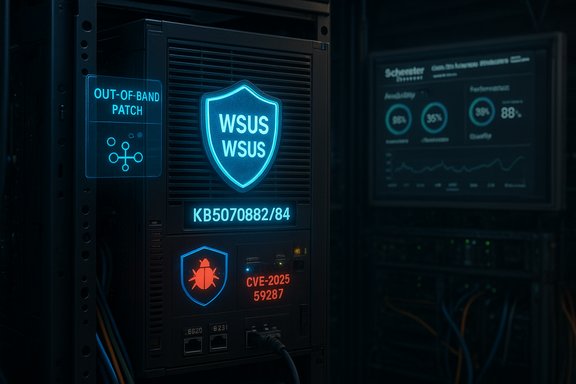
Schneider Electric has confirmed that its EcoStruxure Foxboro DCS Advisor service is affected by a critical Microsoft Windows Server Update Services (WSUS) vulnerability — tracked as CVE‑2025‑59287 — and operators must prioritize out‑of‑band WSUS patches and layered mitigations to avoid a potential remote code execution (RCE) compromise that could lead to system‑level takeover.
The vulnerability CVE‑2025‑59287 is a deserialization of untrusted data flaw in Microsoft’s WSUS reporting web services that allows an unauthenticated attacker to send a crafted payload and trigger remote code execution running as SYSTEM. Microsoft assigned a CVSS v3.1 base score of 9.8 (CRITICAL) for the issue, reflecting the low complexity and high impact of successful exploitation. Microsoft published out‑of‑band fixes (including KB5070882 and KB5070884) to remediate the flaw across supported Windows Server branches. Schneider Electric’s EcoStruxure Foxboro DCS Advisor — an optional monitoring/diagnostics component for the Foxboro DCS family used in critical manufacturing and energy environments — relies on Windows server components in many deployments. Schneider Electric republished an advisory noting that Foxboro DCS Advisor services that host or rely on WSUS for patch distribution or reporting could be impacted by CVE‑2025‑59287 and urged customers to apply Microsoft’s WSUS fixes and follow vendor remediation guidance.
Independent security researchers and incident responders observed active exploitation in the wild shortly after public proof‑of‑concepts and weaponized payloads appeared, prompting Microsoft to issue emergency updates and CISA to add the vulnerability to its Known Exploited Vulnerabilities (KEV) catalog. Reports indicate threat actors have targeted internet‑exposed WSUS instances over ports 8530/8531 to deploy post‑exploitation tooling and malware. Treat media attribution with caution where appropriate — some reporting names actor groups, but attribution is not uniformly confirmed across all public sources.
Source: CISA Schneider Electric EcoStruxure Foxboro DCS Advisor | CISA
 Background / Overview
The vulnerability CVE‑2025‑59287 is a deserialization of untrusted data flaw in Microsoft’s WSUS reporting web services that allows an unauthenticated attacker to send a crafted payload and trigger remote code execution running as SYSTEM. Microsoft assigned a CVSS v3.1 base score of 9.8 (CRITICAL) for the issue, reflecting the low complexity and high impact of successful exploitation. Microsoft published out‑of‑band fixes (including KB5070882 and KB5070884) to remediate the flaw across supported Windows Server branches. Schneider Electric’s EcoStruxure Foxboro DCS Advisor — an optional monitoring/diagnostics component for the Foxboro DCS family used in critical manufacturing and energy environments — relies on Windows server components in many deployments. Schneider Electric republished an advisory noting that Foxboro DCS Advisor services that host or rely on WSUS for patch distribution or reporting could be impacted by CVE‑2025‑59287 and urged customers to apply Microsoft’s WSUS fixes and follow vendor remediation guidance.Independent security researchers and incident responders observed active exploitation in the wild shortly after public proof‑of‑concepts and weaponized payloads appeared, prompting Microsoft to issue emergency updates and CISA to add the vulnerability to its Known Exploited Vulnerabilities (KEV) catalog. Reports indicate threat actors have targeted internet‑exposed WSUS instances over ports 8530/8531 to deploy post‑exploitation tooling and malware. Treat media attribution with caution where appropriate — some reporting names actor groups, but attribution is not uniformly confirmed across all public sources.
Why this matters to Windows and ICS operators
- WSUS is a trusted pivot: WSUS servers often run with high privileges, manage patch distribution for many endpoints, and are trusted by client machines. Compromise of WSUS can be leveraged to push malicious updates or execute arbitrary code on corporate and OT infrastructure.
- Foxboro DCS Advisor context: The EcoStruxure Foxboro DCS Advisor offers remote diagnostics and continuous KPI monitoring tied into I/A Series or Control Software systems. If the Advisor runs on a Windows host with the WSUS role active (or communicates with a compromised WSUS), an attacker could escalate from the WSUS compromise to the DCS environment.
- Operational risk: For sectors such as energy and critical manufacturing, the combination of high‑privilege compromise and potential lateral movement makes this a materially dangerous scenario — deserialization RCE as SYSTEM permits near‑complete control of an affected host.
What Microsoft published and how it maps to Schneider’s advisory
Microsoft issued emergency (out‑of‑band) updates that explicitly address the WSUS deserialization vulnerability:- KB5070882 — out‑of‑band update for specific Windows Server branches that documents the WSUS RCE fix and notes WSUS reporting web services remediation details. Microsoft also highlights required servicing stack updates (SSUs) and the potential need to reboot after installation.
- KB5070884 — complementary out‑of‑band update for additional Windows Server servicing branches (for example Windows Server 2022 builds), again including the WSUS remediation and SSU prerequisites. Reboot guidance and SSU approval via WSUS are called out.
Technical summary of the vulnerability (high level)
- Vulnerability class: CWE‑502 — Deserialization of Untrusted Data.
- Attack vector: Network (HTTP/S to WSUS web endpoints, typically ports 8530/8531); unauthenticated.
- Impact: Remote Code Execution running under SYSTEM (full system privileges), enabling installation of backdoors, lateral movement, and malicious update distribution.
- CVSS v3.1 base score: 9.8 (CRITICAL).
- Primary exploit path observed in public write‑ups: attacker crafts an AuthorizationCookie or similarly structured SOAP/serialized object; WSUS decrypts and deserializes it without robust type checking, allowing malicious object graph to execute when deserialized.
Immediate, practical remediation checklist (for Foxboro DCS Advisor / WSUS hosts)
- Identify affected WSUS hosts:
- Inventory Windows servers with the WSUS Server role installed.
- Confirm whether the Foxboro DCS Advisor host is itself running WSUS, or which WSUS server the Advisor clients rely on.
- Apply Microsoft Out‑of‑Band Updates:
- Install KB5070882 / KB5070884 on the affected servers as appropriate for your Windows Server version. Confirm the latest Servicing Stack Update (SSU) prerequisites — Microsoft documents SSU requirements inside the KB pages. Reboot hosts as required.
- If patching immediately is not possible:
- Temporarily disable the WSUS role or block inbound network access to ports 8530/tcp and 8531/tcp at perimeter and local firewalls to prevent remote exploitation. Note this will interrupt WSUS functionality until patching or role restoration — plan remediation windows. Microsoft documented these temporary mitigations in urgent guidance.
- Coordinate with Schneider Electric support:
- Notify Schneider Electric Global Customer Support and follow their verification steps to ensure EcoStruxure Foxboro DCS Advisor services are verified post‑patch. Schneider’s advisory explicitly recommends working with support to confirm updates.
- Contain and detect potential compromise:
- Check WSUS host process evergreen artifacts (unexpected child processes of wsusservice.exe or w3wp.exe, unsigned binaries loaded, unusual scheduled tasks, new Windows services).
- Audit Windows Event Logs, IIS logs (if WSUS uses IIS), and Sysmon (if available) for unusual deserialization activity or unexpected remote calls. Perform a full EDR/AV scan and consider memory snapshots for forensic review.
- Restore and validate:
- After patching and rebooting, validate WSUS functionality in a test environment prior to re‑enabling production client synchronization.
- Reconcile update approvals, and scan for any unknown update packages or unauthorized content in WSUS content directories.
- Document and report:
- Log actions taken, notice Schneider support tickets, and if you detect evidence of compromise, follow internal incident response playbooks and report to national CERT/CISA as appropriate. Public advisories urged rapid reporting during active exploitation.
Recommended short‑term hardening (to reduce immediate attack surface)
- Block inbound access to WSUS on the firewall from untrusted networks; restrict to management subnets only.
- Enforce least privilege on any accounts with WSUS administrative rights; remove or disable legacy service accounts.
- Disable WSUS management endpoints that are not required; example: limit remote management to jump servers behind MFA‑protected bastions.
- Segregate the Foxboro DCS Advisor host and other OT monitoring servers into an OT VLAN with strict ACLs — separate from general corporate networks that may host internet‑facing services.
Operational guidance for patching in ICS/OT environments
Patching WSUS is especially fraught in OT contexts because of uptime and change‑control constraints. Use this phased approach:- Test in an isolated lab: replicate the WSUS and Foxboro Advisor stack in a lab environment and apply KB5070882/KB5070884 to observe functional impacts.
- Schedule controlled maintenance windows: coordinate production patching during planned outages; notify operators and create rollback plans.
- Backup WSUS metadata and content: export server metadata and back up the WSUS content folder before applying out‑of‑band updates.
- Post‑patch validation: verify WSUS sync operations, client check‑ins, and the Advisor's telemetry functions; run smoke tests on DCS monitoring workflows.
- Staged rollout: patch a single WSUS replica or downstream server first (if topology allows) to limit blast radius and confirm behavior.
Detection and Indicators of Compromise (IoCs) — practical signals to watch for
- Unexpected process spawning from WSUS service processes (wsusservice.exe, w3wp.exe) — e.g., cmd.exe or powershell.exe invoked by WSUS processes.
- Unexpected network connections to external C2 domains or hosts from WSUS servers.
- Newly registered services, scheduled tasks, or modifications to the WSUS content store not initiated by administrators.
- Abnormal large deletions or modifications in the WSUS content directory, or presence of suspicious update packages.
- Logs showing malformed AuthorizationCookie or other unexpected SOAP / serialized payloads at WSUS endpoints.
Why WSUS compromise becomes a supply‑chain failure mode
WSUS’s role as a centralized patch management and update distribution point makes it a high‑value target: an attacker who controls WSUS can deliver malicious payloads through an otherwise trusted mechanism. For industrial environments, that means an ability to distribute malicious code to endpoints that are ordinarily tightly trusted and rarely reimaged. Successful exploitation of deserialization RCE on WSUS could therefore be escalated into a cross‑domain supply‑chain style attack inside an enterprise. This is why rapid, coordinated patching and network lockdowns were prioritized by vendors and government agencies after exploitation was observed.Long‑term security steps for EcoStruxure and other ICS integrations
- Inventory and minimize Windows roles on OT hosts. If WSUS is not required on a DCS or advisor host, remove the role.
- Maintain an up‑to‑date and validated patching cadence with a clear OT testing fabric and rollback plans.
- Harden deserialization and serialization patterns in custom or third‑party .NET codebases that interact with web APIs; while this vulnerability is in Microsoft WSUS, the underlying class of weakness (unsafe deserialization) is widespread.
- Adopt multi‑layer telemetry and EDR coverage on engineering workstations and jump servers to detect anomalous behavior early.
- Use code signing, package validation, and strict repository controls for any update packages distributed into OT networks.
- Implement strict network segmentation; deny all connectivity by default and allow only necessary flows with explicit auditing.
Risk analysis: strengths of current mitigations and remaining gaps
Strengths:- Microsoft’s rapid issuance of out‑of‑band patches and SSU guidance reduced the time window for exploitation and gave admins actionable fixes.
- Public reporting and third‑party trackers highlighted active exploitation quickly, allowing defenders to prioritize WSUS in their patch windows.
- Vendor coordination (Schneider Electric, Microsoft) and government advisories helped raise awareness specifically for ICS operators running EcoStruxure components.
- Operational constraints in ICS environments (long maintenance windows, change control) slow immediate patch rollouts, leaving high‑value targets exposed longer than typical IT assets.
- WSUS instances exposed to the internet or reachable from less‑trusted networks remain at greatest risk; comprehensive network discovery is still incomplete in many organizations.
- Detection capabilities vary across OT estates; many operator environments lack EDR or adequate logging on critical WSUS or Advisor hosts, hampering timely detection of misuse.
Recommended checklist for Foxboro DCS Advisor operators (summary)
- Immediately inventory WSUS hosts and confirm whether EcoStruxure Foxboro DCS Advisor systems rely on them.
- Apply Microsoft KB5070882 / KB5070884 and required SSUs, then reboot according to guidance.
- If you cannot patch immediately, block WSUS ports (8530/8531) or disable WSUS until patched.
- Coordinate patch validation with Schneider Electric support and preserve forensic evidence if compromise is suspected.
- Harden networks, segregate OT assets, and deploy detection controls focused on WSUS and Advisor hosts.
Conclusion
The CVE‑2025‑59287 WSUS vulnerability is a textbook example of how a trusted infrastructure service can become an active vector for high‑impact supply‑chain style breaches. For organizations running Schneider Electric’s EcoStruxure Foxboro DCS Advisor — particularly in critical manufacturing and energy sectors — the combination of WSUS RCE and Adviser’s role in remote diagnostics raises a clear red flag: patch now, verify thoroughly, and assume that rapid incident detection and strong segmentation are your last line of defense should a WSUS instance be compromised. Microsoft’s KB5070882 and KB5070884 provide the immediate technical fix, Schneider Electric’s advisory frames the operational impact for Foxboro customers, and independent incident reports underscore why this issue required emergency remediation and swift action. Take action now: inventory WSUS roles, apply the out‑of‑band updates with SSU prerequisites, contain network exposure to WSUS, and work with Schneider Electric support to validate the state of EcoStruxure Foxboro DCS Advisor services after patching.Source: CISA Schneider Electric EcoStruxure Foxboro DCS Advisor | CISA
