

Mizuho Americas and NPower have quietly turned a pilot into a noteworthy first-year outcome for New York’s entry-level tech ecosystem, launching Path2TECH: Networking & Systems Administration (NetSA) as a free, blended asynchronous 26-week pathway designed to move underemployed young New Yorkers into systems and network roles. The program — seeded by a three-year FutureReady grant from the Mizuho USA Foundation — couples employer-aligned curriculum, vendor certifications, and an accessibility-first delivery model intended to fit the unpredictable schedules of learners juggling work, family, and transit. Early pilot metrics show promise: completion rates above the pilot goal, early placements, and a heavy take-up of security- and healthcare-adjacent electives that employers increasingly value.
New York’s youth labor market remains a stubborn weak point in the city’s otherwise dynamic technical economy. Young New Yorkers faced a 13.2% unemployment rate in 2024 — a figure highlighted by the New York State Comptroller as evidence that the city still struggles to connect its younger population to stable work. That structural gap frames why corporate-government-nonprofit partnerships aimed at “skills-to-jobs” conversion are receiving renewed attention. Mizuho Americas, through the Mizuho USA Foundation’s FutureReady program, has been investing in repeatable, multi-year grants that target training and placement programs in the New York area. The Foundation’s strategy prioritizes programs that create direct employer pipelines and measurable employment outcomes for young adults. NPower is a national nonprofit focused on launching tech careers through tuition‑free training, wraparound student supports, and placement assistance. The organization reports more than 12,000 graduates since its modern workforce-training pivot, and a stated goal to scale to 15,000 students annually by 2030. That growth target underscores the organization’s ambition to move beyond regional pilots toward national scale.
Source: The Manila Times Mizuho Americas and NPower Advance Tech Career Pathways for New Yorkers Through Path2TECH: NetSA
 Background / Overview
New York’s youth labor market remains a stubborn weak point in the city’s otherwise dynamic technical economy. Young New Yorkers faced a 13.2% unemployment rate in 2024 — a figure highlighted by the New York State Comptroller as evidence that the city still struggles to connect its younger population to stable work. That structural gap frames why corporate-government-nonprofit partnerships aimed at “skills-to-jobs” conversion are receiving renewed attention. Mizuho Americas, through the Mizuho USA Foundation’s FutureReady program, has been investing in repeatable, multi-year grants that target training and placement programs in the New York area. The Foundation’s strategy prioritizes programs that create direct employer pipelines and measurable employment outcomes for young adults. NPower is a national nonprofit focused on launching tech careers through tuition‑free training, wraparound student supports, and placement assistance. The organization reports more than 12,000 graduates since its modern workforce-training pivot, and a stated goal to scale to 15,000 students annually by 2030. That growth target underscores the organization’s ambition to move beyond regional pilots toward national scale. What Path2TECH: NetSA actually offers
Program design and delivery model
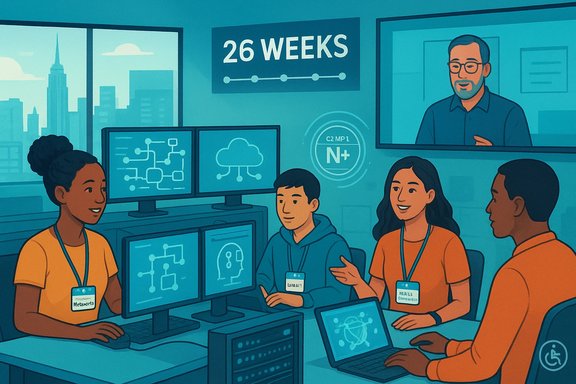
Path2TECH: NetSA is a 26‑week curriculum delivered in a blended asynchronous format — a departure for NPower, which historically relied on cohort-based, instructor-led instruction. The blended asynchronous model mixes self-paced online modules with scheduled touchpoints for mentoring, labs, and career coaching, enabling learners to progress outside strict class hours while still receiving structured support. The design aims to reduce drop-out risk driven by scheduling conflicts and transportation barriers for young New Yorkers. Key program elements:- Core fundamentals in computer networking and systems administration.
- Modules on cloud technologies and generative AI integration into operations.
- Electives that reflect employer demand, such as Pentest Security and Healthcare IT.
- Access to certification exam preparation and vouchers for industry-recognized credentials.
- Career services: resume support, interview prep, placement assistance, and employer matchmaking.
Certifications and technical stack
The pilot emphasized industry-recognized credentials that employers use as screening signals for entry-level roles:- CompTIA Network+ and CompTIA Linux+ (traditional signals for infrastructure and admin roles).
- Microsoft Azure Fundamentals (AZ-900) and Azure AI-related credentials to demonstrate cloud and AI literacy.
These certifications align with employer demand for staff who can operate hybrid on-prem/cloud environments and support AI-enabled services. Documentation of course mappings and vendor exam objectives also shows inclusion of Azure foundational topics (AZ-900) and AI fundamentals (AI-900/AI-102 related content) as part of building cloud fluency.
Early outcomes from the 2025 pilot
NPower and Mizuho have published early performance figures from the Spring and Fall 2025 cohorts that help quantify initial program efficacy:- 70% of students completed or are on track to complete the core programming across the initial cohorts, beating the pilot target of 60%.
- 41% of graduates to date are either employed in tech roles or pursuing further education, with an 80% placement expectation within 12 months of graduation.
- 72% of Spring 2025 completers elected to take additional electives (Pentest Security or Healthcare IT), signaling strong learner appetite for specialization.
- Nearly 50% of students completed either CompTIA Linux+ or CompTIA Network+ certification; certification activity continues into 2026.
Why employers — especially banks and enterprises — should pay attention
- Demand for entry-level infrastructure talent is persistent. Enterprises expanding cloud footprints need reliable systems and networking staff who understand hybrid topologies and vendor platforms.
- Vendor-aligned certifications reduce hiring friction. Employers often use CompTIA and Azure fundamentals as minimum filters for junior roles; candidates who hold these credentials accelerate onboarding time.
- Apprenticeship-ready candidates. Programs that incorporate hands-on labs, scenario-based assessments, and employer-sourced projects shorten the ramp from training to billable work.
- Diversity of pipeline. NPower’s focus on low-income and military-connected cohorts generates candidates from backgrounds underrepresented in tech — which can help firms meet DEI recruitment goals while accessing motivated talent.
Critical analysis: strengths, innovation, and measurable advantages
Strengths
- Accessibility-first delivery. The blended asynchronous model recognizes modern learners’ constraints and reduces barriers caused by rigid scheduling and commuting, increasing the odds of completion.
- Employer-aligned credentialing. Pairing CompTIA and Azure credentials with practical labs addresses the precise skills employers list in job postings for junior systems and network roles.
- Integrated AI literacy. Introducing generative AI concepts into operations and admin workflows is forward-looking: cloud operations increasingly require staff who can use automation and AI tools safely and productively.
- Corporate funding with multiyear horizon. The three-year FutureReady grant structure from Mizuho provides runway to refine curriculum, grow placement partnerships, and stabilize career supports — a better model than one-off grants.
Notable innovations
- The pilot’s elective selection (Pentest Security, Healthcare IT) shows smart curriculum design: graduates with a base in systems/networks plus a domain elective are more easily slotted into employer needs in regulated industries and mission-critical sectors.
- Embedding cloud and AI fundamentals into a networking track is a pragmatic recognition that modern operational roles are increasingly cloud-native and AI-infused.
Risks, trade-offs, and unanswered questions
While promising, the model carries operational and strategic risks that could blunt long-term impact if not addressed.1) Completion vs. employability gap
Certifications and course completions are useful proxies for readiness, but certifications alone don’t guarantee on-the-job performance. Employers repeatedly say that applied experience, troubleshooting under pressure, and soft skills separate hires who succeed from those who don’t. Without guaranteed internships, paid apprenticeships, or structured employer assessments, there remains a risk that high certification rates will not convert to sustained employment for all graduates. The program’s 80% placement expectation within a year is credible but will require sustained employer commitments to realize.2) Quality and parity of hands-on experience
Asynchronous delivery can reduce access friction, but it also risks uneven lab exposure. Low-bandwidth learners or students lacking modern hardware may struggle with vendor labs or interactive simulations. Programs scaling across New York’s socioeconomic diversity must budget for devices, subsidized connectivity, and on-site lab access to avoid selective outcomes. Evidence from scaling pilots in other programs shows that device and connectivity support materially improves completion and placement.3) Employer signaling and vendor lock-in
Heavy reliance on a narrow set of vendor credentials (e.g., Azure-focused content) accelerates placement into Microsoft-centric roles, but could limit portability across multi-cloud environments where employers use AWS, Google Cloud, or platform-agnostic stacks. A balanced curriculum should include platform-neutral fundamentals (Linux, TCP/IP, scripting) alongside vendor-specific skills to maximize graduates’ employability across varied hiring managers.4) The AI caveat — opportunity and hazard
Introducing generative AI into systems administration training is prescient, but it raises governance questions: learner instruction must include hallucination risk, data-handling protocols, and human-in-the-loop verification principles. Teaching students to trust AI tools without parallel emphasis on validation and secure data handling risks the propagation of unsafe practices into production environments. Programs must embed responsible-AI modules and incident-response scenarios to prevent this.5) Measurement transparency and long-term metrics
Pilot materials report early completion and placement indicators; however, sustainable impact claims require transparent, auditable KPIs over multi-year horizons: 6‑ and 12‑month retention in jobs, employer satisfaction scores, wage progression, and equity-disaggregated outcomes (gender, race, neighborhood). Public reporting against these metrics will be essential to justify further scaling and corporate support.Practical recommendations for stakeholders
For employers and hiring teams
- Formalize hiring pathways: sponsor paid apprenticeships or guaranteed interview slots for certified graduates to reduce conversion friction.
- Co-design scenario-based assessments: work with NPower to create short, standard tasks that mimic first-month on-the-job responsibilities; use those to certify readiness beyond vendor exams.
- Invest in device/connection stipends: ensure that the candidate pool is not artificially narrowed by access constraints.
For philanthropic partners and funders
- Condition multi-year grants on published KPIs and independent verification of placement metrics.
- Underwrite infrastructure supports (loaner devices, data stipends, proctored exam vouchers) as part of scale-up budgets, not as optional line items.
- Fund employer-engagement coordinators whose role is to lock in interviews, apprenticeships, and measurable hiring commitments.
For program designers (NPower and peers)
- Maintain a balanced curriculum: combine vendor credentials with platform-agnostic fundamentals and real-world troubleshooting labs.
- Incorporate responsible-AI training: teach validation, provenance, and safe automation practices.
- Publish a public impact dashboard: include 3-, 6-, and 12-month placement, wage data, and demographic breakdowns to build funder and employer confidence.
How this fits into broader workforce development trends
The Path2TECH pilot aligns with several broader trends reshaping early-career supplier markets:- Employers want “day-one” competency and lower ramp time: microcredentials and scenario-based skills maps answer this demand.
- Programs that emphasize flexibility (asynchronous/hybrid delivery) widen access for learners with work and caregiving responsibilities.
- Corporate philanthropy is shifting to multi-year, outcomes-driven grants that expect measurable conversion into jobs and career ladders.
- The skills mix for entry-level roles has evolved: “networking” is now inseparable from cloud and AI literacy.
A reality check: what success looks like in year two and beyond
To credibly scale Path2TECH from a successful pilot into a replicable citywide program, the partnership should aim to demonstrate the following within 12–24 months:- Sustained graduation rates at or above the pilot benchmark (70%+).
- Verified 12‑month placement and retention data published publicly, showing that a high share of graduates are employed in relevant roles and remain employed.
- Employer hiring commitments — formalized letters of intent or apprenticeship contracts — that guarantee practical pathways from certification to paid work.
- Evidence of equitable outcomes by race, gender, and neighborhood to ensure the program reaches the New Yorkers most affected by unemployment.
- A plan to broaden platform proficiency (multi-cloud, Linux-first fundamentals) to preserve graduate portability across different employer environments.
Final assessment
Path2TECH: NetSA is a timely, well-structured experiment in skills-based hiring and flexible delivery. The program’s early metrics are encouraging: above-target completion rates, meaningful certification attainment, and promising early placement figures. The combination of corporate philanthropy (Mizuho USA Foundation), a mission-driven training partner (NPower), and explicit employer-aligned certifications creates a credible route to entry-level IT work for New Yorkers who lack traditional academic credentials. However, the pilot’s long-term success will hinge on converting certifications into durable employment through formal employer commitments, addressing access barriers (devices, bandwidth), and embedding robust assessment and responsible-AI practices into curriculum. Multi-year funding and transparent outcome reporting are necessary to turn a single successful cohort into a scalable workforce solution that meaningfully reduces youth unemployment in New York. The initiative is a constructive step; its promise will be proven when future cohorts consistently convert training into career progression, not just certificates.Conclusion
Path2TECH: NetSA shows how targeted, employer-minded training — backed by multiyear philanthropic support and a curriculum that blends networking, systems administration, cloud basics, and AI literacy — can create realistic pathways into tech careers for young New Yorkers. The pilot’s early indicators are solid, but scaling impact requires sustained employer commitments, infrastructure supports for learners, and transparent, auditable outcome metrics. If stakeholders align on those priorities, Path2TECH can become a replicable model: flexible, skills-first, and built to move underserved talent from unemployment toward stable, higher-paying work in the digital economy.Source: The Manila Times Mizuho Americas and NPower Advance Tech Career Pathways for New Yorkers Through Path2TECH: NetSA
