

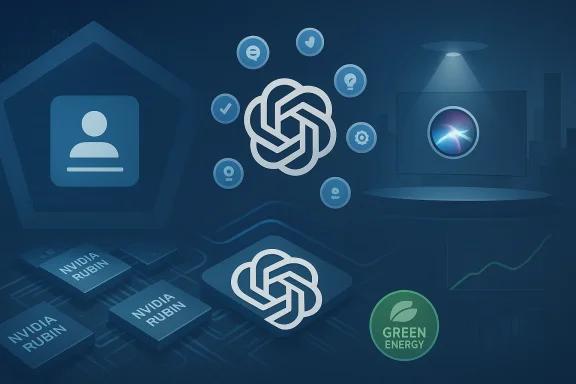
The past 48 hours have delivered a compact but consequential set of tech developments: the Pentagon and Anthropic are in open tension over how far AI safeguards should extend into military use; OpenClaw’s creator has taken a high‑profile jump to OpenAI; Apple has quietly scheduled a special event for March 4 in New York and other cities; Nvidia’s Vera Rubin roadmap and margin guidance remain central to investor calculus; and a new NGO‑commissioned analysis accuses tech firms of overstating AI’s climate benefits. Each story matters to Windows Forum readers because they intersect with national security policy, the future of personal AI agents, hardware buying decisions, and the industry's environmental claims — all of which shape the Windows ecosystem and the devices, services, and cloud infrastructure that power it.
Technology in early 2026 keeps two parallel beats: the commercial sprint to embed generative AI across products and the geopolitical, legal, and ethical debates about how those systems may be used. That tension is visible in the Pentagon’s talks with multiple AI vendors and in the scramble by platform owners to recruit talent and integrate agent capabilities into mainstream products. Meanwhile, chipmakers bid to supply the next generation of data‑center scale hardware — a dynamic that will determine cost, performance, and carbon footprint for years to come. These developments matter beyond press headlines: they will influence enterprise procurement, what features land in Windows‑centric workflows, and how developers design apps that rely on external or on‑prem AI compute.
Key differentiators at a glance:
Source: Bez Kabli Technology News 17.02.2026
 Background
Technology in early 2026 keeps two parallel beats: the commercial sprint to embed generative AI across products and the geopolitical, legal, and ethical debates about how those systems may be used. That tension is visible in the Pentagon’s talks with multiple AI vendors and in the scramble by platform owners to recruit talent and integrate agent capabilities into mainstream products. Meanwhile, chipmakers bid to supply the next generation of data‑center scale hardware — a dynamic that will determine cost, performance, and carbon footprint for years to come. These developments matter beyond press headlines: they will influence enterprise procurement, what features land in Windows‑centric workflows, and how developers design apps that rely on external or on‑prem AI compute.Pentagon vs Anthropic: A governance standoff that could reshape public‑private AI ties
What's happening
Senior Pentagon officials are reportedly considering designating Anthropic as a supply‑chain risk or otherwise dialing back the relationship after months of frustrated negotiations over the terms under which the U.S. military may use Anthropic’s Claude model. The central dispute: the Department of Defense wants participating AI vendors to permit their tools to be used for “all lawful purposes,” including intelligence work and battlefield support, whereas Anthropic has insisted on explicit limits — notably on fully autonomous weapons and mass domestic surveillance. Axios and Reuters report the dispute has escalated to the point where the Pentagon is weighing operational contingency plans.Why this matters
- Operational dependence. Anthropic’s Claude is reportedly already the first major foundation model provisioned into classified DoD environments through third‑party tooling, making any policy rupture operationally disruptive if a replacement is not readily available.
- Precedent for vendor governance. Labeling a domestic AI vendor as a supply‑chain risk would be extraordinary; historically, that designation has targeted foreign entities. Its use here would set a legal and procurement precedent for how value‑aligned and policy‑aligned suppliers are treated.
- Engineering and trust costs. If the Pentagon insists on “all lawful purposes” without carve‑outs, vendors must either remove safeguards (raising ethical/employee pushback) or negotiate complex per‑use approvals — neither is frictionless.
Cross‑checks and caveats
Multiple outlets — Axios, Reuters, and coverage relaying Wall Street Journal reporting about Claude’s operational use via Palantir — converge on the central facts: talks are active, and usage policies are the friction point. At the same time, Anthropic disputes certain characterizations, saying its discussions with the DoD have focused on specific guardrails and not on halting current operations. That divergence highlights a classic information asymmetry: anonymous officials emphasize security flexibility while corporate spokespeople emphasize narrow, defined limits. Readers should treat operational details of classified systems as partially unverifiable in public reporting and expect subsequent updates.Risks and implications
- For defense programs: A sudden requirement to replace a model used on classified networks would cause integration delays and higher costs, potentially slowing mission readiness in short windows.
- For AI governance: The standoff could chill vendor willingness to embed strict, publicly stated content or use restrictions if those restrictions risk exclusion from lucrative defense contracts. That outcome would reduce the variety of governance models available in the market.
- For employees and investors: Worker protests and investor scrutiny can intensify when mission use conflicts with stated company values, especially when ethics are core to a company’s marketing or talent recruitment.
OpenClaw’s creator joins OpenAI: a talent and product coup with broad platform implications
The move in brief
Peter Steinberger — the developer behind the viral autonomous assistant project now known as OpenClaw (previously Clawdbot and Moltbot) — has joined OpenAI. Reports indicate the tool will continue as an open‑source foundation while Steinberger works under OpenAI to accelerate “personal agents” that can do tasks (booking flights, managing calendars, interacting with other apps). TechCrunch, Business Insider, and other outlets covered the hire, and OpenAI’s CEO framed the move as part of a push toward next‑generation assistants.Why the hire is strategically important
- Talent absorption accelerates product roadmaps. Recruiting a developer with a viral, working agent prototype buys OpenAI both code and the product design knowledge to deploy robust agent primitives faster.
- Open‑source buffer plus proprietary scale. Public statements suggest OpenClaw will be stewarded by an open foundation while gaining infrastructure support from OpenAI — a hybrid that reduces fears of immediate vendor lock‑in while enabling scale. That balance is meaningful for enterprise architects who want portable agent frameworks under stable governance.
- Market signaling. For rivals and investors, the hire signals OpenAI doubling down on agents as a next major product vector — a move that could redirect developer attention, tooling standards, and investment across the ecosystem.
Engineering and safety considerations
OpenClaw was notable for emphasizing actionable agent capabilities and for architecting interactions across apps and services. Those capabilities raise immediate security questions: how are credentials handled, what privilege separation is enforced, and how are destructive workflows prevented? The open foundation model helps on transparency, but operationalizing an agent at scale requires careful identity, authorization, and audit design — an area enterprise Windows shops will need to evaluate before adopting agent‑driven automations.Apple’s March 4 “Special Apple Experience”: what to expect and what it could mean for users
Event details and expectations
Apple has scheduled a “special Apple Experience” for March 4 at 9:00 a.m. ET, with simultaneous gatherings in New York, London, and Shanghai. Coverage and leaks suggest a mix of hardware updates — including an entry‑level iPhone (rumored iPhone 17e), refreshed iPads, and lower‑cost Macs — plus ongoing speculation about deeper Siri enhancements powered by third‑party models. Several outlets confirm the timing and the unusual multi‑city format, hinting that this will be a press‑focused hands‑on showcase rather than the classic single keynote.Why Windows users and IT pros should care
- Cross‑platform effects. Apple’s moves around on‑device and private‑cloud AI (including previous reports of working with external model providers) shift the competitive field for assistant features and may accelerate similar productization in other ecosystems. That creates integration opportunities — and privacy‑policy questions — for Windows‑centric organizations integrating Apple devices into fleets.
- New hardware lifecycles. Affordable MacBooks or refreshed iPads change procurement calculus for mixed environments, including scenarios where Macs provide developer tools or designers prefer Apple hardware for content creation.
A note on Siri and model partnerships
Multiple reports have suggested Apple is exploring external model partnerships to accelerate Siri’s capabilities while retaining privacy through on‑prem or attested cloud inference. Apple’s product cadence and recent iOS betas suggest incremental AI features could roll out in the months after March 4. However, expectation management: Apple has historically staggered software rollouts after hardware announcements; a full Siri overhaul is likely a staged release.Nvidia, Vera Rubin and investor expectations: hardware is the choke point for large AI workloads
Product roadmap and performance claims
Nvidia’s Rubin/Vera Rubin family — a multi‑chip, rack‑scale AI platform — is being positioned as the next step beyond Blackwell, promising a material leap in AI throughput and cost efficiency for hyperscalers and enterprise clouds. Nvidia’s own materials describe a platform that pairs a Rubin GPU with a Vera CPU and advanced NVLink fabrics to scale inference and training at exascale levels. Independent coverage and analyst notes suggest Vera Rubin is central to Nvidia’s FY2027 margin and revenue story.Why margins and Vera Rubin matter to Windows readers
- Cloud pricing and availability. If Vera Rubin (and Rubin Ultra) genuinely lowers per‑inference cost at scale, cloud AI pricing — which affects everything from Copilot services to on‑prem appliance economics — could stabilize or fall, making complex AI features more accessible to ISVs and corporate teams.
- Procurement planning. Enterprises evaluating on‑prem AI boxes or co‑located racks will watch Vera Rubin delivery schedules and performance claims closely; delays or yield issues can ripple into project timelines.
Market reality check: competition and margin risk
While Nvidia touts performance and systems integration, investors are asking if hyperscalers will continue to buy third‑party accelerators at scale given rising in‑house chip programs (for example, Amazon’s Trainium family) and AMD’s increasingly competitive Instinct line. Analysts expect Nvidia to aim for mid‑70s gross margin levels, a figure management has signaled publicly as an operational target; keeping margins there while ramping new platforms is part of the story investors will validate at upcoming earnings. In short: the Vera Rubin promise is big, but so are the execution and competitive risks.AI and climate: greenwashing concerns rise as NGOs demand accountability
The new criticism
A recent independent analysis, commissioned by groups including Beyond Fossil Fuels and Climate Action Against Disinformation, evaluated 154 corporate and institutional claims that AI would materially reduce emissions. The study concluded most claims conflate traditional machine‑learning efficiency gains with the burgeoning, energy‑intensive world of generative models, and found limited examples of measurable, verifiable emissions reductions attributable to large foundation models. Energy analyst Ketan Joshi and mainstream outlets covered the findings, which call into question industry narratives that generative AI is a climate silver bullet.Practical takeaways
- Differentiate model classes. When vendors tout “AI for emissions reductions,” confirm whether the reference is to narrow predictive ML (often energy‑efficient) or to large multimodal generative models (which drive substantial data‑center load). The former has a stronger evidence base for operational optimization; the latter often increases energy demand.
- Demand measurable outcomes. IT procurement should ask for concrete, auditable KPIs (kWh saved, offset validated, scope declarations) rather than high‑level percentage claims. NGOs warn that unverified percentages (e.g., “5–10% reduction by 2030”) are often corporate repeats rather than independently validated forecasts.
Risks and vendor claims
The report is a reminder that generative AI’s carbon impact is not only a technical metric but a reputational and regulatory risk. Expect more scrutiny from sustainability officers and potentially stricter disclosure requirements in procurement. Vendors and ISVs must be ready to provide methodology and third‑party verification for any climate‑related claims tied to AI deployments.Hardware and device news: tablets, privacy‑focused OS choices, and accessory deals
Xiaomi Pad 8 Pro vs OnePlus Pad 3 — which offers better value?
Two recent comparisons emphasize the tradeoff buyers face between portability and productivity. The Xiaomi Pad 8 Pro prioritizes a lighter frame (sub‑500 g), compact 11.2‑inch display with a 3:2 ratio, and a balanced performance‑battery package — a device aimed at reading, light multitasking, and travel. The OnePlus Pad 3 leans heavily into large‑screen productivity with a 13.2‑inch panel, a much larger battery (~12,140 mAh), and eight‑speaker audio for immersive media. Reviews and spec aggregators highlight these contrasts and suggest the choice comes down to whether you value portable comfort (Xiaomi) or desktop replacement multimedia and endurance (OnePlus).Key differentiators at a glance:
- Xiaomi Pad 8 Pro: lighter, 3:2 aspect ratio (reading‑friendly), HyperOS 3/Android 16 in some regions, higher camera specs on paper; better for handheld use.
- OnePlus Pad 3: larger 13.2‑inch canvas, heavier, larger battery and faster charging, stronger speaker system and productivity focus — better as a laptop adjunct.
Murena’s Volla Tablet ships with /e/OS — a de‑Googleing option
Murena is shipping a Volla Tablet preinstalled with /e/OS, a privacy‑focused Android fork that replaces Google services with open‑source alternatives. The device retains a 12.6‑inch 2560×1600 display, MediaTek Helio G99, 12GB of RAM and 512GB storage with microSD expansion, along with a 10,000 mAh battery — typical hardware for a productivity tablet that opts out of the Google Play ecosystem. NotebookCheck and price trackers show the device is available in Europe and the US at price points reflecting the niche, privacy‑first market. For enterprises and users who require minimized telemetry and vendor lock‑in, /e/OS devices are increasingly practical.Pixel accessory deal: Pixelsnap case at historic low
On the accessory front, Google’s official Pixelsnap Case for Pixel 10/10 Pro dropped to $30 on Amazon (advertised as a 40% discount from list), which is being tracked by deal outlets and price monitors. If you rely on magnetic accessory ecosystems for wireless stands and chargers, this is a practical, time‑limited buy signal. As always, buyers should verify stock and seller reputation before purchasing.What this string of stories means for enterprise architects and Windows users
Strategic checklist for IT decision‑makers
- Reassess AI vendor contracts. If your organization uses cloud AI providers for security or mission‑critical use, ensure contractual language about permissible use cases, data residency, and carve‑outs is explicit rather than assumed. Recent defense‑vendor friction shows policy divergence can have operational consequences.
- Plan for agent‑driven workflows carefully. With OpenClaw’s momentum and OpenAI’s interest in agents, evaluate identity, least‑privilege credentials, and audit trails before delegating multi‑step tasks to agents. Consider sandboxing and staged rollouts.
- Factor hardware cadence into cloud and on‑prem roadmaps. Nvidia’s Vera Rubin promises capacity changes that could materially affect TCO for large AI projects; track supplier roadmaps and temper capacity assumptions with contingency plans for delays or competition from in‑house silicon.
- Scrutinize sustainability claims. Require measurable carbon metrics for AI‑related procurement and avoid marketing claims that lack third‑party verification. NGO findings show many AI climate claims remain aspirational rather than demonstrably effective.
Tactical recommendations
- Use feature flags and progressive rollout for agent‑based automations so safety checks are enforced before full‑scale access.
- When procuring edge or server‑class GPUs, demand vendor roadmaps and RAS (reliability/availability/serviceability) commitments; Rubin‑class platforms emphasize systems integration, not just raw chip metrics.
- For privacy‑sensitive endpoints, test de‑Googleed OS options (like /e/OS) in pilot groups to quantify user experience and app compatibility tradeoffs before broad deployment.
Conclusion
This snapshot of tech headlines — from a Pentagon‑Anthropic governance clash and a high‑profile developer hire, to Apple’s March 4 showcase, Nvidia’s Vera Rubin timetable, and NGO scrutiny of AI climate claims — shows a market maturing in complexity. The implications are operational (how models are used in sensitive settings), product‑level (what personal agents will be able to do), infrastructural (where and how AI is computed), and reputational (how credible sustainability claims are). For Windows Forum readers — IT pros, power users, and device buyers — the right response is pragmatic skepticism paired with tactical preparedness: verify vendor claims, demand measurable outcomes, and design agent and AI integrations with security, auditability, and fallback plans front and center. The next few months will reveal whether policy and market signals converge toward durable governance, or whether the industry will need further, harder nudges to align safety, capability, and accountability.Source: Bez Kabli Technology News 17.02.2026
