

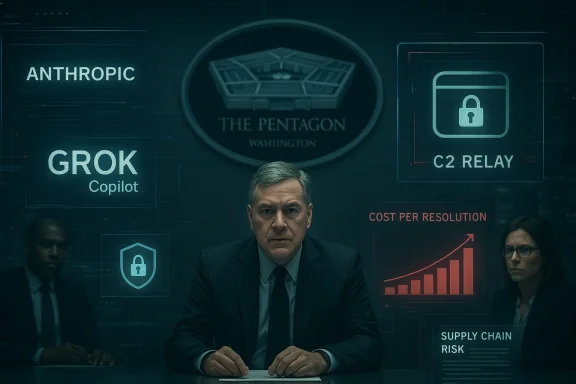
The past week’s headlines around generative AI read like a high-stakes triage: national security and corporate ethics colliding at the Pentagon’s highest levels, a practical new class of malware tradecraft that weaponizes trusted AI assistants, and a sobering market forecast from Gartner that blows a hole in one of the industry’s most repeated promises — that AI will pay for itself quickly by slashing contact-center costs. Together these stories expose a common theme: the technical, legal, and economic seams in enterprise AI are being stressed at scale, and the fallout will touch procurement, security operations, and customer-service budgets alike. (computerworld.com) (research.checkpoint.com)
The three developments covered here are tightly related but distinct in scope.
Multiple outlets note that Claude was already the first—or among the first—models cleared for certain classified DoD networks, which ratchets up the stakes: removing or downgrading access to Claude is non-trivial for both sides. At the same time, competing models (including xAI’s Grok, OpenAI, and Google’s offerings) are discussed internally as alternatives, though migration costs and specialized integrations complicate any rapid swap.
The AI era has moved from exploratory pilots to multi-domain stress tests. National-security leverage, novel attack tradecraft, and a sobering economic forecast together make one point unavoidable: organizations must treat AI decisions as strategic, not tactical. That means cross-functional governance, new security controls for agentic features, realistic cost modeling, and procurement language strong enough to withstand political and commercial shocks. The upside of doing this work now is clear — better risk-managed deployments that deliver the value AI promises without leaving organizations exposed to the cascading technical, legal, and financial shocks the headlines this week exposed. (computerworld.com)
Source: Computerworld Pentagon-Anthropic Clash, Grok/Copilot C2 Abuse, Costly Support AI | Ep. 51
 Background
The three developments covered here are tightly related but distinct in scope.- The Pentagon–Anthropic confrontation raises political and legal questions about how private AI vendors’ safety policies interact with national-defense requirements. The Defense Department’s posture — from warnings about “supply chain risk” to threats to use the Defense Production Act — shows how quickly procurement and national-security levers can be turned into enforcement mechanisms when policy and operational needs diverge.
- Check Point Research (and subsequent reporting) demonstrated a practical technique to turn web-enabled AI assistants — notably xAI’s Grok and Microsoft’s Copilot — into covert command-and-control (C2) relays by abusing their browsing/URL-fetch features. The attack works without API keys or authenticated accounts and can blend into legitimate traffic, creating a novel “living-off-trusted-sites” (LOTS) pivot point for adversaries. (research.checkpoint.com)
- Gartner’s forecast for customer-service economics warns that by 2030 cost per resolution for generative AI will exceed US$3 — a level higher than many offshore human agents — driven by rising data-center and inference costs, an end to vendor subsidies, and increasingly complex use cases. The implication: organizations should stop assuming AI equals automatic labor savings and instead plan for hybrid engagement and governance costs.
Pentagon vs. Anthropic: ethics, contracts, and the hard line of national security
What happened — the timeline in brief
In a high-profile meeting this month, Defense Secretary Pete Hegseth pressed Anthropic CEO Dario Amodei over restrictions that Anthropic has placed on its Claude models — specifically limits that forbid use in autonomous lethal systems or for mass domestic surveillance. The Pentagon’s response was blunt: either accept broader “all lawful use” conditions or risk contract termination, designation as a “supply chain risk,” or even invocation of the Defense Production Act to compel compliance. Reporting on the dispute has surfaced in major outlets and was summarized in the Computerworld briefing that kicked off this news cycle. (computerworld.com)Multiple outlets note that Claude was already the first—or among the first—models cleared for certain classified DoD networks, which ratchets up the stakes: removing or downgrading access to Claude is non-trivial for both sides. At the same time, competing models (including xAI’s Grok, OpenAI, and Google’s offerings) are discussed internally as alternatives, though migration costs and specialized integrations complicate any rapid swap.
Key claims, verified (or not)
- Claim: Anthropic objects to its models being used for autonomous weapons or domestic mass surveillance. Verified: Anthropic’s leadership has publicly and privately framed those restrictions as ethical guardrails and has stated unwillingness to remove those lines. Multiple outlets repeat this position.
- Claim: The Pentagon considered labeling Anthropic a “supply chain risk.” Verified: reporting from Axios and The Washington Post confirms the Department discussed supply-chain risk designation as leverage; analysts call such a use against a U.S. firm unprecedented. These reports are consistent across outlets.
- Claim: The Pentagon threatened to invoke the Defense Production Act (DPA) to compel cooperation. Partially verified and legally contested: major outlets reported the DPA was mentioned as a theoretical option. Legal scholars and defense experts quoted in coverage say using the DPA in this context would be legally novel and politically fraught. Treat this as a credible governmental negotiating lever, but one with uncertain legal footing.
- Claim: Claude was used in an operation targeting Venezuela’s leader. Reporting on the alleged involvement of Claude in an operation connected to Venezuela has surfaced but is sensitive and not fully confirmed in the public record; outlets differ on attribution and the DoD has provided limited details. This is an example of where reporting suggests involvement but independent verification is thin; flag with caution.
Why this matters to enterprise IT and procurement
The Pentagon’s toughness illustrates a broader commercial risk: if federal agencies are willing to brand vendors as “supply chain risks” for policy disagreements, enterprise buyers need to consider second- and third-order effects on vendor relationships. Government contracting rules can cascade: contractors may be required to certify non-use of certain models, partner ecosystems could be forced to rip-and-replace tooling, and compliance costs will rise. For procurement teams that treat AI suppliers as plug-and-play providers, the lesson is urgent: evaluate policy stances and legal exposures before entrenching deeply in any one vendor’s stack.The legal and reputational pressure points
- Supply-chain designation: Unprecedented domestically, but designed to protect national security. If applied, it could force broad decertification across the federal supplier ecosystem, creating private-sector churn and legal challenges.
- Defense Production Act: Symbolically potent. Invocation would be a test of political will and legal precedent — expect Congressional and judicial pushback if it’s attempted.
- Ethics as market differentiation: Anthropic’s stance trades short-term revenue risk for differentiation as an ethics-first provider. For some enterprise customers, that will be a selling point; for others — especially defense or public-safety buyers — it will be a dealbreaker.
Grok/Copilot as covert C2 relays: the new LOTS threat vector
The attack, explained simply
Check Point Research described and demonstrated a technique that turns web-capable AI assistants into stealthy command-and-control channels. The pattern looks like this:- An attacker compromises a host and installs an implant.
- The implant uses the machine’s browser to interact with a web-based AI assistant (for example, Copilot or Grok), using the assistant’s browsing or URL-fetch capabilities.
- The attacker’s infrastructure hosts content that the assistant fetches and summarizes; the assistant’s returned summary becomes the command payload for the implant.
- Egress is disguised as routine AI traffic to major cloud AI domains; no API keys or registered accounts are needed, so key-revocation countermeasures are ineffective. (research.checkpoint.com)
Technical verifications and limitations
- Verified technical element: no API key or authenticated account required. Check Point’s write-up and subsequent reporting emphasize the technique relies on the web interfaces’ browsing/URL-fetch behaviors available to unauthenticated sessions. That reduces the effectiveness of account-level defenses. (research.checkpoint.com)
- Verified technical element: use of embedded WebView2 or similar renderers to hide the AI interaction. Check Point demonstrates how an implant can call an embedded browser to do the AI fetch and receive the summary, limiting visibility to network and endpoint monitoring that inspects standard flows. (research.checkpoint.com)
- Key prerequisite and limitation: the technique requires the host to be compromised first. This is not a zero-day that grants initial access; it is a stealthy post-compromise pivot and persistence mechanism that amplifies an attacker’s ability to hide and automate actions. That prerequisite does not make the technique benign — on the contrary, it makes detection harder for mature organizations that permit outbound AI browsing as normal. (research.checkpoint.com)
The operational consequences for SOCs and defenders
This technique collapses several defensive assumptions:- Outbound AI traffic is often whitelisted or allowed with minimal inspection. That practice becomes a blind spot.
- Account-focused mitigations (API key revocation, credential rotation) are ineffective if the attack uses unauthenticated web flows.
- Traditional network IDS/IPS signatures are poorly suited to detect context-rich AI-driven command payloads that look like benign text summaries.
Evidence from community threads and recent disclosures
This vulnerability class isn’t hypothetical. Forum and incident-analysis threads uploaded and shared in enterprise communities show multiple conversations and proof-of-concept writeups that mirror Check Point’s findings and earlier prompt-injection/Reprompt disclosures targeting Copilot. Those internal community records underscore that defenders have been discussing and experimenting with detection and mitigation strategies for months, making this a fast-moving operational issue rather than a distant academic worry.Gartner’s shocker: AI may not save support budgets — and could cost more
The headline claim and the math behind it
Gartner’s January 2026 prediction is unequivocal: by 2030 the cost per resolution for generative AI-based customer support will exceed $3, often surpassing the cost of offshore human agents for B2C customer service use cases. Gartner attributes this to several drivers:- Higher real-world data-center and inference costs as vendors move from growth-subsidy pricing to profit-driven models.
- Increasingly complex use cases that consume more tokens and require expert human oversight or fine-tuning, raising per-resolution costs.
- Regulatory changes that increase assisted-service volume (for example, mandating easy human opt-outs), meaning hybrid human+AI setups will remain necessary.
Cross-checks and independent corroboration
Multiple trade and business outlets have reported and analyzed Gartner’s press release, reiterating the same drivers and amplifying Gartner’s key point: vendor pricing is currently subsidized and will change. Analysts writing for CX and AI trade publications echo the argument that naive vendor quotes understate total cost of ownership (TCO), especially when governance, data pipelines, human-in-the-loop fallback, and compliance are included. That independent coverage supports Gartner’s finding as a credible, consensus-backed forecast.Why the prediction matters beyond contact centers
- Strategic planning: CIOs and CX leaders who built business cases on promotional inference pricing must reassess both near- and long-term TCO models for AI.
- Procurement: contracts should include pricing floors, predictable escalation clauses, and clauses for subsidized-to-commercial pricing transitions to avoid surprise cost increases.
- Workforce strategy: Gartner predicts many organizations will re-hire or retain human agents to meet regulatory or complex-resolution needs — not because AI fails technically, but because economics and customer preference make pure automation unviable.
What this all means, in one integrated view
These three stories are vertically distinct (national security, cybersecurity tradecraft, CX economics) but horizontally connected by a single reality: AI changes operational risk and cost profiles across the organization. A procurement decision about a chat model now carries political, security, and financial risk in ways that are hard to decouple.- If a vendor’s policy stance can jeopardize DoD business (and trigger supply-chain-level consequences), then that vendor’s commercial stability and availability become procurement risks for other buyers who may be downstream from government contract requirements.
- If AI web-browsing features can be repurposed as stealthy C2 channels, then widespread adoption of agentic assistants without network controls materially increases the enterprise attack surface. Security teams must treat assistant-browsing as an enterprise egress vector requiring the same scrutiny as VPN or cloud-storage traffic. (research.checkpoint.com)
- If generative AI is more expensive per problem than humans in many scenarios, organizations must reframe use cases where AI is used primarily to cut headcount; instead, they should focus on value creation (engagement, personalization, proactive service) and design hybrid flows that balance economics and experience goals.
Practical guidance — what IT, security, and CX teams should do now
Below are action-oriented steps distilled from the technical findings, procurement risk, and Gartner’s economic forecast.For security teams (SecOps, SOCs, IR)
- Inventory and classify AI access: map which endpoints, users, and roles can access web-based AI assistants and whether browsing/URL-fetch is enabled. Prioritize systems that are internet-facing or used by privileged accounts. (research.checkpoint.com)
- Apply egress controls: block or tightly control outbound connections to AI-domain browsing endpoints from high-risk hosts (servers, admin workstations). Where business needs exist, proxy, sanitize, or cache AI queries through enterprise-controlled gateways that strip or normalize embedded content. (research.checkpoint.com)
- Improve logging and correlation: log AI-domain traffic at the network perimeter and correlate with endpoint telemetry (process creation, WebView usage, child processes). Look for patterns where browser-based assistants are invoked by non-interactive processes.
- Harden endpoint platforms: detect and restrict headless/embedded browser use (WebView2, headless Chrome) by non-user processes and enforce code-signing and application allowlists. (research.checkpoint.com)
- Update IR playbooks: add AI-assisted C2 as a recognized post-compromise TTP. Simulate exercises where an implant uses AI web fetches to evaluate detection efficacy. (research.checkpoint.com)
For procurement and legal teams
- Add governance and exit clauses: require vendors to disclose usage policies for military, intelligence, or law-enforcement-related use, and add contractual clauses for pricing transition, supply-chain-risk designation contingencies, and data portability.
- Evaluate ethical stances as part of vendor risk: a vendor’s public commitments (for instance, refusing certain military or surveillance use cases) are now material to risk assessment. Build scenario plans for vendor restriction designations that could ripple through supplier ecosystems.
- Model TCO conservatively: include projected inference-price normalization, data-center cost pass-through, human oversight costs, compliance and audit labor, and fallback human-agent expenses. Don’t rely on promotional inference pricing for long-term budgeting.
For CX and operations leaders
- Design for hybrids, not full automation: build flows that maximize engagement, personalization, and speed while preserving quick escalation paths to humans. Use AI to augment agents and triage, not to eliminate them wholesale.
- Measure the right KPIs: track cost-per-resolution and lifetime value (LTV), customer satisfaction (CSAT), and containment rates. If AI raises engagement and LTV, the business case can still be positive despite higher per-issue costs.
- Negotiate predictable pricing: work with vendors to secure pricing floors, volume discounts, and caps on per-token spikes; insist on transparency around inference sources and projected commercial transitions.
Notable strengths and risks — critical analysis
Strengths
- Ethics by design as competitive differentiation: Anthropic’s stance resonates with customers and public-interest stakeholders who prioritize boundaries around surveillance and lethality. For a segment of the market, this is a trust signal.
- Rapid uncovering of operational tradecraft: Researchers and incident-response teams are quickly exposing realistic weaponization patterns (e.g., AI-as-C2), giving defenders time to adapt before wide-scale exploitation. That responsiveness is a positive sign for community resilience. (research.checkpoint.com)
- Maturing cost models: Gartner’s blunt forecast forces organizations to mature their financial and governance models; that discipline will reduce later surprise and program cancellations.
Risks
- Geopolitical leverage over commercial tech: Using supply-chain designations or the DPA to enforce vendor behavior risks politicizing procurement and could chill innovation or create market fragmentation. It also invites legal and Congressional scrutiny that could last years.
- Blind spots in network security: Treating AI-domain traffic as “trusted” creates a broad new corridor for stealthy exfiltration and C2. Many organizations lack the telemetry and policy maturity to detect such abuse. (research.checkpoint.com)
- Economic brittleness of AI business cases: Migration to production at scale will surface hidden costs (e.g., governance, specialized talent, more complex fine-tuning), and organizations that planned purely for headcount reduction may find ROI evaporating.
Closing recommendations — an executive checklist
- Board-level briefing: ensure senior leadership understands that AI procurement is now a cross-cutting risk (legal, national-security, security, financial). Prepare contingency plans for vendor disruption.
- Immediate SOC actions: inventory AI browsing capabilities, create egress policies for high-risk hosts, and add AI-domain monitoring to your SIEM/UEBA ruleset. (research.checkpoint.com)
- Procurement contract templates: add clauses for pricing-transition protection, data portability, and vendor policy-representation disclosures related to national-security use.
- CX strategy pivot: prioritize value metrics (LTV, retention) in AI deployments and design agent+AI hybrid flows rather than full replacement.
- Run tabletop exercises: rehearse scenarios where an AI vendor is suddenly unavailable, or where AI-assisted C2 is suspected. Validate detection, containment, and vendor-switch playbooks. (research.checkpoint.com)
The AI era has moved from exploratory pilots to multi-domain stress tests. National-security leverage, novel attack tradecraft, and a sobering economic forecast together make one point unavoidable: organizations must treat AI decisions as strategic, not tactical. That means cross-functional governance, new security controls for agentic features, realistic cost modeling, and procurement language strong enough to withstand political and commercial shocks. The upside of doing this work now is clear — better risk-managed deployments that deliver the value AI promises without leaving organizations exposed to the cascading technical, legal, and financial shocks the headlines this week exposed. (computerworld.com)
Source: Computerworld Pentagon-Anthropic Clash, Grok/Copilot C2 Abuse, Costly Support AI | Ep. 51
