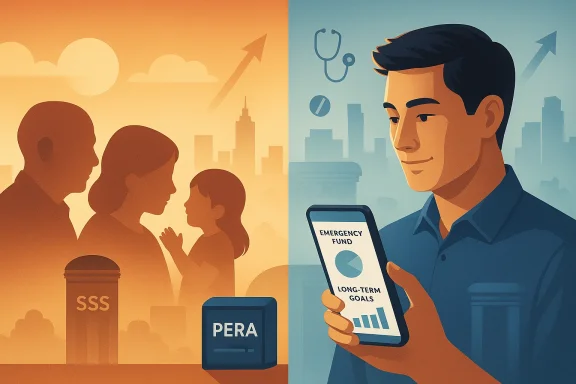
Many Filipinos are redefining retirement from a family-supported life stage into a personal financial mission, and that shift is already reshaping how savings, pensions, and investment products are being discussed across the Philippines. The old expectation that children or extended relatives would carry the burden of old age is giving way to a stronger desire for independence, even as inflation, fragile short-term savings, and uneven access to financial tools keep long-term readiness under pressure. In practical terms, the story is no longer just about retirement age; it is about whether workers can build enough resilience to avoid becoming financially dependent later on. The trust industry, regulators, and pension providers now sit at the center of that transition.
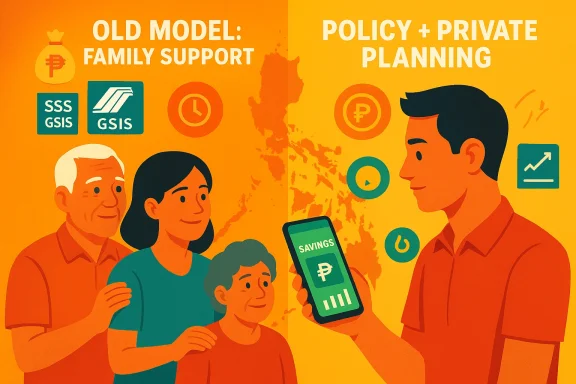
For decades, retirement planning in the Philippines was shaped by a social compact that was more familial than financial. In many households, the assumption was simple: parents helped raise children, and children would later help support aging parents. That arrangement fit a culture of strong family ties, but it also reduced the urgency of building formal retirement portfolios, especially among workers who relied on SSS or GSIS as their main safety net. The problem, as the current debate shows, is that social support is not the same thing as financial adequacy.
That historical model is increasingly under strain. Filipino workers now face a more expensive, more volatile economic environment, where living costs can spike quickly and jobs can be disrupted by shocks such as pandemics, inflation waves, or illness. Even when people do save, many are still operating with very short cash buffers, which means an emergency can easily wipe out months of progress. The long-term question, therefore, is not whether Filipinos care about retirement, but whether they can protect those plans from day-to-day financial pressure.
The broader retirement ecosystem has also changed. The BSP has pushed PERA as a voluntary retirement savings layer that supplements state and employer-sponsored plans, while the SSS has continued to modernize benefit access and products such as the MySSS Card, WISP, and the MySSS Pension Booster. Those reforms matter because they show a public-policy recognition that basic pension coverage alone may not be enough to sustain retirement needs in a country where longevity is rising and private wealth accumulation remains limited.
At the same time, the market side of the story is becoming more sophisticated. Trust entities, wealth managers, and banks are no longer just custodian-like operators of deposits and funds; they are increasingly expected to educate consumers, design diversified portfolios, and explain how retirement assets can be aligned with time horizon and risk tolerance. That is why the retirement debate has moved beyond pensions and into the realm of financial literacy, digital onboarding, and behavioral change. In a country where many consumers still distrust complexity, simplicity and guidance may matter as much as returns.
The shift also reveals a deeper tension in Filipino social values. The family remains central, but younger workers increasingly understand that family can be both a support system and a financial obligation. In that context, saving for retirement is not an act of selfishness; it is often framed as a way to reduce future pressure on children. That framing helps explain why retirement planning is now being marketed not just as self-protection, but as intergenerational responsibility.
The Philippines appears to be improving in feelings of security faster than in actual structural readiness. That is not unusual in a recovering consumer environment, but it should not be mistaken for retirement preparedness. In practical terms, many households may be one medical emergency away from revising their financial assumptions. The surveys suggest that people are learning to save, but they are not yet saving long enough or deeply enough.
The pandemic also exposed the weakness of plans that rely too heavily on a single income source. Many workers discovered that one disruption was enough to unsettle the whole household budget. As a result, retirement planning is now being linked with redundancy, flexibility, and asset diversification rather than just age-based withdrawal. In other words, retirement readiness has become part of broader household risk management.
This is where behavioral economics becomes important. When the barrier to opening an account is low, users are more likely to test financial habits, automate transfers, and experiment with saving rules. But convenience can also encourage complacency if users stop at deposits and never move into diversified, long-term instruments. The challenge is to convert easy saving into durable investing.
Their role also extends into education. As Alvarillo noted, many misconceptions about retirement stem from culture, optimism about future income, or lack of planning. Trust entities can help counter those misconceptions by translating abstract risks into concrete account behaviors. In that sense, they serve as a bridge between financial literacy campaigns and real-world retirement outcomes.
The SSS itself has recently moved to strengthen the system through reforms and new products. The agency’s 2025 pension reform program, for example, is set to raise pensions in stages from September 2025 through 2027, affecting millions of pensioners. That matters because it shows the government is trying to improve benefit adequacy while keeping the system sustainable. Still, a stronger pension is not the same as a full retirement plan.
Still, the behavioral shift is important. Younger workers are more likely to treat retirement as something they should own personally rather than delegate to family. They also appear more open to the idea of compound growth and early investing, which could improve outcomes if income growth eventually catches up. In the long run, that could produce a more self-directed retirement culture.
There is also a branding effect. As more Filipinos seek independence in later life, firms associated with retirement security gain reputational value. Sun Life, BDO Trust, and other players are effectively competing on credibility as much as yield. That is a notable shift in a market where trust itself can be a differentiator.
What to watch next is not just the headline pension numbers, but the behaviors underneath them. Adoption of PERA, the growth of digital savings habits, the quality of retirement advice, and the credibility of trust institutions will tell us whether the cultural shift is sticking. In a country where family has long been the retirement plan, the most meaningful sign of progress may be when Filipinos no longer assume their children will have to carry the same burden.
Source: BusinessWorld Online On Filipinos’ changing attitudes about retirement - BusinessWorld Online
 Background
For decades, retirement planning in the Philippines was shaped by a social compact that was more familial than financial. In many households, the assumption was simple: parents helped raise children, and children would later help support aging parents. That arrangement fit a culture of strong family ties, but it also reduced the urgency of building formal retirement portfolios, especially among workers who relied on SSS or GSIS as their main safety net. The problem, as the current debate shows, is that social support is not the same thing as financial adequacy.That historical model is increasingly under strain. Filipino workers now face a more expensive, more volatile economic environment, where living costs can spike quickly and jobs can be disrupted by shocks such as pandemics, inflation waves, or illness. Even when people do save, many are still operating with very short cash buffers, which means an emergency can easily wipe out months of progress. The long-term question, therefore, is not whether Filipinos care about retirement, but whether they can protect those plans from day-to-day financial pressure.
The broader retirement ecosystem has also changed. The BSP has pushed PERA as a voluntary retirement savings layer that supplements state and employer-sponsored plans, while the SSS has continued to modernize benefit access and products such as the MySSS Card, WISP, and the MySSS Pension Booster. Those reforms matter because they show a public-policy recognition that basic pension coverage alone may not be enough to sustain retirement needs in a country where longevity is rising and private wealth accumulation remains limited.
At the same time, the market side of the story is becoming more sophisticated. Trust entities, wealth managers, and banks are no longer just custodian-like operators of deposits and funds; they are increasingly expected to educate consumers, design diversified portfolios, and explain how retirement assets can be aligned with time horizon and risk tolerance. That is why the retirement debate has moved beyond pensions and into the realm of financial literacy, digital onboarding, and behavioral change. In a country where many consumers still distrust complexity, simplicity and guidance may matter as much as returns.
The Cultural Shift in Retirement Thinking
The most important change is psychological. Filipinos are gradually moving away from the assumption that retirement can be outsourced to family and toward the idea that old age should be funded through personal planning. That does not mean family support has disappeared; rather, it means more people now see it as a fallback, not a strategy. The shift is especially visible among middle-class workers and younger earners, who increasingly want to avoid becoming a burden later in life.From dependency to autonomy
This is more than a generational slogan. It reflects a reordering of priorities, where retirement has become tied to dignity, mobility, and control over later-life choices. For younger Filipinos, especially Gen Z and younger millennials, the ideal retirement is no longer simply survival; it is financial independence with options. That is a meaningful change because it turns retirement into an active planning goal rather than a passive family expectation.The shift also reveals a deeper tension in Filipino social values. The family remains central, but younger workers increasingly understand that family can be both a support system and a financial obligation. In that context, saving for retirement is not an act of selfishness; it is often framed as a way to reduce future pressure on children. That framing helps explain why retirement planning is now being marketed not just as self-protection, but as intergenerational responsibility.
- Old model: retirement funded largely by children or extended relatives.
- New model: retirement funded through personal savings, pensions, and investments.
- Core motivation: avoid becoming a burden to the next generation.
- Behavioral effect: more openness to financial products and advice.
- Cultural nuance: family support remains important, but no longer sufficient.
Why this matters now
The timing matters because economic pressure has made dependence feel riskier. When inflation eats into household budgets and emergencies arrive more often than expected, relying solely on social ties becomes less practical. The result is a growing recognition that independence requires liquidity, diversification, and a plan that extends beyond the next paycheck. In that sense, the cultural change is being driven as much by necessity as by aspiration.What the Latest Surveys Say
The article’s strongest evidence comes from a cluster of recent surveys that point in the same direction: short-term confidence is improving, but long-term readiness remains weak. The Digital Bank Association of the Philippines said the country’s score on the Financial Health Index rose to 62 this year from 56 in 2024, moving into the “good” range. The same survey also found that 73% of respondents say they have emergency savings, but most said those savings would last only about a month. That is a critical distinction, because having savings is not the same as being resilient.Short-term comfort, long-term fragility
Sun Life Asia’s Financial Resilience Index tells a similar story. In the latest Philippines results, 66% of Filipinos said they feel financially secure now, up sharply from 45% previously, and confidence in managing monthly finances rose to 69%. Yet confidence in meeting future goals slipped to 64% from 72%, and one in three respondents said they could not sustain themselves for more than three months after income loss or illness without outside help. That gap between present confidence and future fragility is the most revealing finding in the data.The Philippines appears to be improving in feelings of security faster than in actual structural readiness. That is not unusual in a recovering consumer environment, but it should not be mistaken for retirement preparedness. In practical terms, many households may be one medical emergency away from revising their financial assumptions. The surveys suggest that people are learning to save, but they are not yet saving long enough or deeply enough.
- 62 on the Financial Health Index indicates improvement, but not maturity.
- 73% with emergency savings sounds strong until the duration is tested.
- 66% feeling financially secure today does not imply retirement readiness.
- 64% confidence in future goals shows long-range uncertainty.
- One in three unable to last three months without support is a warning sign.
Why survey methodology matters
These studies are useful not because they provide a perfect national balance sheet, but because they capture how Filipinos are thinking. Retirement behavior begins with beliefs, and beliefs can change faster than asset allocation. If consumers now view emergency savings as essential, they are more likely to accept the logic of broader financial planning later. But the surveys also show how easy it is to overestimate progress when people are only measuring immediate stability.The Pandemic as a Financial Wake-Up Call
One of the clearest themes in the BusinessWorld piece is the role of the pandemic as an inflection point. Patricia Lei S. Alvarillo of the Trust Officers Association of the Philippines described COVID-19 as a financial wake-up call that changed how people think about liquid assets, emergencies, and planning. That interpretation fits the broader market behavior seen across the country: households became more focused on survival, cash buffers, and practical security than on abstract long-term goals.Liquid assets regained importance
In ordinary times, retirement planning can feel distant and intangible. During a crisis, however, the value of liquidity becomes obvious very quickly. Filipinos who previously treated retirement contributions as a distant obligation suddenly had a reason to care about accessible funds, emergency savings, and the tradeoff between locking money away and keeping it available. That experience is likely to influence behavior for years.The pandemic also exposed the weakness of plans that rely too heavily on a single income source. Many workers discovered that one disruption was enough to unsettle the whole household budget. As a result, retirement planning is now being linked with redundancy, flexibility, and asset diversification rather than just age-based withdrawal. In other words, retirement readiness has become part of broader household risk management.
A change in priorities
The surveys reinforce that point. The Metrobank study cited in the article found that 21% of respondents save primarily to build an emergency fund or prepare for future needs, while financial stability topped concerns in Metro Manila. Elsewhere, Sun Life found that inflation pushed people toward short-term thinking, with emergency savings climbing in importance. Those findings suggest that the pandemic did not create the problem, but it accelerated awareness of it.- The pandemic elevated the value of liquidity.
- It made job loss and illness feel like immediate financial threats.
- It pushed households to re-rank priorities toward emergency saving.
- It exposed the weakness of relying on a single income stream.
- It made retirement part of a broader resilience conversation.
The Role of Digital Banks and Financial Inclusion
One reason attitudes are shifting is that saving has become easier to start, if not yet easy to sustain. The spread of digital banks and app-based financial services has lowered the friction involved in opening accounts, moving money, and setting aside small amounts regularly. For a country where many workers used to treat banking as inconvenient or intimidating, that matters a great deal.Convenience is changing behavior
Digital access does not automatically produce disciplined investing, but it does alter the entry point. Workers who once had to visit a branch or deal with paperwork can now begin with a phone and a few taps. That convenience may be one reason younger Filipinos are becoming more willing to engage with financial products early. It also helps explain why emergency savings are more common now, even if they remain shallow.This is where behavioral economics becomes important. When the barrier to opening an account is low, users are more likely to test financial habits, automate transfers, and experiment with saving rules. But convenience can also encourage complacency if users stop at deposits and never move into diversified, long-term instruments. The challenge is to convert easy saving into durable investing.
Inclusion is not the same as readiness
Financial inclusion statistics often get treated as success stories, but they can mask the quality of financial behavior. A person may have multiple wallets, a digital savings account, and an e-money app while still lacking an actual retirement strategy. That is why the move from access to financial health is so important. Without education, inclusion risks becoming a distribution victory without a planning outcome.- Digital banks make it easier to start saving.
- They lower the psychological barrier to formal finance.
- They can support automation and habit formation.
- They do not automatically create retirement discipline.
- They need to be paired with education and goal-based planning.
Consumer vs. enterprise impact
For consumers, digital finance means faster access and lower friction. For banks, insurers, and trust companies, it means a new expectation: they must deliver simplicity without dumbing down the message. The firms that succeed will be those that turn retirement from a product category into a guided journey. That is a harder sales job, but a much more valuable one.Why Trust Officers Matter More Than Before
The BusinessWorld feature places unusual emphasis on the role of trust officers, and that is not accidental. In the Philippines, trust entities sit at the intersection of investment management, fiduciary responsibility, and retirement education. They are among the few institutions that can connect deposit-style safety with market-linked growth in a way that ordinary savers can understand.Fiduciary discipline as a public good
Trust officers are not merely portfolio managers. They are expected to act with strict fiduciary standards, which matters in a retirement context because many savers are vulnerable to hype, panic, and overconfidence. When retirement funds are managed professionally, the goal is not just return maximization; it is preserving purchasing power over years or decades. That distinction is especially important in a market environment where inflation can quietly erode savings.Their role also extends into education. As Alvarillo noted, many misconceptions about retirement stem from culture, optimism about future income, or lack of planning. Trust entities can help counter those misconceptions by translating abstract risks into concrete account behaviors. In that sense, they serve as a bridge between financial literacy campaigns and real-world retirement outcomes.
Products need a narrative
Products like PERA are technically sound, but they still need a compelling user story. A voluntary retirement account only becomes useful if people understand why to start early, how tax advantages work, and what role the account plays relative to SSS, GSIS, and emergency savings. That is where trust entities can make a difference by turning a policy instrument into a personal habit.- Fiduciary trust helps protect inexperienced savers.
- Portfolio diversification reduces the damage from one bad outcome.
- Education is necessary for adoption, not just compliance.
- Retirement products need clear narratives, not jargon.
- Institutional credibility matters in a skeptical market.
PERA, SSS, and GSIS: The Policy Backbone
The retirement conversation cannot be understood without the state pension system. The SSS offers retirement benefits either as a monthly pension or lump sum, depending on contribution history, while GSIS serves government workers. But the central policy point is that these programs were never designed to absorb every retirement need on their own, especially as life expectancy rises and retirement periods lengthen.Why supplemental savings matter
This is where PERA becomes important. The BSP describes PERA as a voluntary retirement savings program that supplements state-based and employer-sponsored plans. In theory, that makes it the right policy tool for workers who want to build tax-advantaged retirement assets outside the mandatory system. In practice, uptake has been slower than policymakers would like, which suggests that awareness and accessibility still lag behind policy design.The SSS itself has recently moved to strengthen the system through reforms and new products. The agency’s 2025 pension reform program, for example, is set to raise pensions in stages from September 2025 through 2027, affecting millions of pensioners. That matters because it shows the government is trying to improve benefit adequacy while keeping the system sustainable. Still, a stronger pension is not the same as a full retirement plan.
The limits of the public pillar
There is also a hard fiscal reality. Public pensions provide a floor, not a luxury lifestyle. Even with reforms, many retirees will still need additional sources of income to cover healthcare, inflation, and family obligations. That means the policy conversation has to go beyond pensions and toward a broader ecosystem of savings, investments, and financial advice.- SSS and GSIS remain the first pillar.
- PERA is the supplemental third pillar for voluntary savings.
- Pension reform can improve adequacy, but not fully solve longevity risk.
- Better access and awareness are still needed for PERA adoption.
- Retirement planning must blend public support with private accumulation.
Sequential steps for workers
- Estimate how much income you would need monthly after retirement.
- Compare that number with expected SSS or GSIS benefits.
- Set aside emergency savings first so retirement funds are not raided.
- Add a voluntary instrument such as PERA if feasible.
- Diversify into assets that match time horizon and risk tolerance.
- Review the plan at least annually, not only when a crisis hits.
Gen Z, Millennials, and the New Financial Mindset
Younger Filipinos are not simply inheriting the retirement problem; they are changing its language. Gen Z and younger millennials grew up in an environment of apps, comparisons, side hustles, and global financial content. That makes them more exposed to planning concepts, but also more exposed to pressure, uncertainty, and unrealistic benchmarks. The result is a generation that is often more aware of retirement risk, yet still constrained by income instability and high living costs.Faster learning, shorter horizons
Younger consumers may be quicker to adopt digital banks, budgeting apps, and online financial education. But they are also the group most likely to juggle irregular incomes, rising rent, and the temptation to spend in the present. That is why their retirement outlook can look paradoxical: greater awareness does not always translate into greater capacity. Knowing more is not the same as being able to do more.Still, the behavioral shift is important. Younger workers are more likely to treat retirement as something they should own personally rather than delegate to family. They also appear more open to the idea of compound growth and early investing, which could improve outcomes if income growth eventually catches up. In the long run, that could produce a more self-directed retirement culture.
The rural-urban divide
The Sun Life findings add another layer: vulnerability is greater among younger respondents in rural areas, where access to financial tools and emergency savings is lower. That suggests retirement readiness is not just about age; it is about geography, infrastructure, and opportunity. In the Philippines, the digital divide can still shape how much financial resilience a worker can realistically build.- Gen Z is more digitally fluent but not necessarily more financially secure.
- Younger workers are more likely to value independence.
- Rural households face fewer tools and thinner buffers.
- Awareness is growing faster than incomes.
- Financial education needs to be tailored by generation and geography.
Enterprise Implications for Banks, Insurers, and Advisors
The market opportunity here is substantial, but it will reward firms that think beyond product placement. Retirement planning in the Philippines is becoming a trust, education, and distribution problem all at once. Institutions that can make long-term saving feel understandable, accessible, and low-friction are likely to win loyalty over time.The advisory model is changing
Traditional sales approaches often fail because retirement is an abstract promise, while daily life is immediate. Banks and insurers therefore need to shift from transactional pitching to life-stage advising. That means helping clients answer questions such as how much to keep liquid, how much to invest, and what mix of products fits a retirement timeline. The institutions that answer those questions well will be seen not just as vendors, but as partners.There is also a branding effect. As more Filipinos seek independence in later life, firms associated with retirement security gain reputational value. Sun Life, BDO Trust, and other players are effectively competing on credibility as much as yield. That is a notable shift in a market where trust itself can be a differentiator.
The importance of digital onboarding
Digital onboarding is not just an efficiency play; it is a behavioral tool. If opening a retirement-related product is cumbersome, many consumers will abandon the process before it begins. Simplifying onboarding, while keeping compliance and fiduciary standards intact, may be one of the most effective ways to broaden participation in products like PERA or managed retirement accounts.- Advisory firms must become educators, not just sellers.
- Product design should prioritize clarity and habit formation.
- Digital onboarding can reduce friction and increase adoption.
- Brand trust will matter more than glossy promises.
- The retirement market is becoming a long-duration relationship business.
Strengths and Opportunities
The Philippines is not starting from zero. The good news is that awareness is rising, institutional frameworks exist, and digital access is making it easier for workers to take first steps. If banks, insurers, and public agencies cooperate better, the country could turn a cultural shift into a meaningful increase in retirement resilience. The next phase is about converting attitude into accumulation.- Growing awareness of retirement risk is pushing behavior in the right direction.
- Digital banks are lowering barriers to entry for first-time savers.
- PERA offers a tax-advantaged path for voluntary retirement investing.
- SSS reforms can strengthen the public pension floor.
- Trust entities can provide professional guidance and diversified portfolios.
- Younger workers are more open to financial independence narratives.
- Financial literacy campaigns now have a more receptive audience.
Risks and Concerns
The main danger is mistaking sentiment for preparedness. Filipinos may feel more secure now, but many still have very short emergency buffers, limited diversification, and no formal retirement plan beyond mandatory contributions. Another risk is that digital convenience could create the illusion of progress without enough long-term commitment. Confidence can rise faster than capability, and that gap can become costly later.- Shallow savings may not survive a serious illness or job loss.
- Inflation can erode the real value of cash-heavy households.
- Overreliance on family support remains risky in smaller or stressed households.
- Low PERA adoption limits the reach of supplemental retirement planning.
- Financial literacy gaps can lead to misunderstanding or underuse of products.
- Rural access disparities may leave younger workers behind.
- Policy reforms can help, but they cannot replace individual saving behavior.
Looking Ahead
The next few years will likely determine whether the Philippines experiences a true retirement transformation or only a temporary rise in consumer optimism. If inflation stays manageable, digital financial tools keep spreading, and pension reforms improve confidence, more Filipinos may begin saving earlier and diversifying more intelligently. But if household budgets remain tight, many workers will continue to prioritize survival over planning, which would keep the retirement conversation aspirational rather than practical.What to watch next is not just the headline pension numbers, but the behaviors underneath them. Adoption of PERA, the growth of digital savings habits, the quality of retirement advice, and the credibility of trust institutions will tell us whether the cultural shift is sticking. In a country where family has long been the retirement plan, the most meaningful sign of progress may be when Filipinos no longer assume their children will have to carry the same burden.
- Uptake and visibility of PERA products.
- Further SSS and GSIS policy adjustments.
- Digital bank features that support long-term saving, not just spending.
- Financial education initiatives aimed at Gen Z and rural workers.
- Trust industry innovations that make retirement planning simpler and more personal.
Source: BusinessWorld Online On Filipinos’ changing attitudes about retirement - BusinessWorld Online