

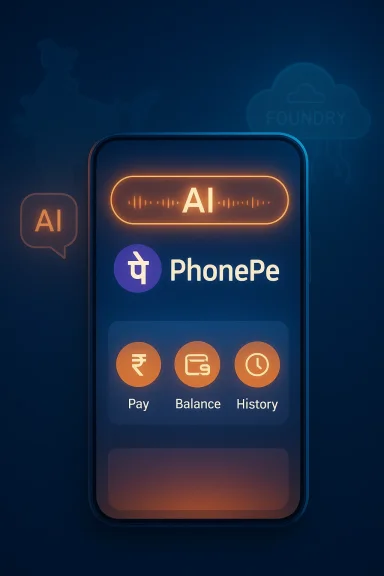
PhonePe’s newest update brings conversational AI into the heart of everyday payments, letting users speak or type natural-language commands to make transfers, check balances, and manage routine financial tasks — a move that turns the app’s search bar into a smart payments assistant and signals a meaningful shift in how fintech interfaces will be built in India going forward. ([economictimes.indionomictimes.indiatimes.com/industry/banking/finance/phonepe-rolls-out-ai-powered-feature-to-pay-via-voice-or-text/articleshow/128601184.cms)
PhonePe’s voice- and text-driven payment feature was unveiled in a staged rollout on February 20, 2026 and is being introduced as part of the company’s broader strategy to make payments more intuitive and accessible for hundreds of millions of users. The capability was developed in partnership with Microsoft and is reported to be powered by Microsoft’s modern AI stack — most prominently Microsoft Foundry — with hybrid on-device and cloud processing to reduce latency and protect sensitive audio or transaction data.
This launch comes on top of other recent PhonePe product moves — from biometric UPI authentication for small transfers to prior AI collaborations announced by the company — that show PhonePe accelerating beyond basic payments into an AI-first user experience. Those prior AI efforts include public collaborations and press disclosures that positioned PhonePe as an early adopter of conversational AI at scale.
PhonePe describes the implementation as a hybrid architecture: lightweight models or speech transcription run on the device when possible, while heavier reasoning and transaction orchestration are performed in the cloud. This hybrid approach is explicitly intended to reduce latency, preserve privacy for sensitive signals, and allow the app to work reasonably well even in low-connectivity conditions. Microsoft’s Foundry Local initiative — which enables on-device models and speech processing — is cited by Microsoft as a foundation for the mobile component of such experiences.
Key practical benefits for users include:
Cautionary note: specific legal or regulatory compliance (for example, banking licenses, payment instrument regulations, and data residency laws in India) requires contractual and operational alignment beyond platform promises. The public statements describe architecture and intent but do not constitute independent proof of regulatory approvals or full security certifications; readers should treat implementation claims as company statements until independent audits or regulator filings are available.
Source: Republic World PhonePe Leverages Microsoft AI to Launch Voice and Text Payment Features for Users
 Background
PhonePe’s voice- and text-driven payment feature was unveiled in a staged rollout on February 20, 2026 and is being introduced as part of the company’s broader strategy to make payments more intuitive and accessible for hundreds of millions of users. The capability was developed in partnership with Microsoft and is reported to be powered by Microsoft’s modern AI stack — most prominently Microsoft Foundry — with hybrid on-device and cloud processing to reduce latency and protect sensitive audio or transaction data.This launch comes on top of other recent PhonePe product moves — from biometric UPI authentication for small transfers to prior AI collaborations announced by the company — that show PhonePe accelerating beyond basic payments into an AI-first user experience. Those prior AI efforts include public collaborations and press disclosures that positioned PhonePe as an early adopter of conversational AI at scale.
What PhonePe announced, in plain terms
PhonePe’s new conversational feature allows users to interact with the app using simple sentences or spoken commands. Typical interactions include:- “Pay Hemanth 20 rupees”
- “Recharge my FASTag”
- “Show recent transactions for last week”
- “Remind me to pay electricity bill on 25th”
PhonePe describes the implementation as a hybrid architecture: lightweight models or speech transcription run on the device when possible, while heavier reasoning and transaction orchestration are performed in the cloud. This hybrid approach is explicitly intended to reduce latency, preserve privacy for sensitive signals, and allow the app to work reasonably well even in low-connectivity conditions. Microsoft’s Foundry Local initiative — which enables on-device models and speech processing — is cited by Microsoft as a foundation for the mobile component of such experiences.
Why this matters: scale, accessibility, and practical gains
PhonePe serves a very large and diverse user base. For companies operating at PhonePe’s scale, even incremental improvements in discovery and ease-of-use can meaningfully increase successful payments, reduce failed interactions, and lower support overhead. PhonePe itself has reported hundreds of millions of registered users and tens of millions of daily transactions in its public materials — a context that magnifies the impact of a feature that shortens the path from intent to payment.Key practical benefits for users include:
- Faster payments: natural-language commands reduce the need to hunt through menus and copy payee details.
- Improved accessibility: voice-first flows lower friction for users who are less comfortable with complex UIs or those who rely on voice interaction.
- Resilience in poor networks: on-device transcription can keep the interface usable when connectivity is limited.
- Reduced support costs: contextual AI can detect intent and route users to the correct flow, reducing repetitive support queries.
How it works — a technical breakdown
Architecture: hybrid on-device + cloud
PhonePe’s announced architecture uses a mix of local inference and cloud-based generative components:- On-device speech transcription and intent parsing — short utterances or sensitive audio can be processed locally using optimized models (Microsoft’s Foundry Local includes Whisper-based speech capabilities for Android and similar local runtimes). This keeps raw audio on the device for default privacy and latency advantages.
- Cloud reasoning and orchestration — once intent is established, the app may call cloud-hosted models or backend services to validate accounts, fetch balances, or prepare a transaction. This allows more compute-intensive steps — such as multi-turn dialog management, fraud checks, and compliance gating — to happen off-device in a controlled environment.
- Policy and privacy guardrails — enterprise-grade controls and orchestration layers enforce policy decisions, auditing, and model selection so that the system can balance cost, latency, and compliance. Microsoft’s Foundry and Azure stacks are explicitly positioned to provide governance, telemetry, and role-based controls at scale.
Models and capabilities
- Speech-to-text: likely powered by compact on-device models (Whisper or similar) for transcription with edge privacy.
- Intent classification and entity extraction: small-footprint models on-device can parse “pay X amount to Y” commands and extract parameters.
- Generative/LLM reasoning: cloud LLMs orchestrate multi-step tasks, generate confirmations, summarize transaction history, and manage follow-up prompts.
- Agentic orchestration: the platform coordinates between fraud checks, payment rails, and user confirmation flows to complete a transaction reliably. This mirrors the kind of “agentic commerce” and in-chat checkout advances Microsoft has been rolling out elsewhere.
Security, privacy, and compliance — what PhonePe and Microsoft are saying
PhonePe and Microsoft emphasize privacy-preserving design and compliance as pillars of this rollout. The company states that the conversational layer is built on secure infrastructure and that user privacy protections are core to its deployment. Reported specifics include:- Keeping personal and transactional data "within the PhonePe environment" when possible.
- Using on-device inference for the most privacy-sensitive components (speech and immediate intent recognition).
- Relying on enterprise-grade cloud services with role-based access, audit logs, and regional controls for backend processing.
Cautionary note: specific legal or regulatory compliance (for example, banking licenses, payment instrument regulations, and data residency laws in India) requires contractual and operational alignment beyond platform promises. The public statements describe architecture and intent but do not constitute independent proof of regulatory approvals or full security certifications; readers should treat implementation claims as company statements until independent audits or regulator filings are available.
What PhonePe gains from Microsoft’s stack — and what Microsoft gains
PhonePe gains from Microsoft in several practical ways:- On-device AI toolchain: Foundry Local allows PhonePe to keep speech and some inference on-device, reducing latency and exposure of audio data.
- Enterprise governance and scale: Azure/Foundry offers tooling for telemetry, policy enforcement, and regional deployments that are important for a large financial app.
- Multi-modal capabilities: Microsoft’s work on voice, agent orchestration, and RAG (retrieval-augmented generation) enables more context-aware payment assistance.
Risks, edge cases, and potential failure modes
Every large-scale integration of conversational AI into financial workflows brings practical and security risks that merit scrutiny. Notable risk areas include:- Voice spoofing and synthetic audio attacks
Voice-based confirmations can be vulnerable to replay or deepfake audio attacks. On-device speaker verification can mitigate risk, but robust anti-spoofing mechanisms and multi-factor confirmations are necessary for high-value transactions. - Model hallucination and incorrect guidance
LLMs can produce plausible but incorrect information. In a payments context, hallucinations could misroute funds, suggest wrong payees, or misinterpret ambiguous instructions. Strong deterministic checks and human-in-the-loop confirmations for risky flows are essential. - Data leakage through prompts and telemetry
Even if audio never leaves the device, logs and telemetry might accidentally capture PII unless strict redaction and retention policies are in place. - Regulatory and compliance friction
Payments, KYC, anti-money-laundering, and consent rules are tightly regulated. Conversational layers must not enable transaction flows that bypass required authentication or audit trails. Regulators may require explicit disclosure of AI involvement in customer-facing decisions. - Device heterogeneity and performance
India’s device landscape is highly fragmented. On-device models must be compact, robust, and fail gracefully on lower-end hardware to avoid creating inconsistent user experiences. - Accessibility and misunderstandings
Natural language interfaces reduce friction, but they can also misinterpret dialects, code-mixed language, or regional speech patterns, which risks exclusion or erroneous transactions for certain user cohorts.
How PhonePe can and should mitigate these risks
A defensible rollout strategy typically includes:- Gradual functional rollout — begin with low-value transactions and read-only flows (balances, transaction summaries) before enabling higher-risk payment flows. This reduces exposure while real-world behavior is observed.
- Multi-factor confirmation for high-risk flows — require biometric or PIN confirmation for value above a defined threshold, even when initiated via voice. PhonePe recently introduced biometric UPI for smaller amounts; combining biometrics with conversational initiation is a pragmatic pattern.
- Robust anti-spoofing and voice biometrics — implement voice anti-replay detection or pair voice with device-bound biometrics to minimize synthetic audio risk.
- Deterministic verification gates — use server-side deterministic checks (payee validation, tokenized identifiers) before authorizing fund movements.
- Explainability and user confirmation prompts — present a short, deterministic summary of the transaction for explicit user confirmation ("You asked to pay Hemanth ₹20. Confirm by saying ‘Yes’ and scanning your fingerprint").
- Conservative defaults and clear UI affordances — make it obvious when a user is interacting with an AI, what data is used, and how to opt-out.
Regulatory context: India’s approach and what to watch
India has rapidly evolved rules for digital payments and data protection. Important context for this rollout includes:- UPI transaction rules and thresholds that govern authentication and settlement, which determine whether voice initiation can substitute for PIN or biometric steps for certain amounts.
- Data-residency expectations and sectoral guidance that may require certain payment-related data to remain in-country or within prescribed infrastructure.
- Consumer-protection and explicit consent frameworks that govern automated decision-making and the use of AI in customer-facing services.
Broader industry implications
PhonePe’s move is part of a broader industry shift toward conversational commerce and agentic AI — where assistants do more than answer questions and instead act to complete tasks, including payments. Microsoft has been advancing features that embed checkout and in-chat payments in other markets, and the technology patterns here mirror those larger trends. These developments are enabling new product forms:- Conversational payments surfaces embedded into search and discovery
- Voice-driven remittances for low-literacy or rural users
- AI-guided financial advice integrated into transaction flows
- Frictionless commerce where intent is converted to transaction in fewer steps
What users should expect and practical tips
If you are a PhonePe user (or a user of any payments app exposing conversational AI), here is what to expect and best practices:- Expect phased availability: features will roll out gradually and might first appear only to a subset of users.
- Use conservative voice commands for monetary actions: for now, prefer confirming high-value transfers with PIN or biometrics.
- Check confirmation prompts carefully — ensure the app repeats the payee and the exact amount before confirming.
- Enable biometric protections on-device where offered; they act as a second line of defense for voice-initiated flows.
- If you have concerns about voice privacy, opt to use typed commands or disable voice features until you are comfortable.
Where the announcements differ — a note on technical naming and vendor claims
Different news outlets and vendor statements use overlapping terminology that can cause confusion. Some reports say PhonePe’s feature is built on Microsoft Foundry, while others describe integration with Microsoft’s Azure OpenAI Service. Both descriptions may be accurate: Foundry is Microsoft’s orchestration and on-device/local runtime that can surface multiple models and pipelines, and Foundry-hosted solutions can also orchestrate calls to Azure-hosted models (including OpenAI models) when needed. This means the implementation can legally and technically incorporate on-device Foundry Local inference for speech while relying on Azure-hosted model endpoints for heavier reasoning — a hybrid pattern that Microsoft’s Foundry documentation and enterprise case studies describe. Readers should interpret single-source phrases like “powered by Azure OpenAI” or “built using Foundry” as shorthand for a multi-component implementation, and treat detailed implementation claims as company statements until a technical whitepaper or audit is published.Final assessment: strengths, caveats, and likely next steps
PhonePe’s conversational payment launch is a decisive step toward more natural, context-aware money movement on mobile. The strengths are clear:- User experience uplift for large segments of India’s population.
- Operational benefits for PhonePe through lower support load and faster flows.
- Technical soundness in the hybrid approach — combining on-device transcription with cloud reasoning — which is aligned with contemporary privacy-first AI architecture.
- Security and fraud mitigation must be continuously hardened, especially as adversaries develop synthetic-audio capabilities.
- Regulatory scrutiny is inevitable; PhonePe will need documented audits, deterministic authorization paths, and demonstrable compliance.
- Model behavior must be governed to prevent errors that have real financial consequences.
Conclusion
PhonePe’s conversational payments feature is a meaningful example of generative and on-device AI being operationalized inside a regulated, high-volume financial product. The partnership with Microsoft combines edge-driven speech and hybrid cloud reasoning to deliver a faster, more accessible payments experience, while raising the predictable challenges of security, explainability, and compliance. If PhonePe can keep transaction controls deterministic, deploy robust anti-spoofing measures, and remain transparent with regulators and users, this could be a founding case study for conversational payments worldwide — but the transition must be measured, audited, and conservative where money is at stake.Source: Republic World PhonePe Leverages Microsoft AI to Launch Voice and Text Payment Features for Users
