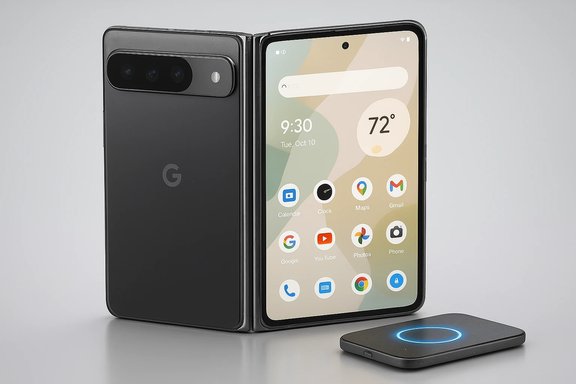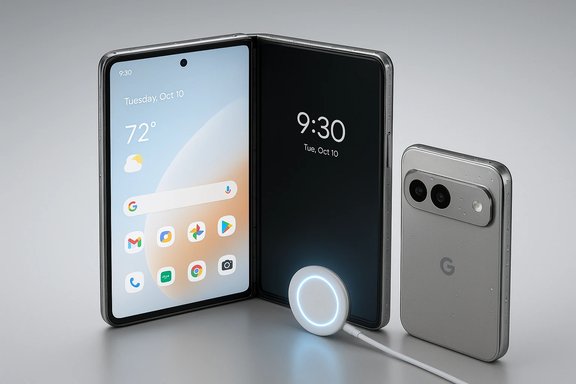
Google's newest foldable is the company's most ambitious—and most expensive—smartphone yet, a premium device that pairs a new gearless hinge and IP68 dust-and-water resistance with a larger inner screen, a bigger battery, and a raft of AI features powered by Google's custom Tensor G5 silicon.
Background
The Pixel 10 Pro Fold launched during Google's product cycle as the crown jewel of the Pixel 10 family: a book-style foldable built to resolve many of the durability and usability complaints that dogged earlier foldables. Google positions the device as the first mainstream foldable to ship with a full IP68 ingress-protection rating, and it highlights a novel gearless hinge engineered to avoid the dust- and wear-related failure modes of traditional gear-based hinges. Those engineering claims are central to Google's pitch that this is the most durable Pixel foldable yet. Price and availability reflect the device’s positioning: the Pixel 10 Pro Fold starts at a premium asking price and is offered with multiple storage tiers—placing it squarely against rival foldables in performance and cost. The headline starting price widely reported is $1,799 for the base configuration.Overview: What Google actually shipped
Key hardware highlights
- Gearless hinge designed using cam-based mechanisms rather than toothed gears, intended to improve long-term reliability and reduce dust ingress.
- IP68 water and dust resistance, a notable first for a mainstream foldable.
- Displays: an 8.0-inch Super Actua Flex inner OLED (1–120 Hz, peak up to 3,000 nits) and a 6.4-inch Actua cover OLED (60–120 Hz, peak up to 3,000 nits). These panels use Ultra Thin Glass plus multiple protective films to improve drop and crease resilience.
- Processor and AI: Google’s Tensor G5 SoC paired with the Titan M2 security coprocessor for on-device ML, enhanced camera intelligence, and new Pixel-exclusive AI features.
- Battery and charging: a larger 5,015 mAh battery (typical) with fast wired charging that Google advertises as getting to 50% in about 30 minutes (30W USB‑C PPS recommended), plus Qi2 magnetic wireless charging through Google’s new Pixelsnap system.
- Memory and storage: 16 GB of RAM, storage options up to 1 TB via zoned UFS implementations.
Engineering the gearless hinge: why it matters
What "gearless" means in practice
Traditional foldable hinges often use multiple small gears and pinions to ensure symmetric motion between the two halves of the device. Those gears do useful mechanical work, but they introduce small cavities, moving teeth, and surfaces where dust or grit can lodge—accelerating wear or producing hinge stiffness and failure over time.Google’s approach replaces tooth-and-gear mechanisms with cam-based motion and bespoke internal linkages engineered to maintain symmetrical closure while eliminating the small-tooth geometries that trap particulates. This frees internal volume for a larger battery and mitigates a major failure vector for foldables. Google’s engineering blog and product documentation emphasize this as the hinge’s primary benefit.
Strengths of the approach
- Greater long-term mechanical reliability is the core promise: fewer moving teeth and enclosed cams reduce the chance of dust plugging the hinge.
- The internal packaging gains afforded by the gearless design enabled a larger 5,015 mAh cell and a marginally slimmer bezel around the cover screen.
- The ability to achieve IP68 sealing on a foldable is directly tied to the hinge redesign: sealing a hinge with traditional gear geometry is considerably harder. Google states that the new hinge, combined with redesigned gaskets and tolerances, was key to the IP68 rating.
Caveats and open questions
- Manufacturer claims vs. long-term field data: Google's durability projections (the company suggests the hinge can handle "10+ years of folding") are optimistic and based on accelerated life testing. Real-world longevity will vary with user habits, environmental exposure, and repair incidents. Treat multi-year folding lifetime claims as manufacturer-provided benchmarks, not guarantees.
- Repairability concerns: a more integrated hinge and sealed device typically means higher repair complexity and cost. If the hinge assembly or internal waterproof seals fail, expect expensive authorized repairs or replacements, and a potential lack of third-party repair options. This is the trade-off for better ingress protection and internal packaging.
Display, brightness, and the practical value of 3,000 nits
Both internal and cover screens push peak brightness figures into the 2,000–3,000 nits range for various HDR and peak use cases. The inner foldable panel is an LTPO design supporting 1–120 Hz adaptive refresh to save power while enabling fluid motion when needed. Those high peak brightness figures aim to deliver legibility outdoors—even under harsh sunlight—while the inner LTPO panel improves static power consumption for always-on content and reading. High brightness matters because foldable screens are larger, often used outdoors for content consumption, and more reflective due to extra protective layers. The Pixel 10 Pro Fold’s combination of ultra-thin glass, dual impact films, and high peak luminance is a practical step toward addressing those real-world pain points. That said, extreme brightness also consumes battery fast, so the real-world benefit depends on how Google’s software manages brightness, ambient sensing, and adaptive refresh.Battery, charging, and PixelSnap: endurance vs. speed
Battery capacity and longevity
Google’s move to a 5,015 mAh cell is one of the clearest hardware improvements in the Pixel 10 Pro Fold line. Independent spec sheets and in-lab measurements confirm the larger capacity relative to the prior generation, which should translate into notably longer endurance for mixed use. Google advertises "up to 30+ hours" of battery life in realistic mixed-use scenarios with aggressive power-management modes included.Charging speed—measured vs. marketed
Google’s own spec documentation recommends a 30W USB‑C PPS charger to reach 50% battery in roughly 30 minutes. Some independent testers and early reviews report lower measured charging throughput under certain conditions; measured real-world results can vary depending on temperature, battery chemistry, and charger compliance. That means while Google’s published 30W figure is the official specification, end users may see slower effective charging during some sessions. This inconsistency between advertised and observed charging performance is common in modern phones where thermal throttling and charge curves modulate peak rates.Pixelsnap and Qi2 magnetic charging
One notable platform change is the built-in Qi2 magnetic alignment system—branded Pixelsnap—that integrates magnets to better align the phone to compatible chargers and accessories. It’s intended to make magnetic wireless charging more convenient on a foldable without requiring a separate MagSafe-like ring. The phone supports Qi2 up to 15W with magnetic alignment and accessory interoperability, which is handy but still far below the fastest wired charging competitors.AI features and the Tensor G5: practical enhancements or marketing gloss?
The Pixel 10 Pro Fold ships with Google's latest on-device and cloud-assisted AI experiences. Tensor G5 is presented as a purpose-built SoC for running Gemini-enabled models, camera intelligence, and system-level features like real-time transcription, Magic Cue, Camera Coach, and Gemini Live. Those features aim to leverage the foldable form for productivity—multi-app workflows, live collaboration, and contextual AI suggestions on the larger inner screen. Strengths:- Local on-device ML reduces latency for real-time features and keeps sensitive inference tasks off the cloud when possible.
- The combination of a large, tablet‑like inner display and AI features geared toward multitasking underlines the product’s positioning as a productivity-first foldable.
- Many AI features still depend on cloud services, user accounts, and data-sharing policies—so true offline capability is limited to specific on-device models and less capable versions of the cloud assistants.
- Feature parity across regions and carriers can vary; some advanced capabilities may arrive later or be limited by localization and regulatory constraints.
Camera system: evolution, not revolution
Google tuned the camera stack for the Pixel 10 Pro Fold with a 48 MP main sensor, an improved telephoto supporting 5x optical (plus high-res Super Res Zoom to 20x), and an upgraded ultrawide module. Google continues to fold much of its computational photography expertise into the foldable’s camera pipeline—features like Add Me, Best Take, and Instant View aim to make content capture more reliable across hinge positions. Practical reality:- While image quality is sharply improved in many scenarios—especially HDR and low-light computational modes—these cameras are not necessarily class-leading in raw hardware terms when compared to flagship monolithic phones with larger sensors or periscope optics.
- Foldable camera positioning and ergonomics complicate some shooting modes; Google’s software attempts to mitigate those shortcomings through features like Rear Camera Selfie and Instant View.
Software support, security, and long-term ownership
One of the Pixel 10 Pro Fold’s strongest non-hardware selling points is Google’s extended update policy. The device ships with modern Android and is covered by Google’s longer support windows—promises that include multiple OS upgrades and many years of security patches. This approach reduces total cost of ownership and preserves device value over a longer timeframe; it’s an area where Pixel often outcompetes other Android vendors. That said, precise end dates have been subject to slight changes in how Google displays them on support pages, so users should confirm the specifics for their region and purchase date when counting on exact coverage windows. Security hardware includes the Titan M2 coprocessor, and Google bundles VPN-by-default options as additional protections for sensitive traffic—features meant to appeal to privacy‑ and business‑oriented buyers.Market positioning and competition
Google prices the Pixel 10 Pro Fold as a premium competitor to Samsung’s Fold family and other high-end foldables. The Pixel’s unique selling points are the IP68 rating and gearless hinge, combined with Google’s AI and software lifecycle promises. Samsung’s Galaxy Z Fold series traditionally leads on camera hardware, ecosystem integrations, and accessory support, but many models still ship with an IP48 rating for water/dust resistance rather than full IP68—an important distinction for some buyers. The trade-offs between competitor devices typically boil down to camera hardware, battery/charging performance, ecosystem (apps and accessories), and post‑purchase service. Price comparison snapshot (rounded, examples):- Pixel 10 Pro Fold: starting around $1,799 for the base model, higher for 512 GB and 1 TB tiers.
- Competing foldables typically occupy a similar price band; promotional discounts and carrier deals can change net costs substantially.
Strengths — what Google did right
- Durability first: Achieving IP68 on a book-style foldable is a genuine engineering milestone if the fielded devices match lab claims. The gearless hinge and new sealing approach directly address the most glaring consumer concern about foldables: susceptibility to dust and water damage.
- Longer battery life: The 5,015 mAh cell is a material improvement that many users will notice under mixed usage.
- Bright, usable displays: Peak brightness figures and an LTPO inner panel combine to make the foldable more usable outdoors while saving power during low-refresh activities.
- Software longevity: Extended update promises and integrated security hardware make the device a stronger long-term buy for business users and those wary of short OS support windows.
Risks and shortcomings to weigh
- Repairability and cost: A sealed design with integrated magnetic systems and a complex hinge likely drives up repair costs and reduces third-party repair options. Extended durability claims may reduce incidents, but when a sealed component fails, replacements can be expensive.
- Price vs. value: At the $1,799+ price point, the Pixel 10 Pro Fold competes with very mature ecosystems where buyers expect not only top hardware but also excellent after-sales support and affordable repairs. The premium is justified only if the longevity and software pledges materialize.
- Charging and thermal realities: Wired charging speeds are modest for the price tier; while battery capacity is large, competitors offer faster wired and wireless charging. Observed real-world charging behavior sometimes trails the published spec.
- AI feature variability: AI features that depend on cloud backends, region locks, or carrier partnerships may not be uniformly available at launch across all markets, reducing the practical feature set for some buyers.
Practical buying guidance
- Consider the trade-off between durability and repairability. The Pixel 10 Pro Fold trades easier repairs for better ingress protection and a cleaner internal layout. If you plan to use your phone in wet or dirty environments, the IP68 rating is meaningful; if you value DIY repairs, this model may be less forgiving.
- If you want the longest software support and integrated security, the Pixel’s multi-year update promise and Titan M2 chip make this a safer long-term purchase than many Android alternatives. Confirm the specific update window in your market.
- Evaluate charging needs. If ultra-fast top-up speed matters (e.g., 65W+ wired charging), note that the Pixel prioritizes endurance and thermal management rather than peak wattage.
- Compare real-world camera samples and video performance with competitors if imaging is your primary use case; in many scenarios, Pixel’s computational photography still outperforms hardware-larger sensors but isn't always the absolute leader.
The wider impact: what Pixel 10 Pro Fold means for the foldable market
Google’s approach—raising durability and sealing standards while emphasizing long-term software support—represents a shift in how foldables are engineered and marketed. If the hinge and sealing architecture proves robust in the field, we can expect other manufacturers to prioritize similar trade-offs: longer lifetimes at the cost of more integrated designs and potentially higher repair bills.The mainstreaming of magnetic Qi2 charging and integrated accessory ecosystems like Pixelsnap may also standardize accessory behavior across Android vendors, improving interoperability over time. At the same time, Samsung and others will likely continue to push camera hardware and peak charging rates, leaving consumers to balance priorities: durability and software longevity vs. peak performance and repairability.
Conclusion
The Pixel 10 Pro Fold is a decisive statement: Google wants to compete at the high end of the foldable market not just on features, but on durability and long-term ownership. The gearless hinge and IP68 rating are the most immediately interesting engineering advances; if they hold up under years of real-world use, this device could mark a turning point for consumer confidence in foldables. The Pixel’s strong software support and security hardware further sweeten the proposition for buyers who plan to keep their phones for many years. That said, the premium price, potential repair costs for a sealed and magnetically interlinked chassis, and modest peak charging speeds are practical downsides that buyers should weigh. For professionals and enthusiasts who value a robust, AI‑enhanced large-screen experience on a mobile device, the Pixel 10 Pro Fold is an exciting option—one to evaluate side-by-side with rival Fold-class devices and to judge by long-term durability data as the first units settle into daily use.Source: MSN http://www.msn.com/en-ae/lifestyle/...vertelemetry=1&renderwebcomponents=1&wcseo=1]