

Sony has finally delivered the long‑promised cloud upgrade for the PlayStation Portal, turning the handheld from a Remote Play accessory into a true, stand‑alone streaming device for thousands of PS5 games — but the move rewrites assumptions about ownership, network hygiene, and where PlayStation fits in a cloud‑first gaming era.
The PlayStation Portal debuted in late 2023 as a tethered Remote Play companion for PS5 owners. It relied on a paired PS5 to run titles while the Portal acted as a second screen. Over the last year Sony gradually trialed cloud streaming on the Portal in beta, but the November 5, 2025 update converts that beta into a broadly available capability: PlayStation Plus Premium subscribers can now stream select PS5 titles directly from Sony’s cloud infrastructure without a live connection to their home PS5. Sony set the official rollout time at 6:00 p.m. PT on November 5 (2:00 a.m. GMT November 6) and published a PlayStation Blog post detailing the feature set and rollout regions. At launch, Sony says the service supports thousands of PS5 games from players’ own digital libraries as well as hundreds of titles from the PlayStation Plus Game Catalog and Classics Catalog. Notable marquee mentions in launch messaging include Astro Bot, Borderlands 4, Final Fantasy VII Rebirth, Fortnite, Grand Theft Auto V, and Resident Evil 4. Independent outlets and aggregated reports corroborate the timing and headline list. This update is not just a streaming toggle — it ships with a UI revamp and a set of quality‑of‑life features that reshape day‑to‑day usability on the device.
The PlayStation Portal’s cloud streaming update is a notable evolution: it expands access to PlayStation’s ecosystem while forcing renewed attention to networks, licensing, and the economic relationship between access and ownership. Users should validate title availability on their accounts, test their networks against the recommended bandwidth and latency targets, and treat the update as a powerful convenience that comes with the familiar caveats of cloud‑delivered gaming.
Source: Windows Report Cloud Streaming Officially Lands on PS Portal for Your PS5 Game Library
 Background / Overview
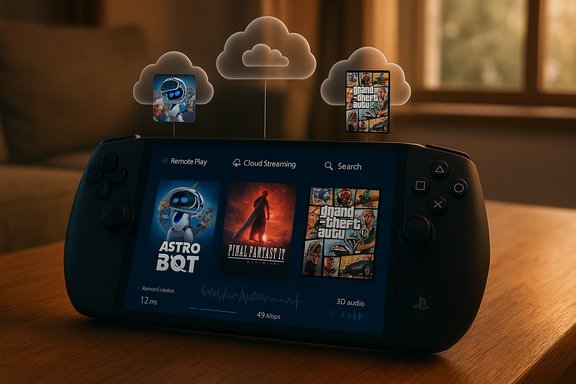
The PlayStation Portal debuted in late 2023 as a tethered Remote Play companion for PS5 owners. It relied on a paired PS5 to run titles while the Portal acted as a second screen. Over the last year Sony gradually trialed cloud streaming on the Portal in beta, but the November 5, 2025 update converts that beta into a broadly available capability: PlayStation Plus Premium subscribers can now stream select PS5 titles directly from Sony’s cloud infrastructure without a live connection to their home PS5. Sony set the official rollout time at 6:00 p.m. PT on November 5 (2:00 a.m. GMT November 6) and published a PlayStation Blog post detailing the feature set and rollout regions. At launch, Sony says the service supports thousands of PS5 games from players’ own digital libraries as well as hundreds of titles from the PlayStation Plus Game Catalog and Classics Catalog. Notable marquee mentions in launch messaging include Astro Bot, Borderlands 4, Final Fantasy VII Rebirth, Fortnite, Grand Theft Auto V, and Resident Evil 4. Independent outlets and aggregated reports corroborate the timing and headline list. This update is not just a streaming toggle — it ships with a UI revamp and a set of quality‑of‑life features that reshape day‑to‑day usability on the device.What changed: key features and UX improvements
Three primary home tabs
Sony reorganized the Portal’s front end into three clear tabs:- Remote Play — the legacy mode that connects to a paired PS5.
- Cloud Streaming — the new, dedicated hub for immediate streaming from Sony’s servers.
- Search — unified lookup for streamable games and entitlement checks.
Gameplay and system upgrades
- Cloud streaming for owned digital PS5 games: Premium members can stream eligible PS5 titles from their own library without the console being on or available. Sony’s messaging emphasizes thousands of titles at launch, but exact availability varies by title, region, and publisher contracts.
- 3D Audio during streaming: Spatial audio support is enabled for supported games and compatible headsets, bringing parity with local console sessions for supported titles.
- In‑game purchases and store access: Players can buy DLC and microtransactions during a cloud session and receive entitlements immediately.
- Accessibility features during cloud play: Screen readers, adjustable text sizes, and a set of streaming‑specific accessibility toggles are now available within Cloud Streaming.
- Security and diagnostics: A passcode lock and a real‑time network status screen were added so users can monitor connection quality during streaming sessions.
What remains limited or conditional
Sony emphasizes adult account gating and regional availability—Cloud Streaming on Portal is a PlayStation Plus Premium benefit and is only available in markets where Premium (or Deluxe with cloud rights) is offered. The playable catalog can change over time; some titles may not be immediately streamable due to licensing or technical reasons. That nuance matters for shoppers and collectors.Technical expectations: network, latency, and device behavior
Cloud gaming is a network service first and a device second. The Portal offloads rendering to Sony’s servers, so the user’s local hardware only needs to decode and transmit input.- Bandwidth targets: Sony lists a minimum of 5 Mbps for basic Remote Play, with 15 Mbps recommended for a better 1080p experience. Independent testing and cloud‑gaming guidance suggest planning for ~20 Mbps or more for comfortable 1080p/60fps sessions and headroom for bitrate spikes.
- Latency sensitivity: Cloud play’s Achilles’ heel is round‑trip latency. Practical guidance places desirable round‑trip latency under ~50 ms for action games; higher values materially affect fast, twitch‑dependent genres. Network jitter and packet loss often cause more perceived lag than raw throughput.
- Wi‑Fi considerations: Use 5 GHz or wired Ethernet when possible. For mobile situations, choose quiet, uncongested Wi‑Fi access points and avoid simultaneous heavy uploads/downloads that steal bandwidth.
- Data usage: Expect several gigabytes per hour depending on resolution and bitrate — important for capped ISP plans or mobile hotspots.
Library realities: what “thousands” actually means
Sony’s announcement uses large, consumer‑friendly language: thousands of PS5 titles, hundreds from the PS Plus Catalog, and a list of high‑profile examples. That phrasing is accurate as a headline but hides complexity:- Catalogs are dynamic: Regions, licensing windows, and publisher opt‑ins change per title. A game marked available today might be restricted tomorrow if licensing contracts lapse or if the publisher limits cloud distribution.
- Not everything you own is guaranteed streamable. Technical constraints, publisher decisions, and older titles with complex middleware or DRM can be excluded or delayed.
- Availability differs by account type and region. Premium entitlements, adult account status, and local legal/regulatory limits all influence what you can stream.
How this compares to other cloud ecosystems
Sony’s move brings the Portal closer to what Microsoft has offered with Xbox Cloud Gaming and what NVIDIA GeForce NOW has long provided: device‑agnostic access to a library without local installs.- Microsoft (Xbox Cloud Gaming / Game Pass): Microsoft combines a large curated catalog (Game Pass) with the ability to stream certain owned titles in some markets; tight Azure integration gives them broad edge coverage and aggressive codec work (AV1 testing, adaptive bitrate improvements). Microsoft also publishes clear bandwidth and latency guidance and has iteratively expanded which subscription tiers include cloud access. Sony’s Portal is now in the same functional category for PlayStation first‑party and supported third‑party titles, but the business and licensing approaches differ.
- NVIDIA GeForce NOW: Emphasizes streaming a user’s existing PC libraries (Steam, Epic) rather than a subscription catalog. GeForce NOW’s advantage is library coverage for PC‑based purchases; its model contrasts with PlayStation’s catalog-plus‑owned‑digital model.
Strengths: where the Portal upgrade matters
- True portability for PlayStation exclusives: The Portal now lets Premium members play many PS5 exclusives away from their console, opening couch‑to‑cafe continuity without carrying a PS5.
- Second‑account flexibility: Cloud Streaming allows someone else at home to use the PS5 while you stream a game tied to your account — a practical, immediate benefit for shared households.
- Improved device utility: The Portal becomes more than a glorified Remote Play screen; it’s a compact streaming console that’s useful for travel and transient play sessions.
- Integrated purchases and accessibility: Immediate in‑game purchases and streaming‑specific accessibility options reduce friction and broaden the Portal’s usefulness for varied player needs.
Risks and limitations: what to watch out for
- Network fragility: The experience can degrade sharply with poor routing, high jitter, or ISP peering issues. Competitive gamers and latency‑sensitive players will still prefer local installs.
- Licensing and catalog volatility: Streaming is access, not ownership. Titles can leave a catalog or have streaming rights revoked; this undermines permanence for collectors. Sony’s messaging is explicit about regional and temporal variability.
- Partial feature parity: DualSense advanced features (adaptive triggers, haptics) and some platform‑specific integrations are not guaranteed to work identically over cloud streams. Certain titles may limit or emulate DualSense functions rather than fully reproduce them. Past PC streaming experiences and community testing suggest DualSense parity is inconsistent outside native consoles.
- Privacy and telemetry: Cloud gaming increases reliance on centralized telemetry. Session data, play history, and in‑game purchases flow through Sony’s cloud; families and privacy‑conscious users should review account settings and entitlements.
- Anti‑cheat and multiplayer edge cases: Titles that rely on kernel‑level anti‑cheat or special server‑side checks may not be eligible for cloud streaming. Expect some competitive multiplayer titles to remain download‑only or require publisher work to stream reliably.
Practical setup and troubleshooting checklist
- Ensure you have a PlayStation Plus Premium subscription and an adult PSN account in a supported region.
- Use a wired connection at home whenever possible; otherwise place the Portal near a strong 5 GHz AP and minimize competing traffic.
- Target 20 Mbps+ for consistent 1080p play. For constrained connections, reduce in‑session visual settings or accept lower quality.
- Enable the Network Status overlay on the Portal to diagnose jitter, packet loss, and latency mid‑session.
- If a title won’t launch from Cloud Streaming, verify entitlement and regional availability via the Search tab; if the title is gated, a QR code will prompt purchase/upgrade flows.
- Reboot the Portal, your router, and any intermediary mesh nodes.
- Pause large downloads and backups on the same network during play.
- Try a different ISP path (mobile hotspot or other Wi‑Fi) to test whether the issue is local or upstream.
Business and strategic implications
Sony’s addition of owned‑library cloud streaming on the Portal is a strategic pivot: it signals a willingness to let players access PlayStation content independent of console hardware constraints. That has short‑term and long‑term implications:- Short term: It expands the perceived value of PlayStation Plus Premium and materially increases the Portal’s market utility as an add‑on purchase for PS fans.
- Long term: If cloud access becomes a common expectation, Sony can monetize back‑catalog content more aggressively through on‑demand purchases, DLC sales, and impulse in‑session transactions. Yet cloud access also erodes hardware exclusivity: if top PlayStation titles are broadly streamable, Sony must balance first‑party sales strategies with subscription retention goals.
What’s verifiable and what remains uncertain
- Verifiable facts:
- The official PlayStation Blog announced Cloud Streaming for PS Portal and the 6:00 p.m. PT rollout time.
- Independent outlets (The Verge, Gematsu, Meristation) reported the same launch details and highlighted the major supported titles mentioned in Sony’s release.
- Sony documented the UI changes, network screen, passcode lock, 3D audio support, in‑session purchases, and accessibility improvements.
- Unverifiable or fluid claims:
- The exact count of “thousands” of streamable PS5 titles is a rolling figure dependent on region and publisher agreements; treat headline counts as a snapshot, not an immutable catalog size.
- Per‑title DualSense feature parity over cloud remains inconsistent in practice and is best validated on a case‑by‑case basis; past PC streaming history shows varied results.
Final assessment: who should care, who should wait
- The upgrade is a clear win for travelers, households that share a single PS5, and PlayStation subscribers who value portability over absolute fidelity. It reduces friction and lowers the cost of “trying” titles without buying a second console.
- Competitive and latency‑sensitive players, streamers who require capture fidelity, and collectors who insist on guaranteed ownership should remain cautious; those use cases still favor local installs on a PS5 or PC.
- For network professionals and home IT admins, cloud gaming should be treated as a high‑priority, low‑latency application: apply QoS, favor wired links, and test ISP peering to Sony’s edge locations if possible.
The PlayStation Portal’s cloud streaming update is a notable evolution: it expands access to PlayStation’s ecosystem while forcing renewed attention to networks, licensing, and the economic relationship between access and ownership. Users should validate title availability on their accounts, test their networks against the recommended bandwidth and latency targets, and treat the update as a powerful convenience that comes with the familiar caveats of cloud‑delivered gaming.
Source: Windows Report Cloud Streaming Officially Lands on PS Portal for Your PS5 Game Library
