

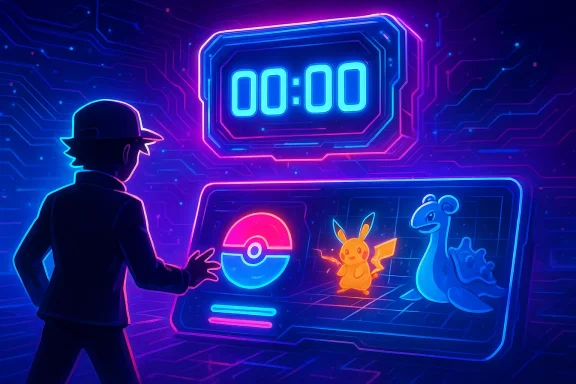
Pokémon Champions has barely settled into players’ hands, and already one of its most important competitive rules has become a flashpoint. The game now treats a match that reaches the overall timer limit as a draw, regardless of board state, instead of using the older Pokémon tiebreakers that rewarded the player with more remaining Pokémon or higher HP. That sounds simple on paper, but in practice it cuts straight into the logic of competitive play, where who is ahead has always mattered almost as much as who survives the final turn.
The debate is bigger than a single rules tweak. It exposes a tension that has followed Pokémon’s organized play for years: how do you balance anti-stall protections against the need to fairly credit a player who has already built a winning position? Pokémon Champions is also arriving at a moment when The Pokémon Company is trying to turn a long-running ecosystem of video game competition into a more centralized, more accessible live service. That makes every rule choice feel less like a footnote and more like a statement of intent.
Pokémon Champions is not being introduced as a side experiment. The official site frames it as a battle-focused game with Ranked Battles, Casual Battles, and Private Battles, and it is designed to sit at the center of the franchise’s future organized play. The game’s own materials emphasize seasonal ranked rewards and a competitive structure built around recurring play rather than one-off novelty.
That matters because Pokémon has spent years evolving its time rules through a very particular lens. Traditional video game competition in Pokémon has historically used turn-by-turn end-of-match procedures, including tiebreakers based on remaining Pokémon and HP when the clock runs out. Those rules were meant to preserve competitive fairness while still preventing marathon games from spiraling out of control. In other words, the system rewarded the player who had actually won the game state, not merely the player who had survived to the buzzer.
Pokémon Champions changes that logic in a way that is easy to describe and difficult to dismiss. According to Automaton’s reporting, if the overall timer expires in Ranked or Casual Battles, the result is now an unconditional draw. The separate personal turn timer still exists, so players cannot simply sit forever and force a draw without spending their own clock. But the final outcome no longer distinguishes between a dominant position and a desperate one if the match times out.
That’s why the reaction has been so sharp. Competitive Pokémon players are used to debates about balance, tiering, and move interactions. A clock rule is different. It defines the shape of competition itself, because it decides whether a match ending in progress counts as a loss, a win, or something more frustratingly neutral. Once that happens, the argument is no longer about one archetype or one Pokémon; it becomes about the legitimacy of the entire ranked ladder.
The timing also heightens the stakes. Pokémon Champions is arriving as The Pokémon Company prepares to shift major official video game competition into the new platform, including the 2026 World Championships. That means the timer rule is not some throwaway ladder quirk. It is a preview of the environment competitive players may need to master at the highest levels.
Pokémon Champions, by contrast, appears to remove those final-state tiebreakers from Ranked and Casual Battles entirely. Once the overall match timer hits zero, the result is a draw, full stop. This is a radical simplification, and in one sense it is admirably clear. There is no need for players to memorize a cascade of fallback conditions, and no awkward post-clock dispute over whether the board was “really” won.
Still, simplicity does not automatically equal fairness. Competitive systems often add complexity precisely because they need to preserve competitive meaning. The older Pokémon tiebreakers were not there to be clever; they were there to make the end state reflect the board state. Removing them changes what the game is valuing.
The practical question is whether the game is now saying that failing to close a win before time expires is equivalent to never having been ahead in the first place. That is the heart of the controversy. If a player spent 15 turns carefully gaining board control, forcing switches, and preserving resources, a draw can feel like the system refusing to recognize the work that was already done.
That safeguard is important, and it should not be understated. Without a personal clock, any draw-on-time system would invite obvious abuse. A player who knew they were losing could stall every action, turn a sure defeat into a draw, and potentially preserve rank in a way that undermines the ladder entirely. The personal timer cuts off that worst-case scenario.
That distinction matters because competitive games are rarely broken by the obvious exploit alone. They are broken by the gray areas around the exploit. If the best response to a lost position becomes “keep playing just actively enough to avoid a penalty, but slowly enough to reach a draw,” then the rule may still reward the wrong behavior. That is why some players are already worried about stall teams becoming even more frustrating.
There is also a philosophical issue here. A timer exists to prevent endless games, not to erase the meaning of the board. Once the clock becomes the ultimate arbiter in all timed-out games, the system stops asking who was ahead and starts asking only whether the match reached its formal endpoint.
One side sees the change as a direct reward to passive, disruptive teams. If a player is ahead on the board but cannot convert before time runs out, why should the game fail to acknowledge that advantage? This camp worries the draw rule will make already-annoying strategies even more attractive, especially in ladder environments where consistency and psychological pressure often matter as much as raw damage output.
This camp also worries about the emotional impact on matches. Nothing feels worse than playing well, controlling the pace, and ending with a result that says your win meant nothing. That is especially true in ranked play, where every result affects progression. The old tiebreakers converted those edge cases into outcomes; the new rule converts them into unresolved stalemates.
That logic is not frivolous. Many competitive formats wrestle with unwinnable but not yet finished games, and the more complex the interaction space, the more likely those states become. A draw says, in effect, that neither player managed to conclusively secure the match before the clock ended. For some players, that is cleaner than awarding a win for what may have been a marginal positional edge.
The tension is that both arguments are defensible. One side wants the game to acknowledge advantage. The other wants it to acknowledge completion. Those are not the same thing, and Pokémon Champions has chosen completion.
The immediate consequence is that a player who is clearly winning may no longer be guaranteed credit for that advantage. In practical ladder terms, that means the most important edge in a tight match might be less about board position and more about clock management. That is a subtle but profound shift, and it will likely affect how players build teams and plan endgames.
That creates a strange psychological effect. A winning player may begin to play more aggressively to avoid the clock, which can be healthy for match pace, but it can also push games toward volatility rather than strategy. Meanwhile, a trailing player may feel encouraged to maximize survivability rather than pursue a comeback, because surviving to time now carries a different kind of value. That is not necessarily broken, but it is definitely different.
There is also the question of what a draw means to progression systems. Pokémon Champions says Ranked Battle results are tallied seasonally and used to determine placement and rewards. In a system like that, a draw can become a frustrating dead zone: not a loss, but not evidence of superiority either. The more often that happens, the more the ladder risks feeling sterile.
That concern is particularly acute in a game like Pokémon, where limited turns and information asymmetry already create a lot of room for attrition-based strategies. If a stall player can survive just long enough to deny a loss, then the ladder may begin to reward survival architecture over conversion skill. That would not kill offense, but it could tilt the social perception of the meta in an ugly direction.
Still, the public perception problem is real. If players believe the system is kinder to defensive teams, they may become more hostile to those teams regardless of actual win rates. That kind of sentiment can matter just as much as balance data, because ladder environments are shaped by what players feel is fair. Perceived unfairness travels faster than statistical nuance.
There is also a hidden design possibility here. The Pokémon Company may be trying to eliminate rules that feel opaque or overly technical to newer players. A draw is easy to explain. A multi-step tiebreaker is not. But if the goal is to simplify the competitive story, it comes at the cost of making the meta less satisfying for veterans who want precision.
Pokémon Champions is already positioned as the software that will support the franchise’s top-end video game competition, including the VGC shift for the 2026 World Championships. That means the battle timer rule is not isolated from the broader ecosystem. If players train in Champions, ladder in Champions, and eventually compete in Champions at the highest level, then the timer philosophy becomes part of the competitive culture itself.
For competitive users, however, simplicity can feel like blunt force. Tournament environments often need rules that appear fussy precisely because they preserve strategic meaning. Pokémon’s official tournament framework has long used detailed rules and penalty guidelines for video game play, and Champions will have to live up to that standard if it wants trust from the VGC community.
The key issue is consistency. If the ladder trains one set of expectations and official tournament play follows another, players may feel whiplash. If both use the same draw logic, then the franchise is making a deliberate statement that timeouts should never reward board advantage. Either way, the decision is bigger than it looks.
That pattern can be productive. Live-service and always-connected games often need to react quickly to problems that only become obvious after millions of games. If old timer tiebreakers were causing more frustration than they solved, then changing them is defensible. The danger is that reactive design can also drift into instability, especially when the audience expects a mature competitive rulebook from day one.
That tension is especially visible now because the competitive scene is paying close attention to every change. Small rules tweaks in a game built around a legacy franchise can take on outsized importance. When the community is already worried about missing features, launch roughness, and the long road from beta-like uncertainty to a polished competitive standard, even a timer rule becomes symbolic.
In that sense, this is less about whether one person “deserves” a win and more about what kind of competitive culture Pokémon Champions is trying to build. If the game wants an accessible, friction-light ladder, the draw rule makes sense. If it wants to preserve the long-standing Pokémon notion that end-state advantage should count, then the new system is a step away from tradition.
The most likely outcome is not a total reversal but some kind of adjustment, clarification, or mode-specific exception. The Pokémon Company could preserve the draw rule in casual play while restoring end-state tiebreakers in ranked or official contexts. It could also keep the draw rule but change the personal and match timer structure to reduce the possibility of tactical clocking. Any of those options would suggest the company is still calibrating the competitive model rather than locking it in forever.
Source: games.gg Pokemon Champions Timer Draws: Good or Bad for Competition? | GAMES.GG
The debate is bigger than a single rules tweak. It exposes a tension that has followed Pokémon’s organized play for years: how do you balance anti-stall protections against the need to fairly credit a player who has already built a winning position? Pokémon Champions is also arriving at a moment when The Pokémon Company is trying to turn a long-running ecosystem of video game competition into a more centralized, more accessible live service. That makes every rule choice feel less like a footnote and more like a statement of intent.
 Background
Pokémon Champions is not being introduced as a side experiment. The official site frames it as a battle-focused game with Ranked Battles, Casual Battles, and Private Battles, and it is designed to sit at the center of the franchise’s future organized play. The game’s own materials emphasize seasonal ranked rewards and a competitive structure built around recurring play rather than one-off novelty.That matters because Pokémon has spent years evolving its time rules through a very particular lens. Traditional video game competition in Pokémon has historically used turn-by-turn end-of-match procedures, including tiebreakers based on remaining Pokémon and HP when the clock runs out. Those rules were meant to preserve competitive fairness while still preventing marathon games from spiraling out of control. In other words, the system rewarded the player who had actually won the game state, not merely the player who had survived to the buzzer.
Pokémon Champions changes that logic in a way that is easy to describe and difficult to dismiss. According to Automaton’s reporting, if the overall timer expires in Ranked or Casual Battles, the result is now an unconditional draw. The separate personal turn timer still exists, so players cannot simply sit forever and force a draw without spending their own clock. But the final outcome no longer distinguishes between a dominant position and a desperate one if the match times out.
That’s why the reaction has been so sharp. Competitive Pokémon players are used to debates about balance, tiering, and move interactions. A clock rule is different. It defines the shape of competition itself, because it decides whether a match ending in progress counts as a loss, a win, or something more frustratingly neutral. Once that happens, the argument is no longer about one archetype or one Pokémon; it becomes about the legitimacy of the entire ranked ladder.
The timing also heightens the stakes. Pokémon Champions is arriving as The Pokémon Company prepares to shift major official video game competition into the new platform, including the 2026 World Championships. That means the timer rule is not some throwaway ladder quirk. It is a preview of the environment competitive players may need to master at the highest levels.
What Changed
The simplest way to understand the new rule is to compare it to the older Pokémon model. Under previous battle systems, the match timer could end the game without making the outcome ambiguous. If one player had more Pokémon left, that player won. If both sides were tied on Pokémon, the game looked deeper and compared HP totals. Only after those layers were exhausted did the result become a draw. That logic rewarded the player who had created the better position by the time the clock expired.Pokémon Champions, by contrast, appears to remove those final-state tiebreakers from Ranked and Casual Battles entirely. Once the overall match timer hits zero, the result is a draw, full stop. This is a radical simplification, and in one sense it is admirably clear. There is no need for players to memorize a cascade of fallback conditions, and no awkward post-clock dispute over whether the board was “really” won.
Why the change is easy to grasp
The new rule is easier for casual players to understand because it is blunt. A timed-out game is a tie, and that’s the end of it. There is no calculation, no hidden comparison, and no argument about whether one Pokémon’s HP fraction should matter more than another’s. For newer players, clarity is a real design advantage.Still, simplicity does not automatically equal fairness. Competitive systems often add complexity precisely because they need to preserve competitive meaning. The older Pokémon tiebreakers were not there to be clever; they were there to make the end state reflect the board state. Removing them changes what the game is valuing.
The practical question is whether the game is now saying that failing to close a win before time expires is equivalent to never having been ahead in the first place. That is the heart of the controversy. If a player spent 15 turns carefully gaining board control, forcing switches, and preserving resources, a draw can feel like the system refusing to recognize the work that was already done.
- The old system rewarded board advantage at time out.
- The new system prioritizes absolute completion over state-based scoring.
- Casual readability likely improves.
- Competitive nuance likely suffers.
- The result is cleaner, but not necessarily more just.
Two Timers, One Problem
A key reason this change is not as exploitable as it first appears is the presence of two timers. Pokémon Champions uses both an overall match timer and a separate personal timer for each player. If a player simply stops acting, the personal timer ticks away and that player eventually forfeits those turns rather than freezing the match indefinitely. That means a losing player cannot just go AFK and force a draw for free.That safeguard is important, and it should not be understated. Without a personal clock, any draw-on-time system would invite obvious abuse. A player who knew they were losing could stall every action, turn a sure defeat into a draw, and potentially preserve rank in a way that undermines the ladder entirely. The personal timer cuts off that worst-case scenario.
Why the safeguard still leaves a gap
The problem is that the safeguard only solves the most blatant version of time abuse. It does not address the subtler issue of a player who is already behind but still active enough to shepherd the game toward time. In a game with recovery, status pressure, and low-variance endgames, that can matter a lot. The design blocks inactivity, but it cannot fully block deliberate clock management.That distinction matters because competitive games are rarely broken by the obvious exploit alone. They are broken by the gray areas around the exploit. If the best response to a lost position becomes “keep playing just actively enough to avoid a penalty, but slowly enough to reach a draw,” then the rule may still reward the wrong behavior. That is why some players are already worried about stall teams becoming even more frustrating.
There is also a philosophical issue here. A timer exists to prevent endless games, not to erase the meaning of the board. Once the clock becomes the ultimate arbiter in all timed-out games, the system stops asking who was ahead and starts asking only whether the match reached its formal endpoint.
- Personal timers prevent outright inactivity abuse.
- Overall timers still create incentives for clock pressure.
- Slow, defensive teams may gain indirect value.
- Fast, decisive play is no longer fully rewarded at time.
- The anti-stall fix does not eliminate all stall incentives.
Why Competitive Players Are Split
The reaction from the community has been unusually divided, and that alone tells you something. Competitive Pokémon fans are not shy about consensus when a mechanic clearly helps or harms the meta. In this case, the debate has been close enough to feel like two different philosophies of fair play colliding in real time.One side sees the change as a direct reward to passive, disruptive teams. If a player is ahead on the board but cannot convert before time runs out, why should the game fail to acknowledge that advantage? This camp worries the draw rule will make already-annoying strategies even more attractive, especially in ladder environments where consistency and psychological pressure often matter as much as raw damage output.
The stall argument
The anti-change argument is easy to summarize: you should not be able to neutralize a losing position by surviving the clock. Players who dislike the new system believe the game should still honor board advantage, because that advantage was earned through decision-making, positioning, and resource management. A draw in that context feels like a denial of effort, not a neutral outcome.This camp also worries about the emotional impact on matches. Nothing feels worse than playing well, controlling the pace, and ending with a result that says your win meant nothing. That is especially true in ranked play, where every result affects progression. The old tiebreakers converted those edge cases into outcomes; the new rule converts them into unresolved stalemates.
The anti-stall argument
Supporters of the rule point out that some endgames genuinely are unsalvageable within the clock. When both players are locked into recovery loops, residual damage, or low-power chip exchanges, the old system could still hand a win to the player who merely had a slightly better end-state snapshot. In those situations, a draw can feel more honest than a forced technical victory.That logic is not frivolous. Many competitive formats wrestle with unwinnable but not yet finished games, and the more complex the interaction space, the more likely those states become. A draw says, in effect, that neither player managed to conclusively secure the match before the clock ended. For some players, that is cleaner than awarding a win for what may have been a marginal positional edge.
The tension is that both arguments are defensible. One side wants the game to acknowledge advantage. The other wants it to acknowledge completion. Those are not the same thing, and Pokémon Champions has chosen completion.
- Critics see a reward for stall.
- Supporters see a protection against false precision.
- Both sides can point to real gameplay examples.
- The draw rule turns edge-case frustration into a structural rule.
- Community disagreement is unusually even for a Pokémon controversy.
Ranked Mode and Ladder Integrity
Ranked systems live or die by the clarity of their incentives. If a player understands exactly what the game rewards, they can shape their strategy around it. Pokémon Champions’ timer draw rule has the potential to muddy that clarity because it changes the value of board advantage at the worst possible moment: the end of a ranked match.The immediate consequence is that a player who is clearly winning may no longer be guaranteed credit for that advantage. In practical ladder terms, that means the most important edge in a tight match might be less about board position and more about clock management. That is a subtle but profound shift, and it will likely affect how players build teams and plan endgames.
The ladder incentive problem
Ranked ladders are supposed to reward winning. They can tolerate some variance, but they cannot afford to make players feel that the best possible position is functionally worth the same as a dead heat. If that perception spreads, competitive players may begin to view draws as a kind of anti-reward, especially when the player who was ahead gets no ranking benefit from their advantage.That creates a strange psychological effect. A winning player may begin to play more aggressively to avoid the clock, which can be healthy for match pace, but it can also push games toward volatility rather than strategy. Meanwhile, a trailing player may feel encouraged to maximize survivability rather than pursue a comeback, because surviving to time now carries a different kind of value. That is not necessarily broken, but it is definitely different.
There is also the question of what a draw means to progression systems. Pokémon Champions says Ranked Battle results are tallied seasonally and used to determine placement and rewards. In a system like that, a draw can become a frustrating dead zone: not a loss, but not evidence of superiority either. The more often that happens, the more the ladder risks feeling sterile.
- Ranked integrity depends on meaningful outcomes.
- Draws can reduce false certainty in messy endgames.
- Too many draws can also flatten skill expression.
- Clock awareness may become a hidden skill test.
- Ladder rewards become less informative when wins and near-wins blur together.
Stall, Recovery, and the Meta
The biggest metagame concern is not that every match becomes a draw. It is that the rule may subtly reshape what kinds of teams are attractive. Defensive Pokémon, recovery loops, and status pressure already exist in competitive play, but a draw-on-time rule could make those tools feel safer for the player using them and more exasperating for the player facing them.That concern is particularly acute in a game like Pokémon, where limited turns and information asymmetry already create a lot of room for attrition-based strategies. If a stall player can survive just long enough to deny a loss, then the ladder may begin to reward survival architecture over conversion skill. That would not kill offense, but it could tilt the social perception of the meta in an ugly direction.
Why slow play and stall are not the same thing
It is important not to conflate stall teams with slow play. Stall is a legitimate archetype built around sustaining itself and exhausting the opponent’s resources. Slow play is a time-management issue that can exist in any archetype. Pokémon Champions’ rule changes target neither perfectly, which is why the conversation is so messy.Still, the public perception problem is real. If players believe the system is kinder to defensive teams, they may become more hostile to those teams regardless of actual win rates. That kind of sentiment can matter just as much as balance data, because ladder environments are shaped by what players feel is fair. Perceived unfairness travels faster than statistical nuance.
There is also a hidden design possibility here. The Pokémon Company may be trying to eliminate rules that feel opaque or overly technical to newer players. A draw is easy to explain. A multi-step tiebreaker is not. But if the goal is to simplify the competitive story, it comes at the cost of making the meta less satisfying for veterans who want precision.
- Defensive play may gain indirect value.
- Status and recovery loops become more annoying in timed games.
- Slow play remains a separate issue from stall.
- Veterans may see the rule as flattened competitive design.
- Newer players may appreciate the simpler outcome.
Enterprise, Casual, and Official Play
The rule has different implications depending on where the match happens. In Casual Battles, a draw is mostly an annoyance or an anecdote. In Ranked Battles, it can affect seasonal progress and the emotional legitimacy of the ladder. In official competitive play, it becomes much bigger, because official play is where the franchise defines what serious Pokémon competition is supposed to look like.Pokémon Champions is already positioned as the software that will support the franchise’s top-end video game competition, including the VGC shift for the 2026 World Championships. That means the battle timer rule is not isolated from the broader ecosystem. If players train in Champions, ladder in Champions, and eventually compete in Champions at the highest level, then the timer philosophy becomes part of the competitive culture itself.
Consumer convenience versus competitive rigor
For casual users, the draw rule may simply reduce confusion. It is straightforward, quick to understand, and less likely to lead to arguments over end-state math. That is useful in a free-to-start game trying to onboard a broad audience, including players who may be there for Mega Evolution spectacle more than tournament precision.For competitive users, however, simplicity can feel like blunt force. Tournament environments often need rules that appear fussy precisely because they preserve strategic meaning. Pokémon’s official tournament framework has long used detailed rules and penalty guidelines for video game play, and Champions will have to live up to that standard if it wants trust from the VGC community.
The key issue is consistency. If the ladder trains one set of expectations and official tournament play follows another, players may feel whiplash. If both use the same draw logic, then the franchise is making a deliberate statement that timeouts should never reward board advantage. Either way, the decision is bigger than it looks.
- Casual players value clarity.
- Ranked players value meaningful end states.
- Official play demands predictable fairness.
- The same rule can feel acceptable in one context and damaging in another.
- Consistency across modes will shape trust more than any patch note.
A Familiar Pokémon Pattern
One reason this controversy feels so familiar is that Pokémon often moves by accretion rather than by clean redesign. New systems are introduced, legacy assumptions are trimmed back, and the competitive community is left to decide whether the change is an improvement or a compromise. Pokémon Champions has already drawn attention for broader rule and feature differences from prior entries, so the timer debate fits a larger pattern of the game still finding its identity.That pattern can be productive. Live-service and always-connected games often need to react quickly to problems that only become obvious after millions of games. If old timer tiebreakers were causing more frustration than they solved, then changing them is defensible. The danger is that reactive design can also drift into instability, especially when the audience expects a mature competitive rulebook from day one.
The bigger design question
The deeper question is whether Pokémon Champions wants to be a simulation of competitive battle or a gameified battler with cleaner outcomes. Those are related goals, but not identical ones. A simulation wants the board state to matter all the way to the end; a gameified ruleset may prefer simplicity and decisive boundaries, even if that sacrifices nuance.That tension is especially visible now because the competitive scene is paying close attention to every change. Small rules tweaks in a game built around a legacy franchise can take on outsized importance. When the community is already worried about missing features, launch roughness, and the long road from beta-like uncertainty to a polished competitive standard, even a timer rule becomes symbolic.
In that sense, this is less about whether one person “deserves” a win and more about what kind of competitive culture Pokémon Champions is trying to build. If the game wants an accessible, friction-light ladder, the draw rule makes sense. If it wants to preserve the long-standing Pokémon notion that end-state advantage should count, then the new system is a step away from tradition.
- The rule fits a broader pattern of iterative redesign.
- Reactive updates can solve real problems.
- They can also weaken trust if they feel improvised.
- Pokémon Champions is defining its identity in public.
- The timer debate is symbolic of that larger shift.
Strengths and Opportunities
Pokémon Champions’ timer rule is not without merit. There is a coherent design logic behind it, and if The Pokémon Company tunes the surrounding systems carefully, the rule could produce cleaner, faster, less argument-prone battles. The opportunity is to create a clearer competitive language for a broader audience while still preserving deep play. That is a hard balance, but not an impossible one.- It gives the game a simple, easy-to-explain end condition.
- It eliminates a class of clock-based technical wins that some players dislike.
- It may reduce confusion for newer players entering competitive Pokémon.
- It forces players to think more carefully about tempo and time management.
- It could encourage more decisive play and fewer endless endgames.
- It fits a live-service model that can be adjusted if feedback is strong.
- It makes the ruleset feel more consistent across casual and ranked modes.
Risks and Concerns
The downside is that the rule may flatten competitive meaning at the exact moment when meaning matters most. A draw can be fair in a literal sense while still being deeply unsatisfying in a strategic sense, and Pokémon Champions risks teaching players that a hard-earned lead is worth the same as no lead at all if the clock runs out. That is not a small complaint; it goes to the heart of ladder legitimacy.- It can reward survival over advantage.
- It may make stall-heavy teams feel more oppressive.
- It creates frustration for players who were clearly ahead on board.
- It may encourage more clock-conscious, less expressive play.
- It could complicate the transition into official competitive play.
- It risks making ranked results feel less meaningful.
- It may produce a bad first impression for a game already under scrutiny.
Looking Ahead
The next few weeks will matter more than the first wave of reactions. If timed-out draws remain rare, the controversy may cool into a niche competitive complaint. If they become common, the rule could become one of the defining criticisms of Pokémon Champions’ early competitive identity. Pokémon has a long history of eventually adapting to community pressure, so the real test is whether feedback translates into rule refinement.The most likely outcome is not a total reversal but some kind of adjustment, clarification, or mode-specific exception. The Pokémon Company could preserve the draw rule in casual play while restoring end-state tiebreakers in ranked or official contexts. It could also keep the draw rule but change the personal and match timer structure to reduce the possibility of tactical clocking. Any of those options would suggest the company is still calibrating the competitive model rather than locking it in forever.
What to watch next
- Whether The Pokémon Company issues a formal clarification on the timer rule.
- Whether Ranked Battles and official events adopt the same end-of-match logic.
- Whether players identify consistent stall or clock-manipulation patterns in live play.
- Whether future updates restore some kind of state-based tiebreaker.
- Whether community sentiment shifts once more high-level matches are played under the new system.
Source: games.gg Pokemon Champions Timer Draws: Good or Bad for Competition? | GAMES.GG
Last edited:
