

Poland’s late‑December assault on distributed energy sites and a major combined heat‑and‑power plant exposes a dangerous truth: the industrial edge — those internet‑facing routers, VPN gateways, RTUs, HMIs, and serial servers that sit between the internet and critical control systems — remains the weakest link in modern energy networks, and attackers are prepared to weaponize it to brick devices, wipe data, and sever operational visibility across geographically dispersed renewable and CHP assets.
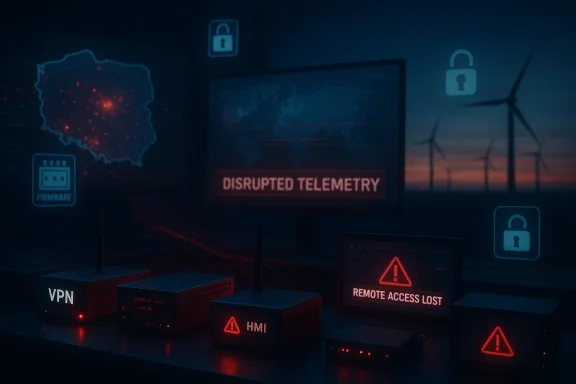
On December 29, 2025, a coordinated campaign targeted more than 30 distributed energy resource (DER) sites — primarily wind and photovoltaic grid‑connection substations — plus a large combined heat‑and‑power (CHP) plant and an industrial manufacturing site. Adversaries used internet‑exposed edge appliances (notably VPN/firewall gateways and web management interfaces) and default or weak credentials to move into OT environments, where they deployed destructive tools that overwrote files, corrupted firmware, reset network devices to factory state, and disabled HMIs and remote terminal units (RTUs). Although generation continued at many renewable sites, operators lost view and remote control of stations; at some locations hardware and firmware changes caused devices to fail or require replacement.
The incident is notable for scale, target selection (distributed renewable assets, not just centralized transmission), and the combination of IT and OT destructive techniques — including custom wipers and unsigned firmware uploads that left some devices permanently inoperative. Multiple trusted incident responders and vendors independently analyzed the activity and confirmed the core facts: internet‑exposed edge devices were the principal initial attack surface; default credentials and absent multi‑factor authentication (MFA) were exploited; and the destructive phase included both Windows‑based wipers and targeted corruption of industrial device firmware.
Importantly, several researchers observed evidence of long‑term reconnaissance and staged preparation — a hallmark of sophisticated state or nation‑level operations — but some destructive scripts and wiper functions also contained artifacts that could have been generated by automated code‑generation tools. Where a vendor or report makes a claim that cannot be verified from public technical artifacts (for example, assertions of AI/LLM‑generated segments), treat those as plausible hypotheses rather than settled fact.
Nevertheless, the Poland incident shows that the cost of inaction — device bricking, permanent hardware replacement, manual configuration labor, prolonged loss of remote control, and reputational damage — can far exceed planned upgrade investments. Management and board‑level understanding must shift from viewing OT cybersecurity as optional to treating it as a core operational expense that directly protects uptime, safety, and customers.
Operators that treat OT security as a checkbox or an afterthought will remain vulnerable. Those who adopt a prioritized, pragmatic program — starting with eliminating internet‑exposed management surfaces, enforcing MFA, replacing EOS edge devices, enabling firmware integrity checks, and rehearsing worst‑case recovery scenarios — will materially reduce the odds that a similar campaign leaves them blind, stranded, or forced into expensive hardware replacements.
This is not a problem that can be deferred. The energy network’s increasing reliance on distributed assets makes each remote substation a potential target. The time to act is now: replace unsupported edge devices, enforce secure defaults, harden remote access, and assume that the next destructive campaign will target precisely the kinds of weak links exposed in Poland.
Source: CISA Poland Energy Sector Cyber Incident Highlights OT and ICS Security Gaps | CISA
 Background: what happened, in plain terms
On December 29, 2025, a coordinated campaign targeted more than 30 distributed energy resource (DER) sites — primarily wind and photovoltaic grid‑connection substations — plus a large combined heat‑and‑power (CHP) plant and an industrial manufacturing site. Adversaries used internet‑exposed edge appliances (notably VPN/firewall gateways and web management interfaces) and default or weak credentials to move into OT environments, where they deployed destructive tools that overwrote files, corrupted firmware, reset network devices to factory state, and disabled HMIs and remote terminal units (RTUs). Although generation continued at many renewable sites, operators lost view and remote control of stations; at some locations hardware and firmware changes caused devices to fail or require replacement.The incident is notable for scale, target selection (distributed renewable assets, not just centralized transmission), and the combination of IT and OT destructive techniques — including custom wipers and unsigned firmware uploads that left some devices permanently inoperative. Multiple trusted incident responders and vendors independently analyzed the activity and confirmed the core facts: internet‑exposed edge devices were the principal initial attack surface; default credentials and absent multi‑factor authentication (MFA) were exploited; and the destructive phase included both Windows‑based wipers and targeted corruption of industrial device firmware.
Overview: why this is a wake‑up call for energy operators
- Edge appliances are high‑value pivot points. Firewalls, SSL‑VPN endpoints, serial‑to‑Ethernet gateways, and remote access appliances commonly integrate with identity and monitoring systems and often have privileged network reach into OT zones. When these devices are internet‑exposed and not hardened, attackers get a fast lane into control networks.
- Distributed energy resources expand the attack surface. DERs are geographically dispersed and frequently managed remotely. Many DER grid‑connection points lack mature OT security controls (segmentation, hardened management interfaces, asset management), making them easier to probe and exploit at scale.
- Basic cyber‑hygiene failures have catastrophic outcomes. The incident demonstrates that default credentials, disabled security features, end‑of‑support firmware, and absent firmware verification are not theoretical risks — they enabled destructive outcomes in live control systems.
- Destructive cyber sabotage is real and repeatable. The tools and tactics observed — mass deployment of wipers, firmware corruption, and device factory resets — are explicit sabotage techniques, not mere espionage or ransomware. Recovery can require lengthy hardware replacement, manual device reconfiguration, and coordination with vendors.
The technical anatomy of the attack: a concise reconstruction
Initial access: internet‑facing edge devices
Attackers gained entry primarily through internet‑exposed edge appliances acting as VPN/firewall termination points and management interfaces. In multiple cases the appliances allowed authentication without MFA, and in several devices default or weak credentials were present. Edge devices with public management interfaces and outdated firmware enabled lateral movement into corporate and OT networks.Reconnaissance and credential harvesting
Once inside, adversaries conducted internal network discovery, harvested credentials (including domain and local admin accounts), and established persistence. Evidence indicates reconnaissance and intermittent access may have occurred across months prior to the destructive events, enabling preparatory mapping of OT zones and identification of reachable RTUs, HMIs, protection relays, and serial device servers.Lateral movement into OT and destructive staging
Armed with valid credentials and persistent footholds, attackers moved into control networks and targeted specific device classes: RTUs (remote terminal units), protection relays, HMIs, and serial server devices. They disabled or bypassed vendor‑recommended protections in some units (for example, unsigned firmware update protections being disabled) and prepared destructive payloads.Destructive phase: wipers, corrupted firmware, factory resets
The campaign’s destructive actions included:- Uploading corrupted or malicious firmware to RTUs, causing boot failures or persistent misbehavior.
- Deploying wiper malware on Windows hosts hosting HMI software, destroying files and rendering visualization/control workstations inoperative.
- Resetting serial device servers to factory defaults and reassigning IP addresses, delaying recovery and manual reconnection.
- Disabling or wiping device configuration files on protection relays and other controllers.
Attribution and uncertainty: what vendors and responders say
Multiple incident responders and vendors have examined the tooling and infrastructure used in the operation. Some telemetry and TTP overlap with known Russia‑linked activity clusters (variously tracked by different vendors under names like Sandworm, Electrum, Static Tundra, or Berserk Bear). However, formal attribution differs among analysts: some attribute with medium confidence to one actor, while CERT Polska’s own report references overlaps with multiple historical clusters. Attribution in complex, multi‑stage OT sabotage is often probabilistic; technical overlaps in infrastructure and malware families provide leads, but geopolitical analysis and intelligence correlation are needed for higher‑confidence attribution. Energy operators should treat attribution as informative but not dispositive for immediate mitigations.Importantly, several researchers observed evidence of long‑term reconnaissance and staged preparation — a hallmark of sophisticated state or nation‑level operations — but some destructive scripts and wiper functions also contained artifacts that could have been generated by automated code‑generation tools. Where a vendor or report makes a claim that cannot be verified from public technical artifacts (for example, assertions of AI/LLM‑generated segments), treat those as plausible hypotheses rather than settled fact.
What went wrong: catalogue of common failures
- Default credentials and weak password hygiene on OT devices and supporting network appliances.
- Internet‑exposed edge devices with management interfaces open to public networks and lacking MFA.
- End‑of‑support (EOS) or outdated firmware/software on edge and OT devices, leaving known CVEs unpatched.
- Security features in OT devices (such as firmware signature verification) disabled or unavailable.
- Poor segmentation between IT and OT zones; inadequate controls on VPN termination points.
- Lack of centralized asset inventories and automated discovery for distributed devices.
- Overreliance on remote access without hardened jump hosts and OT‑centric access controls.
- Insufficient tabletop exercises covering scenarios where RTUs and HMIs are inoperative.
Strengths shown during the response
Despite the destructive intent, several positive factors limited operational impact:- Endpoint detection and response (EDR) tools caught and blocked some wiper activity in the CHP plant, preventing full destructive impact.
- Operators and incident response teams were able to isolate affected substations and implement manual control where necessary, avoiding large‑scale blackouts or heat supply disruptions.
- Collaboration among national CERT, vendors, and operators enabled rapid technical analysis and the dissemination of indicators of compromise and mitigations.
- The resilient design of grid operations (redundant capacity and central transmission backbone) prevented localized device failures from cascading into a system‑wide outage.
Immediate, practical mitigations energy operators must prioritize now
Operators should treat the Polish incident as a template for what adversaries will attempt elsewhere. These actions should be prioritized and executed with urgency.- Change default credentials and enforce strong local passwords on all OT devices now.
- Enforce multi‑factor authentication (MFA) on all remote access (VPN, web management, RDP/SSH portals) that touch control networks.
- Inventory and remediate end‑of‑support edge devices: replace EOS devices or apply vendor‑provided compensating controls. Follow lifecycle deadlines and prioritization for internet‑exposed appliances.
- Disable unnecessary public‑facing management interfaces. Where remote access is needed, use hardened jump hosts or bastion hosts that log and control sessions.
- Enable and verify firmware signature verification on OT devices where supported; upgrade devices to firmware that supports signature checks.
- Implement network segmentation and micro‑segmentation: strictly control flows between the enterprise, DMZ, and OT layers, and between OT subnets.
- Harden device configurations using vendor hardening guides and benchmark controls; disable default service accounts (e.g., FTP/service accounts) and enforce least privilege.
- Maintain known‑good configuration backups and offline configuration repositories for RTUs, protection relays, HMIs, and serial servers; validate backups regularly.
- Develop and rehearse Incident Response plans that explicitly address inoperative OT devices — assume some devices may be irretrievably damaged and plan manual and replacement procedures accordingly.
- Deploy OT‑aware detection: collect and retain logs for OT protocols, monitor for abnormal configuration changes, and instrument serial device traffic monitoring where feasible.
- Enforce vendor and integrator contract clauses that require secure‑by‑default configurations, minimal open services, credential change enforcement at commissioning, and signed firmware update mechanisms.
A recommended recovery and resilience checklist (step‑by‑step)
- Isolate affected segments to prevent further lateral spread and preserve forensic evidence.
- Preserve volatile logs and device configuration backups before rebooting or power cycling devices (when possible and safe).
- Switch to manual or local control procedures per operational continuity plans if remote control is lost.
- Use authenticated, out‑of‑band channels with vendors to validate firmware, configuration integrity, and potential recovery steps.
- If firmware is corrupted and devices cannot verify signatures, treat the device as compromised; follow rebuild/replace procedures rather than trusting possibly tampered firmware.
- Reset exposed edge device credentials and reconfigure remote access behind hardened jump hosts and MFA.
- Rotate domain and privileged credentials exposed during the incident; treat compromised accounts as fully controlled by the adversary until proven otherwise.
- Reconstruct timeline and TTPs for post‑incident lessons and to support threat‑intelligence assessments and law‑enforcement coordination.
- Conduct a post‑incident patch & hardening campaign: prioritize edge devices with external exposure, then OT controllers and HMIs.
- Run recovery exercises that simulate permanent device loss (RTU/HMI unrecoverable) to refine DR playbooks and vendor SLAs for replacement hardware.
Long‑term strategic recommendations for energy policy and procurement
- Mandate secure‑by‑default configurations in procurement contracts. Require vendors to ship devices with management interfaces disabled or protected, default accounts removed, and strong password enforcement at first boot.
- Require signed firmware and secure update mechanisms in all OT procurement; prioritize replacing devices that do not support firmware signature verification.
- Build asset lifecycle and replacement budgets that accommodate periodic edge refresh cycles; technical debt at the edge is a national critical‑infrastructure risk.
- Enforce MFA as a standard for any remote administrative access across regulated utilities and energy suppliers.
- Encourage or require participation in coordinated vulnerability disclosure and vendor PSIRT (Product Security Incident Response Team) processes; institute mandatory vulnerability patching SLAs for critical OT vendors.
- Incentivize and fund OT‑specific threat hunting and SOC capabilities that have the tooling and OT protocol expertise to detect subtle reconnaissance inside OT networks.
- Promote cross‑sector exercises that involve vendors, DSOs, national CERTs, and government ministries to rehearse sabotage and extensive device replacement scenarios.
The business reality: tradeoffs, costs, and hard choices
Replacing EOS edge devices, upgrading RTU firmware, and instituting robust MFA and segmentation are not free. Utilities and distributed generators face budget, availability, and operational window constraints. Firmware and appliance upgrades can change network behavior, which risks unintended outages if rushed.Nevertheless, the Poland incident shows that the cost of inaction — device bricking, permanent hardware replacement, manual configuration labor, prolonged loss of remote control, and reputational damage — can far exceed planned upgrade investments. Management and board‑level understanding must shift from viewing OT cybersecurity as optional to treating it as a core operational expense that directly protects uptime, safety, and customers.
Risks and open questions operators should watch closely
- Signed firmware gaps: Some legacy devices simply do not support firmware signature verification. Replacing or isolating such devices must be prioritized or compensated with robust compensating controls.
- Supply chain and vendor readiness: Device replacement at scale may be bottlenecked by spare‑parts availability and vendor timelines. Operators should coordinate with vendors now to understand lead times.
- Attribution uncertainty: While signs point to high‑skill threat actors with OT experience, attackers using commodity tools or copycats could replicate destructive techniques. Don’t assume only nation‑state actors can deploy wipers and firmware corruption.
- Use of AI/LLMs: Analysts noted that parts of destructive scripts resemble code that could be generated by automated tools. Whether LLMs materially lowered the attacker's bar is an open question, but defenders must assume easily available automation can accelerate destructive campaign engineering.
- Legal/regulatory pressure: Expect regulators and national CERTs to increase mandatory reporting, audits, and minimum security standards for DER operators and energy suppliers. Prepare compliance programs accordingly.
What energy sector security teams should do this week
- Run an immediate check for internet‑exposed management interfaces and VPN endpoints. If a management interface is publicly accessible, either harden it behind MFA and jump hosts or remove direct exposure immediately.
- Force a credential rotation for all device default accounts and ensure integrator credentials are revoked or changed.
- Validate that EDR/EDR‑like controls covering HMI hosts are active and detecting suspicious wiper or file‑overwrite behaviors. If EDR is not present on system hosts, treat the risk as high.
- Identify all devices that do not support firmware signature verification; add them to a high‑priority replacement or compensating control list.
- Contact vendors for firmware/patch guidance and escalate for emergency fixes on devices with publicly known exploited CVEs.
- Test manual control and local HMIs at representative DER sites to ensure operators can safely continue operations without remote supervision.
Final analysis: a shifting battlefield for OT defenders
The Poland incident should reshape how the energy sector prioritizes security investments. Attackers have shown an appetite for targeting distributed grid components and the know‑how to render ICS edge devices unusable through a combination of credential abuse, firmware corruption, and Windows‑hosted wipers. The technical sophistication lies not only in exotic zero‑days but in disciplined exploitation of basic misconfigurations, poor credential hygiene, unsupported edge gear, and disabled security features.Operators that treat OT security as a checkbox or an afterthought will remain vulnerable. Those who adopt a prioritized, pragmatic program — starting with eliminating internet‑exposed management surfaces, enforcing MFA, replacing EOS edge devices, enabling firmware integrity checks, and rehearsing worst‑case recovery scenarios — will materially reduce the odds that a similar campaign leaves them blind, stranded, or forced into expensive hardware replacements.
This is not a problem that can be deferred. The energy network’s increasing reliance on distributed assets makes each remote substation a potential target. The time to act is now: replace unsupported edge devices, enforce secure defaults, harden remote access, and assume that the next destructive campaign will target precisely the kinds of weak links exposed in Poland.
Source: CISA Poland Energy Sector Cyber Incident Highlights OT and ICS Security Gaps | CISA
