

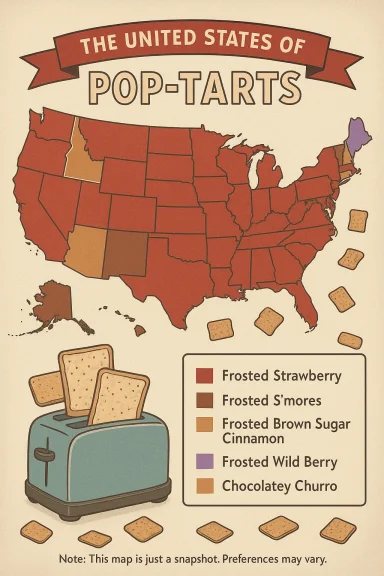
America still has strong opinions about its toaster pastries: according to a nationwide survey published as “The United States of Pop‑Tarts,” Frosted Strawberry is the single most popular Pop‑Tarts flavor across the most states, while regional tastes send Frosted S’mores and Frosted Brown Sugar Cinnamon into distant second and third place in the national map of pastry preferences.
The map and state‑by‑state breakdown that circulated widely in spring 2024 originated with a CasinoReviews survey of 2,000 Americans in March 2024 and was republished, with commentary, by consumer sites including Cheapism and AOL. The study asked respondents about frequency of Pop‑Tarts consumption, whether they prefer them toasted or straight from the box, and which flavor they favored in their state. The raw headlines — “Frosted Strawberry wins,” “New Mexico eats Pop‑Tarts the most” — traveled fast through lifestyle and local news outlets.
What’s in the dataset:
Why that matters to flavor maps:
Industry‑level data and product movement reporting tell a complementary story: the Pop‑Tarts lineup changes frequently, with discontinued flavors returning or being retired, and recent product revivals (e.g., Chocolate Chip Cookie Dough) illustrate how manufacturer decisions and fan demand can reshape the available flavor set. These retail realities affect survey outcomes and mean that flavor maps are inherently ephemeral unless matched to sales or distribution data.
For readers hungry for the truth behind their favorite toaster pastry: if your state “lost” to Strawberry on the map, don’t panic. Your local shelves, club stores, and a little online sleuthing are better guides to what’s actually being bought and eaten where — and, if the flavor you want is discontinued, fan campaigns have forced beloved comebacks before. Treat the map as a conversation starter, and when you next push your Pop‑Tart into the toaster (or eat it straight from the foil), remember that food tastes are local, personal, and often delightfully inconsistent.
Source: AOL.com This Is the Most Popular Pop-Tarts Flavor in Your State
 Background / Overview
The map and state‑by‑state breakdown that circulated widely in spring 2024 originated with a CasinoReviews survey of 2,000 Americans in March 2024 and was republished, with commentary, by consumer sites including Cheapism and AOL. The study asked respondents about frequency of Pop‑Tarts consumption, whether they prefer them toasted or straight from the box, and which flavor they favored in their state. The raw headlines — “Frosted Strawberry wins,” “New Mexico eats Pop‑Tarts the most” — traveled fast through lifestyle and local news outlets.What’s in the dataset:
- The survey sample size was 2,000 respondents with a reported median age of 35 and gender split noted as ~37% male, ~61% female, and ~2% non‑binary.
- Consumption frequency results: roughly 60% reported they rarely eat Pop‑Tarts, 25% eat them a few times a month, 7% once a week, 6% a few times a week, and 2% daily.
- States that reported the highest share of Pop‑Tarts eaters included New Mexico (52%), Tennessee (46%), and Michigan (39%), among others.
What the survey actually found
National headline results
- Most popular flavor by number of states: Frosted Strawberry comes out on top, occupying the lead spot in more states than any other flavor. That pattern was consistent in the CasinoReviews reporting and the Cheapism/AOL republishing.
- Second and third: Frosted S’mores and Frosted Brown Sugar Cinnamon were the next most frequently selected front‑runners across states, each dominating clusters of states and reflecting a national split between very sweet chocolate/novelty tastes and the classic cinnamon comfort profile.
- Consumption frequency: The big picture is that Pop‑Tarts remain a casual snack for most Americans — the majority say they eat them rarely. Only a very small slice report daily consumption. That suggests Pop‑Tarts remain anchored in nostalgia and occasional snacking rather than everyday breakfast rituals for most households.
Regional quirks and curiosities
- Some states favored unexpected choices: Maine alone selected Wild Berry, South Dakota favored Unfrosted Blueberry, and Rhode Island’s top pick on the map was Chocolatey Churro — a flavor many outlets and shoppers note as discontinued or at least rare in the market. These one‑state outliers are eye‑catching but require extra caution before drawing broad conclusions.
- The “most Pop‑Tarts‑eating states” — New Mexico, Tennessee, Michigan, South Carolina, Louisiana — suggest clusters in the South and parts of the Midwest where packaged sweet snacks retain stronger purchase frequency, but that pattern can be driven by many factors beyond mere flavor preference: promotional activity, local availability, cultural snack habits, and even small sample noise.
How reliable is the study? Methodology, sample size, and the limits of state‑level claims
Strengths of the dataset
- A 2,000‑respondent national survey is a reasonable starting point for identifying broad trends in consumer snack preferences. The survey produced easily digestible categorical results (frequency, toasting preference, top flavor), which work well for lifestyle journalism and shareable maps. The authors also published demographic summary statistics, which is better practice than many viral listicles.
- The study tapped into a timely cultural hook — the renewed public conversation about Pop‑Tarts spurred by media attention and product comebacks — giving the findings newsworthiness that lifestyle outlets could amplify rapidly.
Key limitations and risks to interpretation
- Sample size per state is small and likely uneven. A 2,000‑person national sample divided across 50 states does not guarantee robust state‑level estimates — particularly for states with smaller populations or fewer respondents. When you see a flavor “leading” a state, that could be the result of a handful of respondents in that state, not a statistically stable majority preference. This is the single largest caveat readers should hold in mind.
- Potential sampling bias. CasinoReviews is not an academic polling organization; the survey methodology (panel provider, weighting strategies, recruitment modality) is not fully reported at the level of detail social‑science journals require. The published demographics show a skew toward female respondents (61%) and a median age of 35, which can influence flavor profiles — women and younger adults may have systematically different tastes or willingness to report novel flavors. Without transparent sampling and weighting details, state‑level claims should be treated as indicative rather than conclusive.
- Question framing and flavor list matters. How questions are phrased — whether respondents selected from a fixed list of flavors or provided free responses — affects outcomes. Also, the retail availability of certain flavors varies by region and over time; discontinued or limited‑run flavors can produce deceptive results if a small group of collectors or local convenience stores skew choice options. The CasinoReviews write‑up includes a flavor list used in the map, but the details of how missing or discontinued flavors were handled are not exhaustively documented.
- Temporal volatility and seasonal items. Pop‑Tarts cycles flavors regularly (limited‑time offerings, seasonal runs, and reintroductions). What is available in February might not be available in August, and local promotional cycles (club stores, regional launches) can create temporary spikes. That makes a single month’s survey a snapshot, not a durable measurement. See the brand’s history of discontinuations and reappearances for examples.
Why certain flavors cluster regionally: supply, nostalgia, and marketing
Availability and distribution
Not all flavors are equally available across all retail channels. National supermarkets tend to stock the core lineup — Strawberry, Brown Sugar Cinnamon, Blueberry, S’mores — while more experimental flavors appear in limited regions, club stores, or limited‑time promotions. Local stocking decisions by distribution centers, regional promotions at grocery chains, and club‑store bulk sales can all shape what shoppers see on the shelf and therefore what they choose when polled. This partly explains why some states show surprising favorites: a discontinued or test flavor that was briefly available in one region can register as that state’s top pick among a small sample.Nostalgia and habit formation
Pop‑Tarts is a nostalgia brand. The product’s cultural identity — childhood breakfasts, dorm room snacks, convenience for busy parents — biases many consumers toward comfort flavors. Frosted Strawberry benefits from this nostalgia premium: it’s both an archetypal Pop‑Tart and a widely distributed SKU. Brown Sugar Cinnamon and blueberry variants resonate with “warm breakfast” associations, which explains their strength in regions where baked breakfast traditions are culturally significant.Marketing, seasonal drops, and social media
Product socialization matters. Viral social posts, limited drops tied to pop culture moments, and collaborations can rapidly boost awareness for a flavor in specific demographics or geographies. Pop‑Tarts regularly rotates novelties and sometimes brings back discontinued flavors after fan campaigns; those promotional spikes will influence survey responses gathered during or shortly after the campaign. Recent product revivals show the brand’s responsiveness to fan demand, but they also increase noise in short‑term preference measures.The business context: who makes Pop‑Tarts and what industry moves matter
Understanding brand ownership and market strategy helps interpret flavor availability and longevity. Pop‑Tarts sits within the snacking portfolio of Kellanova (the company that was formerly the Kellogg Company’s global snacks operation). Kellanova completed its separation in October 2023 and manages brands including Pop‑Tarts, Pringles, and Cheez‑It. Industry consolidation continued into 2024 when a major acquisition of Kellanova was announced and advanced through regulatory reviews. These corporate moves can shift priorities for flavor innovation, distribution strategy, and product investment.Why that matters to flavor maps:
- After mergers or acquisition announcements, companies often adjust SKU assortments, prioritize core sellers in certain channels, and rationalize limited‑run flavors to reduce complexity. That can affect which flavors remain in circulation and where test SKUs roll out.
- Promotional budgets and trade terms with large retail chains can shift rapidly after corporate deals, changing what consumers find on shelves and how often flavors are restocked.
What the map says — and what it doesn’t
What it does:
- Offers a fun, shareable snapshot of self‑reported favorites that highlights the continued cultural presence of Pop‑Tarts in American life.
- Identifies Frosted Strawberry as the most frequently named state favorite in the sample, and shows Frosted S’mores and Brown Sugar Cinnamon as strong national contenders.
- Gives local outlets an engaging human interest angle (and readers a chance to argue about their state’s choices).
What it doesn’t:
- Prove majority preference within states — the dataset isn’t robust enough to claim that “a majority of Californians prefer Strawberry” or similar majoritarian conclusions without a more rigorous, state‑level sample design.
- Control for retail availability, promotional artifacts, or temporal changes in flavor distribution.
- Replace sales data. Unit sales by SKU across retailers would be a more reliable measure of true consumer behavior than a short online poll. Industry and retail scan data — the kinds of datasets companies use to manage SKU assortment — are not part of this public survey.
Cross‑checking the claims: what other outlets found
Multiple lifestyle outlets republished or summarized the CasinoReviews results; Cheapism and AOL were among the most visible republishers, both echoing the headline that Frosted Strawberry leads the state map and repeating the consumption frequency breakdown. Independent lifestyle reporting from The Daily Meal and local news sites also reran the chart and emphasized the same set of flavor winners and high‑consumption states. That consistency across outlets shows strong amplification of a single dataset but does not independently verify the population‑level accuracy.Industry‑level data and product movement reporting tell a complementary story: the Pop‑Tarts lineup changes frequently, with discontinued flavors returning or being retired, and recent product revivals (e.g., Chocolate Chip Cookie Dough) illustrate how manufacturer decisions and fan demand can reshape the available flavor set. These retail realities affect survey outcomes and mean that flavor maps are inherently ephemeral unless matched to sales or distribution data.
Practical takeaways for readers and snack brand watchers
- Read these maps as entertaining social data, not definitive market measurement. They’re great conversation starters; they’re weak as inputs for supply chain, inventory, or marketing decisions.
- If you care about flavor availability in your own region, your best evidence is local store shelves and club channels: flavor revivals and retirements often appear first in specific retailers, and scarcity may give the false impression of strong local preference when the reality is a temporary promotional run.
- For journalists and analysts: triangulate social or survey maps with scan data, retail sell‑through, and distributor reports before reporting “state favorites” as settled fact. Publicly shared surveys without transparent weighting and recruitment details should be labeled clearly as indicative snapshots.
The marketing and product risk landscape for Pop‑Tarts
From a corporate and consumer perspective, Pop‑Tarts faces familiar packaged‑food dilemmas:- SKU complexity risk. Maintaining many limited‑run or regional flavors increases manufacturing complexity and shelf clutter. Retail partners often favor predictable core SKUs with proven velocity. That creates pressure on snack makers to prune less profitable flavors, which disappoints fan communities but improves supply‑chain economics. Evidence: recent rounds of discontinuations and comebacks across the Pop‑Tarts line.
- Reputation and nostalgia management. Pop‑Tarts’ identity depends on balancing innovation (novel flavors to attract social attention) and heritage (the core flavors that drive repeat purchase). Missteps — pulling beloved variants without clear communication or over‑relying on gimmicks — can erode brand trust among loyalists even while generating short‑term buzz.
- Consolidation effects. Large mergers and acquisitions in the snacking industry can reshape priorities. When brand owners undergo ownership changes, the new corporate strategy may favor global winners over niche, regional SKUs, affecting local availability. Recent high‑profile corporate moves in this space have that very potential.
Conclusion
The state‑by‑state Pop‑Tarts map is an enjoyable snapshot of American snack preferences: Frosted Strawberry emerges as the most commonly named favorite across states in the published survey, with Frosted S’mores and Frosted Brown Sugar Cinnamon close behind. But the finding is best read as a viral‑worthy cultural chart rather than a definitive market study. Methodological limits — particularly the small and uneven per‑state sample footprint, potential sampling bias, and the fluid availability of flavors — mean the map is more useful for sparking debate than guiding business decisions.For readers hungry for the truth behind their favorite toaster pastry: if your state “lost” to Strawberry on the map, don’t panic. Your local shelves, club stores, and a little online sleuthing are better guides to what’s actually being bought and eaten where — and, if the flavor you want is discontinued, fan campaigns have forced beloved comebacks before. Treat the map as a conversation starter, and when you next push your Pop‑Tart into the toaster (or eat it straight from the foil), remember that food tastes are local, personal, and often delightfully inconsistent.
Source: AOL.com This Is the Most Popular Pop-Tarts Flavor in Your State