

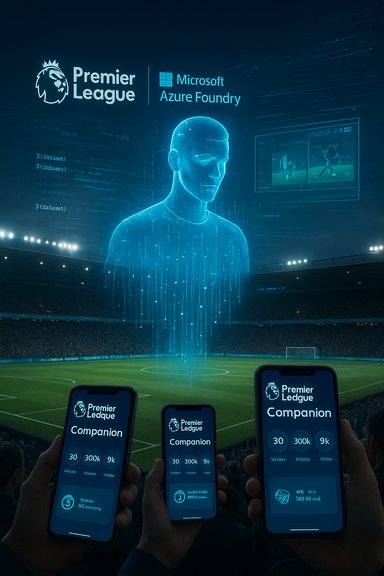
The Premier League has stepped into the generative-AI era with a five‑year strategic partnership with Microsoft that embeds Copilot‑powered experiences across its app, web platforms and broadcast workflows — anchored by a new fan assistant called the Premier League Companion that draws on “over 30 seasons” of stats, 300,000 articles and 9,000 videos to deliver personalized, real‑time insights to fans worldwide.
The deal announced in July positions Microsoft as the Premier League’s official cloud and AI partner and signals a major technology shift: the League will migrate core infrastructure to Microsoft Azure and adopt Microsoft Foundry and Azure OpenAI tooling to underpin new fan experiences, live in‑broadcast overlays and internal productivity improvements. The public launch places the Companion — a Copilot‑branded conversational assistant — at the centre of the fan proposition, available in the official app and on premierleague.com. This initiative comes as the Premier League amplifies its U.S. presence — expanding fan festivals, preseason matches and a dedicated U.S. office to deepen engagement with American audiences — while preparing to capitalise on an anticipated global spike in soccer viewership ahead of the 2026 World Cup. The league and its partners frame AI as the connective tissue that will convert decades of disparate content and match telemetry into conversational, personalized experiences for both seasoned followers and newly converted fans.
However, the difference between a useful product and a public relations exercise will be governance, measurement and humility. The platform’s usefulness will rise or fall on three anchored capabilities: accurate provenance, robust live‑match latency engineering, and transparent governance around rights and privacy. If the League and Microsoft commit to publishing KPIs, allow independent audits, and keep human oversight central — particularly in the early rollouts — the Companion could become a model for how elite sports marry cloud scale with generative AI. If they skip those steps, the project risks eroding fan trust and exposing licensors to legal friction.
The technology is ready; the business case is plausible; the real test will be disciplined execution and measurable transparency as the Companion reaches millions of fans worldwide.
Conclusion
The Premier League Companion is a bold reimagining of how a major sports league can package its archive and live production with generative AI. It leverages a modern Azure‑based stack — Foundry, Azure OpenAI, Databricks and Azure ML — and it promises richer fan interactions, personalized discovery and in‑broadcast insight. The upside is clear: improved retention, new sponsor opportunities and a modern, data‑driven fan product. The downside — hallucinations, legal frictions over content reuse, cost and vendor dependence — is equally real and requires concrete governance, rigorous testing and public KPIs to manage. The next season will show if this is a defining step in sports‑tech productization or a cautionary case in how not to deploy Copilot‑style assistants at global scale.
Source: TechTarget Microsoft helps Premier League fuel fan experience with AI | TechTarget
 Background and overview
The deal announced in July positions Microsoft as the Premier League’s official cloud and AI partner and signals a major technology shift: the League will migrate core infrastructure to Microsoft Azure and adopt Microsoft Foundry and Azure OpenAI tooling to underpin new fan experiences, live in‑broadcast overlays and internal productivity improvements. The public launch places the Companion — a Copilot‑branded conversational assistant — at the centre of the fan proposition, available in the official app and on premierleague.com. This initiative comes as the Premier League amplifies its U.S. presence — expanding fan festivals, preseason matches and a dedicated U.S. office to deepen engagement with American audiences — while preparing to capitalise on an anticipated global spike in soccer viewership ahead of the 2026 World Cup. The league and its partners frame AI as the connective tissue that will convert decades of disparate content and match telemetry into conversational, personalized experiences for both seasoned followers and newly converted fans. What the technology stack actually looks like
The Premier League and Microsoft are not just slapping an LLM on a search box. The architecture they describe is a typical enterprise AI pipeline consisting of:- Data ingestion via APIs from match feeds, editorial archives and video assets.
- Data preparation and ETL using services such as Azure Databricks and Azure Data Factory.
- An AI preparation layer that includes Azure Machine Learning, Microsoft Foundry (Azure AI Foundry / Foundry Models) and Azure OpenAI deployments.
- Production publishing layers and front‑end connectors that serve Copilot interactions in milliseconds to app and web users.
What the Companion does for fans (and what it promises)
The Premier League Companion, as described by the League and Microsoft, targets three connected user outcomes:- Personalized discovery: fans can ask free‑text questions about clubs, players and historic moments, and the Companion synthesizes answers using archival articles, video clips and stats across 30 seasons.
- Real‑time match insight: the stack is intended to ingest live match telemetry so that contextualized stats and overlays can update during games with low latency. Microsoft and the League describe this as near‑real‑time, enabling in‑broadcast enrichment and post‑match analysis.
- Product extensions: the roadmap flagged Fantasy Premier League assistance (AI assistant managers), multilingual Q&A, audio translation and deeper personalization hooks to grow engagement in diverse markets.
Why this matters commercially and strategically
- Scale and retention: a Copilot‑style interface that reliably answers fan questions and surfaces bespoke clips should increase session times, repeat visits and in‑app engagement — the core levers the League uses to grow commercial value for broadcast partners and sponsors.
- Content productization: the migration to Azure and consolidation of editorial, stats and video assets into an indexed fabric makes it easier to productize archive content as search, recommendations and monetizable overlays for broadcast or sponsored integrations.
- Global market focus: with 1.8 billion fans cited in the joint announcements, Microsoft and the League are clearly positioning the product for international scale — multilanguage, regionalized content and personalization are explicit aims. Whether that reach translates into meaningful commercial uplift depends on execution quality and accurate localization.
Verifying the big claims (what checks were possible)
Several of the most prominent technical and quantitative claims in the League’s messaging are verifiable through official sources:- The five‑year, official cloud and AI partnership with Microsoft and the public launch of the Premier League Companion were announced by both the Premier League and Microsoft.
- The Companion’s archive footprint — “over 30 seasons, 300,000 articles and 9,000 videos” — appears in both the Premier League’s own product page and Microsoft’s press release. Those numbers are framed as the League’s data inventory used to seed Copilot outputs.
- The use of Azure Foundry/Foundry Models and Azure OpenAI as core components of the platform is documented on Microsoft’s product pages and matches the technology stack the partners described publicly.
- The Premier League’s push into the U.S. — including a New York international office and fan festivals supported by NBC — has been reported by the League and NBC; NBC has been the league’s U.S. broadcast home since the 2013–14 season, which underpins the U.S. growth narrative.
The engineering and product challenges that will decide success
1. Data heterogeneity and indexing
Thirty seasons of content isn’t just a headline: it’s a complex mix of structured match stats, semi‑structured articles, and unstructured video. Creating accurate index layers and metadata (speaker, timestamp, clip boundaries, rights holder tags) is a major engineering task. How the League normalizes and retains provenance metadata will determine Companion accuracy and legal safety.2. Freshness and live latency
Delivering match‑time insights requires tight latency control. The stack must reliably pass live feeds through ingestion, RAG (retrieval‑augmented generation) layers and into a conversational surface within seconds. Managing caches, fallback logic and regional CDN behavior will be essential, particularly during high‑traffic fixtures. Microsoft and the League claim "near real‑time" updates — that is plausible on Azure, but operational SLAs and stress‑testing will prove whether it holds at scale.3. Hallucination and provenance
Generative models are prone to hallucination. For a sports platform, an incorrect stat, misattributed clip or invented quote will erode trust rapidly. The Companion must attach provenance links, confidence signals and a clear UI label when it synthesizes editorial content — and ideally provide the underlying source (match timestamp, article headline, clip ID) for every factual assertion.4. Data rights and copyright
Using editorial content and broadcast footage inside LLM responses requires careful licensing. The public announcements do not publish the contractual details — we should expect bespoke rights clauses governing summarization, excerpting and global distribution. Without careful rights management, downstream features (e.g., clip extraction for social shares) could face friction with content partners.5. Cost and vendor lock‑in
Large‑scale LLM usage with video indexing and high‑frequency RAG queries is expensive. The partners acknowledge “tension” between cost and performance; caching, model‑routing and hybrid on‑device/off‑cloud strategies will be necessary to control operating costs. The five‑year arrangement also creates vendor dependence; good contract terms must preserve data portability and audit rights.Governance, security and player privacy
The Premier League emphasizes secure stewardship of its data; Microsoft’s enterprise tooling (Azure controls, Purview, Entra, Defender) provides governance primitives. Still, the League must extend governance to:- Player health and biometric telemetry (if ever used): process under strict consent and medical‑ethics frameworks.
- User personalization: comply with global privacy regimes (GDPR, CCPA variants) for storage, profiling and targeting.
- Model audits: continuous accuracy testing and bias evaluations, with public KPIs where consumer trust is material.
Editorial and UX responsibilities
- Label all AI outputs clearly as AI‑generated and include the timestamp and prompt version used.
- Surface provenance inline for factual answers (e.g., "Stat from Opta, 2023/24 matchweek 12").
- Provide "human verification" modes for high‑stakes outputs (e.g., fantasy tips or betting‑adjacent features).
- Localize editorial behavior by region — U.S. fans behave differently to U.K. fans; the League recognizes this and is staffing regional teams to moderate tone and content.
Competition and market context
The Premier League’s move is part of a broader sports‑tech trend: other major leagues and rights holders are entering strategic cloud and AI partnerships — some with Microsoft, some with other hyperscalers. This deal follows similar patterns (cloud migration + AI assistants + archive productization) and will likely accelerate similar investments across football’s ecosystem. The question is not whether AI will be in sports products, but how responsibly it will be implemented.Measurable success criteria the League should publish
For the Companion to be judged a success beyond press headlines, the Premier League and Microsoft should commit to public, auditable KPIs:- Accuracy Rate for Factual Answers — percentage verified against ground truth datasets.
- Provenance Coverage — share of Companion responses that include explicit source links or timestamps.
- Session Lift and Retention — average session time and monthly active user lift after Companion rollout.
- Operational SLAs for Live Features — latency percentiles and match‑day uptime.
- Privacy & Compliance Audits — third‑party verification that personalisation and telemetry meet regulatory requirements.
Practical risks and how they can be mitigated
- Hallucination risk: mitigate with conservative prompting, RAG with strict snippet quotas, and source linking for factual claims.
- Ads / monetization tradeoffs: ensure personalized sponsor activations are opt‑in and non‑intrusive to protect match‑day viewing.
- Cost blowouts: implement model routing and caching, off‑peak batch processing for heavy tasks (e.g., video indexing), and hybrid compute strategies.
- Vendor lock: negotiate robust exit clauses, data export formats and an independent audit right.
What to watch in the next 12–18 months
- Companion accuracy and provenance: Is the app responsibly surfacing sources and stamping confidence levels?
- Live match behavior: Does the Companion reliably update during a match without latency or hallucination spikes?
- Commercial integrations: How the League monetizes overlays and personalized activations, and whether fans feel the balance is fair.
- Published governance: Will the League release the model governance charter, retention policies and third‑party audit results that industry watchers have urged?
Final analysis — opportunity balanced by accountability
This Microsoft‑Premier League partnership is a technically credible and commercially logical next step for a rights holder with a huge archive and a global audience. The combination of Azure infrastructure, Foundry model governance and Copilot UX patterns can create genuinely new fan experiences: conversational access to archives, on‑demand contextual clips, and a personalized fantasy assistant are all realistic product outcomes.However, the difference between a useful product and a public relations exercise will be governance, measurement and humility. The platform’s usefulness will rise or fall on three anchored capabilities: accurate provenance, robust live‑match latency engineering, and transparent governance around rights and privacy. If the League and Microsoft commit to publishing KPIs, allow independent audits, and keep human oversight central — particularly in the early rollouts — the Companion could become a model for how elite sports marry cloud scale with generative AI. If they skip those steps, the project risks eroding fan trust and exposing licensors to legal friction.
The technology is ready; the business case is plausible; the real test will be disciplined execution and measurable transparency as the Companion reaches millions of fans worldwide.
Conclusion
The Premier League Companion is a bold reimagining of how a major sports league can package its archive and live production with generative AI. It leverages a modern Azure‑based stack — Foundry, Azure OpenAI, Databricks and Azure ML — and it promises richer fan interactions, personalized discovery and in‑broadcast insight. The upside is clear: improved retention, new sponsor opportunities and a modern, data‑driven fan product. The downside — hallucinations, legal frictions over content reuse, cost and vendor dependence — is equally real and requires concrete governance, rigorous testing and public KPIs to manage. The next season will show if this is a defining step in sports‑tech productization or a cautionary case in how not to deploy Copilot‑style assistants at global scale.
Source: TechTarget Microsoft helps Premier League fuel fan experience with AI | TechTarget
