

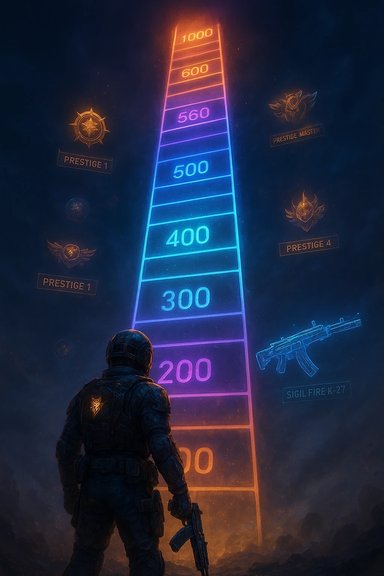
Prestige Master in Call of Duty: Black Ops 7 transforms what many players assumed would be a finish line into the gateway for the game’s deepest grind — extending progression from the classic prestige reset into a 56-to-1,000 level ladder with new cosmetics, title challenges, level colors, and long-term goals that will define the next year of competitive and casual play.
The return of a classic prestige system has been a recurring theme across recent Call of Duty releases, and Black Ops 7 leans into that legacy while expanding it. Instead of a single prestige reset that wipes players back to level 1, Black Ops 7 awards ten base prestige tiers culminating in Prestige Master. Reaching Prestige Master — achieved when a player hits Level 56 at Prestige 10 — does not drop progression back to level 1; it instead unlocks a continuous level range from Level 56 through Level 1,000, creating a long-form climb that’s as much about profile customization as it is about sheer time investment.
This structure is deliberately designed to reward time spent, give completionists new milestones, and provide showpiece cosmetics for players who want permanent on-profile signals of their dedication. The system also borrows and iterates on features introduced in Black Ops 6, while adding new meta layers that aim to keep veteran players engaged beyond the usual seasonal churn.
This has several direct gameplay and UX implications:
The ultimate marker, Prestige Legend, is earned at Level 1,000 and grants one of the most exclusive titles and themed cosmetics the game currently offers. For the vast majority of the player base, Prestige Legend is aspirational, not realistic — intentionally so.
Benefits of Level Colors:
Mechanics and notable properties:
Community threads and discussion hubs reveal a few consistent themes:
For players who enjoy long-form progression and profile customization, Prestige Master is a rich, marriage of purpose and spectacle. For developers and community managers, the challenge is to shepherd that system so it incentivizes healthy play, discourages illicit shortcuts, and fairly rewards investment without becoming a pay-to-win or pay-to-showcase ecosystem.
Source: Windows Central https://www.windowscentral.com/gami...7-all-the-rewards-new-challenges-and-unlocks/
 Background
The return of a classic prestige system has been a recurring theme across recent Call of Duty releases, and Black Ops 7 leans into that legacy while expanding it. Instead of a single prestige reset that wipes players back to level 1, Black Ops 7 awards ten base prestige tiers culminating in Prestige Master. Reaching Prestige Master — achieved when a player hits Level 56 at Prestige 10 — does not drop progression back to level 1; it instead unlocks a continuous level range from Level 56 through Level 1,000, creating a long-form climb that’s as much about profile customization as it is about sheer time investment.This structure is deliberately designed to reward time spent, give completionists new milestones, and provide showpiece cosmetics for players who want permanent on-profile signals of their dedication. The system also borrows and iterates on features introduced in Black Ops 6, while adding new meta layers that aim to keep veteran players engaged beyond the usual seasonal churn.
Overview: What Prestige Master Gives You Immediately — and Over Time
Reaching Prestige Master triggers an immediate unlock package and then opens a reward cadence that continues up to Level 1,000. The most headline-grabbing items and mechanics to know about:- Immediate unlocks at Level 56 (Prestige Master trigger) include an Operator skin (themed to the prestige tier) and the Prestige Master title badge.
- Progress continues from Level 56 rather than restarting at Level 1, meaning all XP gains immediately continue toward higher Prestige Master levels.
- Permanent unlocks: once Prestige Master is achieved, all weapons and scorestreaks remain permanently unlocked at the account level; weapon attachments, however, continue to be governed by the separate individual Weapon Prestige progression.
- Sigil Fire AK-27 Blueprint appears near the early Prestige Master ladder (commonly reported at Level 90) as a mid-tier cosmetic reward.
- Level Colors are a new cosmetic visibility feature, unlocked across the Prestige Master ladder and selectable to display the player’s level in different colors in lobbies and leaderboards.
- Prestige Master Title Challenges unlock starting at Level 100 (and periodically thereafter), offering mode-specific challenges that grant substantial XP rewards and custom titles when completed.
- Legacy prestige icons from earlier Call of Duty titles unlock at Level 100 and recur every 100 levels, providing retro aesthetic choices to swap into a player’s profile marker.
- The endgame — Prestige Legend: the grind stretches to Level 1,000, where the Prestige Legend title (and additional high-tier rewards) await the handful of players who complete the entire ladder.
Deep Dive: The Prestige Master Reward Schedule and What to Expect
What triggers Prestige Master and why the Level 56 anchor matters
The Prestige Master milestone arrives at Level 56 of Prestige 10, which practically means players who fully cycle through the standard prestige tiers reach a point where the game stops resetting and starts expanding. The decision to anchor Prestige Master at Level 56 (instead of forcing a reset) acknowledges the fatigue many players felt in older prestige systems and instead rewards cumulative effort.This has several direct gameplay and UX implications:
- Players keep momentum; there’s no forced recovery period after prestiging.
- Long-term rewards are additive rather than replacement-based.
- Cosmetic unlocks and profile features become primary motivators after core weapon unlocks are secured.
The ladder from Level 56 to Level 1,000: cadence and highlights
Cosmetics and profile rewards are spread across the ladder at regular intervals. Expect item drops every few levels — normally spaced between 5 and 25 levels — including:- Operator skins and themed cosmetics
- Loading screens and calling cards
- Large decals, emblems, and weapon charms
- Blueprint weapons (example: the Sigil Fire AK-27)
- Color unlocks for the displayed level number
- Title Challenges and prestige icons on a 100-level cadence
Legacy platforming: Classic Prestige Icons and Prestige Legend
At every 100-level milestone — Level 100, 200, 300, and so on — players can access legacy prestige icons pulled from previous Call of Duty titles. These function as profile cosmetics and nostalgia triggers, allowing players to adopt a visual marker that harkens back to classic entries in the franchise.The ultimate marker, Prestige Legend, is earned at Level 1,000 and grants one of the most exclusive titles and themed cosmetics the game currently offers. For the vast majority of the player base, Prestige Legend is aspirational, not realistic — intentionally so.
Title Challenges and Level Colors: The New Meta of Profile Play
How Level Colors work
Level Colors let players change the display color of their level number in lobbies and leaderboards. These colors unlock progressively through the Prestige Master ladder, with animated and multi-color options available at higher bands. Level Colors are mostly automatic — they unlock at a given tier and can then be equipped in the profile customization menu.Benefits of Level Colors:
- Instant visual flex in lobbies and leaderboard listings
- A simple cosmetic way to broadcast status without needing rare skins equipped
- Opportunity to mix-and-match with legacy icons and titles for a personalized profile
Title Challenges: a new challenge layer with XP incentives
Title Challenges are a major addition to the prestige system, unlocking at Level 100 and every 100 levels afterward. Each challenge set is mode-specific (Multiplayer, Zombies, Campaign, Warzone) and provides a unique title on completion.Mechanics and notable properties:
- Title Challenges only begin tracking progress once unlocked. Any eliminations, matches, or kills accrued prior to unlocking a specific Title Challenge do not retroactively count toward that challenge.
- Challenges scale wildly in difficulty — from achievable tasks (100 Contracts completed in Warzone, for example) to borderline absurd milestones (reports of Zombie-focused titles requiring hundreds of thousands of kills).
- Completion of these challenges yields a substantial XP payout, making them an attractive tool for level farming during double-XP events or when stacking tokens.
How Progression Tracking and Weapon Prestige Interact
A critical nuance in the system is the split between account-level progression and item-level prestige:- Weapons and Scorestreaks: once Prestige Master is reached, weapons and scorestreaks are reported to remain permanently unlocked at the account level. This removes a frequent pain point from older systems where prestiging could lock items behind repeat grind cycles.
- Weapon Attachments and Weapon Prestige: attachments still follow individual weapon prestige tiers. That means players leveling their account level won’t automatically max out attachments or weapon-specific unlocks; players must still grind each weapon’s prestige independently.
- Camo and mastery systems: weapon mastery camos and mode-specific camo tracks still exist and contribute to XP, but they are separate progress systems. Mastery camos often require large cross-weapon achievements and can be part of higher-level Title Challenge requirements.
Practical XP Strategies: How to Make the Grind Less Brutal
The Prestige Master ladder rewards time but does not require mindless play. Efficient XP strategies help:- Prioritize modes that stack objective and kill XP: objective modes (Kill Confirmed, Hardpoint, Domination variants) yield consistent per-match XP spikes.
- Time challenges for double-XP events: complete Title Challenges or major camo milestones while double XP or XP tokens are active to maximize level jumps.
- Rotate weapon use to benefit from mastery and weapon-level XP: alternating weapons can net camo and weapon mastery milestones that carry significant XP.
- Use shorter, high-action playlists for rapid XP bursts: small-map playlists with dense action produce consistently higher kills-per-minute and medal chains.
- Focused session structure:
- Warm up (10–15 minutes) with weapon-level tasks
- Chase challenge objectives (30–60 minutes) during double XP
- Swap to Zombies or Warzone for unique challenge progress where applicable
Critical Analysis: Strengths and What Could Go Wrong
Strengths — what the system gets right
- Long-term player retention: the extended ladder gives veteran players persistent goals beyond seasonal battle pass cycles.
- Clear cosmetic reward structure: frequent, visible rewards (colors, icons, titles) provide immediate returns for incremental play.
- No weapon/scorestreak lockouts after Prestige Master: permanently unlocked weapons and scorestreaks at Prestige Master reduce frustration around progress resets.
- Cross-mode engagement: Title Challenges across Multiplayer, Zombies, Campaign, and Warzone push players to engage multiple parts of the game, increasing variety.
- Customization and showmanship: Level Colors, legacy icons, and title slots offer players new ways to display identity in lobbies and leaderboards.
Risks and downsides — where the design may backfire
- Extreme grind and player burnout: some Title Challenges and cumulative milestones are intentionally gargantuan (notably the super high kill counts in Zombies). This can drive fatigue and alienate players who prefer bite-sized milestones.
- Progress retroactivity blindspot: Challenge tracking only from the unlock point is a poor UX choice for players who already amassed significant progress while climbing earlier levels.
- Boosting and illicit services: long, repetitive tasks create fertile ground for boosting services and account-selling markets, which degrade matchmaking quality and community fairness.
- Leaderboards and social tension: visible Level Colors and legacy icons could incentivize toxic behavior or exploitative play as players chase social tokens instead of team objectives.
- Unclear official numbers: several widely circulated numerical claims about XP rewards, top-level reward contents (Level 1,000 classified drops), and exact milestone positions vary by outlet; lack of centralized, consistent official documentation hampers accurate expectations.
Monetization and Competitive Balance: The Unsaid Side
The Prestige Master system clearly emphasizes cosmetics, visibility, and time investment rather than power advantages. Yet the economics around cosmetics, season passes, and XP boosts intersect dangerously with fairness.- Cosmetic-driven prestige systems can be monetized indirectly: players tempted to show status may feel pressure to buy battle pass tiers, XP tokens, or other accelerants.
- XP boosts and tokens are commonly available as microtransaction items or battle pass rewards; stacking these with Title Challenges shortens the ladder but increases spend pressure.
- The permanent weapon/scorestreak unlock policy at Prestige Master mitigates pay-for-power criticism somewhat, but weapon prestiges and attachment grind still deliver gameplay friction that can be eased by paid services or boosts.
Community Response and Real-World Signals
Early reception among veteran players is split. Completionists and streamer personalities welcome the extended ladder and vanity rewards — they create content and bragging rights. Many casual players, however, have voiced concern about the extremity of some Title Challenges and the lack of retroactive tracking.Community threads and discussion hubs reveal a few consistent themes:
- Gratitude for permanent weapon unlocks at Prestige Master.
- Frustration at challenges that only begin tracking after unlock, wiping out prior progress.
- Skepticism about the true value of Level 1,000 rewards — some outlets and fans report classified or mystery rewards, but that remains unconfirmed publicly by the developer at the time of writing.
- Anticipation for seasonal integrations and the potential for developer patches to tweak challenge values and XP payouts.
Safety, Cheating, and Account Risks
The more grind-heavy a title becomes, the more it invites illicit shortcuts. Several practical risks should be highlighted:- Boosting services that offer quick completion of prestige tasks often require account credentials or risky VPN setups — these expose players to account theft, ban risk, and privacy violations.
- Third-party software promising XP multipliers or challenge tracking utilities may carry malware or violate terms of service, risking account suspension.
- Leaderboard exploitation: if legacy icons or Level Colors become a target for resellers, leaderboard integrity and social trust in lobbies can erode.
Recommendations for Players and the Studio
For players
- Treat Prestige Master as a long-term cosmetic roadmap, not a short-term checklist.
- Prioritize challenge completion during official double-XP windows or when tokens are active.
- Avoid third-party boosting services; the long-term risk to accounts and communities outweighs short-term convenience.
- Make cosmetic choices that suit playstyle rather than purely for social signaling — Level Colors and titles are showpieces, not gameplay advantages.
For the developer
- Consider retroactive progress tracking for obvious challenge categories (kills, eliminations) to honor players’ prior efforts and reduce frustration.
- Publish an official, centralized guide to Prestige Master milestones and XP payouts to reduce misinformation and speculation.
- Monitor the market for boosting and take decisive action against services that jeopardize competitive integrity.
- Reassess the most extreme Title Challenges and provide alternate milestone routes for players who prefer variety over grind.
The Long View: Prestige Master as a Design Philosophy
Prestige Master in Black Ops 7 represents a modern blend of legacy prestige mechanics and live-service retention design. It rewards perseverance and offers high-visibility cosmetics that feed community bragging rights. At the same time, the system carries inherent risks typical of extended progression designs: burnout, potential for exploitative services, and unmet expectations if milestone tracking and reward clarity are not handled transparently.For players who enjoy long-form progression and profile customization, Prestige Master is a rich, marriage of purpose and spectacle. For developers and community managers, the challenge is to shepherd that system so it incentivizes healthy play, discourages illicit shortcuts, and fairly rewards investment without becoming a pay-to-win or pay-to-showcase ecosystem.
Conclusion
Prestige Master in Black Ops 7 converts the finish line into a horizon: levels, colors, titles, and famed blueprints stretch the journey to something potentially measured in months or years rather than weeks. The system’s strengths — permanent weapon unlocks at account level, legacy icons, and visible customization — are balanced by tangible risks around grind intensity, tracking mechanics, and community health. With careful tuning, clearer communication about XP and rewards, and proactive anti-boosting measures, Prestige Master can be a long-lived, satisfying pillar of Black Ops 7’s endgame. For now, it is both a trophy case and a calendar: a place where pride and patience meet, and where only the most committed will reach the summit.Source: Windows Central https://www.windowscentral.com/gami...7-all-the-rewards-new-challenges-and-unlocks/
