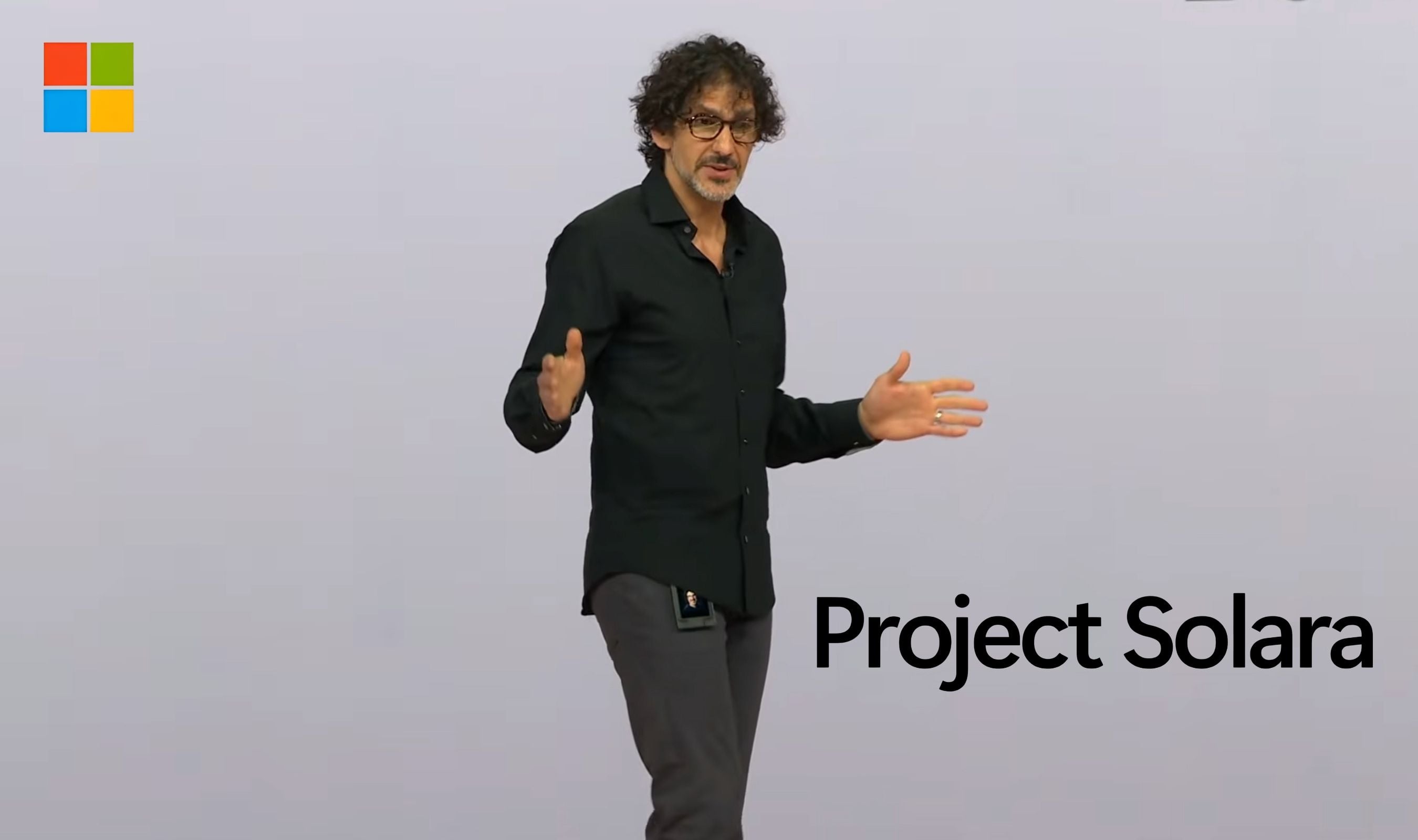
Microsoft unveiled Project Solara at its Build conference in San Francisco on Tuesday, presenting an Android-based device platform for enterprise hardware that runs AI agents rather than conventional apps. The project is early, the hardware is still reference-design territory, and Microsoft says it does not plan to sell the devices itself. But the strategic signal is loud: Microsoft is preparing for a world in which Windows is not always the front door to work.
That is the tension at the heart of Solara. For decades, Microsoft’s power came from making the PC the universal workplace surface. Now it is arguing, implicitly and sometimes explicitly, that the next useful computer may be a badge, a desk puck, a scanner, a pair of glasses, or some other specialized object that does not look like a PC at all.
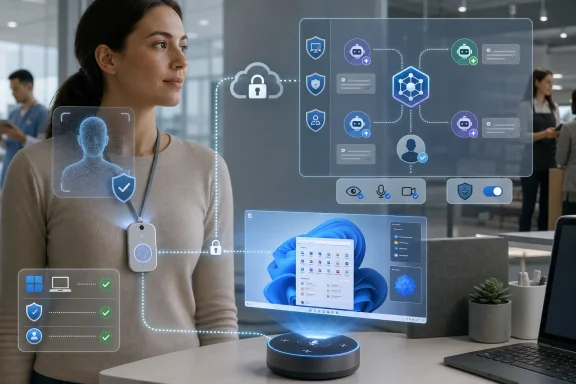
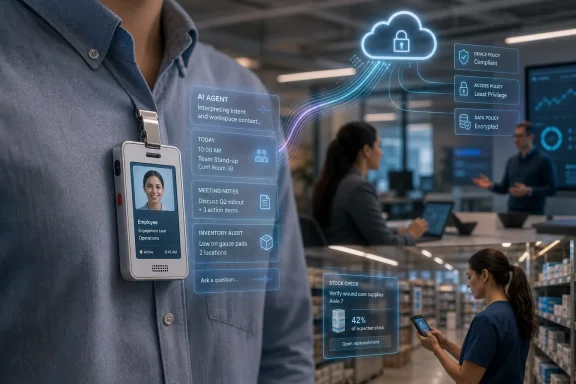
Woman in office wearing biometric ID, with augmented security icons over her and her computer screen.Microsoft Is Letting the PC Become an Endpoint, Not the Center​

Project Solara is not a Windows replacement in the familiar consumer-platform-war sense. It is more interesting than that. Microsoft is building a new class of enterprise devices that may depend on Windows, Microsoft 365, Azure, Intune, Entra ID, and Defender, while not actually running Windows locally.
That is a very Microsoft move in 2026. The company no longer needs every device to boot Windows if the device still authenticates through Entra, talks to Azure, consumes Copilot-style agents, and lives under Microsoft’s management stack. In Solara, Windows becomes one surface among many, sometimes streamed from the cloud, sometimes paired over Bluetooth, sometimes abstracted behind an agent that decides what interface is needed.
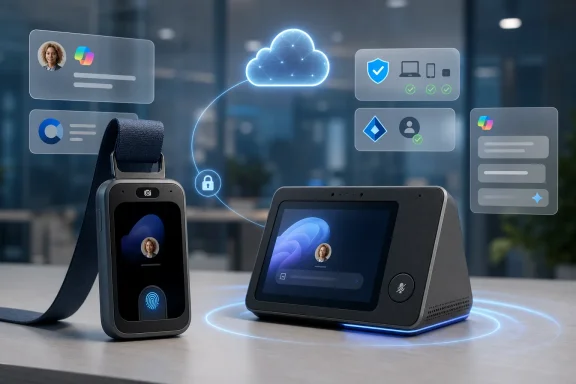
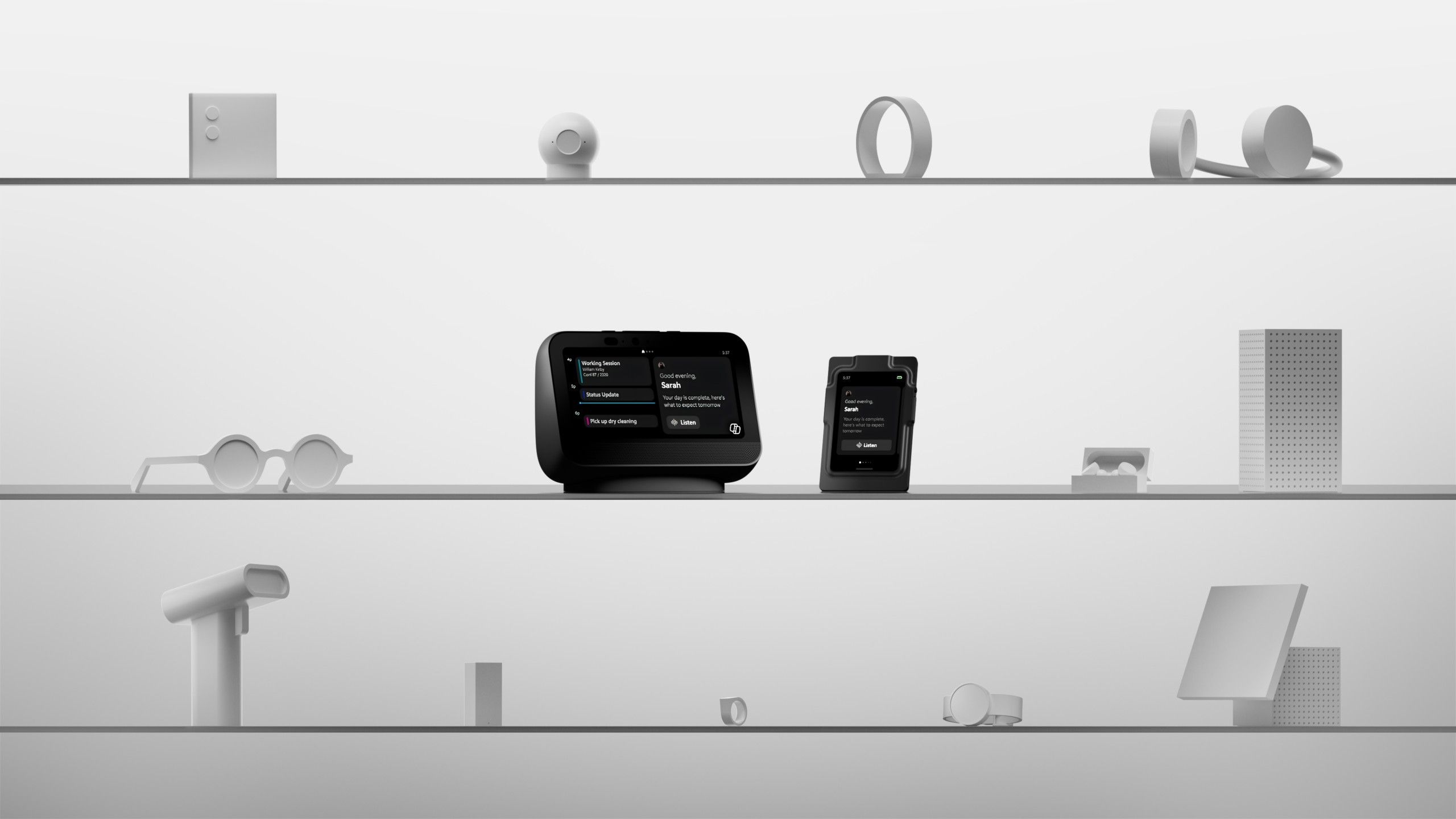
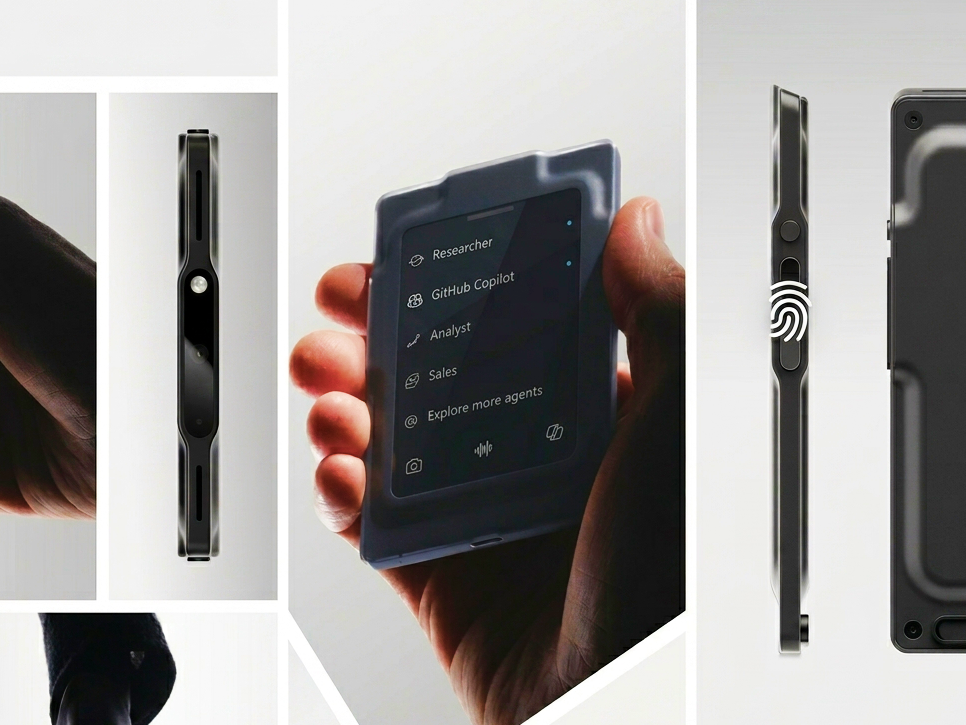
The first two reference designs make the point neatly. One is a desktop hub that sits next to a PC, responds to voice, recognizes the user, and can become a cloud-hosted Windows machine when attached to a monitor. The other is a wearable badge that behaves like an employee ID card crossed with a sensor pack: fingerprint wake, tap-to-record, transcription, and a camera that lets an agent act on what the worker is seeing.
Neither device is meant to be a mass-market gadget in the Surface tradition. Microsoft says hardware makers and industry partners are supposed to take the designs and turn them into practical devices for their own sectors. That distinction matters because Solara is not being pitched as a product launch so much as a platform bet.
The bet is that the app model is becoming too heavy for many work situations. A nurse, a retail worker, a field technician, or a warehouse employee does not necessarily need a phone, a laptop, and a stack of apps. They may need a small device that can authenticate them, observe context, call the right agent, and record the result in a system of record.

Android Is the Tell​

The most revealing part of Project Solara is not the badge or the desk hub. It is the operating-system choice. Microsoft built Solara on the Microsoft Device Ecosystem Platform, an Android Open Source Project-based enterprise platform already used in the orbit of Teams Rooms and other managed workplace devices.
That means Solara is not Windows-first. It is Microsoft-cloud-first.
For old-school Windows partisans, this may look like heresy. For enterprise IT, it is more pragmatic than ideological. Android-derived platforms run well on low-power chips, fit small device form factors, and have a mature hardware supply chain. If Microsoft wants badges, hubs, scanners, room devices, and eventually glasses or rings to get to market quickly, Windows is not always the obvious substrate.
The company’s argument is that MDEP gives it the middle ground it wants: Android’s hardware flexibility with Microsoft’s enterprise controls. Microsoft can talk about over-the-air updates, device integrity, Defender, Intune, Entra sign-in, and conditional access rather than asking administrators to trust a loose fleet of semi-smart gadgets.
That is the real Solara pitch to IT. Microsoft is not saying, “Here is another Android device.” It is saying, “Here is another managed Microsoft endpoint that happens to run on Android.” The distinction is the product.
The move also fits a broader pattern. Microsoft has spent years separating its business from the assumption that Windows owns every computing session. Office became Microsoft 365. Active Directory gave way to Entra. Endpoint management became cross-platform. Windows moved into the cloud. Solara is another turn of that wheel: Microsoft would rather own the identity, management, agent runtime, and cloud bill than lose the scenario because the hardware cannot run Windows elegantly.

Agents Are Microsoft’s New Runtime​

Project Solara’s most ambitious claim is that devices can be organized around agents instead of apps. That phrase can sound like conference-stage fog, but the demos suggest a concrete shift in how Microsoft wants work to happen.
In the old model, a user picks an app, navigates its interface, enters data, and moves to the next app. In the Solara model, a user wakes a device, states or implies intent, and a coordination layer routes the job to whichever agent can complete it. The agent might transcribe a conversation, summarize a patient visit, identify a QR code, log vitals, start a prescription workflow, or suggest changes after looking at a whiteboard.
That does not mean apps disappear overnight. Enterprise software is sticky, regulated, customized, and deeply political. But it does mean Microsoft is trying to move the center of gravity away from the visible application and toward a set of callable services, models, and workflows.
This is where the word agent becomes both useful and dangerous. Useful, because a well-scoped agent can automate a chunk of work that previously required several screens and manual context switching. Dangerous, because the industry is now tempted to call every chatbot, macro, script, and workflow an agent whether or not it can reliably act in the world.
Solara’s hardware-first framing gives the agent idea more substance. A badge with a camera, microphone, fingerprint sensor, and corporate identity is not just a chatbot endpoint. It is a context-capturing device. Its value depends on whether the agent can turn that context into a controlled business action without creating privacy, compliance, or safety problems.
That is the hard part. A device that transcribes a visit is easy to demo. A device that transcribes a visit, correctly separates clinical facts from casual conversation, respects consent, avoids hallucinated entries, integrates with health-record systems, survives audit, and satisfies regulators is a very different proposition.

The Badge Is the Most Interesting Device Because It Is the Most Dangerous​

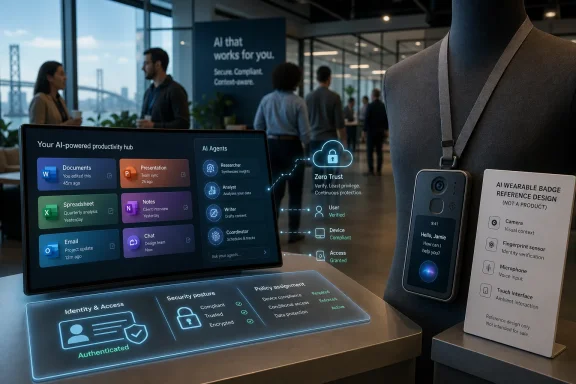
The wearable badge is the stronger proof of concept because it attacks a real enterprise problem: frontline workers are often badly served by phones and laptops. They need access to data and workflows, but the dominant devices were designed for seated knowledge workers or consumers.
Microsoft’s healthcare example is obvious for a reason. A nurse or clinician pulling out a personal phone in front of a patient can look unprofessional even when the intent is legitimate. It can also raise practical security concerns. A managed badge that authenticates the worker, records only under controlled conditions, and feeds the right workflow could be a better fit.
But the same device also concentrates the anxieties that will define agentic hardware. A badge with a camera and microphone worn by employees in workplaces, stores, clinics, and offices is a surveillance device unless the governance is extremely clear. The fact that it is powered by AI does not make that concern smaller. It makes it larger.
Microsoft’s pitch depends on purpose-built hardware having a smaller attack surface than a general-purpose phone. That may be true in a narrow technical sense. A locked-down device with fewer apps, fewer user behaviors, and enterprise management can be easier to secure than a personal smartphone.
Yet the social attack surface is bigger. Who can start a recording? Who is notified? Where are transcripts stored? Can managers query them? Are customers and patients meaningfully consenting? What happens when an agent sees something sensitive in the background? What are workers allowed to delete, dispute, or review?
Those questions are not peripheral to Solara. They are the product. If Microsoft wants agents to operate in the physical workplace, identity and device integrity are only the beginning. The real buying decision will hinge on policy, auditability, data boundaries, and trust.

The Desk Hub Shows Why Microsoft Still Needs Windows​

The desk concept is less futuristic but more revealing about Microsoft’s transitional strategy. A small device beside the PC that recognizes the user, handles voice commands, surfaces priorities, and hands work back and forth with the computer is not a revolution on its own. Its significance is that it treats the PC as something to coordinate with rather than something to replace.
The comparison to an Amazon Echo-style smart display is inevitable, and Microsoft clearly wants to avoid it. The argument is that Solara is not one consumer assistant trying to do everything. It is a managed enterprise endpoint that can run an organization’s own agents and stay synchronized with the user’s PC.
That is a plausible distinction. An Echo on a desk may know your calendar if you wire enough services into it, but it does not belong to the enterprise fabric in the same way. It is not necessarily enrolled, governed, conditioned, and logged under the same administrative model as the rest of the workplace.
The desk hub also shows how Microsoft can make Solara additive rather than threatening to existing Windows deployments. If a monitor is attached and the device becomes a cloud Windows machine, the familiar Windows environment remains available. If the user is working at a PC, the hub can function as an ambient agent endpoint. If the user steps away, the session can be locked or handed off.
In other words, Solara gives Microsoft a way to say that the PC is no longer the only computer in the workflow without saying the PC is obsolete. That is a careful line, and Microsoft has to walk it. Windows remains a massive business, a developer target, and an administrative baseline. But it is no longer sufficient as the company’s answer to every workplace computing problem.

The Fast Prototype Is Also a Warning​

One striking detail from the briefing is that Microsoft reportedly got the badge running on the platform in about three days, using the same software as the desk device on a different chipset. That is exactly the kind of story platform companies love to tell: same stack, different form factor, rapid hardware iteration.
It is also the kind of story that should make enterprise buyers slow down.
Fast prototyping is valuable, especially when off-the-shelf chips from Qualcomm and MediaTek can support multiple device categories. It means the cost of experimentation drops. A retailer, hospital system, logistics company, or manufacturer can imagine purpose-built devices without commissioning a moonshot hardware program.
But fast prototyping is not the same as dependable deployment. Hardware that works in a briefing room still needs battery validation, thermal design, ruggedization, firmware lifecycle planning, replacement logistics, support channels, accessibility testing, and security review. Add AI agents and the list gets longer: model behavior, prompt injection, data retention, human review, policy enforcement, and failure modes.
This is where Microsoft’s choice not to sell the devices itself is both sensible and risky. Sensible, because industry-specific hardware is better handled by partners that understand vertical markets and supply chains. Risky, because the quality of the Solara experience will depend on a partner ecosystem Microsoft does not fully control.
The PC era worked because Microsoft could build a broad software platform and let OEMs flood the market with hardware. It also produced decades of driver problems, crapware, inconsistent device quality, and support fragmentation. Solara inherits the promise of that model and some of its old ghosts.

The Business Model Is Hiding in the Cloud​

Microsoft has apparently not fully defined the Solara business model, beyond the obvious role of Azure. That ambiguity is unsurprising, but it is not trivial. Every agentic device eventually becomes an argument about who pays for inference, storage, management, integration, and support.
If Solara devices are cheap to build but expensive to operate, customers will notice. A badge that records and transcribes conversations, analyzes images, calls agents, writes summaries, and interacts with business systems is not just a hardware purchase. It is an ongoing cloud-consumption machine.
That may be exactly what Microsoft wants. The company has spent years turning enterprise computing into recurring cloud and subscription revenue. Solara extends that logic into places where conventional PCs and phones are awkward: hospital rooms, sales floors, warehouses, service counters, and field sites.
The economic question is whether the productivity gains are concrete enough. For a retailer, does an agent badge reduce training time, improve inventory accuracy, shorten customer interactions, or prevent loss? For healthcare, does it cut documentation burden without increasing compliance risk? For facilities or field service, does it reduce truck rolls, improve safety, or accelerate repair?
Enterprises will not buy “AI agents instead of apps” as a slogan for long. They will buy reduced minutes, fewer errors, faster workflows, better compliance, or new capabilities that were previously impractical. Solara’s future depends less on whether the demos look magical and more on whether pilots with companies such as AccuWeather, Best Buy, CVS Health, Levi’s, and Target can produce numbers that survive procurement scrutiny.

Microsoft Is Replaying the PC Playbook Under Worse Conditions​

The historical analogy is irresistible: Microsoft wants to provide the platform layer for a new generation of devices, much as it did for PCs. The company supplies the software foundation, partners build the hardware, developers and enterprises create the use cases, and Microsoft captures value through the platform.
But Solara enters a market very different from the one that made Windows dominant. In the early PC era, the operating system was the scarce control point. In the agent-device era, the control points are more distributed: chips, models, clouds, identity systems, app ecosystems, data platforms, developer tools, and regulatory trust.
Microsoft has strengths in many of those layers, but it does not own them all. Qualcomm and MediaTek matter. Android matters. OpenAI matters. Google, Amazon, Apple, and a long list of enterprise AI vendors matter. So do the vertical software vendors that own the systems where work actually gets recorded.
The competitive field is also less forgiving. Google has Android and Gemini. Amazon has Alexa’s history in ambient computing and AWS’s enterprise reach. OpenAI has enormous model mindshare and has reportedly been exploring AI-first hardware. Apple, as ever, has patience, silicon, devices, and a deep understanding of personal computing experiences even when it moves slowly.
Microsoft’s advantage is enterprise legitimacy. It already sits inside the identity provider, endpoint manager, collaboration suite, productivity suite, security stack, and cloud budget of many organizations. If an AI badge or desk hub needs to be administered by the same people who manage Windows laptops and Teams Rooms, Microsoft has a natural opening.
That advantage is not absolute. Enterprise buyers are also wary of lock-in, rising cloud costs, and AI features that arrive before governance models are mature. Solara’s challenge is to feel like an extension of existing management investments rather than another proprietary funnel into Azure consumption.

The App Model Will Not Die, but It Will Lose Territory​

The most overblown version of the Solara story is that apps are going away. They are not. Apps remain excellent containers for repeatable tasks, rich interfaces, permissions, offline behavior, and user control. Enterprises have spent decades building around them, and users still need visible tools they can understand.
The more defensible argument is that apps will lose territory at the edges. Many workflows do not deserve a full app session. Many workers do not have the time, hands, attention, or device posture to navigate one. Many tasks are really combinations of observation, authentication, summarization, lookup, and update.
That is where agentic devices could matter. They collapse the distance between event and record. A worker sees something, says something, scans something, or taps something, and the system turns that into structured work.
The danger is that collapsing that distance can also collapse the moment for human judgment. A traditional app slows the user down, sometimes annoyingly, but it also exposes fields, choices, and confirmation steps. An agent that acts too smoothly can hide assumptions. In regulated or safety-critical environments, that opacity is unacceptable.
The future likely belongs to hybrid patterns. Agents will gather context, draft actions, summarize evidence, and recommend next steps. Apps, dashboards, and review surfaces will remain where humans inspect, approve, correct, and audit. Solara’s success will depend on how well Microsoft balances those modes.

IT Will Ask the Boring Questions, and the Boring Questions Will Decide Everything​

The glamorous part of Solara is the idea of agents that see, listen, and act. The decisive part will be the administrative plumbing. IT departments will want to know how these devices enroll, update, authenticate, recover, isolate data, report compliance, and fail safely.
Microsoft is wise to build the story around Intune, Entra ID, Defender, device integrity, and over-the-air updates. Those are the words that make strange hardware less strange to enterprise administrators. If a Solara badge can be treated like another managed endpoint with known policy controls, it has a chance.
But IT will also ask what happens when the network is down, when the camera breaks, when a device is lost, when an employee leaves, when a transcript is wrong, when an agent takes the wrong action, or when a line-of-business system rejects an update. The answer cannot be “the AI will handle it.” It has to be logs, rollback, human review, least privilege, and support contracts.
Security teams will be especially wary of prompt injection and environmental manipulation. A device that can see a whiteboard or scan a code can also be tricked by malicious text, spoofed labels, or adversarial instructions placed in the physical world. Once agents can act, the physical environment becomes part of the input surface.
That does not make Solara doomed. It makes Solara enterprise software. The winners in this category will not be the companies with the flashiest demos. They will be the companies that make agentic hardware governable enough that a cautious CIO can say yes.

The Pilots Will Reveal Whether Solara Is a Platform or a Press Briefing​

The named pilot companies give Solara credibility, but pilots are not deployments. They are structured experiments, and in this case they will test several assumptions at once.
The first assumption is that purpose-built agent devices are better than phones or tablets for certain jobs. That will vary by workflow. A badge may be ideal for hands-free capture, but terrible for tasks that require review, comparison, or detailed input. A desk hub may be useful for ambient coordination, but redundant for users already drowning in notifications.
The second assumption is that organizations want their own agents rather than a generic assistant. Microsoft’s argument here is strong. Enterprises do not want one all-purpose consumer assistant wandering through proprietary workflows. They want constrained agents with identity, permissions, business context, and audit trails.
The third assumption is that hardware specialization can return after years of smartphone consolidation. For a long time, the phone absorbed everything: camera, recorder, scanner, authenticator, pager, and terminal. Solara suggests the pendulum may swing back, with specialized devices reappearing because AI makes them useful without requiring a full app interface.
The fourth assumption is that Microsoft can coordinate the ecosystem. Chip vendors, OEMs, cloud services, enterprise developers, security teams, and vertical partners all have to line up. That is difficult, but it is also the kind of orchestration Microsoft understands better than almost anyone in enterprise technology.
If the pilots produce only novelty, Solara will become another interesting Microsoft lab project. If they produce measurable workflow improvements, the platform could become one of the first serious attempts to define post-smartphone enterprise hardware.

Redmond’s Agent Hardware Bet Comes Down to Five Tests​

Solara is early enough that skepticism is not cynicism; it is discipline. The platform has a coherent strategic logic, but the gap between reference design and deployed fleet is where many ambitious hardware ideas go to die.
  • Microsoft is using Android through MDEP because small, low-power, enterprise-managed devices do not always need Windows to be useful Microsoft endpoints.
  • The badge is the most important concept because it targets frontline workflows where phones and PCs are often awkward, but it also raises the hardest privacy and surveillance questions.
  • The desk hub is less radical than the badge, but it shows how Microsoft can keep Windows central by streaming, pairing, and coordinating it rather than requiring it on every device.
  • The platform’s real business model will likely be tied to Azure consumption, agent services, identity, management, and security rather than hardware margins.
  • The first pilots will matter only if they prove concrete operational value, not just that AI can be embedded into a novel device.
  • Enterprise adoption will depend on governance, auditability, lifecycle support, and failure handling as much as model quality.
Solara is Microsoft’s acknowledgment that the next workplace computer may not look like a computer, may not run Windows, and may not ask users to open an app. That is a profound shift for the company that made its fortune standardizing the PC, but it is also a pragmatic one: if agents become the new runtime for work, Microsoft wants to manage the devices they inhabit, secure the identities they use, and meter the cloud they consume. The open question is whether enterprises want AI agents close enough to see and hear the workplace; the next few years will show whether Solara is the beginning of a new device category or simply an elegant prototype from a company determined not to miss the post-app turn.

References​

  1. Primary source: GeekWire
    Published: 2026-06-02T17:12:06.351110
  2. Official source: learn.microsoft.com
  3. Official source: techcommunity.microsoft.com
  4. Related coverage: nxtoffice.nl
  5. Official source: microsoft.com
  6. Related coverage: teamsinsider.show
 

Microsoft unveiled Project Solara at Build 2026 on June 2 as a chip-to-cloud platform for “agent-first” devices, alongside concept badge and desk hardware meant to move Microsoft 365 Copilot-style agents beyond conventional Windows PCs. The announcement is not simply another AI feature drop; it is Microsoft sketching a post-app computing model while still relying on Windows, Azure, identity, and management plumbing to make it believable. The interesting part is not the badge or the desk puck by themselves. It is Microsoft’s attempt to turn agents from software assistants into a reason for new hardware categories.

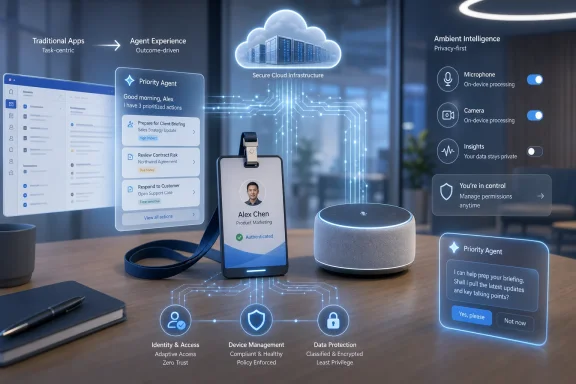
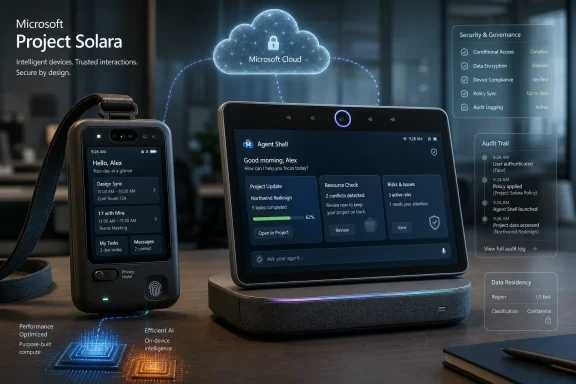
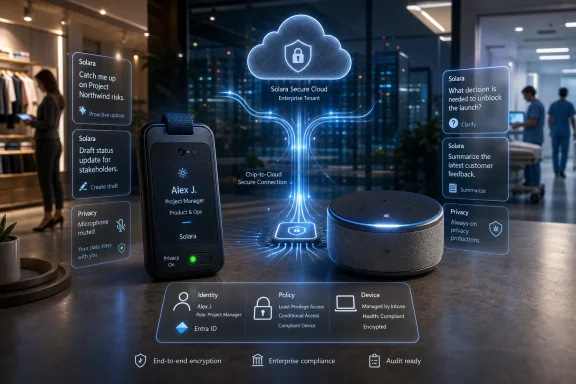
Futuristic office setup with a smartphone and smart speaker showing privacy-first AI assistant alerts and secure cloud UI.Microsoft Is Trying to Move the Center of Gravity Away From the App Window​

For three decades, the PC has trained users to think in rectangles. You open Outlook to read mail, Excel to analyze numbers, Teams to talk to colleagues, a browser to find context, and a file picker to stitch the mess together. Even when cloud services blurred the boundaries, the dominant metaphor remained the same: a person navigates software, and software waits for instructions.
Project Solara is Microsoft’s argument that this pattern is running out of road. The company now wants agents to become the primary interface layer, not just a sidebar bolted onto Word or a chatbot pinned to the taskbar. In Microsoft’s framing, the next device does not need to be a general-purpose screen with a hundred apps; it can be a specialized endpoint where an agent listens, sees, summarizes, authenticates, and hands work off to the rest of the Microsoft stack.
That distinction matters because Microsoft has already spent the last several years embedding Copilot into existing products. The company has put AI “beside” applications and “inside” applications. Solara is the more aggressive third move: the agent operates across applications, devices, and services, while the hardware becomes a context sensor and interaction surface.
This is why the announcement feels both futuristic and very Microsoft. The pitch is wrapped in ambient computing language, but the architecture is classic Redmond: identity, policy, cloud state, device management, partner silicon, and enterprise workflows. The new interface may be voice, vision, touch, and glanceable cards, but the business model still runs through Microsoft 365, Azure, Windows 365, GitHub, and Foundry.

The Badge Is the Provocation, Not the Product​

The wearable badge concept is the device that will attract the most attention, partly because it is the most visibly different from a PC and partly because it revives a familiar Silicon Valley dream: a small always-available AI companion clipped to the body. Microsoft’s version includes a touchscreen, camera, microphone array, speaker, fingerprint authentication, wireless connectivity, and Qualcomm wearable silicon. It is pitched for information workers, nurses, frontline staff, and people moving through meetings or physical workspaces.
That is an ambitious set of users, and it immediately exposes both the promise and the risk of agent-first hardware. A badge could be genuinely useful where laptops are awkward and phones are socially or operationally clumsy. A nurse checking priorities between rooms, a retail worker asking for inventory context, or a manager capturing an impromptu hallway discussion all fit the agent-first story better than the traditional desktop metaphor.
But a badge with a camera and microphone is also a governance object before it is a gadget. In hospitals, stores, warehouses, schools, and offices, “ambient” capture is never just a convenience feature. It touches consent, retention, transcription accuracy, labor monitoring, data loss prevention, and the simple human discomfort of being near a device that may be listening for a machine’s benefit.
Microsoft seems aware of this, at least in product-design terms. The concept includes fingerprint authentication and privacy controls, and the company is tying Solara to enterprise-grade identity rather than pitching it as a consumer toy. Still, the real test will not be whether the badge can record a meeting or surface a Priority Agent card. The test will be whether organizations can prove to workers, customers, patients, and regulators that the device is not a surveillance shortcut with Copilot branding.

The Desk Device Shows the Safer Path Into the Enterprise​

The desk concept is less flashy, but probably more important. Microsoft describes it as a compact companion with a touchscreen, face authentication, privacy buttons, microphone controls, far-field microphones, speaker, UWB presence sensing, USB-C ports, Wi-Fi, Bluetooth, and MediaTek IoT silicon. It can operate on its own, pair with a Windows PC, or become a Windows 365 client when connected to an external display.
That last detail is where the strategy becomes clearer. Solara is not just about inventing new gadgets; it is about creating lightweight endpoints for Microsoft’s cloud PC and agent ecosystem. A desk device that turns into a Windows 365 terminal is easier to imagine in offices, call centers, hoteling desks, secure environments, and shared workspaces than a wearable camera badge clipped to everyone’s shirt.
It also gives Microsoft a way to sidestep the hardest problem in new device categories: persuading buyers that the device deserves to exist. A small agent-first desk companion does not need to replace a PC on day one. It can begin as an authenticated Copilot surface, a Teams and calendar assistant, a presence-aware notification device, or a Windows 365 access point. If it fails to become the next major interface, it can still be useful as a managed enterprise endpoint.
That is the most plausible version of Solara in the near term. Not a revolution where PCs disappear, but a gradual thickening of the Microsoft endpoint universe. The PC remains the workhorse, Windows 365 becomes the roaming desktop, and Solara devices become specialized access points for agent-mediated work.

Chip-to-Cloud Is a Strategy and a Warning Label​

Microsoft’s phrase “chip-to-cloud” is doing a lot of work here. At one level, it means Solara spans silicon, device firmware, operating system behavior, cloud state, and AI services. At another level, it means Microsoft does not want agent-first devices to become a chaotic peripheral market where every vendor ships a clever gadget with its own app, identity model, security posture, and cloud bill.
That ambition is rational. Agents need context, permissions, memory, tool access, and policy enforcement. A standalone device that cannot safely reach corporate data is little more than a voice recorder with a model attached. A device that can reach corporate data without proper governance is a breach waiting for a procurement signature.
The chip-to-cloud language is also a warning label for IT departments. Solara devices will not be evaluated like keyboards or webcams. They will sit closer to the trust boundary, because their entire purpose is to perceive context and act across systems. If the device can invoke agents, access calendars, summarize meetings, trigger workflows, and hand off to Windows 365, then it belongs in the same risk conversation as laptops, phones, privileged apps, and collaboration platforms.
This is where Microsoft has an advantage over most AI hardware startups. It already owns the identity layer for many enterprises through Entra ID. It owns management reach through Intune. It owns the productivity surface through Microsoft 365. It owns a cloud PC story through Windows 365 and a developer/agent platform through GitHub and Microsoft Foundry. Solara is not starting from zero; it is an attempt to bind those assets into a hardware reference architecture.

Surface RTX Spark Dev Box Is the Builder’s Side of the Same Bet​

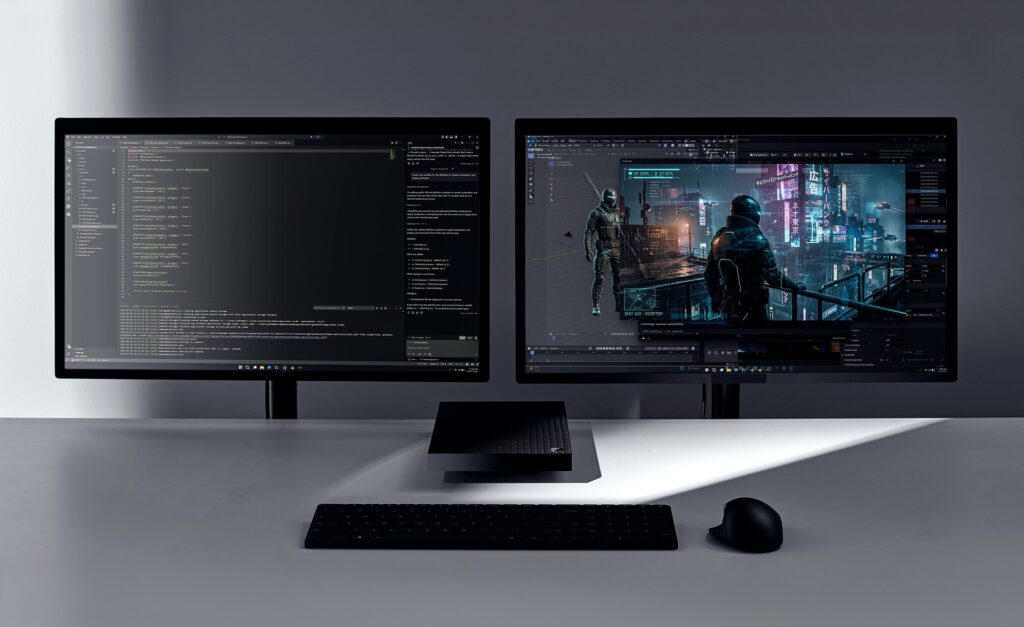
Project Solara did not arrive alone. Microsoft also used Build 2026 to introduce the Surface RTX Spark Dev Box, a compact Windows 11 Pro developer machine powered by NVIDIA RTX Spark silicon. Microsoft says the box offers up to one petaflop of AI compute, 128GB of unified memory, support for large local models, WSL2 with GPU passthrough and CUDA support, and a developer-tuned Windows image with tools such as VS Code, GitHub Copilot, Git, Python, and Node.js.
That device is not Solara hardware in the badge-and-desk sense, but it is part of the same worldview. If agents are going to become an interface layer, developers need a way to build, test, fine-tune, and run them locally without turning every iteration into a cloud invoice. Microsoft is trying to solve both sides of the equation: new endpoints for users, and new local AI workstations for the people building the agent software.
The Surface RTX Spark Dev Box also highlights a tension in Microsoft’s AI strategy. On one hand, the company is deeply invested in Azure as the place where large-scale AI runs. On the other hand, agent experiences cannot feel fast, private, or resilient if every interaction depends on a distant cloud model. Local inference, local prototyping, and edge execution are becoming strategic necessities, not nice-to-have developer perks.
For Windows enthusiasts, this is the more immediately tangible part of Build’s agent story. A new class of Windows machines with NVIDIA Grace and Blackwell-derived architecture, large unified memory, and CUDA-friendly local workflows could change how AI developers treat Windows on Arm and Windows workstations generally. It is also a reminder that “AI PC” is splitting into tiers: consumer Copilot+ PCs for everyday acceleration, and heavier developer boxes for people building the agents and models those users will eventually invoke.

Microsoft’s Agent Stack Is Becoming an Operating System in Everything but Name​

The most revealing thing about Project Solara is that Microsoft keeps circling the idea of the operating system without fully using the term in the traditional way. The company describes Solara as a platform where the operating system is effectively stretched between device and cloud. In practice, that means state, identity, agent behavior, and application access are not confined to a single piece of hardware.
That idea fits Microsoft’s broader Build 2026 announcements. Microsoft Foundry is being positioned as the place to build, deploy, observe, and improve agents. GitHub Copilot is expanding from code completion into command-line, agentic, and workflow territory. Windows AI APIs are being extended beyond the narrowest Copilot+ PC definition. Microsoft 365 Copilot is gaining more specialized agents such as Researcher, Facilitator, and Priority Agent.
The pattern is hard to miss. Microsoft wants agents to become programmable units of work, deployable across Microsoft 365, Teams, Windows, GitHub, Foundry, and eventually new hardware endpoints. Project Solara is the device expression of that stack. It is not the whole platform; it is the place where the platform becomes physically present.
This is also why Microsoft is talking about third-party agents and open architecture. A Solara device that only runs Microsoft’s own assistants would be an accessory. A Solara platform that lets partners build controlled, domain-specific agents for healthcare, retail, weather, logistics, field service, and customer support could become an ecosystem. The announced pilots with companies such as CVS Health, Best Buy, Target, Levi’s, and AccuWeather are best understood as Microsoft probing those verticals rather than claiming the category is ready.

The App Model Will Not Die, but It May Lose Status​

It is tempting to frame agent-first devices as an app killer. That is too simple. Apps will not disappear any more than mainframes, PCs, or phones disappeared when the next layer arrived. The more likely outcome is that apps lose their privileged status as the default unit of user intent.
Today, users still translate goals into app navigation. “Prepare me for my next meeting” becomes opening Outlook, Teams, OneNote, SharePoint, a CRM system, and perhaps a browser. In an agent-first model, that same goal becomes a command to an entity that already has permissioned access to those systems and can return a prepared state: summary, risks, documents, action items, and perhaps suggested replies.
That is powerful, but it changes what software vendors compete on. If the user spends less time inside an app’s interface, the app becomes more of a service endpoint, data source, or tool provider for agents. The front door shifts from the application icon to the agent invocation.
For Microsoft, this is strategically attractive because it already controls many of the front doors inside enterprise computing. For independent software vendors, it is more complicated. Being deeply integrated into Microsoft’s agent fabric could increase usage, but it could also make the app’s own interface less visible. The most valuable real estate may become the permissioned tool call rather than the dashboard.

IT Departments Will Ask the Boring Questions First, and They Should​

The most serious Solara conversations will not start with whether the badge looks cool. They will start with procurement, compliance, identity, device lifecycle, network controls, and incident response. That may sound dull, but it is where this category will either become real or remain a keynote prop.
Every agent-first device raises a chain of operational questions. Who can enroll it? What data can it access? What happens when an employee loses it? Are recordings stored locally, in Microsoft 365, in Azure, or not at all? Can administrators disable cameras by policy? Can agents be restricted by role, location, network, or data sensitivity label? How are prompts, tool calls, and outputs logged? Can a user challenge or correct an agent’s memory?
Microsoft has answers to some of the surrounding infrastructure questions because its enterprise stack already handles pieces of them. But the agent layer introduces new failure modes. A normal app may expose data when a user opens it; an agent may combine data across systems, infer relationships, and act on the user’s behalf. That makes permissions harder to reason about and audit.
This is why Solara’s success depends less on natural language magic than on administrative clarity. Enterprises do not merely need agents that can do things. They need agents that can be limited, supervised, explained, revoked, patched, and investigated. If Microsoft can make that governance feel familiar through Entra, Intune, Microsoft 365, Defender, and Purview-style controls, Solara has a chance. If not, the devices will remain interesting demos with uncomfortable risk profiles.

The Consumer Story Is Still Missing​

For all the futurism, Project Solara is conspicuously enterprise-shaped. The announced concepts are aimed at workers, desks, meetings, frontline environments, and Microsoft 365 workflows. That is probably wise. Consumer AI hardware has already shown how difficult it is to sell a standalone assistant device when smartphones are ubiquitous, app ecosystems are mature, and trust is fragile.
Microsoft is not trying to beat the phone on day one. Instead, it is looking for places where the phone is not ideal and where corporate identity gives an agent more useful context than a consumer assistant can safely access. That makes the workplace the natural first battleground.
Still, a broader question remains: if agent-first devices succeed at work, do they eventually come home? A kitchen display, a family logistics badge, a car companion, or a travel device all fit the ambient agent concept. But Microsoft’s consumer hardware record is uneven, and the company’s strongest AI distribution today is through work accounts, Windows, Edge, and Microsoft 365 subscriptions.
The more likely path is that Solara stays enterprise-first for a long time, with consumer spillover happening indirectly through Windows PCs and Copilot surfaces. That would not be a failure. Microsoft has built enormous businesses by making enterprise infrastructure feel inevitable before consumers fully understand what changed.

The Hardware Is Early; the Direction Is Not​

Microsoft is being careful to describe the Solara devices as concepts and reference designs, not finished mass-market products. That caveat matters. Concept hardware often exists to attract partners, test workflows, pressure competitors, and give developers a target. It does not guarantee a shipping badge or desk companion with the exact features shown at Build.
But dismissing Solara as vaporware would miss the strategic continuity. Microsoft has been moving toward agent-first computing across Copilot, Windows, GitHub, Foundry, and Microsoft 365. The company is also pushing local AI hardware through Copilot+ PCs and the new RTX Spark developer machines. Solara is the connective tissue between those efforts: a way to imagine agents as the reason for devices, not just features inside software.
The challenge is that Microsoft is trying to create a category while the underlying social contract is still unsettled. People may want agents to reduce drudgery, summarize noise, and coordinate work. They may not want cameras, microphones, and corporate AI systems embedded more deeply into physical spaces. The same device that helps a nurse move faster could make a workplace feel more monitored. The same desk assistant that reduces friction could become another endpoint demanding policy review.
That ambiguity does not make Solara less important. It makes it more important to scrutinize now, while the category is still being shaped by reference designs and pilots rather than locked-in procurement cycles.

The Real Solara Test Will Happen Far From the Keynote Stage​

Project Solara will live or die in mundane workflows, not keynote demos. If a badge helps a retail worker answer a customer accurately without leaving the floor, that matters. If a desk device lets a contractor securely access a Windows 365 environment and hand off agent tasks without a full laptop setup, that matters. If a healthcare pilot proves that ambient assistance can work without creating unacceptable privacy and compliance exposure, that matters most of all.
The strongest version of Microsoft’s argument is that agents need dedicated contexts. A general-purpose PC is powerful because it can do almost anything, but that flexibility also creates friction. Specialized devices can be useful when they remove the need to stop, open, search, switch, and manage. Solara is an attempt to make that specialization cheaper for hardware partners and safer for enterprises.
The weakest version is that Microsoft is overextending the Copilot brand into yet another layer of devices before users have fully accepted the last one. Many organizations are still measuring the productivity value of Microsoft 365 Copilot, still building governance around AI-generated content, and still deciding where local AI belongs in their endpoint strategy. Asking them to evaluate agent-first hardware at the same time is a lot.
That is why the pilot phase is crucial. CVS Health, Best Buy, Target, Levi’s, AccuWeather, and Microsoft’s own internal users are not just early adopters; they are the stress test for whether this platform solves real problems outside a controlled demo. Their feedback will determine whether Solara becomes a reference architecture for a new device ecosystem or a fascinating Build-era footnote.

The Agent-First Future Comes With Receipts​

The practical read on Project Solara is narrower than the marketing and more consequential than the skeptics might allow. Microsoft is not announcing the death of Windows PCs. It is preparing for a world where Windows PCs, cloud PCs, AI workstations, badges, desk companions, and other specialized endpoints all become surfaces for the same agent layer.
  • Project Solara is a platform bet, not a single product launch, and the badge and desk devices are reference concepts designed to seed partner hardware.
  • Microsoft’s strongest advantage is its existing enterprise stack, because agent-first devices need identity, management, security, compliance, and cloud state as much as they need clever hardware.
  • The Surface RTX Spark Dev Box gives developers a local AI workstation story that complements Solara’s endpoint ambitions.
  • The wearable badge is the riskiest concept because its usefulness depends on camera and microphone access in environments where privacy and consent are highly sensitive.
  • The desk device may be the more realistic first enterprise endpoint because it can double as a Windows 365 access point and companion to existing PCs.
  • The near-term impact for Windows users is not fewer PCs, but more specialized devices orbiting Windows, Microsoft 365, and Azure.
Microsoft’s bet is that the next computing shift will not arrive as a single replacement for the PC, but as a cloud-connected agent layer that makes some devices smaller, more contextual, and more task-specific. Project Solara is early, unresolved, and full of governance questions, but it points toward a future Windows ecosystem where the most important interface may no longer be the app you open. It may be the agent that already knows what you were trying to do next.

References​

  1. Primary source: Windows Report
    Published: 2026-06-02T18:12:13.339643
  2. Related coverage: tomshardware.com
  3. Related coverage: axios.com
  4. Related coverage: windowscentral.com
  5. Official source: microsoft.com
  6. Official source: commandline.microsoft.com
  1. Official source: blogs.windows.com
  2. Official source: news.microsoft.com
  3. Related coverage: thenextweb.com
  4. Related coverage: nvidianews.nvidia.com
  5. Related coverage: thewincentral.com
  6. Official source: devblogs.microsoft.com
  7. Official source: cdn.techcommunity.microsoft.com
 

Microsoft used Build 2026 on June 2 in San Francisco to preview Project Solara, a chip-to-cloud platform for AI-first hardware that can run agents across badge-like wearables, desk companions, Windows PCs, Azure services, and enterprise identity systems. The announcement is not Windows 12, not a new Surface category, and not yet a shipping consumer product. It is more consequential than that: Microsoft is testing whether the operating system of the AI era is still an operating system at all.
The pitch sounds futuristic, but the business logic is familiar. Microsoft has spent decades profiting from the layer that sits between people, applications, hardware, and work. Project Solara is an attempt to move that layer outward, off the PC screen and into the badge, the desk, the meeting room, the clinic hallway, and every other place where a worker might want software to act before a traditional app is opened.

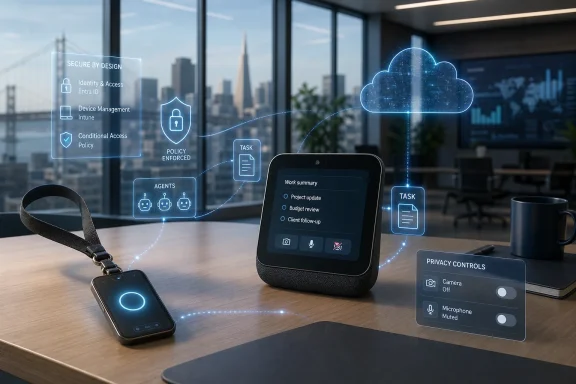
Office desk with smart devices and cloud-based security holograms showing privacy controls and access policies.Microsoft Is No Longer Pretending the PC Is the Whole Story​

For Windows loyalists, the most jarring part of Project Solara is not the hardware. It is Satya Nadella’s framing. In a video discussion tied to the announcement, Microsoft’s CEO described the shift as moving from building operating systems and devices for apps to building for agents. That is the kind of line CEOs use when they want developers to understand that the platform map is being redrawn.
For forty years, Microsoft’s gravity came from the app model. Windows won because software developers targeted it, enterprise buyers standardized on it, and users learned to live inside its windows, menus, files, and taskbars. Even when Microsoft lost mobile, Windows remained the corporate desktop’s default terrain because it was the place where work applications lived.
Project Solara does not kill that model. It quietly demotes it. The agent becomes the primary thing the user addresses, while the device becomes a context-specific surface for that agent to appear, listen, authenticate, and act. In Microsoft’s telling, apps do not disappear so much as sink into the plumbing.
That is why Project Solara matters to WindowsForum readers even if the first demo devices look nothing like PCs. Microsoft is not merely showing a smart badge and a smart display. It is describing a future in which Windows is one endpoint in a wider agent fabric, not necessarily the endpoint that defines the experience.

Solara Is an Operating System Only If Azure Counts as Part of the Machine​

Microsoft’s own description of Project Solara is slippery in the way platform announcements often are. It calls Solara a chip-to-cloud platform, an agent-first device platform, and, in some coverage, an OS for AI agent gadgets. The ambiguity is the point. Solara appears less like a classic operating system and more like a managed runtime for identity, agents, device state, cloud context, and specialized interaction.
That distinction matters. A traditional OS owns the local machine: the kernel, drivers, user interface, permissions, application lifecycle, and hardware abstraction. Solara seems to assume that the “computer” is distributed. Some part lives on the device, some part in Azure, some part in Microsoft 365, some part in identity, and some part inside agents built with Microsoft’s developer tooling.
Microsoft says the platform is designed for an open, multi-agent world. In practice, that means Solara is supposed to let organizations deploy agents from Microsoft and others, manage the devices through enterprise channels, authenticate users through familiar Microsoft identity systems, and avoid rebuilding hardware and software stacks for every new device category. That is attractive to IT departments tired of bespoke smart gadgets that become orphaned the minute a vendor loses interest.
It also means Solara is a cloud-era operating system in the most Microsoft sense possible. The machine is not just the gadget in your hand. The machine is the account, the policies, the tenant, the agent framework, the Azure services, the management plane, and the endpoint. Microsoft learned with Windows that the platform owner gets to tax the ecosystem; with Solara, it is trying to make the platform boundary large enough to include the cloud.

The Smart Badge Is the Demo Microsoft Wants You to Argue About​

The portable reference design is the one that will get the attention. Microsoft showed a badge-like device aimed at information workers, nurses, frontline employees, and others who already carry access cards as part of their workday. The concept includes a touchscreen, fingerprint authentication through Hello for Business, privacy controls, microphones, a speaker, a side-facing camera, Wi-Fi, Bluetooth, GNSS, 5G, and Qualcomm wearable silicon.
That is a lot of computer to hang from a lanyard. Microsoft’s argument is that the badge is a natural place for an always-available agent because it is already tied to identity, presence, movement, and workplace access. Instead of pulling out a laptop or phone between meetings, a worker could tap the badge, check a priority card, record a hallway conversation with consent, scan something in the environment, or ask an agent to move a workflow along.
The more skeptical reading is just as obvious. A badge with a camera, microphone, wireless connectivity, biometric authentication, and workplace identity is a privacy controversy waiting for a procurement meeting. Microsoft can emphasize user permission and hardware privacy switches, but organizations will have to decide whether employees perceive such devices as helpers or surveillance endpoints.
That tension is not incidental. It is the product category. The same sensors that make an agent useful in the physical workplace also make it potentially intrusive. A badge that can help a nurse document patient interactions could also become a badge that measures how long a worker stood in a hallway. A device that can capture context can also capture too much of it.

The Desk Device Is the Safer Sales Pitch​

The desk reference design is less provocative and, for that reason, probably closer to something enterprises can imagine piloting. It resembles a compact smart display for work: touchscreen, facial authentication, privacy buttons, microphone mute, dual microphones, speaker, UWB presence sensing, USB-C, Wi-Fi, Bluetooth, and MediaTek IoT silicon. It can function as a standalone agent companion, pair with a Windows PC over Bluetooth, or become a Windows 365 client when connected to an external display.
This is Microsoft’s more pragmatic wedge. Enterprise users already understand desk phones, Teams displays, thin clients, docking stations, and secondary screens. A Solara desk unit could be sold as a persistent Copilot surface that keeps agents available without requiring the user to keep a full PC session front and center. It is less “AI future badge” and more “Teams display after the agentic rebrand.”
The Windows 365 angle is especially revealing. Microsoft is not positioning every Solara device as a powerful local AI computer. In some scenarios, it is a secure window into a cloud PC and a cloud agent environment. That fits the company’s broader enterprise incentives: move the stateful, expensive, administratively sensitive bits into Microsoft-managed services, then let specialized endpoints reach them.
For admins, that could be comforting or alarming depending on the deployment model. A managed desk agent that authenticates with Entra ID, respects Intune policy, and connects to Windows 365 is far easier to justify than a random AI gadget with its own account system. But it also deepens the dependency on Microsoft’s cloud stack, which is exactly what Solara is designed to do.

Android Under the Hood Would Be a Pragmatic Admission​

One of the more interesting details in the early reporting is that Solara devices are expected to rely on Microsoft’s Device Ecosystem Platform, an Android Open Source Project-based foundation Microsoft has already used in device categories such as Teams Rooms. If that is the path, it is a revealing choice. Microsoft may be pitching the future of agents, but it is not insisting that every future Microsoft endpoint run Windows.
That should not shock anyone who has watched Microsoft since the Windows Phone retreat. The company has grown more comfortable treating Windows as one strategic asset among many, rather than the compulsory substrate for every device. Android gives Solara access to a mature embedded and mobile hardware ecosystem, power-efficient silicon, touch-first assumptions, and device patterns that are more suitable for badges and smart displays than full Windows.
For Windows purists, that can feel like another retreat. For Microsoft’s enterprise business, it is simply rational. If the goal is to seed agent-first hardware quickly across many form factors, Windows is not always the best starting point. A badge does not need a Start menu. A hallway companion does not need Win32 compatibility. A desk agent may need identity, security, management, and cloud handoff more than it needs the Windows shell.
The irony is that Microsoft may be better positioned to build a post-app platform precisely because it no longer believes Windows must be everywhere. The company can use Android-derived device software at the edge, Windows 365 in the cloud, Azure for orchestration, Entra for identity, Intune for management, and Microsoft 365 Copilot for workplace context. That is not a clean story for operating-system romantics, but it is a very Microsoft story for 2026.

Agents Are the New Apps, but the Old Problems Survived the Rebrand​

The phrase “agents are the new apps” is appealing because it suggests a clean break. Apps require users to know which program to open, which menu to choose, which field to fill, and which workflow to remember. Agents promise a higher-level command model: say what you want, and the software negotiates the tools, data, and steps.
But platforms do not become simpler just because the interface becomes conversational. They move complexity elsewhere. Instead of asking whether an app has permission to access a file, IT may need to ask whether an agent can summarize a mailbox, invoke a third-party workflow, update a CRM record, transcribe a conversation, call an internal API, retain context across devices, or hand off a task to another agent.
That is a harder governance problem than the app era’s familiar permission prompts. Apps were bounded things, at least in theory. Agents are valuable precisely because they cross boundaries. They are supposed to maintain context across services, act over time, and use multiple tools. The feature is also the risk.
Project Solara therefore depends on something more mundane than demo magic: policy. If Microsoft can give organizations credible controls over what agents can see, say, store, trigger, and audit, Solara has a chance to become an enterprise platform. If not, it will join the long list of clever workplace devices that looked exciting in a keynote and terrifying in a compliance review.

Microsoft Is Selling Specialization After a Decade of General-Purpose Screens​

The consumer tech industry spent years converging everything into glass rectangles. Phones absorbed cameras, music players, GPS units, flashlights, voice recorders, wallets, and a fair amount of casual computing. PCs absorbed communications, entertainment, productivity, development, and administration. The assumption was that the best device was the most general one.
Project Solara argues for a partial reversal. Microsoft’s thesis is that agents make specialization cheaper because developers no longer need to build a full traditional application stack for every device. If the agent is the interaction layer and the cloud supplies much of the intelligence, hardware can be shaped around a specific environment instead of forcing every workflow through a laptop or phone.
That is plausible. A nurse documenting a patient encounter, a warehouse worker scanning inventory, a field technician checking a procedure, and a manager moving between meetings may all benefit from computing surfaces that do not resemble a laptop. The PC is powerful because it is general, but generality also creates friction. It asks the user to stop, open, navigate, and manage.
The danger is that specialization has failed before for good reasons. Purpose-built devices can be expensive to support, slow to update, awkward to integrate, and easy to abandon. Every IT department has a closet full of once-promising hardware that became e-waste after a vendor pivot, a platform sunset, or a security exception that never got resolved. Microsoft’s challenge is to make Solara devices feel less like gadgets and more like managed endpoints with a lifecycle.

The Windows Angle Is Not Replacement but Absorption​

Project Solara should not be read as Microsoft giving up on Windows. In some ways, it is the opposite. Microsoft is trying to prevent Windows from becoming merely the legacy place where human-operated apps continue to run while the next platform forms somewhere else.
The company’s broader Build messaging around agentic AI, Windows PCs, cloud PCs, developer tools, and silicon partnerships points toward absorption. Windows becomes one agent surface among others. A Solara desk device can pair with a Windows PC. A Solara endpoint can become a Windows 365 client. Agents built for Microsoft’s ecosystem can move between the desktop, the cloud, and specialized devices.
That is a defensive strategy as much as an offensive one. If agents become the dominant software interface, Microsoft wants the agent layer to be grounded in its identity systems, productivity data, management tools, developer frameworks, and cloud runtime. Windows remains valuable, but the value shifts from being the only place where work happens to being part of a larger managed work graph.
For users, the experience could be either liberating or maddening. The best version lets work follow context: a task started at the desk continues on a badge, a cloud PC opens when a display appears, and an agent knows enough to reduce busywork without becoming creepy. The worst version is a swarm of half-integrated Copilot surfaces, each demanding trust, permissions, subscriptions, and patience.

The Enterprise Buyer Will Decide Whether Solara Is a Platform or a Prop​

Microsoft has a long history of showing hardware concepts that express a software strategy more than a near-term product plan. Solara’s reference designs should be viewed through that lens. The point is not necessarily that every office will soon issue AI badges. The point is to give developers, silicon partners, and enterprise buyers a concrete picture of where Microsoft wants agents to live.
That means the early market will not be the average Windows enthusiast. It will be organizations with enough scale, workflow pain, compliance infrastructure, and Microsoft licensing depth to experiment. Healthcare, frontline operations, logistics, manufacturing, customer service, and large corporate campuses are more likely targets than home users.
Healthcare is the obvious example because it combines mobility, documentation burden, identity, consent, and time pressure. If an agent-enabled badge can help clinicians document conversations, structure notes, or interact with records without forcing them back to a workstation, the productivity case is real. The privacy, consent, and regulatory hurdles are equally real.
The same pattern applies elsewhere. A warehouse badge or scanner that can talk to an agent could reduce training time and speed up exception handling. A field-service device could guide repairs and document results. A desk agent could reduce context switching for office workers. In every case, the value depends less on the device than on whether the agent can safely connect to the systems of record.

The Hardware Partners Signal a Bet on Volume, Not Luxury​

Qualcomm and MediaTek are the right first names for Microsoft to attach to this effort. Qualcomm gives Solara credibility in wearables, mobile connectivity, and power-efficient edge devices. MediaTek gives it reach into IoT-style hardware and the kind of cost structures that make desk companions and appliance-like endpoints plausible.
That partner mix also says Solara is not a boutique Surface experiment. Microsoft is aiming for a reference-platform model where other manufacturers can build devices around common assumptions. That is how Windows scaled in the PC era, and how Android scaled in mobile. The difference is that Solara’s most important compatibility layer may not be the local app binary; it may be agent identity, cloud state, management, and user experience conventions.
The reference designs are therefore less important as products than as templates. Microsoft is telling hardware makers what an agent-first device might need: secure authentication, sensors, privacy controls, connectivity, a lightweight UI, enterprise management, and a path back to Microsoft’s cloud. Whether the device is a badge, a desk unit, glasses, a scanner, or something stranger, the pattern is meant to repeat.
The risk is fragmentation. If every vendor implements agent surfaces differently, users and admins will face a new version of the smart-device mess: inconsistent controls, uneven update policies, unclear data flows, and unclear boundaries between device maker, cloud provider, employer, and agent developer. Microsoft’s platform pitch is that it can prevent that chaos. Its history suggests it can, but only if the incentives line up.

Privacy Switches Are Necessary, Not Sufficient​

Microsoft’s inclusion of physical privacy controls is a smart move. A microphone mute switch, camera awareness, biometric authentication, and enterprise identity are table stakes for devices that may sit on desks or hang from bodies all day. Without those visible affordances, Solara would arrive under a cloud of suspicion before anyone tested the workflow benefits.
But hardware switches do not answer the deeper questions. Who owns the transcript of a recorded hallway conversation? How long is environmental context retained? Can an employer require workers to carry an agent badge? What telemetry is collected when a user ignores an agent prompt? What happens when an agent incorrectly summarizes a medical conversation, sales negotiation, or safety incident?
These are not edge cases. They are the normal cases for workplace AI. The more useful an agent becomes, the more it will touch sensitive information and consequential decisions. A privacy switch can stop a microphone; it cannot define an organization’s policy for agent memory.
This is where Microsoft’s enterprise credibility helps and hurts. The company knows how to sell governance, compliance, auditing, identity, and management. It also knows how to turn governance into licensing tiers, admin portals, and complex dependencies. Solara will need trust not only from CIOs but from the employees expected to live with these devices.

Developers Are Being Asked to Build for a World Without Stable Screens​

For developers, Solara extends a shift already underway. The application is no longer assumed to be a rectangular interface with predictable navigation. It may be an agent capability exposed through voice, cards, notifications, generated UI, a tiny display, a PC, a cloud session, or another agent. That changes what it means to design software.
Microsoft has been moving in this direction through Copilot Studio, agent SDKs, Azure AI tooling, and Microsoft 365 integration. Solara gives that work a hardware dimension. If an agent can appear on a badge or desk companion, developers need to think in terms of intents, permissions, context, and handoffs rather than screens alone.
That can be powerful. It can also be vague. Developers are already navigating a noisy agent ecosystem where every vendor claims to have frameworks, orchestration, tools, memory, connectors, and governance. Solara will need clear primitives, not just inspirational language. An “agent-first” device platform only works if builders can predict how agents will authenticate, display information, ask for confirmation, fail safely, and move between endpoints.
The phrase Just-in-Time UI captures both the promise and the uncertainty. A UI that adapts to the device and task is attractive. A UI that is generated unpredictably by a model in a regulated workflow is not. Microsoft will have to draw a firm line between adaptive interface patterns and magical thinking.

Apple, Amazon, and Google Are the Shadow Audience​

Project Solara is not happening in a vacuum. Amazon has spent years trying to make ambient assistants useful in the home and workplace. Google owns Android and has been threading Gemini through phones, search, productivity, and devices. Apple is preparing its own next moves around Siri and agentic capabilities, with the advantage of tight hardware-software integration and the burden of proving it can move quickly in AI.
Microsoft’s advantage is not consumer intimacy. It is enterprise distribution. If Apple’s strongest argument is that it can make agents feel personal on devices people love, Microsoft’s argument is that it can make agents governable in organizations that already run on Microsoft 365, Entra, Intune, Teams, Azure, and Windows. Solara is a workplace platform first because that is where Microsoft’s leverage is strongest.
That may also explain why the first concepts look slightly odd from a consumer perspective. A smart display for your desk is understandable; an AI access badge is more corporate than cool. Microsoft is not trying to win the living room with Solara. It is trying to make the workplace the proving ground for agent hardware.
If Solara succeeds there, consumer implications follow later. Work devices often normalize technologies that eventually become ordinary elsewhere: authentication, video conferencing, cloud documents, device management, and collaboration tools all crossed boundaries over time. But Microsoft’s first fight is not for the pocket. It is for the workflow.

The Solara Bet Comes Down to Five Practical Tests​

The hype around agent hardware will run far ahead of deployments, so the useful way to judge Project Solara is not by the keynote but by the operational questions that follow. Microsoft has shown a direction; now it must prove the direction can survive procurement, security review, employee skepticism, and developer reality.
  • Project Solara is an early platform preview, not a finished consumer product, and its reference devices should be treated as signals of Microsoft’s strategy rather than guaranteed retail hardware.
  • Microsoft is positioning agents as the new interaction layer, which makes Windows part of a broader managed fabric instead of the sole center of the computing experience.
  • The badge concept is the most provocative design because the same sensors that make it useful for work also raise serious surveillance, consent, and data-retention questions.
  • The desk concept is the more immediately plausible enterprise device because it fits existing patterns around thin clients, Teams displays, Windows 365, and managed office hardware.
  • Solara’s success will depend less on AI model demos than on identity, policy, auditing, lifecycle management, developer clarity, and employee trust.
  • Windows enthusiasts should watch Solara because it shows how Microsoft may extend Windows’ value into agent infrastructure even when the endpoint itself is not a traditional PC.
Project Solara is best understood as Microsoft’s first serious attempt to define the hardware grammar of the agent era. It may produce badges, desk companions, scanners, glasses, or devices no one has named yet, and many of those experiments will probably fail. But the strategic move is clear: Microsoft wants the next platform shift to orbit its cloud, identity, management, and productivity stack before someone else turns agents into the new app store. For Windows users and IT pros, the question is no longer whether AI will be bolted onto the desktop; it is how much of the desktop’s old authority will remain once the agent can follow the worker everywhere else.

References​

  1. Primary source: The Verge
    Published: Tue, 02 Jun 2026 17:31:02 GMT
  2. Independent coverage: Let's Data Science
    Published: Tue, 02 Jun 2026 20:35:00 GMT
  3. Independent coverage: 9to5Mac
    Published: Tue, 02 Jun 2026 18:52:00 GMT
  4. Independent coverage: Firstpost
    Published: Tue, 02 Jun 2026 17:36:40 GMT
  5. Related coverage: techradar.com
  6. Official source: commandline.microsoft.com
  1. Related coverage: investing.com
  2. Related coverage: techbuzz.ai
  3. Official source: news.microsoft.com
  4. Related coverage: engadget.com
  5. Related coverage: pcworld.com
  6. Related coverage: heise.de
  7. Related coverage: resources.rework.com
  8. Related coverage: numerama.com
  9. Related coverage: windowscentral.com
  10. Related coverage: digiopedia.com
  11. Related coverage: itpro.com
  12. Related coverage: tomsguide.com
 

Microsoft introduced Project Solara at Build 2026 in San Francisco on June 2 as an early chip-to-cloud platform for agent-first devices, using badge and desk reference designs to show how AI agents could run work tasks beyond conventional Windows PCs and phones. The interesting part is not that Microsoft has found another surface for Copilot. It is that the company is sketching a world where the “computer” becomes less of a general-purpose slab and more of a managed endpoint for a specific job. For Windows users and IT departments, Solara looks like both an escape from app sprawl and the beginning of a new class of devices that will need all the scrutiny normally reserved for laptops, phones, and identity systems.

A secure office video call with AI voice and privacy overlays on a tablet, linked to authenticated identity access.Microsoft Is Moving the Interface Out of the App Drawer​

For decades, Microsoft’s default answer to computing was Windows: a desktop, a shell, a filesystem, a set of APIs, and an ecosystem of applications. Even when the company moved aggressively into cloud services, Teams, Microsoft 365, and Azure, the Windows PC remained the workbench where those services were assembled into a daily routine. Project Solara points in a different direction.
The company’s pitch is that many workplace moments do not need a laptop, a phone, or even a conventional app. They need a short exchange with a system that already knows the worker, the task, the policy boundary, and the available services. In Microsoft’s telling, an employee should not have to unlock a phone, find an app, pick a menu, and manually route context between systems just to record a hallway conversation, scan a patient code, capture a whiteboard, or check the next priority.
That is the appeal of agent-first hardware. The device does not exist to host a collection of apps. It exists to summon, authenticate, display, listen to, and coordinate agents. The hardware becomes a handle for cloud-backed work.
This is a subtle but important inversion. In the app era, developers adapted software to screens. In the agent era Microsoft is describing, devices are adapted to workflows, and the interface is generated only when needed. A badge, a desk display, a microphone, a camera, and a Windows 365 session are not separate endpoints so much as different apertures into the same agentic system.

The Badge Is the Provocation, Not the Desk Display​

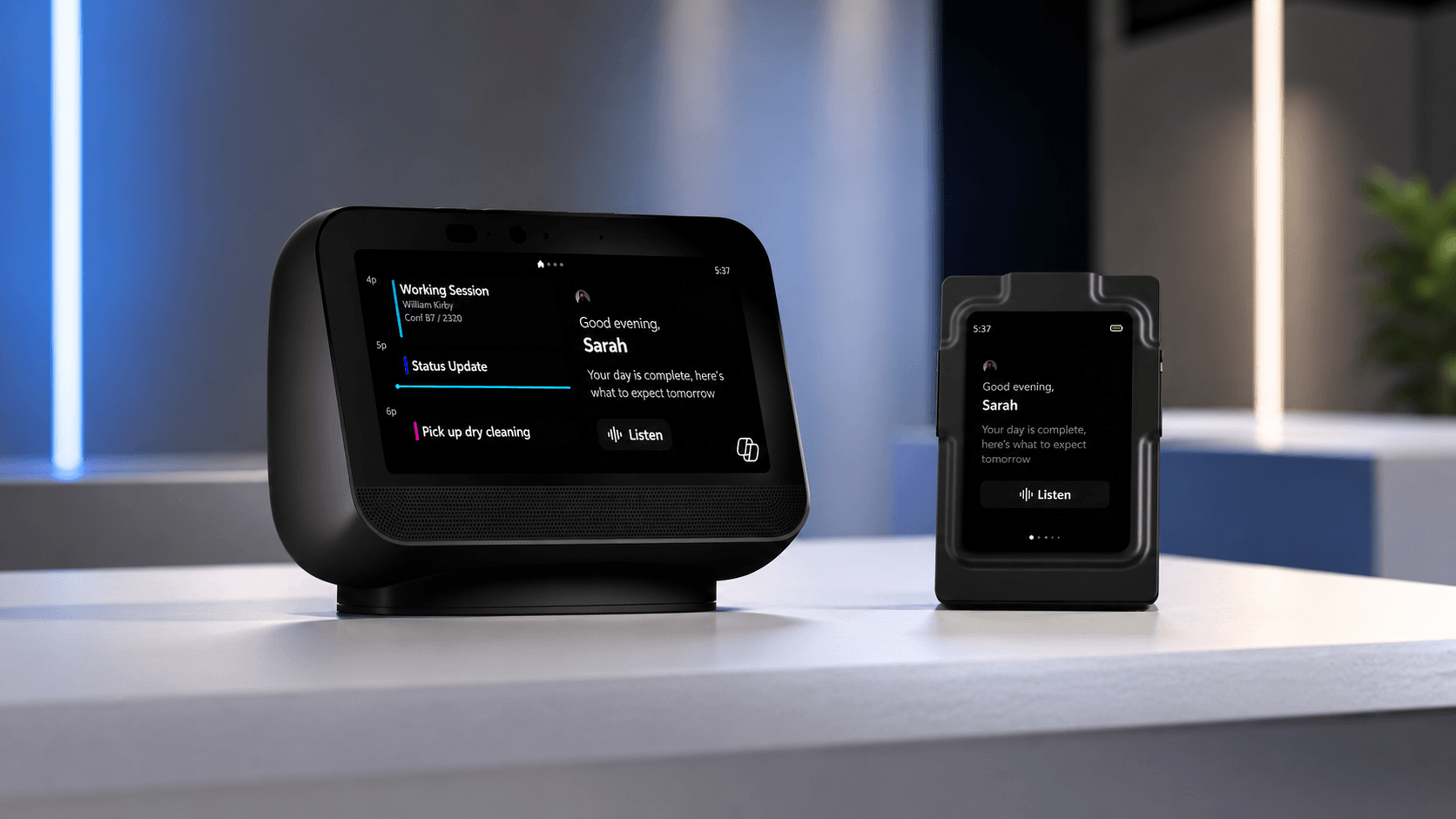
Microsoft showed two concept reference designs: a desk device and a badge device. The desk unit is the easier sell. It resembles familiar smart displays and conferencing companions, with a touchscreen, speaker, microphones, face authentication, USB-C, wireless connectivity, and the ability to become a Windows 365 client when attached to an external display.
That idea is evolutionary. Plenty of offices already contain dedicated room panels, desk phones, smart speakers, and collaboration bars that blend identity, conferencing, calendars, and device management. A Solara desk unit simply makes the agent the center of that ambient workspace.
The badge is the more revealing prototype. Microsoft describes it as a lightweight, always-connected companion for people who move through hospitals, stores, factories, offices, and field environments. Its proposed capabilities include a small touchscreen, fingerprint sign-in through Windows Hello for Business, a camera, microphone, speaker, privacy controls, Wi-Fi, Bluetooth, GNSS, 5G, and wearable silicon from Qualcomm.
That is not just a smaller computer. It is a statement about where Microsoft thinks work happens. The company is targeting moments where a phone is too personal, a tablet is too cumbersome, and a laptop is absurd: a nurse at a bedside, a retail employee on the floor, a technician near equipment, or an office worker leaving a meeting with action items still hanging in the air.
The badge also makes the risk visible. A camera and microphone attached to an authenticated employee identity, continuously available in a workplace, is powerful precisely because it sits close to sensitive activity. The same characteristics that make it useful for documentation and follow-through make it a governance problem if deployment outruns policy.

Android Underneath, Microsoft on Top​

One of the most pragmatic details is that Project Solara is built on Microsoft Device Ecosystem Platform, or MDEP, which itself is based on the Android Open Source Project. That is not an admission that Windows has failed. It is an acknowledgement that specialized, low-power, sensor-rich devices are often better served by the hardware ecosystem around Android than by the assumptions of a desktop operating system.
This matters for OEMs. If Microsoft wants badge-like devices, desk companions, wearable endpoints, scanner-style devices, and retail or healthcare hardware, it needs a platform that chipmakers and device manufacturers can adapt without dragging the full Windows stack into every form factor. Android’s open base offers driver reach, power-management maturity, and hardware familiarity.
Microsoft’s wager is that the value is no longer in the commodity operating-system substrate. The value is in identity, management, security posture, agent orchestration, Microsoft 365 grounding, Azure state, and Windows 365 continuity. In other words, Solara does not need to be Windows to be part of Microsoft’s computing strategy.
That is also why the platform is framed as chip-to-cloud. The local device is intentionally light. The system state, organizational context, and many of the higher-level agent capabilities live in cloud services. The endpoint becomes a secure and context-aware manifestation layer rather than the primary place where work resides.
For WindowsForum readers, that should sound familiar and slightly uncomfortable. Microsoft has spent years persuading organizations to accept cloud PCs, managed endpoints, zero-trust identity, and subscription-tethered productivity. Solara carries those ideas into hardware that may not look like a PC at all.

Agents Are Replacing Menus Before They Replace Workers​

The most immediate change Solara proposes is not mass labor replacement. It is menu replacement. The demos and scenarios Microsoft is emphasizing are about reducing the number of manual transitions between systems.
A hospital badge scans a patient code, captures speech, assists with notes, and surfaces relevant data. An office worker points a camera at a whiteboard and asks for synthesis or next steps. A desk unit summarizes priorities and hands off tasks to nearby devices. These are not science-fiction examples of fully autonomous organizations. They are examples of interface compression.
That is why the “just-in-time UI” concept is central. Microsoft is not saying every device needs a carefully designed app for every task. It is saying the agent should determine whether the right response is spoken, displayed as a small card, shown as a larger layout, routed to a Windows 365 desktop, or handed to another device.
This could be genuinely useful. Many workplace applications are bloated not because every feature is equally important, but because the software must expose every possible workflow somewhere. If an agent can safely infer the user’s context and produce only the necessary controls, the interaction can become shorter and less fatiguing.
But shorter interactions are also harder to audit. A menu at least shows the user a set of possible actions. An agent that compresses a workflow may skip visible intermediate steps. That means enterprises will need logs, permissions, explainability, and rollback mechanisms that are designed for actions, not just access.

The Multi-Agent Story Is Really an IT Control Story​

Microsoft is careful to say Project Solara is built for an open, multiple-agent world. That framing matters because no large organization is going to run on one assistant. A company may use Microsoft 365 Copilot for productivity, GitHub Copilot for development, Dragon Copilot in clinical contexts, custom agents for internal systems, and third-party agents for specialized industry workflows.
The difficult problem is not launching those agents. The difficult problem is deciding which one should act, what data it can see, how its output is trusted, and how responsibility is assigned when agents collaborate. Microsoft’s references to agent dispatching and task management hint at the real platform layer: orchestration.
This is where Solara becomes more than a gadget story. A badge that can summon the wrong agent is annoying. A badge that can route sensitive data to the wrong agent is a compliance incident. A desk device that summarizes calendar items is convenient. A desk device that crosses boundaries between personal notes, confidential project data, and customer information without clear controls is a liability.
Microsoft’s enterprise pitch is therefore predictable but necessary. Identity, privacy, manageability, and user control are not optional extras. They are the only reason an IT department would allow always-available agent hardware into clinical, retail, legal, financial, or industrial settings.
The company has an advantage here. Microsoft already owns many of the identity, device-management, productivity, and cloud surfaces that enterprises use. Solara is an attempt to turn that installed base into a hardware ecosystem without asking every worker to carry another general-purpose computer.

Purpose-Built Hardware Is a Rebuttal to the Smartphone​

The smartphone won the last era because it collapsed many devices into one pocketable computer. Camera, scanner, authenticator, communicator, browser, wallet, notebook, and map all became apps on a glass rectangle. Solara suggests that the next enterprise era may partially reverse that consolidation.
That does not mean phones go away. It means the phone is not always the best workplace interface. It is personal, distracting, heavily app-driven, and awkward in settings where hands-free operation, shared policy, durable authentication, or environmental sensing matter more than app breadth.
A dedicated agent badge can be locked down in ways a personal phone cannot. It can have physical controls for mute and privacy. It can be provisioned, monitored, updated, and recovered as a corporate endpoint. It can be designed around one class of workflow instead of pretending to be everyone’s everything.
This is especially relevant for frontline workers, who have often been underserved by traditional enterprise software. The corporate laptop model fits office employees. The phone app model fits mobile knowledge work. It fits nurses, store associates, warehouse staff, technicians, and hospitality workers less cleanly.
Solara is Microsoft’s way of saying that agentic computing may finally make specialized devices economically interesting again. If the same agent logic can adapt across different screens and input methods, the cost of building niche hardware experiences falls. That is the theory. The practice will depend on whether the agents are reliable enough to justify new devices, new procurement, and new training.

The Windows Angle Is Cloud Continuity, Not Windows Everywhere​

The most Windows-relevant part of Solara may be Windows 365. Microsoft says the desk reference design can become a Windows 365 client when connected to an external display. That is a small detail with large implications.
For years, Microsoft’s endpoint strategy has been moving toward a world where Windows is not only installed locally but also streamed, managed, restored, and accessed through cloud identity. A Solara desk unit that becomes a Cloud PC terminal fits that trajectory perfectly. The local hardware does not need to be a full PC to provide access to a full Windows environment when the task demands it.
This is Microsoft’s hybrid endpoint philosophy in miniature. Use a lightweight agent device for ambient work. Use voice, cards, and short interactions for quick tasks. Attach a display when a full desktop is needed. Keep the state and identity consistent across the experience.
It also gives Microsoft a way to keep Windows central even when the device OS is not Windows. If the desk device runs on an Android-derived platform but becomes a Windows 365 portal, Microsoft still owns the work environment, identity chain, application access, and management plane. Windows becomes less a local operating system and more a reachable work state.
That should worry traditional PC purists less than it might seem. Microsoft is not replacing the workstation used by developers, engineers, gamers, analysts, and creators. The company is targeting the large number of work moments that currently happen badly on phones, paper, shared terminals, or not at all. The PC remains the heavyweight endpoint. Solara is a bet on the spaces around it.

Security Claims Will Meet the Real World at the Camera and Microphone​

Microsoft’s security framing is unsurprising: biometric sign-in, enterprise management, privacy buttons, microphone mute controls, approved accounts, and policy-bound data. Those are table stakes. They are not proof of safety.
The hard question is whether organizations can deploy agent-first devices without turning every workplace into a low-grade surveillance environment. A badge that records a conversation to generate action items may be useful. It may also capture bystanders, patients, customers, or colleagues who did not meaningfully consent. A camera that scans documents and QR codes may reduce friction. It may also observe more than the task requires.
Physical privacy controls help because they give users visible agency. A mute switch is better than a software-only promise. A fingerprint sensor is better than an always-unlocked assistant. But enterprises will need policies that are just as concrete as the hardware controls.
They will need to define when recording is allowed, where cameras may be used, what gets retained, which agents can access transcripts, how bystanders are notified, how regulated data is classified, and who can review the resulting activity. Without those answers, Solara-style devices risk becoming another example of enterprise technology that solves a workflow problem by creating a trust problem.
This is where Microsoft’s “less surface area than a phone full of apps” argument has merit but only goes so far. A locked-down device can indeed be safer than a general-purpose phone. But the risk profile changes when the locked-down device is designed to sense, summarize, and act throughout the day.

The Developer Pitch Is Portability Without App Porting​

For developers, Project Solara’s promise is seductive: build agents once, let the platform adapt the interaction to the device. The same underlying agent might respond through voice on a badge, cards on a small screen, a richer display on a desk unit, or a full Windows 365 session when more room is available.
That could reduce one of the oldest problems in device ecosystems. New form factors usually require new application design, new UI patterns, new testing, and new distribution logic. If Solara can abstract enough of that away, developers may be able to focus on domain logic, data access, permissions, and task completion rather than every pixel of every screen.
Microsoft is not claiming unconstrained generative UI magic, at least not yet. The company’s current framing leans on semi-structured approaches such as adaptive cards and known content types, with more dynamic interfaces evolving over time. That restraint is welcome. Enterprise software does not need a hallucinated button at the edge of a hospital workflow.
The more serious developer challenge will be trust boundaries. An agent that works beautifully in a demo can fail in production when credentials, tenant boundaries, stale data, ambiguous commands, and human interruptions collide. Solara developers will need to think less like app builders and more like workflow engineers designing for identity, context, escalation, and failure.
The upside is that Microsoft already has a funnel for this work. Copilot Studio, Microsoft 365 agent tooling, Azure services, and enterprise identity give developers a familiar starting point. The downside is equally obvious: the more convenient Microsoft makes this stack, the more Solara becomes another gravity well pulling agent development toward Microsoft’s cloud.

The Pilot List Shows the Real Market Microsoft Wants​

Microsoft says companies including AccuWeather, Best Buy, CVS Health, Levi’s, and Target will test the concepts over the coming months. That list is telling. It spans weather services, retail, pharmacy, healthcare-adjacent workflows, and large distributed workforces.
These are environments where a conventional PC is often not the center of the job. Retail employees move constantly. Pharmacy and healthcare workflows involve identity, privacy, scanning, documentation, and regulated information. Store operations depend on tasks being routed quickly to the right person. Weather and logistics-adjacent scenarios often involve field or operational contexts where a small, always-available device could matter.
The pilots also show why Microsoft is starting with reference designs rather than finished consumer products. The company needs to learn which workflows justify a new endpoint. It needs to learn whether workers tolerate wearing or using these devices. It needs to learn how often an agent interaction beats a phone, scanner, tablet, or PC.
That last point is crucial. Enterprise hardware fails when it solves a problem management has but workers do not. If a badge saves a nurse time, improves documentation, and reduces after-shift charting, it has a case. If it mainly creates another channel for task assignment and monitoring, it will be treated like a digital leash.
Microsoft’s internal trials with employees, including frontline and healthcare-oriented scenarios, are therefore more than dogfooding. They are an attempt to discover the social ergonomics of agent hardware. The question is not merely whether the system works. It is whether people will accept it in the intimate spaces where work actually happens.

Solara Is Early Enough That the Hard Parts Are Still Hidden​

The most important word in Microsoft’s Solara announcement is “concept.” The badge and desk devices are reference designs, not finished products with prices, release dates, battery-life claims, support terms, or procurement SKUs. That gives Microsoft room to experiment, but it also means many practical questions remain unanswered.
Battery life will matter. So will heat, durability, cleaning, repairability, cellular costs, offline behavior, local inference capability, and device replacement workflows. A badge used in a hospital or store has a harsher life than a smart display on an executive desk. It will be dropped, wiped, bumped, forgotten, shared incorrectly, and expected to work instantly.
Latency will matter too. Agentic demos tolerate pauses because audiences understand prototypes. Workers do not. If scanning a code, waking an agent, authenticating, retrieving context, and producing a useful response takes too long, users will revert to existing tools. In frontline settings, a bad two-second delay repeated hundreds of times becomes a labor issue.
Then there is the problem of agent correctness. Summarizing a whiteboard is forgiving. Capturing clinical notes, routing tasks, or interpreting operational data is not. Microsoft can provide the platform, but customers and developers will own the consequences of bad workflows built on top of it.
That is why Solara should be read as a directional marker rather than a product category that is ready to explode overnight. Microsoft is planting a flag: agents will not be trapped inside Windows, Teams, or a browser. Whether the market follows depends on how much useful work these devices can do without creating new friction elsewhere.

The Small Device Strategy Carries a Big Platform Ambition​

Solara sits alongside a broader Build 2026 message: Microsoft wants agents everywhere, from developer tools and databases to Windows PCs, cloud infrastructure, Microsoft 365, and specialized devices. The company is not pitching AI as a feature layer anymore. It is pitching AI agents as a new organizing principle for the stack.
That explains the breadth of the announcement. Silicon partners matter because the devices need efficient chips. Azure matters because state, model access, and organizational grounding live in the cloud. Microsoft 365 matters because work context is the bait. Windows 365 matters because full desktop access remains necessary. Management and identity matter because enterprises will not deploy unmanaged agent endpoints at scale.
The ambition is impressive because it is coherent. It is also classic Microsoft. The company is taking a messy new computing pattern and trying to turn it into a managed platform with reference hardware, developer tooling, partner channels, and enterprise controls. That is how Microsoft turns uncertainty into an ecosystem.
The danger is that agentic computing still has a reliability gap. Users can forgive a chatbot for being verbose or wrong in a brainstorming session. They will be less forgiving when a wearable device mishandles a task in the middle of a shift. The closer agents move to the physical world, the less tolerance there is for ambiguity.
That may ultimately shape Solara more than any hardware decision. The winning agent devices will not be the flashiest ones. They will be the ones that do a few bounded jobs reliably, visibly, and under policy control.

The Agent Badge Makes Microsoft’s Bet Impossible to Ignore​

Project Solara is not a Windows replacement, and it is not simply another Copilot demo. It is Microsoft’s clearest attempt yet to make AI agents an endpoint category.
  • Microsoft introduced Project Solara at Build 2026 as an early platform for purpose-built, agent-first devices rather than conventional app-centric hardware.
  • The platform builds on Microsoft Device Ecosystem Platform, an Android Open Source Project-based foundation wrapped with Microsoft’s enterprise identity, security, management, and cloud services.
  • The two concept reference designs are a desk companion that can connect to Windows 365 and a wearable badge meant for mobile, frontline, and hands-free work.
  • The strongest enterprise case is workflow compression, where agents reduce the need to move manually between apps, screens, and services.
  • The largest deployment risks are privacy, surveillance creep, agent correctness, and unclear accountability when multiple agents act across sensitive data.
  • The near-term market will depend less on Microsoft’s keynote vision than on whether pilots in healthcare, retail, and office workflows prove that these devices save time without eroding trust.
Microsoft’s Project Solara is compelling because it treats AI hardware as an enterprise systems problem, not a gadget race. The badge may never ship in its current form, and the desk device may evolve into something more mundane, but the direction is unmistakable: Microsoft wants agents to become ambient, authenticated, managed, and available at the point of work. If the company can make that useful without making it creepy, Solara could become one of the more important platform experiments of the post-PC era; if it cannot, it will be remembered as the moment the agent hype cycle tried to pin a microphone to every employee’s shirt.

References​

  1. Primary source: TechEBlog -
    Published: Tue, 02 Jun 2026 20:34:01 GMT
  2. Related coverage: windowscentral.com
  3. Related coverage: techradar.com
  4. Official source: commandline.microsoft.com
  5. Official source: techcommunity.microsoft.com
  6. Related coverage: investing.com
  1. Related coverage: thenextweb.com
  2. Related coverage: techbuzz.ai
  3. Official source: microsofters.com
  4. Related coverage: pcworld.com
  5. Related coverage: redmondmag.com
  6. Related coverage: constellationr.com
  7. Official source: news.microsoft.com
  8. Related coverage: tomsguide.com
  9. Official source: cdn-dynmedia-1.microsoft.com
 

Microsoft unveiled Project Solara at Build 2026 on June 2 as a chip-to-cloud platform for agent-first workplace devices, using an Android Open Source Project base through Microsoft Device Ecosystem Platform rather than Windows, with Qualcomm and MediaTek reference designs for badge and desk hardware. The surprise is not that Microsoft wants AI agents everywhere; that has been the company’s public strategy for years. The surprise is that, when Microsoft sketched a new class of AI-native devices, Windows was not the foundation. Project Solara is a pragmatic admission that the next fight over computing may happen less on the desktop than in the messy edge territory where badges, speakers, clinical tools, retail devices, and industrial endpoints live.

Microsoft Project Solara ad shows a phone and tablet with AI dashboard plus a secured cloud and governance panels.Microsoft Picks the Edge Over the Desktop​

Project Solara is Microsoft’s attempt to turn the AI agent from a software feature into a device category. The company describes it as a platform for agent-first devices, meaning hardware designed around invoking, supervising, and handing off work to AI agents rather than launching traditional applications.
That framing matters because Microsoft is not merely adding Copilot to another screen. It is proposing a different kind of endpoint: lighter than a PC, more enterprise-managed than a consumer gadget, and more specialized than a phone. In Microsoft’s own examples, Solara shows up as a smart workplace badge and a desk companion device, both designed to keep agents close to the user without forcing that user back into the full Windows desktop.
This is why the Android base is the headline. Microsoft could have presented Solara as a variant of Windows IoT, a Windows 365 appliance, or an embedded extension of Copilot+ PCs. Instead, the platform relies on Microsoft Device Ecosystem Platform, an enterprise-oriented operating system built on the Android Open Source Project. The decision says that Microsoft wants the broad device compatibility, power profile, and embedded ecosystem of Android more than it wants the symbolic purity of extending Windows into every corner.
For Windows loyalists, that may sting. For IT buyers, it may simply sound familiar. The enterprise edge is already full of Android-based scanners, kiosks, panels, meeting-room devices, and rugged handhelds, many of them managed alongside PCs rather than pretending to be PCs.

Windows Is Still the Center, but It Is No Longer the Whole Map​

The most useful way to read Solara is not as a betrayal of Windows but as a boundary marker. Microsoft still wants Windows to be the power user’s workspace, the developer’s local environment, the gaming platform, the endpoint for corporate productivity, and the front door to Windows 365. But it is no longer pretending that every future computing surface must be a Windows machine.
That is a significant shift in posture. The old Microsoft instinct was to extend Windows downward into tablets, phones, embedded devices, and appliances. The modern Microsoft is more willing to wrap identity, management, cloud services, and developer tooling around whatever operating system best fits the form factor.
Solara fits that newer model. Entra ID provides identity. Intune provides management. Windows Hello for Business provides biometric authentication. Azure and Microsoft 365 provide the agent substrate. Windows 365 can appear when the desk device is connected to an external display. Windows remains in the constellation, but it is no longer the only planet.
This is a very Microsoft 2026 move. The company is less interested in winning an operating-system purity contest than in making sure the management plane, cloud plane, AI plane, and developer plane all point back to Redmond. If the device underneath is Android-based, Microsoft can live with that so long as the tenant, policy, agents, and data flow through Microsoft’s stack.

The Badge Is the Provocation​

The badge concept is the device that makes Solara feel less like another developer-platform announcement and more like a workplace argument waiting to happen. Microsoft describes a portable badge-like device with a touchscreen, fingerprint authentication, camera, microphone array, speaker, wireless connectivity, and a privacy switch. In plain English, that is an employee credential that can also listen, see, authenticate, display context, and summon agents.
There are obvious useful scenarios. A nurse could capture a clinical conversation without returning to a workstation. A field worker could document a site condition hands-free. A retail employee could ask an inventory agent for the right answer in front of a customer. A developer could get status from GitHub Copilot without opening a laptop.
There are also obvious reasons to be uneasy. A workplace badge is not a neutral form factor. It is already a symbol of access control and institutional oversight, and adding microphones, cameras, and cloud-connected AI agents to that object changes the social contract around it. Microsoft emphasizes privacy indicators, physical mute controls, user permission, and enterprise governance, but the device category itself will invite scrutiny.
That scrutiny is not paranoia. The history of workplace technology is full of tools sold as productivity aids that later became measurement systems. A badge that can help an employee remember, summarize, and act could also become a badge that tracks presence, interactions, responsiveness, and ambient context. The difference between assistance and surveillance will be set less by the hardware than by policy, defaults, auditability, and labor norms.

Android Is the Practical Choice Microsoft Would Rather Not Overexplain​

The Android foundation is not mysterious. AOSP gives Microsoft and device makers a mature base for low-power, connected, sensor-rich hardware. It comes with a vast chip and driver ecosystem, a known embedded-device story, and years of manufacturer familiarity. For badges, desk displays, meeting devices, scanners, and field-service tools, that matters more than compatibility with Win32.
Windows carries enormous strengths, but lightweight embedded diversity is not one of them. It is too heavy for many of these devices, too tied to PC assumptions, and too burdened by decades of application compatibility expectations. Project Solara is aimed at hardware where battery life, cameras, microphones, radios, biometrics, sensors, and cost curves matter more than running Excel locally.
This is where the decision becomes strategically honest. Microsoft does not need Solara devices to run Windows apps. It needs them to invoke agents, authenticate users, render adaptive interfaces, respect enterprise policy, and hand off work to cloud or PC environments. If the application model is no longer the center of the device, Windows compatibility becomes less compelling.
That does not make Windows irrelevant. It makes Windows specialized in the opposite direction: the high-capability general-purpose environment where complex work still happens. Solara is for the moments before, after, and around the PC. It is Microsoft trying to own the connective tissue.

The Agent Shell Replaces the App Launcher​

Solara’s most important software idea is not the Android base; it is the Agent Shell. Microsoft’s concept is that devices will dynamically surface agents and agent-driven experiences instead of asking users to navigate through conventional apps. The user expresses intent, the platform finds or activates the right agent, and the interface appears only as much as needed.
That is a radical claim disguised as a usability improvement. The app launcher has been the organizing metaphor for personal computing for decades. Even smartphones, for all their sensors and notifications, still revolve around icons, app stores, permissions, and app-specific user interfaces. Solara imagines an environment where the interface is generated or adapted around the task rather than prebuilt as a full application.
Microsoft calls part of this just-in-time UI. Today, that likely means semi-structured cards, adaptive layouts, and known content types that can render across different screen sizes and input methods. In the long run, Microsoft gestures toward more dynamic and generative interfaces, though wisely stops short of claiming that fully generated UI is ready for enterprise-critical work.
The risk is that agent-first interfaces can become unpredictable. Administrators like consistency because consistency is supportable. Users like familiarity because familiarity lowers cognitive load. If every agent interaction becomes a bespoke little interface, Microsoft will need strong design constraints, logging, accessibility guarantees, and fallback paths. Otherwise, just-in-time UI becomes just-in-time confusion.

Enterprise IT Gets the Pitch It Was Waiting For​

Microsoft has clearly learned from the backlash that follows consumer-style AI features when they arrive without sufficient enterprise framing. Solara is being introduced with the language IT departments expect: Intune management, Entra ID, Hello for Business, hardware requirements, privacy controls, approved chipsets, and reference designs. That does not solve every problem, but it shows Microsoft knows who must approve these devices.
For sysadmins, the appeal is obvious if the platform works as advertised. A fleet of agent devices that can be enrolled, authenticated, updated, locked down, and governed like other endpoints is far easier to consider than a zoo of unmanaged AI gadgets. If a hospital, warehouse, retailer, or professional-services firm is going to experiment with wearable or desk-based agents, IT will demand exactly this kind of control plane.
The harder questions come after enrollment. What data does each agent access? Where is audio processed? How are recordings retained? Can users inspect what was captured and why? Can administrators disable cameras by policy? Can a unionized workplace distinguish user assistance from productivity monitoring? Can third-party agents be certified, sandboxed, and revoked quickly?
Microsoft’s advantage is that it already owns much of the enterprise trust machinery. Its disadvantage is that AI agents make the blast radius of a bad policy decision larger. A conventional endpoint leaks files when something goes wrong. An agentic endpoint may observe context, infer intent, initiate workflows, and move across systems. That demands a higher bar than ordinary mobile-device management.

Qualcomm and MediaTek Signal the Hardware Microsoft Wants​

The first named silicon partners, Qualcomm and MediaTek, tell us what kind of ecosystem Microsoft is courting. Qualcomm brings wearables, mobile connectivity, and efficient on-device AI acceleration. MediaTek brings breadth in IoT, displays, smart devices, and cost-sensitive embedded platforms. This is not the silicon map of the traditional Windows PC business.
That matters because Solara is not about a single Microsoft-branded product. It is a reference-design strategy. Microsoft wants OEMs and vertical-market device makers to build specialized hardware for healthcare, retail, hospitality, financial services, legal work, industrial settings, and field service. In those markets, the winning device is often not the most powerful one; it is the one that fits a workflow, survives procurement, and can be managed without heroic effort.
The desk concept is the safer of the two initial designs. It resembles a smart display for work: touchscreen, microphones, speaker, face authentication, presence sensing, USB-C, and the ability to become a Windows 365 client when attached to a display. It is easy to imagine it as a Teams Rooms cousin, a Copilot terminal, or a front-office appliance.
The badge is riskier and therefore more interesting. It pushes Microsoft into a category where the device is worn, socially visible, and close to sensitive human interactions. If Solara succeeds there, it could become a platform for many specialized endpoints. If it fails there, it will likely be because the social and governance model could not keep up with the technical ambition.

The Copilot Strategy Moves Out of the Browser Tab​

For the past several years, Microsoft has pushed Copilot into the places users already work: Windows, Edge, Office, Teams, GitHub, and Azure. Solara extends that strategy into physical space. Instead of making the PC the sole container for AI assistance, Microsoft is asking what happens when the agent is available at the desk, on the body, in the clinic, at the counter, or in the field.
This is an important evolution because many high-value workflows do not happen neatly inside a desktop application. Healthcare workers move between patients and systems. Retail workers move between customers, inventory, and point-of-sale terminals. Field technicians move between physical equipment and documentation. In those contexts, the PC is often a station to return to, not the place where the work itself happens.
Solara’s promise is to move the interface closer to the work. That is not a new dream; mobile computing and IoT have chased it for years. What is new is Microsoft’s belief that agents reduce the need to build a custom app experience for every device and workflow. If the agent can understand context and render just enough interface, the economics of specialized hardware may improve.
That is the bet. It is not guaranteed. Agents are still unreliable in ways that ordinary software is not. They can misunderstand, overreach, hallucinate, or take action with misplaced confidence. A purpose-built device does not eliminate those risks; it puts them into environments where mistakes may be more consequential.

The Ghost of Windows Phone Is Not the Right Analogy​

It is tempting to see an Android-based Microsoft platform and immediately reach for Windows Phone. That analogy is emotionally satisfying and strategically lazy. Windows Phone failed because Microsoft was late to a consumer smartphone platform war defined by apps, carriers, developers, and consumer ecosystems. Solara is aimed at enterprise-managed specialized devices in a world where Microsoft already owns much of the identity and productivity infrastructure.
The better comparison is Microsoft’s broader post-Windows strategy: embrace the platform that exists, then make Microsoft services indispensable on top of it. Office on iOS and Android was once heresy. Now it is normal. Microsoft Defender, Intune, Teams, Edge, and Copilot all operate across platforms because the company learned that control at the service layer can matter more than control at the kernel layer.
Solara takes that logic into hardware. If AOSP is the fastest way to get agent devices built, then AOSP is the base. Microsoft can still define the management model, the agent model, the identity layer, and the developer experience. That is where the money and lock-in live.
The unresolved question is whether device makers and customers will see Solara as an open platform or as another Microsoft funnel. The company says it expects a multi-agent world where organizations can bring their own agents. But openness in enterprise platforms is always a matter of implementation, not aspiration. The real test will be how well non-Microsoft agents work, how much policy control customers get, and whether Solara devices remain useful outside the Microsoft 365 orbit.

Developers Are Being Asked to Build for Places, Not Screens​

For developers, Solara reframes the target. The traditional question was which operating system or app framework to support. The Solara question is where an agent should appear, what context it should understand, and how little interface it can get away with. That is a different design discipline.
Microsoft is pointing developers toward Copilot Studio, Microsoft 365 agent tooling, agent SDKs, and cloud-based orchestration. The obvious near-term opportunity is for organizations that have already built internal agents against Microsoft 365 data. Solara gives those agents new endpoints without requiring a full mobile or desktop application for every workflow.
But developers should be cautious about the abstraction. “Build once, adapt everywhere” has been promised many times in computing, and it usually works only within disciplined constraints. A badge, a desk display, a wall panel, and a handheld scanner have different ergonomics, attention models, privacy expectations, and failure modes. Agents may reduce interface work, but they do not repeal product design.
The deeper opportunity is not porting apps to tiny screens. It is building task-specific agents that can survive in constrained, interrupt-driven environments. That means designing for confirmation, handoff, recovery, audit trails, and graceful failure. The agent that works in a Teams chat may not be safe enough for a clinical badge or a factory-floor device.

Security Becomes a Human-Factors Problem​

Microsoft is emphasizing security controls because it has to. A Solara device may include microphones, cameras, biometrics, cloud connectivity, enterprise identity, and access to sensitive organizational data. That combination makes endpoint security inseparable from human-factors design.
A physical mic mute switch is good. Clear recording indicators are good. Biometric authentication is good. Intune policy is good. None of those controls is sufficient if users do not understand when an agent is listening, what it can see, what it can do, and when an action has been taken on their behalf.
The most dangerous failures may not look like classic malware. They may look like ambiguous consent, accidental capture, prompt injection through environmental data, malicious QR codes, unsafe summarization, or an agent taking a plausible but wrong next step. The security model must account for the fact that these devices exist in public and semi-public spaces, not just on desks behind locked screens.
That is especially true for healthcare and frontline work, two areas Microsoft clearly has in mind. A device that records a hallway conversation, summarizes a patient interaction, or surfaces clinical context can be useful only if trust is preserved among workers, patients, administrators, and regulators. In those settings, privacy is not a settings page. It is the condition for deployment.

The Windows Community Should Pay Attention, Not Panic​

For WindowsForum readers, the instinctive question is whether Solara diminishes Windows. The more accurate answer is that it reveals Microsoft’s hierarchy. Windows is still central to productivity, development, gaming, management, and enterprise computing. But Microsoft increasingly sees Windows as one surface in a larger agent-and-cloud system.
That may actually strengthen Windows in some scenarios. The desk concept’s ability to become a Windows 365 client shows how Microsoft can use Solara-class devices as lightweight portals into full Windows environments. A worker may interact with agents on a desk display all day, then attach a monitor and drop into a Cloud PC when deeper work is required.
At the same time, Solara makes clear that Microsoft will not force Windows into every future form factor just to satisfy platform pride. That is a mature decision, but it also narrows Windows’ symbolic role. The operating system is no longer the universal answer to Microsoft’s device ambitions. It is the heavyweight environment in a portfolio increasingly organized around identity, management, agents, and cloud execution.
The practical result is that Windows admins may end up managing more non-Windows Microsoft endpoints, not fewer. Intune already pushed many organizations in that direction. Solara could accelerate it by adding a new class of devices that are Microsoft-governed but Android-based, AI-forward, and deeply tied into Microsoft 365.

The Real Product Is Governance​

The most revealing part of Project Solara is that the hardware concepts are less important than the governance model around them. Badges and desk companions are attention-grabbing, but the real product is a way to make agent devices acceptable to enterprises. Microsoft is selling not just a device platform, but permission to experiment.
That permission has several layers. Device makers need a reference architecture. Developers need agent tooling. IT departments need enrollment and policy. Security teams need authentication and controls. Executives need a story about productivity. Workers need confidence that the device is not a surveillance trap.
If any one of those layers fails, Solara becomes another futuristic demo. If enough of them hold, Microsoft gets a new beachhead at the enterprise edge. That is why the Android-versus-Windows debate, while important, is not the whole story. The operating system is the substrate; the trust model is the product.
Microsoft has been here before in adjacent ways. Teams Rooms, Surface Hub, Windows 365, Intune-managed mobile devices, and vertical cloud offerings all tried to make specific work environments more Microsoft-shaped. Solara is broader and more speculative, but it follows the same pattern: define the enterprise control plane first, then let hardware categories form around it.

The Solara Bet Comes With a Short List of Hard Truths​

Project Solara is early, and Microsoft is careful to describe its devices as concepts and reference designs rather than finished products. Still, the announcement is concrete enough to draw several conclusions about where the company is heading.
  • Microsoft is no longer treating Windows as the default base for every new intelligent device category.
  • Project Solara is built for enterprise-managed agent endpoints, not consumer gadgets chasing the next smartphone moment.
  • The Android Open Source Project base is a practical choice for low-power, sensor-rich, connected hardware.
  • The badge concept is both the most compelling and the most socially sensitive example Microsoft showed.
  • Intune, Entra ID, Hello for Business, Microsoft 365, Azure, and Windows 365 are the real strategic anchors of the platform.
  • The success of Solara will depend less on AI demos than on privacy, governance, developer discipline, and worker trust.
Project Solara is Microsoft’s clearest signal yet that the next Windows story may not always be about Windows itself. The company is betting that agents will escape the app window and inhabit specialized devices all around the workplace, and it is willing to use Android plumbing to make that happen. For users and administrators, the future this points to is neither a clean replacement for the PC nor a simple extension of today’s Copilot sidebar. It is a more fragmented, more ambient, more policy-heavy computing world, where the question is not which device runs Windows, but which devices are allowed to act on our behalf.

References​

  1. Primary source: 디지털투데이
    Published: Tue, 02 Jun 2026 20:22:59 GMT
  2. Independent coverage: Devdiscourse
    Published: Tue, 02 Jun 2026 18:52:43 GMT
  3. Official source: commandline.microsoft.com
  4. Official source: blogs.microsoft.com
  5. Related coverage: techbuzz.ai
  6. Official source: blogs.windows.com
  1. Related coverage: thenextweb.com
  2. Related coverage: pcworld.com
  3. Related coverage: heise.de
  4. Related coverage: redmondmag.com
  5. Related coverage: ebisuda.net
  6. Related coverage: arstechnica.com
  7. Related coverage: techcrunch.com
  8. Official source: info.microsoft.com
  9. Official source: techcommunity.microsoft.com
 

Microsoft unveiled Project Solara at Build 2026 in San Francisco on June 2, 2026, presenting a chip-to-cloud platform for “agent-first” enterprise devices and showing a wearable badge concept that turns the familiar office ID card into an AI assistant. The striking part is not that Microsoft has another AI demo. It is that the company is openly imagining a workplace computer that is neither a PC nor a phone, and not even a Windows device. Solara is Microsoft’s argument that the next interface for work may be something clipped to your shirt, listening for intent, governed by IT, and backed by the cloud.

Healthcare worker in a warehouse with an AI assistant overlay showing device, access, and encrypted data policies.Microsoft Turns the Badge Into a Beachhead​

The office badge is one of the dullest pieces of enterprise hardware ever standardized. It opens doors, confirms identity, and then disappears into muscle memory. That is exactly why Microsoft’s choice is clever.
Project Solara’s badge concept borrows a form factor that workers already accept as part of the job. Microsoft did not start with smart glasses, a pendant, or a futuristic pin that demands social explanation. It started with the plastic rectangle that already sits on millions of collars, lanyards, scrubs, jackets, and retail uniforms.
The concept device includes a touchscreen, a speaker, wireless connectivity, a side-facing camera, biometric authentication through Windows Hello-style fingerprint support, and a privacy switch. Under the hood, Microsoft is leaning on partner silicon rather than asking the market to wait for exotic custom chips. Qualcomm is attached to the wearable side of the story, while MediaTek appears in Microsoft’s stationary concept work.
That hardware list matters less than the posture. This is not a consumer gadget trying to become useful at work. It is an enterprise device that begins with identity, manageability, and ambient access to Microsoft’s cloud services.

The Real Product Is Not the Badge​

Microsoft says Project Solara is a chip-to-cloud platform, which is a slightly awkward phrase for a serious strategic move. The idea is that the useful computing environment no longer lives cleanly on the device. The device becomes an access point for agents, identity, sensors, and enterprise cloud state.
That helps explain why Microsoft is treating the badge as a concept rather than a finished SKU. The company does not appear eager to become the world’s office badge vendor. It wants OEMs, silicon partners, and industry customers to build specialized devices on top of Microsoft’s software, management, identity, and AI layers.
This is familiar Microsoft strategy with a new surface area. Windows succeeded because Microsoft owned the platform while hardware makers fought over the boxes. Azure and Microsoft 365 succeeded because Microsoft owned the control plane while businesses brought their own messy workflows. Solara tries to apply that same logic to AI-native workplace devices.
The badge is therefore a provocation. It says to hardware makers: stop thinking of AI as something that must be bolted onto a laptop, phone, or Teams window. Build devices around the moments where work actually happens.

Android Wins the Job Windows Was Not Built For​

The most revealing detail is that Solara is not Windows. Microsoft’s platform uses the Microsoft Device Ecosystem Platform, which is built on the Android Open Source Project. That is not a footnote. It is the architecture telling the truth before the marketing does.
Windows remains Microsoft’s flagship productivity operating system, but it is not the obvious base for a tiny wearable with sensors, cellular radios, biometric unlock, and multi-day battery expectations. Android’s embedded and mobile heritage gives Microsoft a more plausible foundation for specialized hardware that needs to behave like appliance infrastructure rather than a general-purpose PC.
There is also a political message here. Microsoft is signaling that Copilot-era computing does not require Windows as the local operating system. If the agent, identity layer, cloud service, management stack, and enterprise data live in Microsoft’s ecosystem, the kernel underneath becomes less sacred.
That is a big shift for a company whose history was built on the premise that Windows was the default place where work happened. Solara suggests Microsoft is more afraid of missing the next workplace interface than of admitting Windows is not always the right tool for it.

Agents Replace Apps, at Least in the Pitch Deck​

Microsoft’s stated premise is that these devices are agent-first. In practice, that means users are not expected to open apps, browse menus, or move between traditional software windows. They press a button, speak or gesture intent, and let an AI agent assemble the workflow.
On the badge, that could mean recording a meeting, transcribing it, extracting action items, surfacing a schedule, identifying something in view, or calling up relevant enterprise context. In Microsoft’s demo, the device looked at a brainstorm board and suggested adding plants to an office redesign. It was a tiny example, but the implication was larger: the computer is no longer waiting behind a screen. It is watching the workspace.
This is the same philosophical move Microsoft has been making across Copilot, Windows, Edge, GitHub, and Microsoft 365. Apps become less important than orchestration. The agent does not live inside Word or Teams so much as it crosses between documents, calendars, messages, meetings, databases, and now physical surroundings.
The difficulty is that agents still have to earn the grand name. Today’s AI assistants remain uneven: impressive in constrained demos, brittle in edge cases, and dangerously confident when wrong. Project Solara will rise or fall not on whether the badge can transcribe a meeting, but on whether it can perform useful work reliably enough that employees stop reaching for the phone or laptop.

The Phone Is the Obvious Competitor Microsoft Refuses to Name​

Every AI wearable has to answer the same brutal question: why is this not just a phone? Microsoft’s answer is strongest in settings where phones are socially awkward, operationally disruptive, or administratively messy.
In a hospital room, a clinician pulling out a smartphone can look inattentive even when doing something useful. On a retail floor, a phone can suggest distraction rather than service. In a warehouse, a phone may be less convenient than a clipped device that can be accessed while moving, scanning, talking, or carrying equipment.
A dedicated badge also gives IT more control. It can be locked down to narrow workflows, managed through enterprise tools, authenticated with corporate identity, and designed with fewer consumer distractions. A phone is a general-purpose personal computer full of notifications, apps, personal accounts, and privacy complications. A badge can be a purpose-built work endpoint.
That is the clean version of the argument. The messier version is that employers may prefer a device they own, configure, update, monitor, and restrict. For workers, that difference will matter.

Enterprise IT Gets the Control Plane It Wants​

Microsoft is not pitching Solara as a toy for gadget enthusiasts. It is pitching the platform as manageable enterprise infrastructure. Intune and Entra ID are central to that story, because they let companies treat these devices as part of the same governed fleet as PCs, phones, and tablets.
That is where Solara becomes more plausible than many previous AI wearable concepts. Enterprises do not deploy devices because a demo looks good. They deploy them because identity works, policies apply, updates arrive, audit trails exist, and the hardware can be disabled when an employee leaves.
Microsoft’s security-and-management framing is not just defensive. It is a sales wedge. A hospital, retailer, or logistics company may be more willing to pilot an AI badge if it fits into tools administrators already use. The less exotic the management layer feels, the less risky the hardware experiment becomes.
Still, manageability does not eliminate risk. It merely moves risk into policy. A centrally managed badge that can record, transcribe, authenticate, and send context to cloud services is powerful precisely because it is sensitive.

The Privacy Switch Is Doing a Lot of Symbolic Work​

The presence of a privacy switch is not incidental. Microsoft knows that a camera-equipped, cloud-connected workplace badge invites immediate suspicion. A visible hardware control is meant to reassure not only the wearer, but everyone around the wearer.
The problem is that privacy in this category cannot be solved by a switch alone. Workers will need to know when recording happens, where transcripts go, how long data is retained, who can search it, whether managers can review it, and what happens when customers, patients, visitors, or unionized employees are captured incidentally.
The badge sits at the intersection of productivity and surveillance. That makes it more sensitive than a laptop webcam or meeting-room speaker. It moves through hallways, patient rooms, stockrooms, break areas, and informal conversations. The more useful it becomes, the more intrusive it may feel.
Microsoft can design safeguards, but employers will determine the lived experience. A Solara badge used as a nurse’s hands-free assistant is one thing. A Solara badge used as a worker analytics node is quite another.

Healthcare and Retail Are the Right First Test Beds​

Microsoft’s announced pilot targets make sense. Best Buy, CVS Health, Levi’s, Target, AccuWeather, and other industry partners represent environments where workers move through physical spaces while needing rapid access to information. These are not desk-only jobs waiting for a better desktop app.
Healthcare is the most obvious stress test. A clinician could benefit from ambient documentation, quick patient context, task reminders, and hands-free access to operational systems. But healthcare is also where privacy, consent, regulatory compliance, and trust are least forgiving.
Retail is more commercially straightforward but operationally demanding. A store associate could ask about inventory, product details, returns, promotions, or customer pickup status without stepping away to a terminal. The value proposition is immediate: keep the employee in the aisle and the customer in the conversation.
AccuWeather points to another class of use: field work and time-sensitive information. A wearable agent that can surface live operational context may be more useful outside a traditional office than inside one. The badge may be called an office worker device, but its best early use cases may be among workers who rarely sit at a desk.

Microsoft Is Also Hedging With Heavy Metal​

Project Solara arrived alongside a broader AI hardware push from Microsoft, including the newly announced Surface Laptop Ultra built with NVIDIA for demanding AI workloads. That contrast is important. Microsoft is not betting on one AI device category. It is stretching the Windows ecosystem upward into high-performance local AI while stretching the workplace endpoint outward into lightweight agent devices.
The Surface Laptop Ultra is the brute-force answer: more local compute, more memory, more GPU capability, more room for professional workloads that cannot live entirely in the cloud. Solara is the distributed answer: smaller devices, narrower contexts, cloud-backed intelligence, and enterprise orchestration.
Those strategies may seem opposed, but they reflect the same underlying assumption. AI changes the shape of the device market. Some users will need powerful local machines to run models, build systems, render content, or protect sensitive data. Others will need tiny endpoints that let cloud agents meet them in the hallway, exam room, shop floor, or loading dock.
Microsoft wants to be present in both directions. It wants Windows to matter when compute is local, and it wants Microsoft cloud services to matter when compute is ambient.

Apple’s Shadow Falls Over the Privacy Argument​

Solara also highlights a philosophical divide with Apple. Apple has spent years positioning privacy, on-device processing, and tight hardware-software integration as core advantages. Microsoft’s Solara story is more enterprise-cloud-native: identity, management, Azure-backed agents, and coordinated services across devices.
Neither approach is automatically superior. On-device processing can reduce data exposure and latency, but it constrains model size, battery life, and device cost. Cloud processing can enable more capable agents and centralized governance, but it requires trust in network paths, retention policies, administrative controls, and vendor promises.
For businesses already standardized on Microsoft 365, the cloud-first trade-off may feel acceptable. The data is already in Exchange, Teams, SharePoint, OneDrive, Dynamics, and security tooling. A badge that accesses that universe through governed identity may look like an extension of the existing workplace rather than a new privacy frontier.
Employees may not see it that way. The fact that corporate data already lives in the Microsoft cloud does not mean every hallway conversation should become machine-readable context. The social boundary is not the same as the technical boundary.

The Badge Could Fail and Still Matter​

It is entirely possible that Microsoft’s first badge concept never becomes a mass-market workplace object. Many concept devices exist to teach partners what a platform can do, not to define the final hardware. The eventual winning form factor could be a badge, a small display, an earpiece, a scanner, a vehicle-mounted device, or something built into existing equipment.
That does not make Solara irrelevant. The platform is Microsoft’s attempt to seed a category before someone else defines it. The company missed the smartphone platform shift, retreated from Windows Phone, and watched mobile operating systems become the primary computing layer for billions of people. It is not eager to repeat that history with AI agents.
By using AOSP while tying the experience to Microsoft identity and cloud services, Microsoft is trying to avoid the trap of needing a full consumer app ecosystem. Agents are supposed to make the app gap less important. If the user asks for an outcome and the agent handles the service calls, the traditional app launcher recedes.
That is the theory. The practical question is whether agents can replace the predictability of apps without becoming opaque, error-prone middlemen.

The Workplace Computer Becomes a Sensor​

For decades, the workplace computer was mostly a destination. You went to the terminal, sat at the laptop, opened the app, and entered the data. Mobile devices changed that by letting work follow the employee. AI wearables push further: the computer begins to observe the work as it happens.
That shift has real advantages. Documentation is one of the great hidden taxes of modern work. If an agent can capture a meeting, summarize a shift handoff, update a task system, or retrieve instructions without forcing a worker to stop and type, the productivity upside is obvious.
But the sensor model changes power relationships. A device that can help a worker remember a patient instruction can also help an employer reconstruct what the worker said. A device that can suggest next steps can also measure deviations from process. A device that can reduce paperwork can also expand managerial visibility into moments that used to be ephemeral.
That is why Project Solara should not be judged only as a gadget announcement. It is part of the larger renegotiation of what counts as work data.

The Best Version Is an Assistant, Not a Supervisor​

The success condition for Solara is not simply technical. It is cultural. Workers must experience the device as something that gives them leverage, not something that narrows their autonomy.
That means the best deployments will likely be task-specific and transparent. A badge that helps nurses reduce after-hours documentation has a clearer social contract than a badge that continuously captures workplace interactions for unspecified analytics. A retail assistant that answers inventory questions is easier to justify than a device that scores every customer conversation.
Microsoft’s enterprise customers will be tempted to ask for both productivity and oversight. The platform can probably support both. The question is whether organizations are disciplined enough to avoid turning every assistive device into a monitoring device.
The history of workplace technology is not encouraging on that point. Tools introduced to streamline work often become tools to measure it. Solara’s privacy controls and management features need to be paired with human policies that are just as explicit.

Developers Get a New Target, but Not a Blank Check​

For developers, Solara is interesting because it suggests a new class of agent surfaces. Instead of building apps for screens of known size and input models, developers may be building agents that manifest differently depending on device, context, sensor input, and enterprise policy.
That is a more fluid model, but it is also harder to reason about. Traditional apps give developers a container. Agent-first devices ask them to think in tasks, permissions, identity, workflows, and context handoffs. The interface may be generated or adapted just in time.
Microsoft would love for this to become a new developer platform around agents, Copilot integrations, Azure services, and Microsoft Graph-style access to enterprise data. The opportunity is real, but so is the dependency. Developers building for Solara will be building inside Microsoft’s rules for identity, management, and cloud execution.
That may be fine for enterprise software vendors already living in the Microsoft ecosystem. It will be less appealing to developers who want portable agents across Google, Apple, Salesforce, OpenAI, and independent hardware environments. The agent era may reduce dependence on apps, but it will not eliminate platform lock-in. It may simply move lock-in up the stack.

The Old App Model Will Not Disappear Quietly​

Microsoft’s rhetoric around agents can make traditional apps sound obsolete. That is premature. Apps persist because they are legible. They have buttons, states, permissions, logs, settings, and user expectations. When something goes wrong, there is at least a visible place to start.
Agents blur those boundaries. They can be more natural, but they can also be harder to audit. If a badge summarizes a conversation incorrectly, files a task in the wrong system, or exposes data to the wrong context, the user needs a way to inspect and correct what happened. “The agent did it” is not an acceptable enterprise failure mode.
The likely future is hybrid. Apps will remain systems of record and deep workspaces. Agents will become the connective tissue around them, especially in mobile and frontline scenarios. Solara’s job is not to kill apps overnight. It is to make app interaction less central in moments where opening an app is the wrong shape of work.
That is a more modest claim than the agent hype cycle prefers, but it is also more believable.

The Badge Makes Microsoft’s AI Bet Physical​

Until now, much of Microsoft’s AI push has been experienced as software intrusion: Copilot buttons, sidebars, chat panes, summaries, generated drafts, and coding assistants. Project Solara gives that strategy a body. The AI assistant leaves the window and enters the room.
That physicality raises the stakes. A Copilot pane in Word can be ignored. A badge on a worker’s chest becomes part of the social environment. Customers will notice it. Patients will ask about it. Co-workers will wonder whether it is recording. Security teams will ask what it can see.
This is why Microsoft’s badge concept is both more compelling and more unsettling than another Copilot integration. It promises to make AI useful at the edge of work, where laptops are clumsy and phones are impolite. It also forces institutions to confront the fact that ambient computing is not just a technical interface. It is a social contract.

The Solara Badge Is Small, but the Deployment Questions Are Not​

The practical lessons from Microsoft’s announcement are already clear, even before the pilots report back. Solara should be treated less like a novelty wearable and more like an early enterprise endpoint category with identity, sensors, AI, and policy baked in from the beginning.
  • Microsoft introduced Project Solara on June 2, 2026, as a chip-to-cloud platform for agent-first devices rather than a conventional Windows hardware product.
  • The badge concept uses a familiar workplace form factor to test whether AI assistance can work in physical environments where phones and laptops are awkward.
  • Solara’s Android Open Source Project foundation shows that Microsoft is willing to decouple future workplace AI endpoints from Windows when the form factor demands it.
  • Enterprise manageability through tools such as Intune and Entra ID is central to the pitch, because IT buyers will not deploy ambient AI hardware without policy control.
  • The privacy challenge is not solved by hardware switches alone, because recording, retention, consent, and managerial access will define whether workers trust the device.
  • The first pilots in retail, healthcare, weather, and related frontline environments will matter more than the demo, because those settings expose both the value and the risk of ambient AI.
Microsoft’s Project Solara badge may never become the exact device hanging from office workers’ shirts, but it gives the industry a clearer picture of where enterprise AI hardware is headed: away from the assumption that every task begins on a PC, beyond the phone as the default mobile endpoint, and toward managed, sensor-rich devices that turn real-world context into software action. If Microsoft and its partners get the balance right, the badge could become a useful new interface for workers who need information without breaking eye contact with the world in front of them. If they get it wrong, it will become another reminder that the future of computing is not decided by what a device can perceive, but by whether people can trust why it is watching.

References​

  1. Primary source: Memeburn
    Published: 2026-06-03T05:50:26.041310
  2. Official source: commandline.microsoft.com
  3. Related coverage: gigazine.net
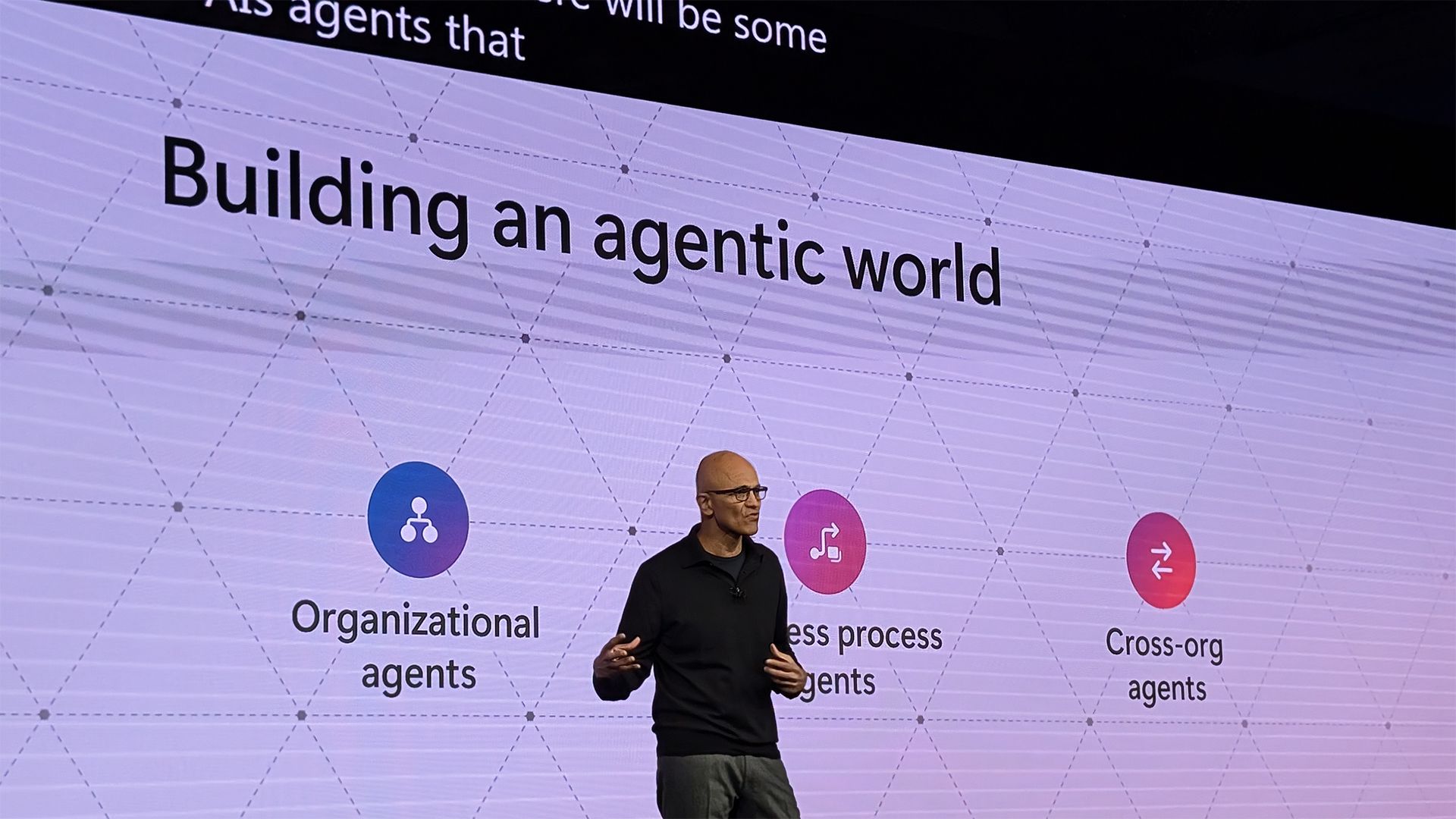
  4. Related coverage: business-standard.com
  5. Related coverage: arstechnica.com
  6. Related coverage: thenextweb.com
  1. Official source: news.microsoft.com
  2. Related coverage: stuff.tv
  3. Related coverage: tecnogeek.com
  4. Related coverage: techtimes.com
  5. Official source: cdn.techcommunity.microsoft.com
  6. Official source: download.microsoft.com
  7. Official source: microsoft.com
  8. Official source: info.microsoft.com
  9. Related coverage: windowscentral.com
  10. Related coverage: techspot.com
  11. Related coverage: notebookcheck.org
  12. Related coverage: technetbooks.com
  13. Related coverage: tomshardware.com
  14. Related coverage: 01net.com
  15. Related coverage: windowslatest.com
  16. Related coverage: axios.com
  17. Related coverage: omni.se
 

Microsoft introduced Project Solara on June 3, 2026, as a chip-to-cloud platform for agent-first enterprise devices, beginning with badge and desk reference designs tied to Microsoft 365 Copilot, Intune, Entra ID, Windows 365, and Microsoft’s Android-based Device Ecosystem Platform. The announcement matters because it moves Microsoft’s agent strategy out of the chat box and into hardware that can be worn, placed, managed, authenticated, and deployed. This is not a new Surface gadget in disguise; it is Microsoft trying to define the operating environment for a class of devices that may not look like PCs at all. The risk is equally plain: if agents remain unreliable, over-permissioned, or awkward in real work, Solara becomes another elegant Microsoft platform waiting for a market to arrive.
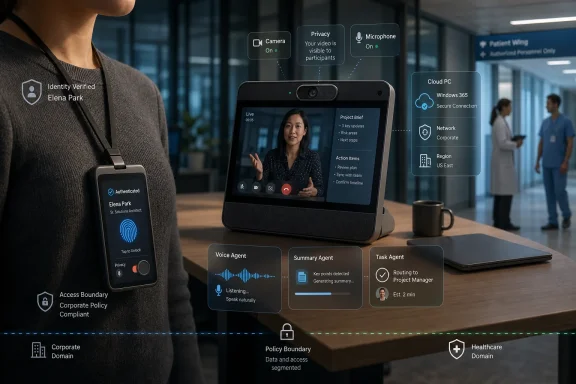
Two biometric devices on a desk with cloud security icons and connection UI overlays.Microsoft Is No Longer Pretending the PC Is the Only AI Endpoint​

For the past two years, Microsoft’s AI story has been easy to summarize and hard to separate from Windows: Copilot in the taskbar, Copilot in Microsoft 365, Copilot+ PCs with local NPUs, and a steady effort to make the PC feel like the center of enterprise AI. Project Solara changes the geometry. It says the agent era may need devices that are closer to the task than a laptop, smaller than a tablet, and more tightly managed than a consumer wearable.
That is a more radical claim than another assistant button on a keyboard. Solara imagines agents as persistent work companions that can surface in a badge, a desk device, a hospital workflow, a retail floor, a developer loop, or a Windows 365 session. Microsoft’s argument is that once the primary interaction is intent rather than app navigation, the hardware no longer needs to carry the full burden of a traditional app ecosystem.
That is also why the announcement should not be read as “Microsoft made an AI badge.” The badge is a reference design. The desk unit is a reference design. The platform is the point, and the platform is Microsoft’s attempt to make agent devices look less like experimental Kickstarter hardware and more like fleet-managed enterprise endpoints.
The interesting question is not whether the first Solara prototypes are attractive. The interesting question is whether Microsoft can make a new class of agent hardware feel administratively boring enough for IT departments to accept.

The Badge Is a Wearable Computer With Enterprise Manners​

The portable Solara concept starts with a familiar object: the work badge. Microsoft’s pitch is clever because the badge already has social permission in many workplaces. Nurses wear badges, front-line staff wear badges, information workers wear badges, and enterprise security teams already understand the badge as a controlled access object.
The Solara badge concept adds a touchscreen, fingerprint authentication through Windows Hello for Business, privacy controls, a far-field microphone array, a speaker, a side-facing camera, Wi-Fi, Bluetooth, GNSS, 5G, and Qualcomm wearable silicon. That is not a minimalist ID card. It is a small multimodal computer built around the assumption that a worker may need to ask, record, glance, authenticate, and act without opening a laptop.
There is an obvious lineage here from failed and half-failed AI gadgets. The difference is that Microsoft is not pretending the badge is a universal consumer device that will replace the phone. It is pitching the device at managed work, where narrower scenarios can justify awkward new hardware. A nurse capturing a hallway update, a retail worker checking an inventory exception, or a field technician asking for procedural guidance has a clearer reason to use a badge than a consumer has to wear a second assistant next to a smartphone.
But the badge also sharpens the hardest privacy problem. A side-facing camera and far-field microphones can be useful in precisely the places where bystanders, patients, customers, and coworkers may not want ambient capture. Microsoft’s inclusion of physical privacy controls and clear indicators is not decorative; it is the minimum price of admission. In regulated environments, the social contract around recording may matter as much as the silicon.
The enterprise badge succeeds only if it feels like a work tool, not a surveillance pendant. That distinction will be made in policy, audit logs, device posture, retention controls, and physical cues, not in launch-day prose.

The Desk Device Is a Thin Client With an Agent Sitting in Front​

The stationary Solara concept is less visually provocative but potentially more important for WindowsForum readers. Microsoft describes a desk device with a touchscreen, face authentication, privacy lock buttons, microphone mute and volume controls, dual far-field microphones, a full-range speaker, UWB presence sensing, two USB-C ports, Wi-Fi, Bluetooth, and MediaTek IoT silicon. It can operate on its own, pair with a Windows PC, or become a Windows 365 client when attached to an external display.
That last detail is the hinge. Microsoft is not merely building a smart speaker with a screen for office workers. It is describing an agent-first endpoint that can also become a cloud PC terminal. In Microsoft’s world, the desk device is both a local agent surface and a managed access point into the broader Windows estate.
This is strategically neat. Microsoft can argue that Solara does not compete with Windows because it complements Windows, extends Windows 365, and keeps identity and management inside Microsoft’s enterprise stack. It also gives Microsoft a way to place AI hardware on desks without requiring every employee to receive a new high-end Copilot+ PC.
The desk device may be easier to pilot than the badge because it is less socially invasive. A microphone mute button and presence sensing at a desk are familiar. A small companion screen for briefings, priority cards, Copilot voice, meeting capture, and handoff to a PC is not a giant leap from Teams Rooms panels, desk phones, or smart displays.
The challenge is usefulness density. A desk already has a PC, a phone, perhaps a tablet, and multiple notification streams. A Solara desk device has to earn its footprint by doing something better than another monitor widget. If it becomes a shrine to Copilot notifications, it will be ignored. If it becomes a trusted control plane for attention, meetings, authentication, and cloud PC access, it becomes interesting.

MDEP Reveals the Real Platform Play​

The most consequential part of Solara is not the shape of the badge or the desk unit. It is Microsoft Device Ecosystem Platform, the AOSP-based operating system layer underneath. MDEP lets Microsoft court hardware makers with an Android-derived base while wrapping the device in Microsoft security, management, identity, and enterprise integration.
That is an important compromise. Microsoft does not need to convince the world to adopt a new Windows variant for every oddball agent device. It can use Android’s device ecosystem gravity while making the management and identity story feel Microsoft-native. For OEMs and silicon partners, that lowers friction. For IT departments, it means the device can enter the same conceptual bucket as phones, Teams devices, shared endpoints, and specialty hardware rather than becoming an orphaned appliance.
This is where Solara becomes more concrete than a vision deck. Microsoft lists Intune management, Entra ID accounts, Hello for Business biometrics, approved chipsets, Agent Shell, and physical privacy controls as platform attributes. That is a very Microsoft list, and that is the point. The company is not merely selling agents; it is selling the administrative scaffolding around agents.
The phrase chip-to-cloud can sound like marketing fog, but in this case it is doing real work. Microsoft wants device makers, silicon partners, agent developers, and enterprise customers to see Solara as a stack that spans hardware reference designs, edge interaction, cloud state, identity, management, and agent orchestration. If the strategy works, the individual device becomes less important than the certification path and the management model.
There is a familiar Microsoft move here. The company is trying to define the enterprise version of a messy consumer trend. Consumer AI gadgets have mostly struggled to explain why they should exist. Microsoft’s answer is that the gadget only makes sense when it is part of a governed fleet, tied to workplace identity, grounded in organizational data, and deployed for a role-specific workflow.

Agent Shell Is Microsoft’s Bet That Apps Become Too Heavy​

Solara’s Agent Shell is the conceptual break from traditional endpoint design. Instead of assuming users launch apps, resize windows, and move through menus, Microsoft assumes agents can dynamically present the right interface for the task, device, screen size, modality, and organizational context. The company calls this direction just-in-time UI.
The idea is both appealing and dangerous. It is appealing because specialized devices have always suffered from app scarcity. Every new form factor needs developers to rebuild or adapt interfaces, and most developers will not do that for small markets. If an agent can generate or adapt enough of the interface from structured components, cards, known content types, and eventually more dynamic layouts, Microsoft can reduce the tax on new hardware categories.
It is dangerous because interfaces are not merely decoration. They encode predictability, affordances, accessibility, compliance behavior, error handling, and user trust. A generated interface that looks clever but behaves inconsistently will be worse than a boring app. In enterprise settings, the cost of ambiguity is not just annoyance; it can be a missed task, a bad record, a privacy incident, or a support ticket.
Microsoft appears aware of this, which is why its description of just-in-time UI is more restrained than the most breathless AI interface pitches. The company is not claiming fully generative UI has arrived. It is positioning Solara in the middle: more adaptive than traditional responsive design, but not dependent on unconstrained generation. That is the sober version of the idea, and it is the only version that has a chance in managed environments.
The bigger bet is that agents become a new unit of software distribution. In that world, developers build agents with Microsoft 365 Copilot extensibility, Copilot Studio, Microsoft 365 Agents SDK, or Microsoft Agent Framework, and Solara becomes another place those agents can appear. That would let Microsoft sidestep the cold-start problem that kills many device platforms: no apps, no users; no users, no apps.

Microsoft’s Partner List Shows the Market It Wants First​

Microsoft says hundreds of its own employees are already using Solara concept devices, and it plans private pilots with organizations including AccuWeather, Best Buy, CVS Health, Levi’s, Target, and others. That lineup tells us more than a generic statement about “enterprise interest.” It points toward retail, healthcare, field operations, knowledge work, and customer-facing environments where workers are mobile, interrupted, and often not sitting in front of a full PC.
Those are sensible early targets. In retail, an agent badge could theoretically combine task prompts, inventory questions, customer lookup, translation, shift updates, and escalation. In healthcare, the attraction is ambient capture and follow-through without forcing clinicians to become typists. In field service, hands-free or glanceable guidance is obvious. In knowledge work, the desk device is less about mobility and more about attention management.
The Microsoft 365 agent examples also map onto this world. Researcher is about long-running work. Facilitator is about meetings and capture. Priority Agent is about filtering attention. GitHub Copilot is about development workflows. Dragon Copilot is about clinical work. Solara is not trying to invent all the agents from scratch; it is trying to give existing and emerging agents a dedicated surface.
That is a stronger story than a generic AI assistant. Enterprise buyers do not buy “AI” in the abstract forever. They buy reductions in documentation burden, faster access to information, fewer missed handoffs, better shift continuity, cleaner incident response, or more efficient developer workflows. Solara will be judged by whether it produces those outcomes in specific roles.
The danger is pilot theater. Enterprises often experiment with impressive prototypes that never survive procurement, security review, labor negotiation, accessibility evaluation, frontline training, or day-two support. Microsoft’s reference designs are a start, not evidence of market adoption. The real milestone will be when OEMs ship certified devices, enterprises deploy them beyond innovation teams, and workers keep using them after the novelty fades.

The Windows Story Is Extension, Not Replacement​

For Windows enthusiasts, Solara may initially look like another sign that Microsoft is drifting away from the PC. That reading is too simple. Microsoft’s better play is to make Windows the high-capability anchor while Solara devices become peripheral agent surfaces around it.
The desk concept makes that explicit. It can pair with a Windows PC over Bluetooth, maintain lock-state consistency, hand off tasks, and become a Windows 365 client through USB-C and an external display. That is not anti-Windows. It is a model in which the Windows desktop is one node in a broader managed computing environment.
This distinction matters because Microsoft has learned the hard way that Windows cannot be stretched into every device category. Windows Phone failed. Windows on tiny devices never became a broad platform. Teams devices and Android-based enterprise endpoints have already shown that Microsoft is willing to use non-Windows operating systems when the management and service layer stays Microsoft-aligned.
Solara therefore looks less like a Windows replacement and more like a post-Windows perimeter. The PC remains the place for deep work, complex local software, development tools, large displays, and legacy application compatibility. Solara devices become the places where agents interrupt, summarize, authenticate, capture, remind, and route work.
That model could benefit Windows if it reduces the notification and context-switch overload that has made modern desktops exhausting. But it could also fragment attention further if every device becomes another surface demanding response. Microsoft’s challenge is to make Solara feel like a filter, not a multiplier.

Security Is the Feature That Decides Whether This Leaves the Lab​

Every agent device is a security problem wearing a product badge. It has microphones, cameras, biometric access, cloud connectivity, organizational data, and a software layer designed to act across workflows. In the old app model, permissions were already difficult to reason about. In an agent model, permissions become both more powerful and more ambiguous.
Microsoft’s enterprise framing is therefore not optional. Intune, Entra ID, Hello for Business, physical privacy controls, approved chipsets, and management hooks are the difference between a Solara device and an unmanaged recorder connected to corporate data. If these devices are to enter hospitals, stores, offices, and factories, administrators will need clear answers about enrollment, conditional access, device compliance, logging, update cadence, remote wipe, data residency, and least-privilege agent behavior.
The bystander problem is even harder. A user can consent to their own agent interactions, but a badge camera or far-field microphone may capture people who never touched the device. Microsoft can mitigate with visible indicators, hardware controls, policy enforcement, and user education, but it cannot make the social issue disappear. In some workplaces, labor relations and regulatory concerns may be the real deployment blocker.
There is also the question of agent provenance. Microsoft says Solara is designed for a world of multiple agents, including Microsoft agents, third-party agents, and organization-built agents. That openness is necessary, but it creates a supply-chain problem for cognition. Enterprises will need to know which agent answered, what data it accessed, what action it took, what model or service backed it, and how mistakes can be reviewed.
Traditional endpoint security assumes software does what it was coded to do. Agent security has to assume software may decide what to do next. That does not make Solara impossible. It makes governance the product.

The Hardware Is Real Enough to Matter and Early Enough to Doubt​

Microsoft deserves credit for showing actual reference-design visuals and specifications rather than leaving Solara as a vaporous agent manifesto. The badge and desk concepts make the strategy tangible. Readers can see the trade-offs: a badge must balance mobility, battery life, privacy, input, and connectivity; a desk unit must justify itself next to a PC.
But reference designs are not products. They are a way to guide partners, test assumptions, and accelerate OEM work. Microsoft is not promising that the exact badge or desk device will ship to customers as shown. It is saying these are concept devices to inform the platform and give the ecosystem something concrete to build around.
That distinction matters because Microsoft has a long history of compelling prototypes and uneven device ecosystems. Surface succeeded because Microsoft kept iterating and built a premium PC business. Other efforts, from Windows Mixed Reality to various ambient computing plays, never achieved the same durable market. Solara will need more than a good Microsoft demo; it will need devices that survive budgets, support desks, and worker skepticism.
The silicon partnerships with Qualcomm and MediaTek are promising because they align the two reference designs with realistic hardware categories. Qualcomm makes sense for a wearable, connected badge. MediaTek makes sense for an IoT-oriented stationary device. That does not guarantee products, but it suggests Microsoft is not merely sketching impossible hardware.
The open question is who becomes the Surface of Solara. Microsoft could let OEMs lead, or it could eventually produce first-party devices to set the standard. The former is safer politically; the latter may be necessary if the category needs a canonical implementation. For now, Microsoft is wisely calling them concepts.

The Ghosts of AI Gadgets Are Standing in the Room​

No one should analyze Solara without remembering the recent wave of AI hardware disappointment. The broader market has seen ambitious devices promise to free users from phones and apps, only to run into latency, limited functionality, poor reliability, unclear use cases, and the brutal convenience of the smartphone. The lesson is not that AI hardware is doomed. The lesson is that “an assistant in a new shape” is not enough.
Microsoft’s enterprise focus is the right response to that lesson. A consumer AI pin has to beat the phone at nearly everything. An enterprise badge only has to beat the existing workflow for a defined job. That is a much lower and more realistic bar, especially where phones are impractical, laptops are unavailable, or documentation burden is high.
Even so, Microsoft cannot escape the fundamental agent problem. If the agent misunderstands context, invents facts, fails to take action, or requires constant correction, the device becomes a liability. A bad assistant on a laptop is annoying. A bad assistant worn by a nurse or used in a retail escalation can disrupt real operations.
Latency will also matter. The whole premise of a badge or desk device is that it reduces friction. If a worker has to wait awkwardly for a cloud round trip, repeat commands, confirm obvious actions, or dig through generated UI, the device loses the advantage of proximity. Agent devices have to feel instant enough to be worth invoking in the moment.
That is why the phrase “agent-first” should be treated as a testable claim, not a slogan. An agent-first device should not merely have Copilot installed. It should be shaped around fast invocation, trustable context, constrained action, privacy legibility, and graceful failure. If it cannot do those things, it is just another screen.

The Real Product Is a Managed Attention Layer​

The most generous interpretation of Solara is that Microsoft is building a managed attention layer for work. The badge says, “Your agent follows you through the day.” The desk device says, “Your agent sits between you and the flood of work.” MDEP says, “IT can manage this like an endpoint.” Agent Shell says, “Developers do not need to rebuild every interface for every form factor.”
That is a coherent thesis. It also fits the direction of Microsoft 365 Copilot, which has been steadily moving from a prompt box toward a workspace that reasons over documents, meetings, mail, calendars, chats, code, and business data. Solara extends that trajectory into physical space.
The term attention layer is useful because it separates Solara from both PCs and phones. PCs are general-purpose work machines. Phones are personal communication and app machines. Solara devices, at least in Microsoft’s telling, are meant to capture, filter, surface, and route work at the edge of a user’s day.
That framing also clarifies why Priority Agent appears in the announcement. A device like this needs a reason to be glanced at. “What needs my attention right now?” is one of the few questions that can justify a dedicated screen on a desk or a badge on a worker. If Microsoft can answer that question better than email, Teams, or the Windows notification center, it has something.
But attention is a dangerous product category. The same tool that filters noise can become a new channel for managerial pressure, automated nudges, productivity scoring, and always-on work. Microsoft will need to be explicit about user control because enterprise buyers and employees will not always have identical incentives.

Developers Get a New Surface, but Not a Blank Check​

For developers, Solara is both an opportunity and a constraint. Microsoft is telling agent builders that their work may not remain trapped in Teams, Office, GitHub, or a browser. Agents could appear on specialized devices in role-specific workflows. That expands the addressable surface area for Microsoft 365 agents, Copilot Studio projects, custom-engine agents, and future agent frameworks.
The constraint is that Solara devices are not traditional app platforms. Developers should not expect to port full interfaces wholesale. The model is more likely to reward agents that can express intent, state, actions, summaries, confirmations, and compact UI components across modalities. That is a different design discipline from building a desktop application.
This could be healthy. Too many enterprise workflows are still just forms, tables, dashboards, and notifications layered on top of each other. Agent surfaces may force developers to ask which decisions matter, which actions are safe, which context is required, and which user confirmations are essential. A tiny badge screen is a brutal editor.
It could also be limiting. Complex work often needs rich interfaces, not just conversational snippets or adaptive cards. Developers will need escape hatches to full applications, web views, Windows sessions, or specialized tools. The best Solara experiences may be the ones that know when to stop being agentic and hand the user to a conventional interface.
Microsoft’s job is to make that boundary clean. If Solara becomes another fragmented platform with partial SDKs, inconsistent UI behavior, and unclear distribution, developers will wait. If it becomes a predictable extension of the Microsoft 365 agent ecosystem, they may experiment.

Enterprises Will Ask the Boring Questions First​

The announcement is visionary, but procurement will be mundane. How much do these devices cost? Who owns them? How long do batteries last? What happens when an employee leaves? Can a badge be shared? Can cameras be disabled by policy? Can recordings be prevented in certain locations? Can agents be limited by role? How are updates staged? What is the failure mode when the network drops?
Those questions are not signs of unimaginative IT departments. They are how new endpoint categories become real. The history of enterprise computing is full of technically impressive devices that failed because they did not fit asset management, help desk processes, compliance rules, or worker training.
Solara’s use of Intune and Entra ID gives Microsoft a head start. Administrators already understand device compliance, conditional access, identity-based controls, and managed configurations. If Solara devices can be enrolled, monitored, updated, wiped, and governed through familiar channels, they will face less resistance.
But agents add new administrative layers that existing tools may not fully cover. IT will need controls not just over the device, but over agent capabilities, connectors, data grounding, retention, action permissions, and cross-agent delegation. The phrase “bring your own agents” sounds attractive until a security team asks how those agents are reviewed, sandboxed, audited, and revoked.
The first successful Solara deployments will probably be narrow. A retailer may pilot one workflow. A healthcare provider may test clinical documentation support under strict constraints. A developer team may use a desk device for build status and coding-agent updates. That is how it should be. Broad agent autonomy should come after boring operational trust, not before it.

Solara’s First Job Is to Make Agent Hardware Boring​

The biggest test for Project Solara is not whether the reference devices look futuristic. It is whether Microsoft can make agent-first hardware feel boring enough to deploy and useful enough to keep.
  • Microsoft has framed Project Solara as a platform for enterprise agent devices, not as a finished consumer gadget line.
  • The badge concept targets mobile and frontline work with biometric access, wireless connectivity, microphones, a speaker, a camera, and physical privacy controls.
  • The desk concept is a stationary agent surface that can pair with a Windows PC or become a Windows 365 client when connected to an external display.
  • The platform rests on Microsoft Device Ecosystem Platform, an AOSP-based foundation tied to Intune, Entra ID, Hello for Business, Agent Shell, and approved chipsets.
  • Microsoft’s early partner and pilot framing points toward retail, healthcare, knowledge work, development, field service, and other role-specific enterprise scenarios.
  • The unresolved questions are privacy, governance, reliability, cost, bystander consent, agent permissions, and whether OEMs will turn reference designs into durable products.
Solara is most credible when viewed as infrastructure. The hardware is the visible artifact, but the management model, identity layer, agent runtime, and UI adaptation strategy are what Microsoft is really trying to standardize.

The Platform War Moves From Apps to Where Work Happens​

Project Solara is Microsoft’s clearest admission yet that the next phase of AI computing may not be won by stuffing a chatbot into every existing surface. The company is preparing for a world in which agents need their own endpoints, their own interaction patterns, and their own enterprise controls. That does not make the PC obsolete, and it does not make apps disappear overnight. It does mean Microsoft is trying to ensure that if agent-first devices become a real category, they inherit Microsoft’s cloud, identity, management, and productivity stack from the start.
This is a familiar platform maneuver with a new interface layer. Microsoft does not have to own every device to shape the category. It has to define what a trustworthy enterprise agent device looks like, make it easy for partners to build, and make it natural for customers already invested in Microsoft 365, Intune, Entra ID, and Windows 365 to pilot. If Solara succeeds, the next “computer” many workers touch may not feel like a computer at all; it may feel like a badge, a desk companion, or some other quiet object whose real job is to bring the agent into the moment where work is actually happening.

References​

  1. Primary source: Tech My Money
    Published: 2026-06-03T07:12:11.118704
 

Microsoft used Build 2026 in San Francisco and online to show Project Solara, a chip-to-cloud platform for agent-first workplace devices, including a desk display and a wearable AI badge reference design with a touchscreen, camera, fingerprint sensor, and Microsoft 365 integration. The important word is not badge. It is reference. Microsoft is not simply floating another gadget; it is testing whether the enterprise PC can be surrounded, and eventually pressured, by a new class of managed AI endpoints.
The company’s pitch is familiar in outline and newly unsettling in form. AI agents, Microsoft argues, should not be trapped inside a browser tab, a Copilot sidebar, or a meeting recap. They should follow workers across rooms, desks, shifts, and workflows. That makes Project Solara less a quirky Build demo than a declaration of intent: Microsoft wants the next workplace interface to be ambient, authenticated, managed, and always close enough to hear or see what work looks like.

Office scene showing an AI productivity dashboard, “Zero Trust” security visualization, and an AI wearable badge display.Microsoft Is Trying to Move Copilot Out of the Window​

For the past three years, Microsoft’s AI strategy has mostly been expressed through software surfaces. Copilot appeared in Windows, Microsoft 365, Teams, Edge, GitHub, Security, and the management stack, often with the same basic promise: the assistant would sit beside the work and help compress it. Project Solara suggests Microsoft now thinks that model is too narrow.
The PC remains central to Microsoft’s business, but it is a poor metaphor for the kind of automation the company keeps describing. A PC waits for a user to open it, unlock it, pick an app, and frame a task. An agent-first device is supposed to invert that relationship. It is meant to notice context, broker identity, summon cloud services, and act without forcing the user back into the desktop ritual.
That is why the badge matters more than the desk display. A small office display that surfaces Outlook or Excel data is easy to understand as an extension of Teams Rooms, smart speakers, and enterprise dashboards. A wearable badge with a camera, microphone, fingerprint reader, and agent interface is a more aggressive proposal. It asks whether the access card, the meeting assistant, the mobile endpoint, and the corporate identity device can collapse into one managed object.
Microsoft has made this kind of leap before, with mixed results. Surface tried to redefine the Windows PC around touch and hybrid work. HoloLens tried to put enterprise computing directly into the user’s field of view. Teams Rooms pushed Microsoft’s productivity stack into shared spaces rather than personal devices. Solara borrows from all three, but its center of gravity is different: it assumes AI agents, not apps, are the unit of work.

The Badge Is a Reference Design, but the Strategy Is Real​

Microsoft has been careful to say the Solara badge and desk unit are concept devices, not retail products. That distinction matters. A concept device can be strange, incomplete, and provocative without carrying the burden of support contracts, procurement cycles, battery-life claims, and quarterly sales targets.
But “reference design” is not the same as “science project.” In the hardware industry, reference designs are how platform owners show partners what is possible and reduce the cost of building the first wave of devices. Microsoft is effectively telling OEMs, silicon vendors, and enterprise customers: here is the shape of an agent endpoint, here is the management story, and here is how it can connect to the Microsoft cloud.
That is why Qualcomm and MediaTek matter in this story. Their involvement signals that Microsoft is not treating Solara as a one-off accessory. Qualcomm’s role around wearable silicon points to mobile, low-power, connected devices. MediaTek’s role around desk hardware points to ambient office endpoints. Together they sketch an ecosystem that is not Windows PCs, not phones, and not simple peripherals.
This is also why Microsoft is leaning on the Microsoft Device Ecosystem Platform, an enterprise-grade operating environment built on AOSP. For Windows loyalists, that may sound almost heretical: Microsoft is showing the next wave of AI workplace hardware on an Android-derived base rather than Windows. But from Microsoft’s perspective, it is brutally practical. If the device is not meant to run Win32 apps, if it needs lightweight deployment, embedded-style management, biometric access, and cloud-first interaction, Windows may be the wrong tool for the first job.
That does not make Windows irrelevant. It makes Windows less exclusive. Solara is a reminder that Microsoft’s modern moat is increasingly identity, management, data access, developer tooling, and cloud orchestration. The operating system still matters, but only insofar as it helps Microsoft place its services at the point where work happens.

AOSP Is the Quietest Provocation in the Demo​

The most interesting technical detail in Project Solara may be the least theatrical one. A wearable AI badge with a camera is visually arresting; an AOSP-based enterprise device platform is strategically sharper. Microsoft is proposing a managed endpoint category that borrows Android’s hardware flexibility while trying to wrap it in Microsoft’s security and administration model.
That solves a real problem. Enterprises already deploy fleets of devices that are neither classic PCs nor personal smartphones: Teams panels, kiosks, scanners, room systems, rugged handhelds, digital signage, shared tablets, and specialized medical or retail endpoints. IT departments want these devices to enroll, authenticate, update, restrict data access, and report compliance without becoming one-off exceptions.
Project Solara fits neatly into that administrative appetite. Microsoft can talk about Intune, Entra ID, Windows Hello for Business, privacy controls, and device management because those are the languages IT buyers already speak. The company is not asking a CIO to trust a consumer gadget with a chatbot strapped on. It is pitching a corporate endpoint that happens to expose agents rather than apps.
Still, the platform choice is telling. Microsoft’s old reflex would have been to make this a Windows device, or at least to frame it as part of the Windows family. Instead, Solara appears designed around a lighter substrate that can host agent interactions and connect to Microsoft services without pretending to be a PC. That is both sensible and revealing.
It suggests Microsoft understands that the AI endpoint market may not wait for Windows to be adapted to every object. If agents are going to appear in badges, desk hubs, room fixtures, industrial devices, and retail counters, the winning platform may be the one that can be deployed cheaply, updated centrally, and kept boring under the hood. In that world, Windows remains the workstation, but Entra and Intune become the connective tissue.

The Office Badge Turns Presence Into an Interface​

The badge form factor is not accidental. Office badges already carry institutional meaning: they identify the worker, open doors, mark access boundaries, and make the employee visible inside a controlled environment. Microsoft’s concept adds computation to that social contract.
In the Build demonstration described by multiple outlets, the badge was activated by fingerprint and used to capture images for review. That is a simple demo, but it contains the whole controversy. The device can authenticate a user, perceive an environment, route data to a workflow, and invoke an agent. In enterprise language, that sounds efficient. In human language, it sounds like a camera you wear to work.
Microsoft will argue, reasonably, that a managed badge could be safer than the chaos already inside most offices. Employees use personal phones to photograph whiteboards, record meetings, scan documents, and message coworkers through unmanaged channels. A corporate device with identity-bound access, policy controls, and auditable workflows may reduce some risk.
But “safer than shadow IT” is not the same as “socially acceptable.” A wearable camera changes the atmosphere of a workplace even if it is well managed. It can make bystanders wonder whether they are being recorded, whether consent is meaningful, and whether a casual hallway conversation has become input for an agentic system. The technical controls matter, but the visible presence of the sensor may matter more.
That is the line Microsoft has to walk. The badge is compelling precisely because it follows workers into the messy spaces where work actually happens. It is risky for the same reason. The more useful an ambient AI endpoint becomes, the harder it is to keep it from feeling like surveillance infrastructure.

Agents Need Eyes, Ears, and Policy​

The push toward agent-first hardware exposes a tension in Microsoft’s AI story. Agents are most useful when they have context. But context in an office is often sensitive, ambiguous, or legally constrained.
A calendar entry is one kind of context. A spreadsheet is another. A live meeting, a patient intake area, a store aisle, a factory floor, or an HR conversation is something else entirely. Once an agent-capable device can capture audio, images, presence, location, and identity, the governance problem expands beyond permissions in Microsoft Graph.
That is where Solara becomes an IT operations story rather than a gadget story. Administrators will want to know when cameras can be used, whether microphones are hot, where data is processed, how long captured material is retained, how prompts and responses are logged, and whether agents can take action across applications. Compliance teams will ask who consented, who can retrieve records, and how the company proves deletion or access control after the fact.
Microsoft’s answer will almost certainly be policy. The company has spent years building the enterprise cloud as a compliance environment: conditional access, sensitivity labels, audit logs, retention rules, device compliance, endpoint protection, and identity governance. Solara’s viability depends on whether those controls feel native to the device rather than bolted on after a scandal.
There is also a harder question: what counts as user intent? A fingerprint unlock proves a worker activated a device. It does not automatically prove that everyone in the room agreed to be photographed, summarized, analyzed, or routed into a workflow. Enterprise AI hardware will need more than authentication. It will need visible state, friction at the right moments, and policy defaults that assume the office is full of people who are not the wearer.

The Desk Device Is the Safer Half of the Bet​

The desk concept is less dramatic, but it may be easier to deploy first. A small office display that can surface Microsoft 365 information, respond to voice input, and connect to agents fits an existing pattern. Workers already tolerate smart speakers, meeting-room panels, video bars, and desktop docks. A stationary device is easier to label, locate, mute, manage, and avoid.
That makes it a likely proving ground for Solara’s software model. If Microsoft wants to show that agent-first endpoints can be useful without requiring a full PC interaction, the desk is the right place to start. It can summarize the day, monitor tasks, prepare documents, route messages, and bridge voice commands into Microsoft 365 workflows while remaining visibly tied to one workspace.
The desk device also avoids some of the badge’s social ambiguity. A camera or microphone on a stationary office hub can be governed by room policy and physical placement. A wearable moves across contexts and drags its permissions with it. The desk display says “this workspace has an assistant.” The badge says “this person has a sensor.”
For vendors and IT departments, that distinction will matter. The desk unit can be evaluated like a Teams Rooms device or a managed collaboration endpoint. The badge demands policies closer to body-worn cameras, visitor management, mobile device governance, and employee monitoring rules. One is a productivity appliance. The other is a cultural negotiation.

HoloLens Still Haunts Microsoft’s Hardware Ambitions​

Any Microsoft workplace hardware story has to pass through the ghost of HoloLens. The headset was technically ambitious, visually distinctive, and repeatedly framed as a future of enterprise computing. It also struggled with cost, comfort, developer adoption, field-of-view limitations, shifting internal priorities, and the gap between compelling demos and routine deployment.
Project Solara is not HoloLens. It is smaller, cheaper in concept, less immersive, and much more tightly tied to cloud agents. But the lesson is relevant. Enterprise hardware does not fail only because the technology is weak. It fails when the daily habit never forms, when the management burden outweighs the benefit, or when the device solves a problem that buyers admire but do not standardize around.
Microsoft appears to have internalized some of that history. Instead of presenting Solara as a finished Microsoft-branded product, it is showing reference designs and inviting partners to build. Instead of betting on a single spectacular interface, it is spreading the idea across desk and wearable forms. Instead of asking developers to build an entirely new mixed-reality world, it is attaching devices to Microsoft 365, agents, identity, and cloud workflows.
That is the smarter play. It is also a less romantic one. Solara’s success would not look like everyone wearing futuristic hardware in glossy demos. It would look like Best Buy, CVS Health, Target, AccuWeather, and other enterprise pilots discovering narrow workflows where an agent endpoint saves enough time, reduces enough friction, or standardizes enough process to justify procurement.

The Smartphone Is the Unspoken Rival​

Microsoft is not saying Solara replaces the phone. It does not need to. The entire concept is built around the idea that the phone is not always the right interface for work.
That argument has merit. Phones are personal, distracting, app-centric, and often poorly aligned with enterprise workflows. In a warehouse, clinic, retail floor, laboratory, or conference environment, pulling out a phone can be awkward or prohibited. A dedicated corporate device can be locked down, shared in policy terms, and designed around a narrow work mode.
But the phone is also the hardest device category in modern technology to displace. It already has a camera, microphone, biometric security, cellular connection, notifications, apps, and user familiarity. Any AI badge has to justify why it exists alongside the phone rather than as an app on it.
Microsoft’s answer appears to be specialization and trust. A Solara device can be provisioned by the employer, governed by enterprise policy, bound to work identity, and stripped of consumer distractions. It can be a work object in a way a personal phone never fully is. That is useful for IT, but it may not be enough for workers unless the device does something meaningfully faster, safer, or less annoying than the phone they already carry.
This is where agents become the wager. If AI agents remain glorified chat panels, a badge is overkill. If they become reliable operators that can inspect context, prepare actions, and move work across systems with minimal user attention, then a dedicated endpoint starts to make sense. Solara is a bet that the interface layer is about to change enough to make new hardware plausible.

Enterprise Buyers Will Ask Boring Questions First​

The Build demo invites futuristic speculation, but procurement will be mundane. Enterprises will not buy AI badges because the keynote looked clever. They will buy them if the devices fit into lifecycle management, security review, labor policy, and measurable workflows.
Battery life will matter. Replacement cost will matter. Device loss will matter. Camera indicators will matter. So will repairability, ruggedness, connectivity, sanitization, accessibility, and whether the device can be disabled in specific physical zones. If Microsoft and its partners want Solara devices to become real workplace infrastructure, they will have to answer questions usually reserved for fleet hardware, not AI demos.
Admins will also want clarity about agent boundaries. Can a badge-triggered agent send email, update a customer record, modify a spreadsheet, open a support ticket, or trigger a business process? Does the device store prompts locally? Are images processed on-device, in Microsoft’s cloud, or by third-party agents? Can organizations restrict which agents appear on which device classes?
The more Microsoft frames Solara as agent-first, the more these questions become central. Traditional endpoint management assumes software executes under policies. Agentic systems blur execution, recommendation, automation, and communication. That ambiguity is powerful when it works and dangerous when it does not.
There is a reason Microsoft keeps emphasizing enterprise management. The company knows the badge cannot be sold as a toy. It has to be sold as a compliant endpoint, with administrators able to say no before a worker’s AI assistant says yes.

Privacy Is Not a Feature Toggle​

The most predictable reaction to an AI office badge is discomfort. That reaction should not be dismissed as nostalgia or resistance to innovation. Cameras and microphones in workplaces have always carried power dynamics, and attaching them to AI systems raises the stakes.
Privacy controls can reduce risk, but they cannot erase the social meaning of recording-capable wearables. A mute switch, camera LED, policy banner, or retention setting is useful only if people understand and trust it. In many offices, the problem will not be whether the badge is technically compliant. It will be whether coworkers, visitors, contractors, patients, or customers believe they have any practical choice.
Microsoft’s enterprise customers will face different constraints by industry. A retailer may see value in floor assistance and inventory workflows. A healthcare organization will see patient privacy implications immediately. A financial firm will worry about regulated communications. A school or public agency will need to account for public records, minors, union rules, or local surveillance laws.
This is why pilots matter. Solara’s first real test will not be whether an agent can take a picture and send it for review. It will be whether organizations can define use cases narrow enough to be valuable and controlled enough to be acceptable. The companies that succeed will probably start with specific roles, specific spaces, and specific workflows rather than handing badges to every knowledge worker and hoping culture catches up.
The worst version of this product category would be an always-available workplace recorder justified by productivity rhetoric. The best version would be a tightly governed, user-visible tool for moments when hands-free, identity-bound, context-aware assistance actually solves a work problem. The gap between those versions is policy, design, and restraint.

Windows Users Should Watch the Perimeter​

For WindowsForum readers, the immediate temptation is to ask what this means for Windows. The answer is not that Windows is being replaced by an AI badge. The answer is subtler: Microsoft is building more of the future around the perimeter of Windows rather than inside Windows alone.
That has been happening for years. Microsoft 365 made the browser and cloud identity as important as the desktop. Teams made collaboration cross-platform. Intune made device management broader than traditional domain-joined PCs. Azure Virtual Desktop and Windows 365 made the PC itself more elastic. Copilot pushed AI across surfaces that include but are not limited to Windows.
Solara extends that trajectory. It imagines a class of devices that may never run Windows applications but still belong deeply to the Microsoft estate. They authenticate through Microsoft identity, expose Microsoft 365 data, obey Microsoft management policy, and call Microsoft-aligned agents. From a business perspective, that may be more valuable than insisting every endpoint be a Windows endpoint.
This does not diminish the PC’s importance for serious work. Developers, analysts, designers, admins, and power users still need keyboards, windows, local tools, multiple displays, and high-trust computing environments. But the center of innovation in enterprise interaction may increasingly sit outside the traditional desktop. The PC becomes the heavy workstation, while agent devices handle ambient capture, quick actions, and workflow nudges.
That shift should interest Windows enthusiasts rather than alarm them. The Windows ecosystem has always expanded through adjacent devices: printers, scanners, docking stations, phones, tablets, headsets, meeting systems, and cloud desktops. Solara is another adjacency, but one with a stronger claim on interface itself.

The Badge Will Succeed Only If It Becomes Less Interesting​

The most successful enterprise devices often become boring. The barcode scanner, conference-room panel, security token, desk phone, and badge reader all won by becoming infrastructure rather than conversation pieces. If Solara’s wearable badge remains a headline-grabbing AI curiosity, it will probably fail.
That is the paradox. Microsoft showed a provocative form factor because it needed to make the agent-first future visible. But enterprises do not standardize on provocation. They standardize on tools that disappear into workflow, reduce exceptions, and survive budget review.
For the badge to work, it must become ordinary in the right places. It must be obvious when it is active, quiet when it is not, constrained by role, and useful enough that workers do not feel they are carrying management’s camera. It must make a nurse, store associate, field technician, or meeting facilitator faster without making everyone nearby feel processed.
That kind of adoption is slower than keynote energy suggests. It will require hardware partners, vertical software integration, labor consultation, regulatory review, and a lot of failed pilots. Microsoft can supply the platform, identity, and agent framework. It cannot single-handedly supply trust.

The Solara Signal Buried Inside the Badge Demo​

Project Solara is early, unresolved, and easy to overread. Still, its concrete implications are already visible.
  • Microsoft is treating agent-first computing as a hardware problem as well as a software problem.
  • The Solara badge and desk unit are reference designs, which means Microsoft wants partners to build the category rather than merely admire the prototypes.
  • The use of an AOSP-based enterprise platform shows Microsoft prioritizing manageability, flexibility, and cloud integration over Windows purity for this device class.
  • The wearable badge will force harder privacy and consent conversations than the desk device, especially because cameras and microphones move with the worker.
  • IT departments should evaluate Solara-like devices as managed endpoints with identity, retention, audit, and action-control requirements, not as simple accessories.
  • The real test will be whether pilots find narrow, high-value workflows where agent hardware beats a phone, laptop, or Teams room device.
Microsoft’s AI badge may never arrive as a product with a Microsoft logo and a procurement SKU, and that may be beside the point. Project Solara is best understood as a map of where Microsoft thinks work is going: away from apps as destinations, toward agents as intermediaries, and into devices that make the cloud physically present in the office. The opportunity is a workplace where computing is less interruptive and more context-aware; the danger is a workplace where context becomes another word for capture. Whether Solara becomes useful infrastructure or another ambitious Microsoft hardware detour will depend less on the badge itself than on whether Microsoft and its partners can make ambient AI feel governed, legible, and worth wearing.

References​

  1. Primary source: TechRepublic
    Published: Thu, 04 Jun 2026 02:59:09 GMT
  2. Related coverage: windowscentral.com
  3. Related coverage: tomsguide.com
  4. Related coverage: tomshardware.com
  5. Official source: commandline.microsoft.com
  6. Related coverage: notebookcheck.net
  1. Official source: news.microsoft.com
  2. Official source: learn.microsoft.com
  3. Related coverage: megamobilecontent.com
  4. Related coverage: pcworld.com
  5. Related coverage: techmymoney.com
  6. Related coverage: techtimes.com
  7. Official source: microsoft.com
  8. Related coverage: lynnemarieoconnor.com
 

Microsoft unveiled Project Solara at Build 2026 as a chip-to-cloud platform for agent-first wearable and desk devices, built on an Android Open Source Project foundation called Microsoft Device Ecosystem Platform rather than on Windows, and aimed initially at enterprise pilots, hardware partners, and Microsoft’s own employees. The announcement is less a gadget story than a platform story: Microsoft is testing whether AI agents can become the interface layer that apps once were. If the bet works, Windows remains important but no longer owns every endpoint where Microsoft wants work to happen. If it fails, Solara may join a long list of clever post-PC ideas that underestimated how hard it is to create a new device category.

Abstract secure cloud connection concept with phone, smart speaker, and privacy/encryption UI in a city office.Microsoft Moves the Windows Boundary Without Saying Windows Is Moving​

Project Solara is striking because it does not look like the usual Microsoft platform expansion. The company is not trying to squeeze Windows into a smaller shell, revive a phone strategy, or ask developers to port desktop software to a weird new screen. It is instead acknowledging something the industry has been circling for years: some future devices may not need a conventional app model at all.
That is the real provocation. Microsoft is not merely saying that AI belongs inside Windows, Office, Edge, Teams, or GitHub. It is saying that agents can justify new hardware, new interaction patterns, and a new operating layer that sits somewhere between the device and the cloud.
For a Windows audience, the Android foundation is impossible to ignore. Microsoft’s Device Ecosystem Platform, or MDEP, is built from the Android Open Source Project, not from Windows Core OS, not from Windows IoT, and not from some resurrected mobile Windows branch. That is a quiet but meaningful admission that Windows is not always the best answer to every compute problem, especially when the endpoint is a badge, a desk companion, or a vertical-market appliance.
The company will not phrase it that way, because Microsoft’s public story is additive. Windows is still the PC, Windows 365 is still the cloud desktop, Microsoft 365 is still the productivity substrate, and Azure is still where state and intelligence scale. But Solara shows a company increasingly comfortable using Windows as one node in a larger Microsoft-controlled work graph, rather than as the universal operating-system answer.
That shift has been underway for years. Microsoft 365, Entra ID, Intune, Defender, Azure Virtual Desktop, and Windows 365 already made the Windows endpoint less singular than it used to be. Solara simply makes the hardware implication explicit: if the identity, policy, data, and AI orchestration layers are Microsoft’s, the local OS can be something else.

The App Store Problem Becomes Someone Else’s Problem​

The most interesting thing about Solara is what it omits. There is no app store pitch, no browser-first pitch, no promise that familiar mobile apps will run beautifully on a new class of devices. Microsoft is not trying to persuade developers to rebuild Word, Excel, Slack, ServiceNow, Epic, or GitHub for a badge-sized screen.
That matters because the app gap destroyed more than one ambitious platform. Windows Phone’s technical merits were not enough to overcome missing apps and weaker developer incentives. Mixed reality struggled partly because the installed base never became compelling enough to justify broad software investment. Even smartwatches, which eventually found a market, did so by narrowing their scope around notifications, health, payments, and quick interactions rather than becoming tiny phones.
Solara’s answer is to sidestep the app store fight. The interface is supposed to be agent-driven, with just-in-time UI adapting to the device, modality, and context. In Microsoft’s framing, developers build agents and workflows rather than bespoke experiences for every form factor.
That is elegant in theory and dangerous in practice. It relieves developers of some layout work, but it also asks users and administrators to trust an intermediary layer that decides how intent becomes action. Apps are clumsy, but they are inspectable. Buttons, menus, documents, and windows give users a sense of containment. Agents dissolve some of that containment, which is exactly why they are powerful and exactly why enterprises will be cautious.
Still, Microsoft has identified the right bottleneck. New device categories die when they demand a new app ecosystem before they have a user base. Solara tries to invert that sequence: first make the agent portable across devices, then let the hardware ecosystem specialize around use cases.

A Badge Is Not a Phone, and That Is the Point​

The wearable reference design is the clearest expression of the strategy. Microsoft showed a badge-like device with a touchscreen, camera, fingerprint sensor, far-field microphone array, speaker, wireless connectivity, and Qualcomm wearable silicon. A single button can summon an agent, record a conversation, transcribe it, and use the camera to understand the user’s surroundings with permission.
This is not subtle hardware. A workplace badge with a camera and microphones is a privacy conversation waiting to happen. Microsoft knows this, which is why the reference design includes physical privacy controls, visible indicators, biometric authentication, and management hooks. The company is trying to make the device feel like enterprise equipment rather than consumer spyware on a lanyard.
The target scenarios are obvious: healthcare, retail, field service, warehouses, hospitality, and other environments where workers often need information while their hands, eyes, or time are constrained. In those settings, the smartphone is often too general-purpose, the PC is too stationary, and voice assistants have historically been too dumb or too poorly integrated with enterprise systems.
A badge agent could be useful if it can reliably capture a hallway conversation, summarize a patient interaction, surface inventory information, open a task, authenticate the worker, and hand off context to a PC or cloud system later. That is the kind of mundane workflow automation that could make dedicated AI hardware less silly than the last wave of AI pins and assistant gadgets.
But the device also introduces a social problem. The PC sits on a desk; the phone is culturally understood; a badge with persistent sensing hardware sits in a more ambiguous zone. Workers, customers, patients, and bystanders will want to know when it is listening, what it records, who can retrieve the data, and whether refusing to be recorded is practically possible. The physical mute button is not a complete answer, but it is at least an acknowledgment that trust must be designed into the hardware.

The Desk Device Reveals the Cloud PC Strategy Hiding Underneath​

The desk reference design looks less provocative at first. It is a stationary companion with a touchscreen, dual microphones, speaker, UWB presence sensor, facial recognition, MediaTek IoT silicon, wireless connectivity, and USB-C. It can act as an ambient agent portal while the user works.
The clever part is what happens when it connects to an external display. Microsoft says the desk device can become a Windows 365 cloud PC client, which turns Solara from a new gadget concept into a thin-client strategy wearing an AI badge. The local endpoint handles identity, presence, voice, lightweight interaction, and agent access; the heavy Windows environment runs in the cloud.
That is a very Microsoft idea. It preserves Windows where Windows is strongest — full desktop compatibility, enterprise management, legacy app access — while moving the endpoint into a simpler, more controlled appliance model. The user gets a local agent shell and a cloud PC on demand. IT gets something closer to a managed terminal than a fully exposed laptop.
This also makes Solara more plausible than a pure post-PC pitch. Enterprises do not have to believe that agents will replace every application overnight. They can deploy a desk device as an agent interface and still fall back to Windows 365 when the user needs the full desktop. The agent becomes the front door, not the whole house.
The risk is that this creates another layer to manage rather than reducing complexity. A company with Windows PCs, mobile devices, Teams Rooms hardware, shared frontline devices, virtual desktops, and now Solara endpoints may not see simplification. It may see another procurement path, another lifecycle, another privacy review, another support queue, and another class of hardware that needs to justify its place on the desk.

Android Is the Practical Choice Microsoft Would Once Have Resisted​

The choice of AOSP is not an embarrassment. It is a pragmatic answer to a hardware ecosystem problem. Android already supports a wide range of chipsets, sensors, power profiles, radios, and embedded-device assumptions. For Qualcomm and MediaTek partners, it is a known base with mature tooling and a broad supplier world.
A Windows-derived platform would have carried more baggage. Windows brings decades of compatibility, but that compatibility is not free. It implies assumptions about windows, drivers, updates, security boundaries, user sessions, legacy APIs, and UI conventions that may be irrelevant on a badge or ambient desk device.
MDEP lets Microsoft keep what it needs: enterprise identity, management, policy, security posture, and Microsoft service integration. The underlying kernel and hardware enablement come from the Android world, while the visible platform story belongs to Microsoft.
That is strategically uncomfortable but technically sensible. The cloud era already trained Microsoft to meet customers where they are. SQL Server runs on Linux. Microsoft Defender protects non-Windows endpoints. Office and Teams are first-class on mobile platforms Microsoft does not control. Solara extends that logic to hardware: if the endpoint does not need to be Windows, Microsoft would rather own the management and agent layer than lose the category altogether.
For Windows traditionalists, this can feel like a retreat. For enterprise IT, it may look more like realism. The platform that wins a wearable badge deployment is unlikely to be the one with the richest desktop API history. It will be the one that boots reliably, authenticates securely, updates predictably, conserves power, handles sensors well, and fits into existing management.

Agents Are the New Shell, Which Makes Governance the Real Product​

Microsoft’s language around Solara is deliberately expansive. Agents become a unit of programming and a unit of interaction. The device becomes a window into long-running intelligence. The UI becomes an adaptive access layer. This is big-platform rhetoric, but beneath it is a practical enterprise question: who gets to act on behalf of the user, and under what rules?
That question is harder than launching apps. An app typically has a boundary, even when it is connected to cloud services. An agent may traverse calendars, files, chats, tickets, records, code repositories, CRM systems, and business applications. It may summarize, decide, delegate, remind, draft, record, retrieve, and execute.
Solara’s success will therefore depend less on the cuteness of the hardware than on the boring machinery of governance. Entra ID, Intune, Hello for Business, device compliance, audit trails, data loss prevention, app protection policies, and role-based access are not accessories here. They are the reason a CIO might listen.
This is where Microsoft has an advantage over consumer AI hardware startups. The company can tell enterprises that Solara devices are managed alongside PCs and phones, authenticated with existing identity, and governed through familiar administrative controls. It can connect the devices to Microsoft 365 Copilot, GitHub Copilot, Dragon Copilot, and organization-specific agents without asking IT to reinvent its security model from scratch.
The counterargument is that familiarity can conceal new risk. A managed microphone-and-camera agent on an employee’s body is not the same governance problem as Outlook on a laptop. The policies may live in familiar consoles, but the social, legal, and operational implications are different. Enterprises will need retention rules, consent workflows, recording indicators, disabled zones, union and works council conversations, patient and customer disclosure policies, and incident procedures for agent mistakes.

The Pilot Customers Are the Story Microsoft Cannot Yet Tell​

Microsoft’s private pilot list is carefully chosen. AccuWeather, Best Buy, CVS Health, Levi’s, and Target represent environments where frontline work, customer interaction, inventory, scheduling, compliance, and real-time information matter. These are not abstract “future of work” logos; they are companies with workflows where a small agent-first device could plausibly save time.
Retail is an especially obvious proving ground. Store associates often need product information, inventory status, task lists, policy guidance, customer assistance, and escalation paths. A badge-like device could provide quick answers without forcing the worker to pull out a phone, log into a shared terminal, or disappear from the customer interaction.
Healthcare is both more compelling and more fraught. Dragon Copilot exploring agent-first experiences makes sense because clinical documentation, patient handoffs, and contextual retrieval are high-friction areas. But healthcare also raises the ceiling for privacy, accuracy, consent, and liability. A device that records and summarizes an interaction with a patient must be more than convenient; it must be defensible.
AccuWeather suggests field and operations scenarios where environmental context matters. Best Buy brings tech retail and support possibilities. Levi’s and Target point to brand, retail, and supply-chain workflows. The common thread is not that these companies need a new gadget. It is that they have roles where the PC is not always the center of the workday.
The pilots will answer whether Solara is a category or a demo. Internal testing with hundreds of Microsoft employees can validate dogfooding, battery life, wake flows, authentication, and agent responsiveness. External pilots will expose the harder questions: whether employees actually wear the device, whether customers tolerate it, whether managers can measure value, and whether IT can support it without creating a shadow device program.

Microsoft Is Early, but It Is Not Alone​

Solara arrives in a market already crowded with agent rhetoric. Google is embedding Gemini across Android, Workspace, Search, and devices. Salesforce is pushing agentic workflows into CRM. OpenAI is building toward agents that can operate across tools, data, and services. Every platform company wants to become the place where intent turns into action.
Microsoft’s distinctive move is to push that contest into dedicated enterprise hardware. Others may build agents for phones, browsers, smart glasses, headphones, cars, and productivity suites. Microsoft is proposing a reference platform for devices where the agent is not an app on the device; it is the reason the device exists.
That is ambitious, but it also narrows the initial market. Solara is not trying to sell consumers a magic companion. It is trying to give hardware partners and enterprise customers a managed way to put agents into specific work contexts. That is less glamorous than replacing the smartphone, but it is more believable.
The comparison to failed AI gadgets is tempting but incomplete. Consumer AI pins and pocket assistants have struggled because they asked people to carry another device without offering enough utility beyond what a phone already does. Solara’s enterprise angle changes the equation: if the employer buys, manages, assigns, and integrates the device into a workflow, adoption does not depend solely on consumer desire.
But enterprise adoption has its own traps. Hardware refresh cycles are slow, pilots can stall, procurement is conservative, and frontline devices are judged by durability, battery life, total cost, sanitation, supportability, and training requirements. A magical demo does not survive a warehouse floor, a hospital shift, a retail holiday rush, or a help desk backlog.

The Developer Pitch Is Freedom With a Hidden Dependency​

For developers, Solara promises fewer form-factor headaches. Build the agent once, let the platform adapt presentation across screens, voice, touch, and multimodal interactions. Use Microsoft’s agent tooling, Copilot Studio, Microsoft 365 Agents SDK, and related frameworks to reach new devices without designing every pixel.
That is a seductive pitch. It suggests a world where software no longer waits for a perfect app container. A developer builds a workflow capability, and the platform surfaces it through a badge, a desk display, a PC, a Teams interface, or another endpoint as needed.
The hidden dependency is platform mediation. If the agent shell, task dispatcher, identity layer, UI generation model, and distribution path are Microsoft-controlled, developers are not escaping platforms. They are moving from app stores and operating-system APIs into an agent runtime governed by Microsoft’s priorities.
That may be acceptable for many enterprise developers. They already build for Microsoft 365, Graph, Teams, Power Platform, Azure, and Entra. Solara could be a natural extension of that environment. But it also means the “no apps” future does not eliminate lock-in. It changes its shape.
This is the paradox of agent-first computing. The user sees less interface, but the platform becomes more important. The fewer explicit app boundaries there are, the more trust shifts to orchestration, identity, permissions, ranking, context selection, and execution policy. Whoever controls those layers controls the experience.

The Hardware Partners Get a Shortcut, Not a Guaranteed Market​

Qualcomm and MediaTek are sensible first silicon partners. Qualcomm brings wearable and mobile expertise, including power-efficient chips, connectivity, and sensor-rich device designs. MediaTek brings IoT reach and a broad hardware partner ecosystem. Microsoft needs both if Solara is to become more than two reference concepts.
The reference-design strategy is also familiar. Give OEMs a starting point, define minimum platform expectations, provide silicon guidance, and let partners adapt form factors for vertical markets. In theory, that reduces the cost of experimentation and helps enterprises buy from existing hardware channels rather than waiting for Microsoft-branded devices.
Microsoft’s decision not to sell the two reference devices is important. It avoids another first-party hardware distraction and keeps the announcement positioned as a platform invitation. Surface has taught Microsoft how difficult it is to balance ecosystem leadership with OEM sensitivities. With Solara, the company appears to be saying: we will define the stack, you build the category.
But a shortcut is not a market. Hardware partners still need demand forecasts, certification paths, margins, support models, replacement policies, accessory ecosystems, and proof that Solara devices will not become niche pilots that never scale. Enterprises may like the idea of specialized agent hardware but hesitate to deploy yet another endpoint class unless the return is obvious.
The most likely early successes will be narrow. A healthcare badge for documentation and task follow-up. A retail associate device for inventory and customer assistance. A desk companion for Windows 365 users in hot-desking environments. A field-service device for inspection capture and guided workflows. Solara does not need to replace phones or PCs to matter; it needs to become the best answer for a handful of expensive workflow problems.

The Privacy Switch Is a Product Requirement, Not a Courtesy​

Microsoft’s inclusion of hardware mute and privacy controls is not just good citizenship. It is table stakes. Any enterprise device built around microphones, cameras, biometric identity, and agents that can act across business systems must make its state legible to humans nearby.
The problem is that privacy hardware can only solve part of the issue. A mute switch tells people something about sensor access. It does not explain where transcripts go, how summaries are generated, whether video frames are stored, which agent saw what, how long data persists, or whether a manager can retrieve interaction history.
For admins, the device will need policy depth. Can cameras be disabled by location, role, tenant, or time? Can recording require explicit tap-to-start behavior rather than wake words? Can certain facilities prohibit capture? Can users review and delete drafts before they are saved? Can organizations separate personal, customer, patient, and corporate data cleanly?
For workers, the issue is power. A company-issued AI badge can be framed as empowerment, surveillance, or both. If it helps a nurse document care without staying late, that is meaningful. If it becomes a productivity monitor that records every hesitation, it will be resisted. The same device can be liberating in one policy environment and oppressive in another.
Microsoft’s enterprise posture gives it the vocabulary to address this, but customers will define the reality. Solara may ultimately be judged less by its agent UI than by whether organizations deploy it with restraint.

The Windows 365 Link Makes Solara a Bridge Rather Than a Rebellion​

It would be easy to cast Solara as Microsoft’s betrayal of Windows. That is too simple. The desk device’s Windows 365 capability shows a more nuanced strategy: Microsoft wants agents to live outside the PC, but it also wants the PC experience available when needed.
That makes Solara a bridge. On one side is the world of conventional Windows applications, desktops, files, policies, and peripherals. On the other side is a world of ambient agents, voice, glanceable screens, specialized devices, and cloud state. The company is trying to connect them without requiring one to immediately defeat the other.
For enterprises, this is the only viable path. Nobody is ripping out line-of-business Windows apps because an agent badge can summarize a meeting. Nobody is replacing Excel with a tiny screen on a lanyard. But organizations may add agent-first endpoints around the edges of work, especially where PCs are awkward and phones are unmanaged, distracting, or insufficiently integrated.
Windows 365 gives Microsoft a safety net. If the agent interface is not enough, a full Windows environment can appear on an external display. That fallback could make Solara hardware easier to justify in shared workspaces, branch offices, healthcare stations, and retail back rooms where cloud PCs already make operational sense.
The long-term question is whether the fallback becomes the main feature. If customers mostly use Solara desk devices as cute Windows 365 terminals, the agent-first vision weakens. If they use Windows 365 only when necessary and spend most of the day invoking agents, Microsoft will have proven that a new endpoint model can coexist with Windows without being subordinate to it.

The Real Competition Is the Smartphone in the Worker’s Pocket​

Despite the Windows angle, Solara’s hardest competitor is not Windows. It is the smartphone. Phones already have cameras, microphones, radios, biometric authentication, app ecosystems, and increasingly capable AI assistants. They are familiar, replaceable, and already carried by almost everyone.
To beat the phone in an enterprise workflow, Solara hardware must be better in ways that matter to the employer and the worker. It must be faster to access, easier to manage, more secure, more durable, less distracting, more policy-compliant, or better integrated with role-specific agents. “It has AI” will not be enough.
The badge concept has a plausible answer because it is wearable, corporate-controlled, and purpose-built. It can be assigned to a role rather than a person, designed for quick capture, locked to approved agents, and managed under enterprise policy. It can avoid the personal-data mess of bring-your-own-device deployments.
The desk concept has a different answer. It can become an always-available agent surface that does not require unlocking a PC, switching windows, or opening Teams. Presence sensing and facial authentication could make it feel more like an office appliance than another app. Its Windows 365 mode adds utility beyond AI.
But both devices must clear the same bar: they must reduce friction more than they add it. Workers are ruthless judges of imposed hardware. If the badge is slow, awkward, socially uncomfortable, or redundant, it will sit in a drawer. If the desk companion becomes another notification screen, it will be muted, ignored, or removed.

The Solara Bet Comes Down to Six Enterprise Realities​

Solara is early enough that the safest prediction is humility. Microsoft has a credible platform thesis, serious enterprise machinery, and the right instinct to start with reference designs and pilots rather than consumer hype. It also has to prove that agent-first hardware can survive contact with procurement, privacy review, frontline work, and human skepticism.
  • Project Solara is not a Windows replacement, but it does show Microsoft moving more of its platform power into identity, management, agents, and cloud services rather than the local operating system alone.
  • Microsoft’s use of an AOSP-based platform is a practical hardware decision that gives silicon and device partners a familiar embedded foundation while Microsoft supplies the enterprise layer.
  • The badge concept is most compelling in frontline and mobile workflows where phones and PCs are clumsy, but it will face the toughest privacy and workplace-trust questions.
  • The desk concept may be easier to deploy because it can double as a Windows 365 client, making it a bridge between agent-first computing and the existing Windows estate.
  • The absence of a traditional app model is both Solara’s advantage and its risk, because it avoids the app-store cold start while making governance, permissions, and agent behavior more consequential.
  • The private pilots with large retail, healthcare, and information-services organizations will matter more than the Build demo because they will reveal whether dedicated AI endpoints solve real operational problems.
Solara is Microsoft’s clearest admission yet that the next computing interface may not be another desktop, another phone launcher, or another browser tab. The company is betting that enterprises will accept new hardware if agents make work faster, more contextual, and more manageable than today’s app-bound workflows. That is a plausible future, not an inevitable one. The next year of pilots will decide whether Project Solara becomes a new class of managed endpoint — or another ambitious Microsoft platform idea remembered mostly for showing where the industry wanted to go before users were ready to follow.

References​

  1. Primary source: Technobezz
    Published: 2026-06-05T16:53:36.000665
  2. Related coverage: windowscentral.com
  3. Related coverage: tomsguide.com
  4. Related coverage: t3.com
  5. Related coverage: tomshardware.com
  6. Related coverage: livemint.com
  1. Related coverage: techradar.com
  2. Related coverage: notebookcheck.net
  3. Related coverage: techtimes.com
  4. Official source: commandline.microsoft.com
  5. Related coverage: techrepublic.com
  6. Related coverage: techadvisor.com
  7. Related coverage: business-standard.com
  8. Related coverage: voip.review
  9. Related coverage: thenextweb.com
  10. Related coverage: arstechnica.com
 

Back
Top